Updated: February 2026 • Based on UK Law
A landlord in Birmingham takes a £1,200 deposit. Protects it with DPS on day 31 — one day late. Tenant moves out two years later and claims the deposit wasn’t protected within the legal deadline. Court awards the tenant 2x the deposit: £2,400. The landlord returns the original £1,200 too. Total cost for being one day late: £3,600.
Meanwhile, she tries to serve a Section 21 notice to regain possession of another property. The notice is invalid — because the prescribed information was never served on the tenant. She can’t evict. She has to start from scratch.
Roughly 43% of UK landlords fail to provide compliant prescribed information within the 30-day deadline. The penalty averages £2,400 per tenancy. And the landlord doesn’t just lose money — they lose the right to use Section 21 entirely.
What Is Deposit Protection in the UK?
Deposit protection is a legal requirement under the Housing Act 2004 where landlords must protect tenancy deposits in a government-approved scheme and serve prescribed information on tenants within 30 days. Getting the process wrong — or missing the deadline — results in penalties of 1–3x the deposit and blocks Section 21 eviction notices.
This guide covers 30-day deadlines, prescribed information rules, approved schemes, holding deposits, and Section 21 implications, with a free deposit protection checklist.
✓ Deposit Protection Notice Template (England & Wales)
Answer guided questions — your prescribed information notice is built for you. No legal knowledge needed. Free updates included when we update for law changes or improvements — at no extra cost. From £10, no subscriptions.
→ Build Your Deposit Protection Notice
Prefer to write your own? Download the free DIY checklist →
What Are the Deposit Protection Rules in the UK?
Quick Answer: Landlords must protect all AST deposits in a government-approved scheme within 30 days of receiving the deposit AND provide tenants with prescribed information within the same 30-day period. Non-compliance results in civil penalties of 1–3x the deposit and inability to serve Section 21 notices.
What’s the Legal Framework?
The Housing Act 2004 (as amended by the Localism Act 2011 and Deregulation Act 2015) sets the rules. Deposits must be protected within 30 days. Prescribed information must be served within 30 days. Deposits must remain protected until returned or legitimately withheld. And landlords cannot serve Section 21 notices unless compliance is proven.
When Did This Start?
Deposit protection became mandatory on 6 April 2007 for all new ASTs in England and Wales.
Scotland introduced its own scheme in 2012. Northern Ireland followed in 2013. Despite nearly 20 years of operation, deposit disputes remain the most common landlord-tenant conflict — over 140,000 disputes are adjudicated annually by the three schemes.
The Mandatory Requirements at a Glance
| Requirement | Deadline | Penalty for Non-Compliance |
|---|---|---|
| Protect deposit in approved scheme | Within 30 days of receipt | 1–3x deposit value + cannot serve Section 21 |
| Provide prescribed information to tenant | Within 30 days of receipt | 1–3x deposit value + cannot serve Section 21 |
| Keep deposit protected throughout tenancy | Until returned or lawfully withheld | Loss of deposit + damages claim |
| Return deposit or initiate dispute | Within 10 days of agreement on deductions | Interest payments + potential court action |
| Prove Section 21 compliance | Before serving Section 21 notice | Section 21 notice invalid — cannot evict |
What’s the Maximum Deposit a Landlord Can Take?
There’s no legal maximum on what can be protected, but the Tenant Fees Act 2019 caps what can be charged: 5 weeks’ rent for annual rents under £50,000, or 6 weeks’ rent for annual rents of £50,000 or more.
In practice:
- Monthly rent £1,000: Maximum deposit = £1,153.85 (5 weeks’ rent)
- Monthly rent £1,500: Maximum deposit = £1,730.77 (5 weeks’ rent)
- Monthly rent £4,200 (annual £50,400): Maximum deposit = £4,846.15 (6 weeks’ rent)
Landlords who charge deposits exceeding these caps must repay the excess within 30 days, face civil penalties up to £5,000 per breach, and cannot serve a Section 21 notice until the excess is repaid.
Key Takeaway: Deposit protection is mandatory for all AST deposits within 30 days. Non-compliance carries penalties of 1–3x the deposit and loss of Section 21 eviction rights. The 30-day deadline applies to both protecting the deposit AND providing prescribed information.
Which Deposit Protection Scheme Should You Use?
Quick Answer: Landlords can choose any of the three government-approved schemes: DPS (Deposit Protection Service), MyDeposits, or TDS (Tenancy Deposit Scheme). All three are equally valid and offer both custodial (free) and insured (paid) options. The choice is the landlord’s decision.
The Three Approved Schemes Compared
| Scheme | Custodial Option | Insured Option | Key Features |
|---|---|---|---|
| DPS | Free — landlord transfers deposit to DPS | Paid — landlord holds deposit, pays insurance | Government-backed, largest scheme, free custodial |
| MyDeposits | Free — landlord transfers deposit to MyDeposits | Paid — landlord holds deposit, pays insurance | Part of Hamilton Fraser, comprehensive online tools |
| TDS | Free — landlord transfers deposit to TDS | Paid — landlord holds deposit, pays insurance | Oldest scheme, established reputation, charity-backed |
Custodial vs Insured — What’s the Difference?
Custodial (free): Landlord transfers the full deposit to the scheme. The scheme holds it until the tenancy ends. No cost to the landlord, but you lose access to the funds during the tenancy. Undisputed deposits are returned within 10 days.
Insured (paid): Landlord keeps the deposit and pays an insurance premium (typically £20–£40 per deposit). You retain control of the funds and earn any interest. Must return agreed amounts within 10 days. If you fail to return, the scheme reimburses the tenant directly.
What Prescribed Information Must You Give the Tenant?
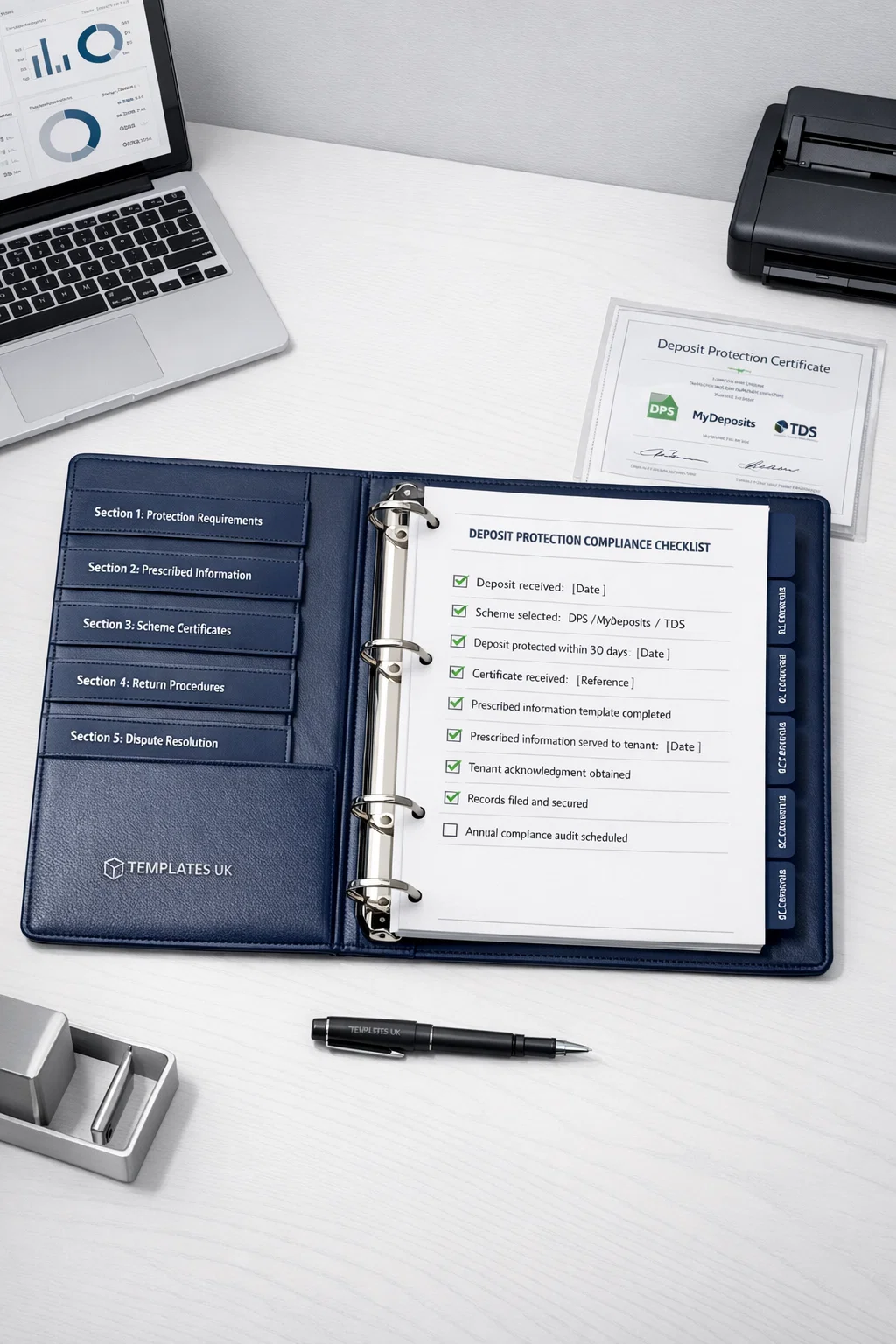
All three schemes require the same prescribed information, served in writing within 30 days:
- Scheme details: Name and contact details of chosen scheme
- Landlord details: Name, address, contact details, company registration if applicable
- Lead tenant details: Name and contact address
- Property address: Full address of tenanted property
- Deposit details: Amount of deposit and date received
- Protection confirmation: Date deposit protected and scheme reference number
- Deduction circumstances: What the deposit may be used for (rent arrears, damage, cleaning)
- Dispute process: How disputes are resolved through the scheme
- Tenant liability: What happens if the tenant cannot be contacted
The prescribed information must be provided on the scheme’s official template or contain all required information in substantially the same form.
Key Takeaway: Landlords can choose any of the three approved schemes and either custodial (free) or insured (paid) protection. All schemes require identical prescribed information within 30 days. Choice of scheme doesn’t affect legal compliance.
How Long Does a Landlord Have to Return a Deposit?
Quick Answer: 10 days from when both parties agree the amount to be returned. If there’s a dispute about deductions, the landlord must return the undisputed portion within 10 days and submit the disputed amount to the scheme for adjudication.
When Does the 10-Day Clock Start?
The deadline begins when both parties have agreed — in writing or otherwise — on the amount to be returned.
If the landlord proposes a £200 deduction and the tenant agrees on 1st January, the undisputed balance must be returned by 11th January. If the tenant disputes, the landlord must return the undisputed amount within 10 days and raise a dispute with the scheme.
Every Scenario — What’s the Timeline?
| Scenario | Timeline | Landlord Obligation |
|---|---|---|
| No deductions claimed | Within 10 days of tenancy end | Return full deposit to tenant |
| Deductions proposed, tenant agrees | Within 10 days of agreement | Return agreed balance to tenant |
| Deductions proposed, tenant disputes | Within 10 days of dispute notification | Return undisputed amount, raise scheme dispute |
| Tenant cannot be contacted | After reasonable attempts (typically 14–28 days) | Contact scheme for “tenant cannot be contacted” process |
| Dispute adjudication | 28–60 days from dispute submission | Scheme adjudicates and distributes deposit |
The Step-by-Step Return Process
Step 1 — Tenancy ends and property inspected
Landlord conducts a check-out inspection (ideally professional), compares condition to the check-in inventory, identifies any damage beyond fair wear and tear, and obtains quotes or invoices for repair and cleaning costs.
Step 2 — Landlord notifies tenant of proposed deductions
Provide a written statement of proposed deductions with evidence — photos, invoices, inventory comparison — and a calculation of deduction amounts. Request the tenant’s agreement or dispute.
Step 3A — Tenant agrees
Tenant confirms agreement in writing. Landlord returns the balance within 10 days. Done.
Step 3B — Tenant disputes
Tenant notifies the dispute in writing. Landlord returns the undisputed amount within 10 days and submits the dispute to the scheme. Both parties submit evidence. An independent adjudicator decides (typically within 28 days). The scheme distributes the deposit according to the decision.
What Happens If You’re Late Returning It?
- Interest liability: Statutory interest at 8% per annum from day 11
- County Court claim: Tenant can sue for deposit return plus interest and costs
- Scheme intervention: Custodial schemes can pay the tenant directly if the landlord fails to respond
- Legal costs: If the tenant sues and wins, the landlord pays both sides’ costs
Key Takeaway: Landlords have 10 days to return deposits once agreement is reached. Undisputed amounts must be returned within 10 days even if part of the deposit is in dispute. Late returns trigger statutory interest at 8% per annum and potential court action.
What Is the Holding Deposit Law in the UK?
Quick Answer: The Tenant Fees Act 2019 allows landlords to take a holding deposit (maximum one week’s rent) to reserve a property during referencing. It must be returned or credited toward the tenancy deposit within specific timescales. Landlords can only retain it in four limited circumstances.
Is a Holding Deposit Legally Binding?
Yes. Once accepted, the landlord agrees to stop marketing the property and reserve it for the tenant. The tenant agrees to proceed if referencing is successful.
If either party breaches without lawful reason, the other has legal remedies. Landlords who unlawfully retain holding deposits face penalties up to £5,000.
The Holding Deposit Rules at a Glance
| Rule | Requirement | Consequence of Breach |
|---|---|---|
| Maximum amount | One week’s rent (£1,000/month = £230.77 max) | Must refund excess, £5,000 penalty |
| Deadline for decision | 15 days from receipt (unless deadline agreed in writing) | Must return holding deposit in full |
| Return if tenancy proceeds | Credited toward deposit or first rent within 7 days | Tenant can reclaim via court |
| Return if landlord withdraws | Within 7 days of withdrawal (unless tenant breach) | Tenant can reclaim via court |
| Retention if tenant withdraws | Landlord can keep if tenant withdraws without lawful reason | Tenant forfeits holding deposit |
When Can Landlords Keep a Holding Deposit?
Only four situations allow lawful retention:
1. Tenant provides false or misleading information — false employment details, concealed CCJs, misrepresented right to rent status.
2. Tenant fails right-to-rent checks — no legal right to rent in the UK, or documents found to be forged or invalid.
3. Tenant withdraws from the tenancy — decides not to proceed after passing referencing, accepts an alternative property, or changes mind without lawful reason.
4. Landlord withdraws due to tenant breach — tenant fails to provide required information, fails to sign the tenancy agreement after passing referencing, or fails to pay deposit or first rent as agreed.
When MUST Landlords Return It?
- Tenant passes referencing and tenancy proceeds: Credit toward deposit or rent within 7 days
- Tenant fails referencing through no fault: Return within 7 days (e.g., affordability borderline)
- Landlord withdraws for own reasons: Return within 7 days (e.g., decides not to let, accepts another tenant)
- 15-day deadline expires without decision: Return in full immediately
- Property becomes unavailable: Return within 7 days (e.g., sale falls through, current tenant doesn’t leave)
Key Takeaway: Holding deposits are capped at one week’s rent and create binding agreements. Landlords have only 15 days to make decisions and can only lawfully retain holding deposits in four specific circumstances. Unlawful retention results in penalties up to £5,000.
Landlord Essentials Pack
Complete Landlord Protection • 8 Templates + Editor & Interview Versions • Save 50% vs Buying Individually
Lifetime Access • Free Updates • 30-Day Money-Back Guarantee*
What Reasons Can a Landlord Keep My Deposit?
Quick Answer: Unpaid rent, property damage beyond fair wear and tear, excessive cleaning required to return to check-in standard, missing items from inventory, unpaid utility bills (if tenant responsible), breach of tenancy terms (e.g., unauthorised pet damage), and gardening costs if the garden was neglected. All deductions must be evidenced and reasonable.
The Seven Lawful Deduction Grounds
1. Rent Arrears
Any outstanding rent owed at tenancy end. Must be actual arrears — not disputed rent increases. Evidence: rent statements, bank records, payment history. Calculate the exact amount owed (daily rate if partial month).
2. Property Damage Beyond Fair Wear and Tear
Holes in walls, broken fixtures, damaged flooring, burns, stains (wine, food, pet), cracked tiles, broken appliances due to misuse. Evidence: check-in vs check-out photos, inventory comparison, repair invoices. Must account for betterment — you can’t improve the property at the tenant’s expense.
3. Professional Cleaning Costs
Property returned in an unacceptably dirty condition — kitchen appliances requiring deep cleaning, carpets requiring professional cleaning (if not fair wear). Evidence: check-out photos, cleaning invoices, inventory notes. But only if the property was professionally cleaned at check-in.
4. Missing Items or Furnishings
Furniture, appliances or fixtures listed on the inventory. Keys not returned (replacement cost). Remote controls, instruction manuals. Evidence: inventory, replacement invoices or reasonable estimates.
5. Unpaid Utility Bills (if Tenant Responsible)
Gas, electricity, water bills in the tenant’s name. Council tax if the tenant is liable. Evidence: final bills, proof tenant was responsible under the tenancy agreement.
6. Breach of Tenancy Terms
Unauthorised subletting causing damage, unauthorised pet causing damage or odour, smoking in a non-smoking property. Evidence: tenancy agreement clause, photos, specialist cleaning or repair invoices.
7. Garden Maintenance (if Tenant Responsible)
Overgrown lawn, dead plants, neglected garden — but only if the tenancy agreement specifies tenant responsibility. Evidence: check-in vs check-out photos, gardening invoices.
What Landlords CANNOT Deduct For
- Fair wear and tear: Normal deterioration from ordinary use over time
- Betterment: Upgrading items beyond original condition (e.g., new carpet when old one simply worn)
- Redecoration: Repainting after several years (unless actual damage)
- Carpet replacement: After expected lifespan (typically 5–7 years)
- Items not on inventory: Cannot claim for items never listed
- Pre-existing damage: Damage documented at check-in
- Landlord repairs: Structural issues, boiler servicing, safety certificates
- General refurbishment: Updating property for next tenant
What Evidence Do You Need to Win a Deduction Claim?
| Deduction Type | Evidence Required | Strength |
|---|---|---|
| Rent arrears | Rent statements, tenancy agreement rent amount, bank records | Strong (clear calculation) |
| Property damage | Check-in/check-out photos, professional inventory, repair invoices | Strong (visual proof) |
| Professional cleaning | Check-out photos, cleaning invoice, proof property professionally cleaned at start | Medium (subjective standards) |
| Missing items | Signed inventory, replacement invoice or reasonable estimate | Strong (if inventory signed) |
| Gardening | Check-in/check-out photos, tenancy clause specifying responsibility, invoice | Medium (must prove tenant responsibility) |
Key Takeaway: Deposit deductions are only lawful for specific, evidenced reasons. Landlords must prove damage occurred during the tenancy beyond fair wear and tear. Without a professional inventory and photographic evidence, most deduction claims fail at adjudication.
Frequently Asked Questions: Deposit Protection UK
What are the deposit protection rules in the UK?
Landlords must protect all AST deposits in a government-approved scheme within 30 days and provide tenants with prescribed information within the same 30-day period. Non-compliance results in penalties of 1–3x the deposit and inability to serve Section 21 notices.
When did deposit protection start in the UK?
Deposit protection became mandatory on 6 April 2007 for all new ASTs in England and Wales under the Housing Act 2004. It was introduced to prevent landlords unfairly withholding deposits and to provide independent dispute resolution.
How long does a landlord have to give a deposit back in the UK?
10 days from when both parties agree the amount to be returned. If there’s a dispute, the undisputed portion must be returned within 10 days and the disputed amount submitted to the scheme for adjudication.
What reasons can a landlord keep my deposit in the UK?
Unpaid rent, property damage beyond fair wear and tear, excessive cleaning required, missing items from inventory, unpaid utility bills (if tenant responsible), and breach of tenancy terms. All deductions must be evidenced and reasonable.
Is a holding deposit legally binding in the UK?
Yes. Once accepted, the landlord agrees to reserve the property and the tenant agrees to proceed if referencing is successful. Landlords can only retain holding deposits in four limited circumstances under the Tenant Fees Act 2019.
Do landlords have to use DPS?
No. Landlords can choose any of the three government-approved schemes: DPS, MyDeposits or TDS. All three are equally valid and offer both custodial (free) and insured (paid) options. The choice is the landlord’s decision.
What information is DPS prescribed to tenants?
All approved schemes require prescribed information including scheme name and contact details, landlord and tenant details, property address, deposit amount and date received, circumstances for retention, and the dispute resolution process. This must be provided within 30 days.
What is the deposit protection limit in the UK?
There’s no maximum on what can be protected, but the Tenant Fees Act 2019 caps deposits at 5 weeks’ rent for annual rents under £50,000 (or 6 weeks’ rent for £50,000+). All deposits regardless of amount must be protected.
What is the holding deposit law in the UK?
The Tenant Fees Act 2019 allows landlords to take a holding deposit (maximum one week’s rent) to reserve a property during referencing. It must be returned or credited within specific timescales, and landlords can only retain it in four limited circumstances.
What is the legal deposit law in the UK?
The legal framework comes from the Housing Act 2004 (as amended by the Localism Act 2011 and Deregulation Act 2015). Deposits must be protected within 30 days, prescribed information must be provided within 30 days, and landlords cannot serve Section 21 notices unless compliance is proven.
The Truth About “Free” Legal Template Sites (What You’re Really Signing Up For)
Most websites offering a “free legal template” follow the same pattern:
- You click because it’s advertised as free
- You spend 10–15 minutes answering questions
- At the very end, you must create an account or start a “free trial”
- Your card is required upfront
- The subscription auto-renews at £29–£39 per month
This isn’t a free template — it’s a subscription service. Many people only realise after being charged £300–£400 over the year.
Why These “Free” Templates Are a Legal Risk
- Outdated wording: not aligned with current UK law
- Missing mandatory clauses: required for legal validity
- No compliance guidance: leaving users without legal context
- No structured checklist: no way to verify the document works
- Not kept updated: often unchanged when legislation changes
One incorrect clause can weaken or invalidate the entire document.
Hidden Problem: Many “Free Template” Sites Aren’t Even UK-Based
Another major issue is that many free or auto-subscription template sites operate outside the UK and use documents originally drafted for the US legal system. These are then loosely adapted for “international use,” which creates serious problems:
- Incorrect terminology: taken from US contract law
- Missing UK statutory references: essential legal requirements omitted
- Non-applicable clauses: terms that don’t apply under UK legislation
- Legal conflicts: risks breaching UK consumer, employment, or GDPR rules
Why Templates UK Does the Opposite
- Drafted by UK professionals: written by experienced business & legal experts
- UK-law only: no US crossover or generic “international” templates
- One-time price from £10: no subscriptions, no renewals
- Full preview: see the exact document before buying
- Lifetime access: free lifetime updates included
My Templates Dashboard
All purchased templates are stored in your personal My Templates page, organised by category.
When we update a template for UK law changes, the new version appears automatically in your dashboard — free, forever.
Build a growing library of UK legal documents across every area of your business and personal life.
Transparent Pricing
From £10 per template — with free lifetime usage and free lifetime updates. No subscriptions. No renewals. No auto-billing.
Not ready to buy? Use our free interactive checklists to guide your own document — no payment required.
No tricks. No trials. No hidden fees. Just the exact UK-specific legal document you came for — at the price we told you upfront.
Build your own bespoke document with our Deposit Protection Notice Template. Preview the full document before buying — only pay when you’re happy with it.
Get Every Template in One Bundle
The UK Legal Templates Ultimate Bundle includes 91 templates across every category — one purchase, lifetime updates, no subscriptions.
Save with Residential Landlord Bundle Packs
Get multiple residential property templates at discounted rates:
- Ultimate Bundle — All 28 templates for £99 (save £181)
- Essentials Pack — 8 core templates for £40 (save £40)
- Correspondence Pack — 7 letter templates for £35 (save £35)
- Eviction Pack — 6 eviction documents for £30 (save £30)
- Management Pack — 7 management documents for £35 (save £35)
View all landlord bundle options →
Explore Template Bundles by Category
One purchase, lifetime updates, no subscriptions.
- Business Complete Suite — 37 templates, £120 (smaller packs available)
- Landlord Ultimate Bundle — 28 templates, £99 (smaller packs available)
- Complete Family Pack — 18 templates, £65 (smaller packs available)
- Complete Estate Pack — 8 templates, £38 (smaller packs available)
Explore the Master Business Legal Templates Pillar Guide
The complete overview of 37 essential UK business templates.
UK Business Legal Templates — Complete Master Guide
Explore All Templates UK Pillar Guides
- Family Law Documents Guide UK
- Wills & Estate Planning Guide UK
- Residential Landlord Documents Guide UK
- Employment Documents Guide UK
- How to Set Up a Business in the UK — Legal Guide
- Website Legal Documents UK — Compliance Guide
- Financial & Commercial Contracts UK — Protection Guide
- Commercial Office Lease Guide UK
- Digital & IP Agreements Guide UK
Related Guides
- Assured Shorthold Tenancy Guide UK
- Inventory & Schedule of Condition Guide UK
- Guarantor Agreement Guide UK
- Tenant Reference Form Guide UK
Free Legal Templates & Interactive Checklists
Access all our free UK legal templates, checklists and downloadable PDFs.
Last updated: February 2026
Disclaimer: This guide provides general UK legal information, not legal advice. Laws are current as of February 2026.