Updated: July 2026 • Based on UK Law • England Only
What Is a Notice to Quit?
A notice to quit is the written notice a tenant serves to end an assured periodic tenancy in England. Since 1 May 2026, tenants must give at least two months’ notice, ending on a rent-due day or the day before, under the Renters’ Rights Act 2025.This guide covers tenant notice to quit rules, landlord notice periods and eviction steps under the Renters’ Rights Act, with a free notice builder included.
On 1 May 2026, the rules for ending a tenancy in England changed completely. Section 21 is gone. Fixed terms are gone.
Every private tenancy now rolls on as an assured periodic tenancy — and only the tenant can end it with routine notice.
Get a notice date wrong and the tenancy has not validly ended. Rent keeps running, re-letting plans stall, and disputes follow.
✓ 100% FREE Tenant Notice to Quit Builder
Completely free — no payment, no registration, no watermarks, no catch. Unlimited use. Guided questions or classic editor — the built-in date calculator finds the earliest valid end date from the rent schedule, so the notice lands on the right day first time.Landlords: received a notice? Use the same free calculator to check the end date is valid in seconds.
→ Open the Free Notice to Quit Builder
Moving out? Pair it with our End of Tenancy Confirmation Checklist — also free — to close out keys, meters and deposit properly.
How Much Notice Does a Tenant Have to Give in the UK?
Your tenant must give you at least two months’ written notice to end an assured periodic tenancy in England.
Check the tenancy agreement first. It can set a shorter period, but two months is the most you can require — a longer clause is unenforceable.
-
- In writing only: a letter, email or text all count — you cannot dictate the method
-
- Any time: with fixed terms abolished, there is no start date to wait for
-
- Shorter by agreement: you can agree an earlier end date in writing
-
- Rent runs to the end: rent is payable up to and including the final day
-
- Joint tenancies: one joint tenant’s notice usually ends the whole tenancy
There is no official GOV.UK form for a tenant’s notice. Our free Notice to Quit Builder creates it — no payment, no sign-up.
These rules cover every tenancy that was an assured shorthold before 1 May 2026 — our Assured Shorthold Tenancy guide explains the conversion.
The End-Date Rule Most Notices Get Wrong
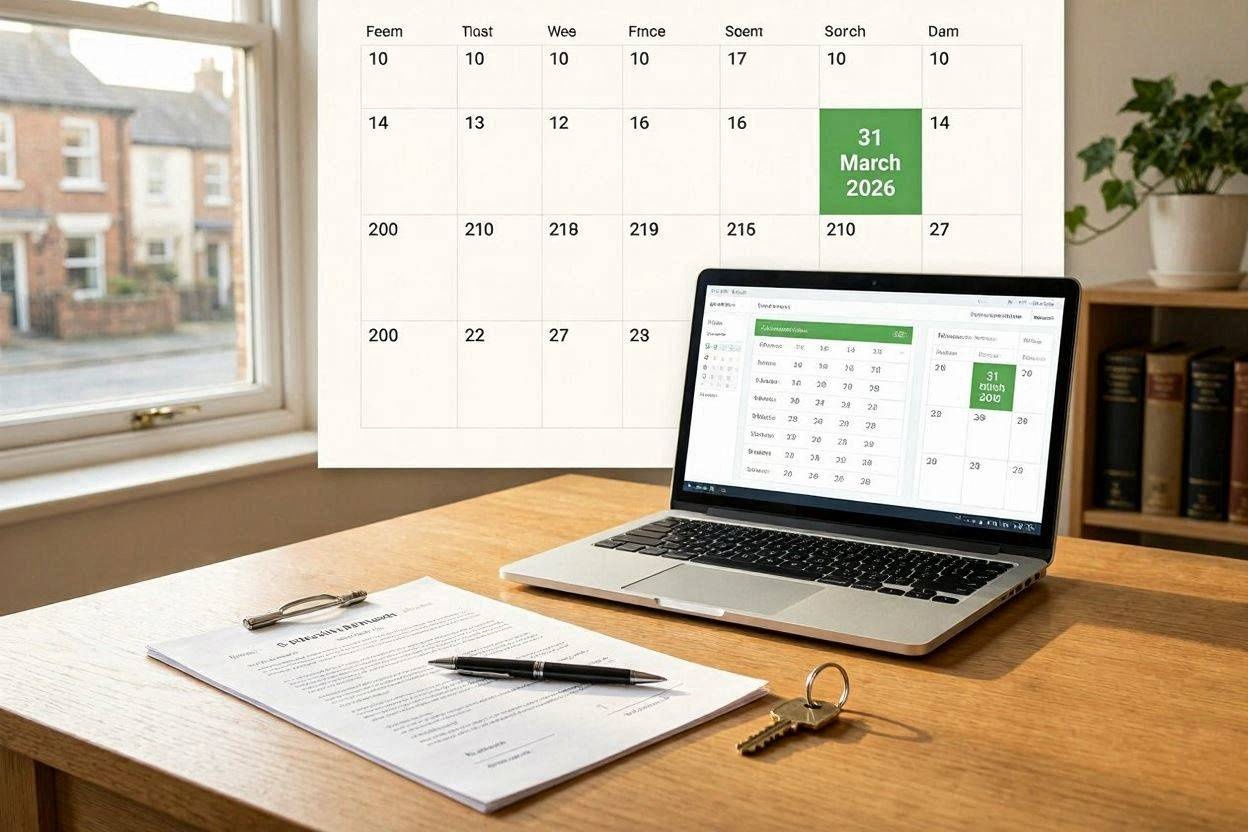
A tenant’s notice must end on a day the rent is due, or the day before it is due. Any other day and the notice can be ineffective.
This is the single most common mistake — and the most expensive. An invalid end date means the tenancy has not validly ended and rent remains payable.
Worked example — rent due on the 1st of each month:
Notice served 15 July with a two-month period. The earliest it could expire is 15 September — but that is not a rent-due day or the day before one.The earliest valid end dates are 30 September (day before rent day) or 1 October (rent day).
Landlords: check every notice you receive against this rule. The free builder’s calculator does the arithmetic in seconds.
If a notice is invalid, tell the tenant promptly in writing and agree a valid date — silence now becomes a deposit and arrears dispute later.
How Much Notice Do I Need to Give Tenants to Vacate?
Since 1 May 2026, you cannot serve a Section 21 notice — see our Section 21 guide for what replaced it.
To end a tenancy you must serve a Section 8 notice (Form 3A) stating a legal ground for possession. The notice period depends on the ground.
| Ground | When It Applies | Minimum Notice |
|---|---|---|
| Ground 1 | You or close family moving in (not in first 12 months) | 4 months |
| Ground 1A | Selling the property (not in first 12 months) | 4 months |
| Ground 4A | Student HMO — end of academic year | 4 months |
| Ground 6 | Demolition or redevelopment | 4 months |
| Ground 8 | At least 3 months’ rent arrears (13 weeks if paid weekly) | 4 weeks |
| Grounds 10 & 11 | Some arrears / persistent late payment | 4 weeks |
| Grounds 12 & 13 | Breach of tenancy / property deterioration | 2 weeks |
| Ground 14 | Anti-social behaviour | None — court application can follow immediately |
Serving the wrong form, the wrong period, or a restricted ground invalidates the notice and restarts the clock.
For the full 2026 framework — all grounds, rent rules and deadlines — read our Renters’ Rights Act 2025 guide.
How Much Notice Does a Landlord Have to Give When Selling?
Selling with vacant possession means Ground 1A — and it comes with strings attached.
-
- Four months’ notice before you can apply to court
-
- Not in the first 12 months of the tenancy
-
- 12-month re-let ban: if the sale stalls, you cannot re-let or re-market for a restricted period
-
- Genuine intention required: misuse carries financial penalties
Treat Ground 1A as a one-way door. Only serve it when the sale is genuinely ready to proceed — pricing agreed and legal work under way.
An alternative many landlords consider first: selling with the tenant in place, which avoids the notice and the re-let restriction entirely.
Can I Ask My Tenants to Leave?
Yes — you can always ask. A tenancy can end at any time by mutual agreement, on any date you both accept.
What you cannot do is pressure tenants out.
Harassment or changing the locks without a court order can be an offence under the Protection from Eviction Act 1977.
If the tenant agrees to go, get the agreement in writing. A verbal deal over the phone is worthless in a deposit dispute six months later.
The document for this job: the End of Tenancy Confirmation (£10 one-time) records the agreed end date, key handover, final meter readings and deposit arrangements in one signed record.
Preview the full document before you pay — Editor and Interview versions included.
How Hard Is It to Evict a Tenant in the UK?
Honestly: harder than it was — if your paperwork is weak. Straightforward — if your ground is genuine and your evidence is in order.
Every eviction now follows the same path. There are no shortcuts and no “no-fault” route.
-
- Step 1 — Serve a valid Section 8 notice: correct form, correct ground, correct notice period
-
- Step 2 — Apply to court: only after the notice period expires and the tenant has not left
-
- Step 3 — Prove the ground: the judge grants possession on evidence, not assertion
-
- Step 4 — Possession order, then bailiffs: only county court bailiffs can physically evict
Most failed claims fail on paperwork — missing compliance records, defective notices, or thin evidence for the ground relied on.
Build the evidence file before you serve, not after.
Our Section 8 Evidence Builder (£10 one-time) organises what the court expects behind your Form 3A.
What Documents Do I Need to Evict a Tenant?
Before a judge looks at your ground, they look at your compliance. Assemble this file first:
-
- The tenancy agreement and the Written Statement of Terms for RRA-era tenancies
-
- Section 8 notice (Form 3A) plus proof of how and when it was served
-
- Evidence for the ground: rent statements, warning letters, incident logs, or sale documentation
-
- Deposit protection records: courts can refuse possession where the deposit is not properly protected
-
- Safety compliance: gas safety, electrical (EICR) and related records
Our Landlord Checklist for the Renters’ Rights Act walks through every obligation on this list.
Need the paperwork itself? The Renters’ Rights Essential Pack covers 26 landlord templates — £99 one-time, no subscriptions.
How Quickly Can You Evict a Tenant in the UK?
It depends entirely on the ground — and on whether the tenant leaves when the notice expires.
-
- Fastest — serious anti-social behaviour: no notice period; court application can follow immediately
-
- Serious rent arrears: 4 weeks’ notice once arrears reach 3 months
-
- Breach grounds: 2 weeks’ notice
-
- Moving in, selling, redevelopment: 4 months’ notice
If the tenant stays past the notice date, add the court stage: claim, hearing, possession order, then bailiff appointment. Timescales vary by court.
The fastest evictions share one feature: a clean file.
Defective notices are the most common cause of delay, because the process restarts from day one.
What Happens If a Tenant Leaves Without Notice?
The tenancy does not end just because the tenant has gone. Rent remains payable until it is ended properly.
A tenancy ends by valid tenant notice, a written agreement between you, or a court possession order.
Keys through the letterbox are none of those.
Do not simply change the locks. If the tenant has not clearly surrendered, re-taking the property can amount to unlawful eviction.
Contact the tenant in writing, invite a formal surrender, and record the agreed end date, key return and deposit position before re-letting.
The End of Tenancy Confirmation closes it out cleanly — and the Assured Periodic Tenancy agreement (£10 one-time) covers the next letting.
Can I Withdraw a Notice to End a Tenancy?
A tenant’s notice to quit takes effect when served.
It can only be withdrawn if the landlord agrees in writing — otherwise the tenancy ends on the date in the notice.
Landlords: that agreement is your choice. If a tenant asks to stay after serving notice, put your decision in writing either way.
In a joint tenancy, withdrawing a served notice needs the written agreement of the landlord and all joint tenants.
Your own Section 8 notice can be withdrawn — and must be, if you want to serve a fresh notice of the same type with different dates or grounds.
Frequently Asked Questions
How do I give my tenant notice to leave?
Serve a Section 8 notice using Form 3A, stating the ground for possession and giving at least the minimum notice period for that ground.
Keep proof of service — how and when the notice was given. If the tenant does not leave, you apply to court to prove the ground.
Is there an official form for a tenant’s notice to quit?
No. GOV.UK publishes prescribed forms for landlords, such as Form 3A, but there is no official form for a tenant ending an assured periodic tenancy.
The notice simply must be in writing, give the required period, and end on a valid date. Our builder produces it with the dates calculated.
Can a landlord refuse a tenant’s notice to quit?
No. A valid notice takes effect whether or not the landlord accepts it. The tenancy ends on the date in the notice.
If the notice is invalid — wrong end date or too short a period — the tenancy has not validly ended.
It is in both parties’ interests to agree a valid date in writing.
Does a tenant have to pay rent during the notice period?
Yes. Rent is payable up to and including the day the tenancy ends, even if the tenant moves out earlier.
An earlier rent cut-off only applies if the landlord agrees in writing to end the tenancy early.
Do these rules apply in Wales, Scotland or Northern Ireland?
No. The Renters’ Rights Act 2025 tenancy reforms apply to England only.
Wales operates under the Renting Homes (Wales) Act 2016, and Scotland and Northern Ireland have separate tenancy regimes with different notice rules.
Renters' Rights Essential Pack
Subheadline: Built for the Renters' Rights Act 2025 • 26 Templates + Editor & Interview • Save 62% vs Buying Individually
Lifetime Access • Free Updates • 30-Day Money-Back Guarantee*
The Truth About "Free" Legal Template Sites (What You're Really Signing Up For)
Most websites offering a "free legal template" follow the same pattern:
- You click because it's advertised as free
- You spend 10–15 minutes answering questions
- At the very end, you must create an account or start a "free trial"
- Your card is required upfront
- The subscription auto-renews at £35–£42 per month
This isn't a free template – it's a subscription service. Many people only realise after being charged £300–£400 over the year.
Why These "Free" Templates Are a Legal Risk
- Outdated wording: not aligned with current UK law
- Missing mandatory clauses: required for legal validity
- No compliance guidance: leaving users without legal context
- No structured checklist: no way to verify the document works
- Not kept updated: often unchanged when legislation changes
One incorrect clause can weaken or invalidate the entire document.
Hidden Problem: Many "Free Template" Sites Aren't Even UK-Based
Another major issue is that many free or auto-subscription template sites operate outside the UK and use documents originally drafted for the US legal system. These are then loosely adapted for "international use," which creates serious problems:
- Incorrect terminology: taken from US contract law
- Missing UK statutory references: essential legal requirements omitted
- Non-applicable clauses: terms that don't apply under UK legislation
- Legal conflicts: risks breaching UK consumer, employment, or GDPR rules
Why Templates UK Does the Opposite
- Drafted by UK professionals: written by experienced business & legal experts
- UK-law only: no US crossover or generic "international" templates
- One-time price from £10.00: no subscriptions, no renewals
- Full preview: see the exact document before buying
- Lifetime access: free lifetime updates included
My Templates Dashboard
All purchased templates are stored in your personal My Templates page, organised by category.
Updated versions appear in your dashboard when we release them – free, forever.
Build a growing library of UK legal documents across every area of your business and personal life.
Transparent Pricing
From £10.00 per template – with free lifetime usage and free lifetime updates. No subscriptions. No renewals. No auto-billing.
Not ready to buy? Use our free interactive checklists to guide your own document – no payment required.
No tricks. No trials. No hidden fees. Just the exact UK-specific legal document you came for – at the price we told you upfront.
Build your own bespoke document with our End of Tenancy Confirmation. Preview the full contract before buying – only pay when you're happy with it.
Get the Largest Bundle — UK Legal Templates Ultimate Bundle
The UK Legal Templates Ultimate Bundle includes 91 templates across every category – one purchase, lifetime updates, no subscriptions.
Explore Template Bundles by Category
One purchase, lifetime updates, no subscriptions.
- Business Complete Suite – 37 templates, £199 (smaller packs available)
- Landlord Ultimate Bundle – 29 templates, £115 (smaller packs available)
- Renters' Rights Essential Pack – 26 templates, £99 (built for the Renters' Rights Act 2025)
- Complete Family Pack – 18 templates, £99 (smaller packs available)
- Complete Estate Pack – 10 templates, £161 (smaller packs available)
Browse Template Libraries
Explore our complete collection of professional templates by category.
- Residential Property Library – 28 templates
- Business Library – 25 templates
- Family & Relationships Library – 18 templates
- Employment Library – 17 templates
- Health & Safety Library – 10 templates
- Wills & Estate Library – 13 templates
- Construction & Trades Library – 2 templates
- Vehicle Sales Library – 2 templates
- Employee Templates Library – 2 templates
Explore the Master Business Legal Templates Pillar Guide
The complete overview of 37 essential UK business templates.
UK Business Legal Templates – Complete Master Guide
Explore All Templates UK Pillar Guides
- Family Law Documents Guide UK
- Wills & Estate Planning Guide UK
- Residential Landlord Documents Guide UK
- Employment Documents Guide UK
- How to Set Up a Business in the UK – Legal Guide
- Website Legal Documents UK – Compliance Guide
- Financial & Commercial Contracts UK – Protection Guide
- Commercial Office Lease Guide UK
- Digital & IP Agreements Guide UK
Related Guides
- Renters' Rights Act 2025 — New Rules for Landlords
- Landlord Checklist for the Renters' Rights Act 2026
- Section 21 Notice Guide UK (Abolished May 2026)
- Assured Shorthold Tenancy Guide UK
Free Legal Templates & Interactive Checklists
Access all our free UK legal templates, checklists and downloadable PDFs.
Last updated: July 2026
Disclaimer: This guide provides general UK legal information, not legal advice. Laws are current as of July 2026.