Updated: 19 May 2026 • Based on UK Law • England Only
What Is a Pet Addendum?
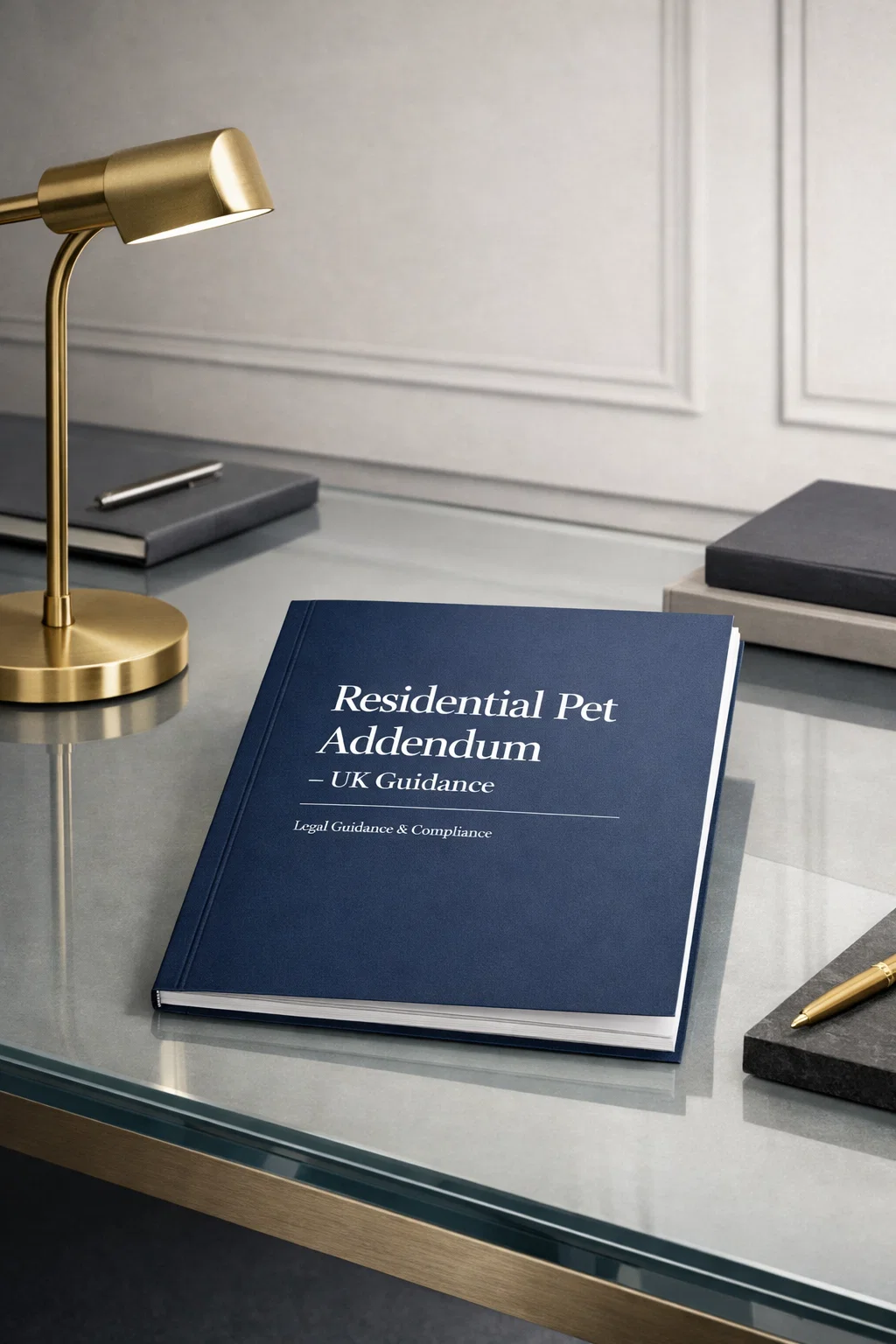
A pet addendum — also known as an animal addendum, pet agreement, pet clause, pet rental addendum, or pet lease addendum — is a written supplement to a tenancy agreement (or lease) setting the conditions on which a landlord agrees a tenant may keep specified pets in the property.
It records pet details, tenant responsibilities, and landlord inspection rights. Under the Renters’ Rights Act 2025, the pet addendum follows a 28-day decision response to the tenant’s statutory pet request.
This guide covers pet addendum requirements, RRA 2025 rights, prohibited charges, damage liability, and essential clauses. Free checklist included.
Get the pet addendum wrong and you risk an unenforceable agreement, prohibited-payment fines up to £7,000, and a tenant who keeps the pet anyway.
The Renters’ Rights Act 2025 is now in force. Blanket “no pets” clauses are unenforceable. Tenants have a statutory right to request a pet — and landlords must respond in writing within 28 days.
Answer simple guided questions — your pet addendum is built for you. Includes pet identification, damage liability, cleaning obligations, noise and nuisance control, landlord inspection rights, and removal procedure. Structured following Renters’ Rights Act 2025 and Tenant Fees Act 2019 requirements. Preview before buying — only pay when you’re happy with it. One-time price from £10.
Prefer to write your own? Download the free DIY checklist →
Handling a new pet request? Pair it with our Pet Permission Decision Notice for the statutory 28-day response.
📦 Pet Addendum is one of many new documents landlords need under the Renters’ Rights Act 2025.
Written Statement of Terms (fines up to £7,000), Information Sheet delivery proof, the 28-day Pet Permission Decision Notice, Section 8 evidence bundles, updated tenancy agreements — every stage of the tenancy now has its own paperwork. Miss one and a possession claim can fail at court.
Not sure where to start? Free RRA Compliance Checklist → — every obligation in chronological order, with deadline warnings and direct links to the templates you need.
Want everything in one place? Renters’ Rights Essential Pack → — 26 templates covering setup, compliance, correspondence, eviction, and court. £99 one-time, no subscription.
What Does a Pet Addendum Mean?
A pet addendum is a written agreement between a landlord and tenant that does five things.
- Records permission: The tenant is allowed to keep specified pet(s). Under the RRA 2025, this often follows a formal 28-day decision notice.
- Specifies conditions: Details exactly which pets are permitted — species, breed, size, number — and tenant responsibilities.
- Establishes liability: The tenant accepts financial responsibility for pet-related damage beyond fair wear and tear.
- Creates enforcement: The landlord can require pet removal or pursue Section 8 grounds if conditions are breached.
- Forms part of the tenancy: Once signed by both parties, the addendum is enforceable as part of the tenancy contract.
Why a written addendum is necessary:
The RRA statutory right is a right to request. The addendum records the agreed terms of consent.
Verbal agreements about pets are difficult to enforce and create disputes. A written addendum protects both parties by clarifying expectations.
It provides documentary evidence if disputes arise about pet damage or behaviour — important for deposit deductions and any Section 8 claim.
What Is a Signed Pet Addendum?
A signed pet addendum is a pet agreement formally executed by both landlord and tenant, making it part of the tenancy contract.
Requirements for valid signature:
- Both parties must sign — landlord or authorised agent, plus the tenant or all joint tenants
- Dated when signed — establishes when the agreement became effective
- Witnesses are not required — simple contracts are valid without witnessing
- Signed before the pet moves in — retrospective addendums are problematic if damage has already occurred
Practical effect of signature:
Creates a contractual obligation. The tenant must comply with all pet conditions specified.
Gives the landlord enforcement rights — can pursue breach of contract if the tenant violates conditions.
Allows the landlord to claim from the deposit for pet damage at end of tenancy, subject to deposit-scheme adjudication.
Supports a Section 8 ground (Ground 12 — breach of tenancy) where the breach is significant and unremedied.
Without signature:
- Pet permission is not properly established in writing
- The tenant may be in breach of tenancy for having an unauthorised pet
- The landlord may find it harder to rely on pet damage clauses when claiming from the deposit
What Is an Example of a Pet Clause?
Standard pet clause example:
“The Tenant is permitted to keep the following pet(s) on the Property: [1 domestic cat, named ‘Whiskers’, microchip number 123456789012345].
The Tenant agrees to:
- (a) be solely responsible for any damage caused by the pet to the Property, fixtures, fittings, or furnishings, and to repair or compensate the Landlord for such damage
- (b) keep the pet under proper control at all times and ensure it does not cause nuisance, annoyance, or disturbance to neighbours or other occupants
- (c) arrange for professional carpet and upholstery cleaning at the end of the tenancy at the Tenant’s expense, where this is required to return the Property to a comparable condition (fair wear and tear excepted)
- (d) maintain the pet in good health with current vaccinations and flea/worm treatments, and ensure microchipping as required by law (dogs from 8 weeks; owned cats in England from 20 weeks)
- (e) not allow the pet to foul communal areas and to clean up any mess immediately
The Landlord reserves the right to:
- (i) inspect the Property with reasonable written notice (typically 24 hours) to check for pet-related damage
- (ii) require permanent removal of the pet if it causes significant damage, persistent nuisance, or danger
- (iii) pursue Section 8 grounds for possession if the Tenant breaches these pet conditions and the breach is significant and unremedied.”
Note: Requiring the tenant to take out or pay for pet damage insurance is no longer permitted.
That provision was removed from the RRA 2025 before Royal Assent and would now breach the Tenant Fees Act 2019.
Pet Addendum Essential Elements
| Element | What to Include | Why Important |
|---|---|---|
| Pet details | Species, breed, name, age, weight, microchip number, vaccination records | Identifies the exact pet permitted (prevents adding more pets later) |
| Damage liability | Tenant responsible for all pet damage beyond fair wear and tear | Establishes financial responsibility; supports deposit deductions |
| Cleaning obligations | Professional carpet/upholstery cleaning at end where required | Helps return property to comparable condition |
| Noise/nuisance control | Pet must not cause unreasonable disturbance | Protects neighbours, reduces ASB complaint risk |
| Health requirements | Current vaccinations, flea/worm treatment, microchipping | Helps prevent infestations; supports legal compliance |
| Inspection rights | Landlord can inspect for pet damage with reasonable notice (24 hours typical) | Allows early detection before damage worsens |
| Removal rights | Landlord can require pet removal if serious problems arise | Provides a remedy short of pursuing possession |
| Breach consequences | Significant unremedied breach may support Section 8 Ground 12 | Makes consequences clear; supports any future possession claim |
Use our professionally drafted Pet Addendum Template with comprehensive pet conditions and damage liability clauses.
Can Landlords Legally Say No Pets in the UK?
Since 1 May 2026, no — not as a blanket policy. A landlord can only refuse a tenant’s pet request on reasonable grounds, in writing, within 28 days.
Current legal position (England, from 1 May 2026):
- Statutory right to request: The RRA 2025 implies a term into all assured periodic tenancies that the tenant may request consent to keep a pet. This applies even where the original tenancy agreement banned pets.
- 28-day written response: The landlord must give or refuse consent in writing within 28 days of receiving the request.
- Cannot unreasonably refuse: Each request must be considered on its merits. A blanket “no pets” policy is no longer a valid ground.
- Refusal must be in writing with reasons: The reasons must be genuine and connected to the specific property or circumstances.
Reasonable grounds for refusal may include:
- The property is genuinely unsuitable for the specific pet (e.g. a large dog in a small flat with no outdoor space)
- The landlord’s superior lease prohibits pets, and the landlord has tried to obtain superior consent without success
- There is a statutory restriction on the animal (e.g. a banned breed under the Dangerous Dogs Act 1991)
- Another tenant who shares the building or communal areas has a documented, evidenced allergy (a weaker ground on its own — strongest when combined with other property-specific reasons)
What landlords cannot do:
- Refuse without giving reasons
- Apply a blanket “no pets” policy
- Refuse based on generalised concerns rather than specific circumstances
- Charge pet deposits (prohibited under the Tenant Fees Act 2019)
- Require tenants to take out or pay for pet damage insurance
- Discriminate against tenants with assistance animals (Equality Act 2010)
What happens if a landlord ignores the request:
If no response is given within the deadline, the tenant may apply to the court.
If a tenant believes a refusal is unreasonable, they can apply to the court — which, under the Renters’ Rights Act 2025, can order the landlord to allow the pet (specific performance) and may order the landlord to pay the tenant’s costs. Once the Private Rented Sector Ombudsman launches, tenants will also be able to challenge a refusal that way. This is why a refusal needs genuine, property-specific reasons, set out in writing within the 28-day deadline.
To issue a compliant approval — or a documented refusal — within the 28-day deadline, see our Pet Permission Decision Notice template.
Can Landlords Refuse Pets in 2026 in the UK?
Yes — but only on reasonable grounds, given in writing, within 28 days. Blanket bans are no longer lawful in England.
What changed on 1 May 2026:
- RRA 2025 (England): Tenants gained a statutory right to request a pet. The landlord must respond in writing within 28 days and cannot unreasonably refuse.
- Section 21 abolished: The “no-fault” route is gone. Possession must now be pursued through Section 8 on prescribed statutory grounds.
- Assured periodic tenancies: Fixed-term ASTs were replaced by open-ended assured periodic tenancies on 1 May 2026.
Wales and Scotland:
Wales — The Renting Homes (Wales) Act 2016 framework continues to apply. The RRA 2025 does not extend to Wales.
Scotland — Private Residential Tenancies under the Private Housing (Tenancies) (Scotland) Act 2016 continue to apply.
Practical effect on landlords:
Around 62% of UK households now own a pet, so reasonable consideration of pet requests significantly widens the tenant pool.
Landlords still control the terms of consent via a written pet addendum — they cannot be forced to accept on unreasonable terms, only to consider the request reasonably.
What Is the Pet Law in the UK from May 2026?
The Renters’ Rights Act 2025 inserted new Sections 16A–16B into the Housing Act 1988, creating a statutory right (in force since 1 May 2026) for tenants in the private rented sector to request to keep a pet.
Key provisions:
- RRA 2025 (England): Implied term in all assured periodic tenancies. Landlord must respond in writing within 28 days and cannot unreasonably refuse.
- Tenant Fees Act 2019 (as amended): Continues to prohibit pet deposits, pet rent, and pet fees. The 5-week deposit cap applies regardless of pets.
- Microchipping Regulations 2023: All owned cats in England must be microchipped from 20 weeks (since 10 June 2024). All dogs from 8 weeks (since 6 April 2016). Fine up to £500 for non-compliance.
Pet insurance — what changed before Royal Assent:
The original Renters’ Rights Bill contained a clause allowing landlords to require tenants to take out pet damage insurance.
This was removed at Report Stage in the House of Lords (July 2025). It is not in the final Act.
The practical effect: landlords cannot require pet insurance or charge tenants for it. Doing so would be a prohibited payment under the Tenant Fees Act 2019.
A landlord can recommend that tenants consider third-party liability insurance, but cannot make it a condition or charge for it.
Landlord Pet Policy Comparison (Post-May 2026)
| Policy Type | What It Means | Status Under the RRA 2025 |
|---|---|---|
| Blanket “no pets” | Landlord refuses all pets regardless of circumstances | No longer lawful — refusal must be reasonable, in writing, within 28 days, or the tenant can apply to the court |
| Case-by-case consideration | Landlord considers each request on its merits with a written 28-day response | Required position under the RRA 2025 |
| Pets accepted with conditions | Landlord grants consent subject to a signed pet addendum with conditions | Lawful and recommended best practice |
| Refusal on reasonable grounds | Landlord refuses a specific request with written reasons connected to the property | Lawful if reasons are genuine and property-specific |
| Assistance animals only | Refusing other pets while accepting assistance animals | Refusing other pet requests on blanket grounds is not lawful; assistance animals are protected by the Equality Act 2010 |
Are Pet Deposits Legal in the UK?
No. Pet deposits remain illegal in the UK under the Tenant Fees Act 2019 (as amended by the RRA 2025).
Prohibited payments:
- Pet deposits: No additional deposit because the tenant has pets. The standard cap is 5 weeks’ rent (under £50,000 annual rent) or 6 weeks (£50,000+). Pets do not increase the cap.
- Pet rent: No higher monthly rent for pet-owning tenants. A rent increase solely because of pets is a prohibited payment.
- Pet fees: No one-off fees for granting pet permission. Setup fees, registration fees, and pet “cleaning deposits” are all prohibited.
- Pet damage insurance: No requirement to take out pet damage insurance or charge tenants for it. This was removed from the RRA 2025 before Royal Assent.
What landlords CAN do:
- Charge the standard deposit up to the cap (5 weeks’ rent): Same cap applies whether the tenant has pets or not
- Deduct from the deposit for pet damage: Evidence-based deductions subject to scheme adjudication
- Require professional cleaning at end of tenancy: As an actual cost incurred, not an advance fee
- Recommend (not require) tenant pet liability insurance: Cannot be a condition of consent or a required payment
What happens if a landlord charges an illegal pet deposit:
The tenant can report it to local Trading Standards.
The landlord is liable for a financial penalty of up to £5,000 for a first breach, rising to £30,000 for repeat breaches within 5 years (Tenant Fees Act 2019).
The tenant can reclaim the prohibited payment, including via the First-tier Tribunal.
The landlord cannot serve a Section 8 notice while a prohibited payment remains unrepaid.
Can a Landlord Charge Extra for Pets UK?
No — a landlord cannot charge any extra money specifically for pets under the Tenant Fees Act 2019.
Illegal charges:
- Additional deposit amount for pets
- Higher monthly rent for pet owners
- One-off “pet fee” or “pet registration fee”
- Separate “pet damage deposit”
- Required pet damage insurance, or charging the tenant for pet insurance
Only permitted charges:
- Standard deposit (5 weeks’ rent maximum for annual rent under £50,000)
- Standard monthly rent (cannot be increased solely because of pets)
- Holding deposit (1 week’s rent maximum)
- Utilities paid directly to suppliers
- Council tax where the tenant is responsible
Legal alternatives landlords can use:
- Require professional cleaning paid at end of tenancy on an actual-cost basis
- Recommend (not require) that the tenant maintain their own third-party pet liability insurance
- Claim from the deposit at end of tenancy for actual, evidenced pet damage
How Much Is a Pet Addendum?
The pet addendum itself should be free to the tenant. A landlord cannot charge a fee for creating or signing it (prohibited under the Tenant Fees Act 2019).
Common illegal charges to avoid:
- “Pet application fee” £50–150
- “Pet addendum processing fee” £30–100
- “Pet registration fee” £20–75
These are all prohibited payments. A landlord cannot charge any fee for considering or granting pet permission.
Associated costs the tenant may choose to incur:
- Voluntary third-party pet liability insurance — typically £5–15 monthly (tenant’s choice)
- Professional cleaning at end of tenancy — typically £80–200 for carpet cleaning, £150–400 for a full property clean
- Veterinary records — £10–30 for vaccination certificates if proof is requested
- Pet damage from the deposit — variable, deducted at end of tenancy on evidence
Template pet addendum cost from Templates UK: £10 one-time, with free lifetime updates available in your My Templates page.
Pet Deposit Law Summary (Post-May 2026)
| Action | Legal Status | Consequence if Violated |
|---|---|---|
| Charging pet deposit | Prohibited (Tenant Fees Act 2019) | Up to £5,000 first breach; up to £30,000 repeat; cannot serve Section 8 until repaid |
| Charging pet rent | Prohibited (prohibited payment) | Up to £5,000 first breach; tenant can reclaim |
| Charging pet fee | Prohibited (prohibited payment) | Up to £5,000 first breach; reportable to Trading Standards |
| Requiring pet damage insurance | Prohibited (removed from RRA before Royal Assent) | Treated as a prohibited payment under the Tenant Fees Act 2019 |
| Standard deposit (5 weeks’ max) | Lawful (same cap for all tenants) | N/A — lawful within the statutory cap |
| Deduct deposit for pet damage | Lawful (evidence-based, at end of tenancy) | Tenant can dispute via the deposit scheme’s adjudication process |
| Require professional cleaning at end | Lawful (actual cost, deducted from deposit) | Must be reasonable cost; evidence required |
Pet Addendum Clauses Required UK?
Essential pet addendum clauses for England (post-May 2026):
- (1) Pet identification: Full description of permitted pet(s) — species, breed, name, age, weight, colour, microchip number, vaccination records. Prevents the tenant claiming “but you agreed to one cat” when they later have three.
- (2) Damage liability: Tenant solely responsible for pet damage beyond fair wear and tear — scratches, stains, odours, garden damage. Establishes financial responsibility clearly.
- (3) Professional cleaning at end of tenancy: Tenant arranges and pays for professional carpet/upholstery cleaning where reasonably required. This is a cleaning obligation, not an advance fee.
- (4) Noise and nuisance control: Tenant must ensure the pet does not cause unreasonable noise, disturbance or nuisance to neighbours.
- (5) Health and welfare: Tenant maintains current vaccinations, flea/worm treatments, and microchipping as required by law.
- (6) Third-party insurance (recommendation, not requirement): Tenant encouraged to consider third-party pet liability insurance — cannot be required or charged for.
- (7) Waste removal: Tenant must promptly remove and dispose of pet waste from the property and communal areas.
- (8) Inspection rights: Landlord may inspect the property with reasonable written notice (typically 24 hours).
- (9) Removal rights: Landlord may require permanent removal of the pet if it causes significant damage, danger, or persistent nuisance. Tenant has 14 days to comply.
- (10) No additional pets without consent: Tenant must not bring additional animals into the property without the landlord’s prior written consent.
How to Write a Pet Agreement?
Pet agreement structure:
- Opening section: Reference the original tenancy agreement and property address
- Pet details section: Complete description of each permitted pet with microchip and vaccination details
- Tenant obligations section: Numbered list of all responsibilities — damage, cleaning, noise, health, microchipping, waste
- Landlord rights section: Inspection rights, removal rights, position on possession if serious breach
- Indemnity clause: Tenant indemnifies the landlord against third-party claims arising from the pet
- Signature block: Spaces for landlord signature/date and tenant signature(s)/date
- Effective date: When the addendum takes effect and forms part of the tenancy agreement
Key drafting tips:
- Be specific not vague — “professional carpet steam cleaning” not “suitable cleaning”
- Use measurable standards — “within 24 hours” not “promptly”
- Include enforcement mechanism — what happens if breached
- Define all terms — “pet waste”, “nuisance”, “damage beyond fair wear and tear”
- Keep obligations proportionate — don’t require disproportionate measures for one small pet
- Do not include any clause requiring pet insurance or a pet-specific charge — both are prohibited payments
Pet Addendum Template Structure
| Section | What to Include | Example |
|---|---|---|
| Title | Clear heading identifying the document | “Pet Addendum to Tenancy Agreement” |
| Parties | Landlord name, tenant name(s), property address | “Between [Landlord] and [Tenant] for [Property]” |
| Reference tenancy | Date of original tenancy agreement | “This supplements the assured periodic tenancy dated 1 June 2026” |
| Pet details | Species, breed, name, age, weight, microchip, vaccinations | “1 Domestic Shorthair cat, ‘Mittens’, 2 years, 4kg, microchip 123456” |
| Tenant obligations | Damage, cleaning, noise, health, microchipping, waste (numbered) | “1. Tenant is liable for all pet damage beyond fair wear and tear…” |
| Landlord rights | Inspection, removal if problems, possession if serious breach | “Landlord may inspect with 24h written notice…” |
| Breach consequences | What happens if conditions violated | “Significant unremedied breach may support Section 8 possession proceedings” |
| Signatures | Landlord signature/date, tenant signature(s)/date | “Signed: [Landlord] Date: [Date] / Signed: [Tenant] Date: [Date]” |
Property Management Pack
Essential Bundle • 7 Templates + Editor & Interview Versions • Save 50% vs Buying Individually
Lifetime Access • Free Updates • 30-Day Money-Back Guarantee*
Pet Damage Liability in Tenancy UK?
The tenant is liable for all pet damage beyond fair wear and tear under the pet addendum.
Types of pet damage a landlord can claim:
- Flooring damage: Scratches to wooden floors, tiles, laminate; stains on carpets; embedded odours requiring replacement; chewed carpets
- Wall and door damage: Scratches on doors, frames, skirting boards; chew marks on woodwork; torn or scratched wallpaper
- Furniture damage: Built-in furniture scratched or chewed; stains on fitted carpets or upholstery; odours requiring specialist treatment
- Garden damage: Lawn dug up, plants destroyed, fencing damaged, patio stained from pet waste
- Cleaning requirements: Professional cleaning of carpets, upholstery, curtains to remove pet hair and odours
Evidence requirements:
The landlord must show that the damage was caused by the pet (check-in inventory + check-out report).
Provide evidence of the cost to repair or replace — quotes from contractors, invoices for work done.
Demonstrate proportionality — reasonable repair costs, no betterment, not gold-plating.
Deposit-scheme adjudicators will assess the claim against the evidence.
Tenant defences:
- The damage was pre-existing (shown in check-in inventory)
- The damage is fair wear and tear (minor scratches expected over years of occupation)
- The landlord’s claim is excessive (replacement claimed where repair would suffice)
- There is no evidence the pet caused the damage
Tenant Pet Agreement Template UK?
A template pet agreement should be comprehensive, balanced and RRA-compliant.
Landlord protections to include:
- Clear damage liability (tenant pays for pet damage beyond fair wear and tear)
- Professional cleaning requirement (specific standards — steam cleaning, odour removal)
- Inspection rights (periodic checks during tenancy with reasonable written notice)
- Removal rights (if the pet causes serious problems)
- Enforcement mechanism (Section 8 possession in serious unremedied breach)
The template must avoid illegal clauses:
- No pet deposit clauses (prohibited under the Tenant Fees Act 2019)
- No pet rent increases (prohibited payment)
- No advance cleaning fees (can only claim actual cost at end on evidence)
- No required pet damage insurance (removed from the RRA before Royal Assent)
- No unreasonable restrictions (e.g. “pet must be caged 24/7”)
For comprehensive landlord property protection, see our Inventory & Schedule of Condition Guide and our Pet Permission Decision Notice for the statutory 28-day written response.
Frequently Asked Questions: Pet Addendum UK
What does a pet addendum mean?
A written supplement to a tenancy agreement recording landlord consent for a tenant to keep specified pets, and setting the conditions of that consent.
It records pet details (species, breed, microchip), tenant responsibilities (damage, cleaning, noise), and landlord rights (inspection, removal).
When signed by both parties, it forms part of the tenancy contract.
Can landlords legally say no pets in the UK?
Since 1 May 2026, no — not as a blanket policy in England. Under the RRA 2025, tenants have a statutory right to request a pet, and landlords cannot unreasonably refuse.
Refusal must be in writing within 28 days, on reasonable grounds connected to the specific property. Wales and Scotland operate under separate frameworks.
Are pet deposits legal in the UK?
No. Pet deposits remain prohibited under the Tenant Fees Act 2019. Landlords cannot charge additional deposits for pets, pet rent, or pet fees.
The standard 5-week deposit cap applies whether the tenant has pets or not. Landlords can deduct from the deposit for evidenced pet damage at end of tenancy.
Can a landlord require pet insurance in the UK?
No, not since 1 May 2026. The original Renters’ Rights Bill contained a pet insurance clause, but it was removed at Report Stage in the House of Lords in July 2025.
Requiring pet insurance or charging tenants for it would be a prohibited payment under the Tenant Fees Act 2019. Landlords can recommend (not require) third-party liability cover.
How much is a pet addendum?
The pet addendum itself should be free to the tenant — a landlord cannot charge a fee for creating or signing it (prohibited under the Tenant Fees Act 2019).
The tenant may incur: voluntary third-party liability insurance £5–15/month, professional cleaning at end of tenancy £80–200 on actual cost.
What is the pet law in the UK from May 2026?
The Renters’ Rights Act 2025 inserts a statutory right for tenants in the private rented sector in England to request to keep a pet.
The landlord must respond in writing within 28 days and cannot unreasonably refuse. Pet deposits and required pet insurance remain prohibited.
Can landlords refuse pets in 2026 in the UK?
Yes — but only on reasonable grounds, given in writing within 28 days.
Reasonable grounds may include the property being genuinely unsuitable for the specific pet, a superior lease prohibition, a statutory restriction on the animal, or a documented allergy of another tenant.
Blanket “no pets” policies are no longer lawful in England.
Can a landlord charge extra for pets UK?
No — cannot charge extra for pets under the Tenant Fees Act 2019. Illegal: additional deposit, pet rent, pet fees, required pet damage insurance.
Legal: require professional cleaning paid at end of tenancy on actual cost; deduct for evidenced pet damage from the deposit.
The Truth About “Free” Legal Template Sites (What You’re Really Signing Up For)
Most websites offering a “free legal template” follow the same pattern:
- You click because it’s advertised as free
- You spend 10–15 minutes answering questions
- At the very end, you must create an account or start a “free trial”
- Your card is required upfront
- The subscription auto-renews at £29–£39 per month
This isn’t a free template – it’s a subscription service. Many people only realise after being charged £300–£400 over the year.
Why These “Free” Templates Are a Legal Risk
- Outdated wording: not aligned with current UK law
- Missing mandatory clauses: required for legal validity
- No compliance guidance: leaving users without legal context
- No structured checklist: no way to verify the document works
- Not kept updated: often unchanged when legislation changes
One incorrect clause can weaken or invalidate the entire document.
Hidden Problem: Many “Free Template” Sites Aren’t Even UK-Based
Another major issue is that many free or auto-subscription template sites operate outside the UK and use documents originally drafted for the US legal system. These are then loosely adapted for “international use,” which creates serious problems:
- Incorrect terminology: taken from US contract law
- Missing UK statutory references: essential legal requirements omitted
- Non-applicable clauses: terms that don’t apply under UK legislation
- Legal conflicts: risks breaching UK consumer, employment, or GDPR rules
Why Templates UK Does the Opposite
- Drafted by UK professionals: written by experienced business & legal experts
- UK-law only: no US crossover or generic “international” templates
- One-time price from £10: no subscriptions, no renewals
- Full preview: see the exact document before buying
- Lifetime access: free lifetime updates included
My Templates Dashboard
All purchased templates are stored in your personal My Templates page, organised by category.
When we update a template for UK law changes, the new version appears automatically in your dashboard — free, forever.
Build a growing library of UK legal documents across every area of your business and personal life.
Transparent Pricing
From £10 per template — with free lifetime usage and free lifetime updates. No subscriptions. No renewals. No auto-billing.
Not ready to buy? Use our free interactive checklists to guide your own document — no payment required.
No tricks. No trials. No hidden fees. Just the exact UK-specific legal document you came for — at the price we told you upfront.
Build your own bespoke document with our Pet Addendum Template. Preview the full document before buying — only pay when you’re happy with it.
Get Every Template in One Bundle
The Renters’ Rights Essential Pack includes 26 templates covering the full RRA 2025 lifecycle.
Tenancy setup, Written Statement, pet consent, compliance, correspondence, Section 8 notices, and court documents. One purchase, lifetime updates, no subscriptions.
Explore Template Bundles by Category
One purchase, lifetime updates, no subscriptions.
- Business Complete Suite — 37 templates, £199 (smaller packs available)
- Landlord Ultimate Bundle — 33 templates, £120 (smaller packs available)
- Complete Family Pack — 18 templates, £65 (smaller packs available)
- Complete Estate Pack — 8 templates, £49 (smaller packs available)
Explore the Master Business Legal Templates Pillar Guide
The complete overview of 37 essential UK business templates.
UK Business Legal Templates — Complete Master Guide
Explore All Templates UK Pillar Guides
- Family Law Documents Guide UK
- Wills & Estate Planning Guide UK
- Residential Landlord Documents Guide UK
- Employment Documents Guide UK
- How to Set Up a Business in the UK — Legal Guide
- Website Legal Documents UK — Compliance Guide
- Financial & Commercial Contracts UK — Protection Guide
- Commercial Office Lease Guide UK
- Digital & IP Agreements Guide UK
Related Guides
- Pet Permission Decision Notice (Statutory 28-Day Response)
- Landlord Checklist for the Renters’ Rights Act 2026
- Inventory & Schedule of Condition Guide UK
- Assured Periodic Tenancy Template (Pet Clauses Included)
Free Legal Templates & Interactive Checklists
Access all our free UK legal templates, checklists and downloadable PDFs.
Last updated: May 2026
Disclaimer: This guide provides general UK legal information for England only, not legal advice.
The Renters’ Rights Act 2025 came into force on 1 May 2026 and amends the Housing Act 1988 and the Tenant Fees Act 2019.
Wales operates under the Renting Homes (Wales) Act 2016. Scotland operates under the Private Housing (Tenancies) (Scotland) Act 2016.
Always verify current requirements with official sources for your jurisdiction. Existing customers receive the updated template free in their My Templates page.