Updated: March 2026 • Based on UK Law
Quick Navigation:
What Is an Inventory & Schedule of Condition?
An inventory and schedule of condition is a detailed record documenting the state of a rental property and its contents at tenancy start. It serves as primary evidence for deposit protection schemes when disputes arise over damage beyond normal wear and tear.This guide covers legal requirements, evidence standards, deposit disputes, and documentation practices for UK rental inventories. Free checklist.
✓ Inventory & Schedule of Condition Template (UK)
Build your inventory using our guided questions or classic editor — preview every section before buying.
→ Inventory & Schedule of Condition Template
Prefer to do it yourself? Use our checklist as a basic guide.
A tenant moves out after two years. There’s a large stain on the living room carpet, scratches across the kitchen worktops, and the garden looks like it hasn’t been touched in months. The damage is obvious — and expensive.
But when the landlord tries to deduct from the deposit, the adjudicator rules against them. Why? No signed inventory. No check-in photographs. No baseline to prove what the property looked like before the tenant moved in. The entire deposit goes back — every penny.
It happens thousands of times a year. According to TDS data, tenants win outright in a significant proportion of deposit disputes, and the single biggest factor in landlord losses is insufficient check-in evidence. The investment in a proper inventory — whether done professionally or with a structured template — is worth more than the deposit itself.
What Is an Inventory and Schedule of Condition?
An inventory is a detailed list of all contents, fixtures, and fittings in a rental property — furniture, appliances, carpets, curtains, kitchen items, and everything in between.
A schedule of condition describes the state and condition of the property structure, decorations, and all items listed in the inventory — cleanliness, wear levels, damage, and functionality.
Together, they form a complete baseline record of the property at tenancy start. The two documents serve complementary purposes:
-
- Inventory: Lists what exists (“2x cream sofa, 3-seater”, “1x Samsung 50″ TV”, “1x Bosch washing machine”)
-
- Schedule of Condition: Describes condition (“Sofa: good condition, minor wear on arms”, “TV: excellent condition, fully functional”)
In practice, most landlords and agents combine these into a single “Inventory and Schedule of Condition” document that lists items and describes their condition in one integrated report.
What Should a Schedule of Condition Cover?
The schedule should cover every aspect of the property:
-
- Structural elements: Walls, ceilings, floors, windows, doors
-
- Decorative condition: Paint quality, wallpaper condition, cleanliness
-
- Fixtures and fittings: Kitchen units, bathroom fittings, light fixtures, heating
-
- Furnishings: Sofas, beds, tables, chairs, wardrobes
-
- Appliances: Oven, hob, fridge, freezer, washing machine, dishwasher
-
- Soft furnishings: Curtains, blinds, carpets, rugs
-
- Gardens/outside space: Lawn condition, plants, fences, paths
Expert Insight: Professional inventory clerks typically use a standardised rating system — Excellent (as new), Good (minor wear, well-maintained), Fair (noticeable wear, functional), and Poor (significant wear, may need replacement). Using consistent ratings makes deposit adjudication far more straightforward.
Quick Answer: An inventory lists what’s in the property; a schedule of condition describes the state of everything listed. Together they create a comprehensive baseline that protects both landlords and tenants in deposit disputes.
Is an Inventory a Legally Binding Document?
Yes — an inventory and schedule of condition is legally binding when signed by both landlord and tenant. It constitutes evidence of the property’s condition at tenancy start and can be used in deposit protection scheme adjudications and court proceedings.
What Makes an Inventory Legally Valid?
To be legally valid and enforceable, an inventory must meet these requirements:
-
- Timing: Completed at check-in (tenancy start date or within first few days)
-
- Signatures: Both landlord/agent and tenant must sign to acknowledge accuracy
-
- Detail: Specific descriptions enabling identification (not “sofa” but “2-seater grey fabric sofa, John Lewis”)
-
- Condition ratings: Clear condition descriptions (excellent/good/fair/poor) for all items
-
- Photographs: Dated photos showing overall rooms and specific items/damage
-
- Check-in date: Clearly stated to prove contemporaneous creation
-
- Tenant opportunity to comment: Space for tenant to note disagreements or additional observations
⚠️ Warning: Landlords bear the burden of proving damage occurred during the tenancy. Without a signed inventory, courts and adjudicators typically assume the property was in poor condition at tenancy start — making it virtually impossible to recover deposit deductions for damage, regardless of what actually happened.
The legal significance comes from deposit protection legislation. The burden of proof sits with landlords, and the check-in inventory establishes the “before” condition against which end-of-tenancy condition is measured.
Key Takeaways: Inventories are legally binding evidence documents. When signed by both parties and supported by photographs, they provide the strongest possible protection in deposit disputes. Without one, landlords lose most deposit claims regardless of actual damage.
What to Write on an Inventory and Condition Form
Write specific descriptions identifying each item (brand, model, colour, size), its exact condition (excellent/good/fair/poor with details), existing damage or wear (scratches, stains, marks with locations), cleanliness level, and functionality.
Include room-by-room layout with meter readings, keys provided, and dated photographs cross-referenced to written descriptions.
Room-by-Room Example
| Item | Description | Condition | Photo Ref |
|---|---|---|---|
| Sofa | 3-seater fabric sofa, grey, IKEA Ektorp | Good — minor wear on right arm, small stain on back cushion (5cm, faded) | IMG_001, IMG_002 |
| TV | Samsung 50″ LED TV, model UE50AU7100 | Excellent — fully functional, no marks, remote included | IMG_003 |
| Carpet | Beige carpet, wall-to-wall | Fair — general wear, no stains, slight flattening near door | IMG_004 |
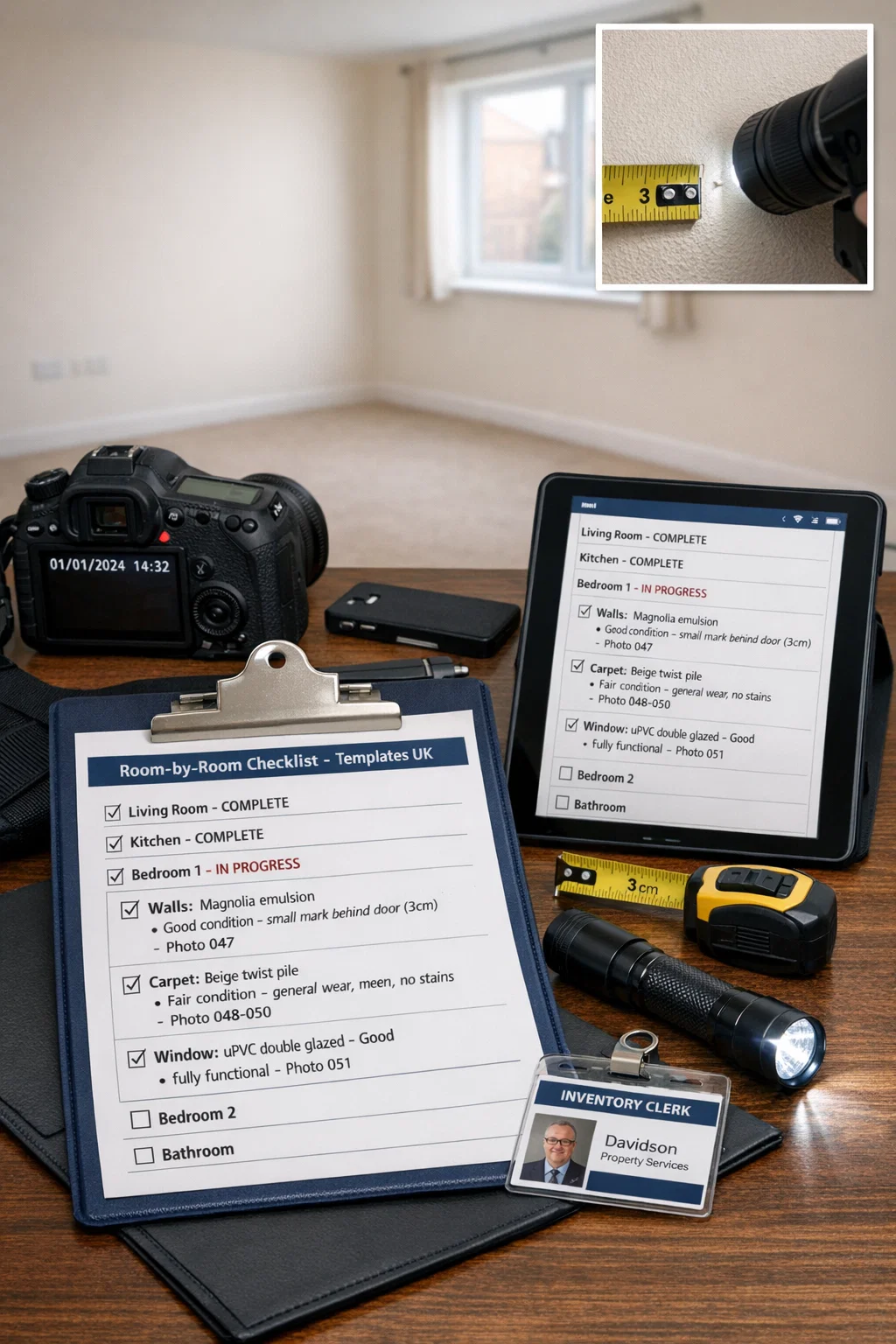
| Walls | Magnolia emulsion paint | Good — small scuff mark behind door (2cm), otherwise clean | IMG_005 |
Essential Elements to Document
Structural elements: Walls (paint/wallpaper condition, marks, holes, cracks), ceilings (condition, staining), floors (type, wear level, stains), windows (frames, glass, handles, locks), doors (condition, marks, functionality).
Kitchen items: Appliances (make/model, condition, functionality, cleanliness — oven interior is particularly important), worktops (material, scratches, stains, chips), cupboards (internal/external condition, handles, hinges), sink (material, taps functionality).
Bathroom items: Bath/shower (condition, sealant quality, staining, limescale), toilet (condition, functionality, seat), sink (condition, taps, sealant), tiles (condition, grouting), extractor fan (functionality).
Additional items: Meter readings (gas, electric, water — photographed), keys (number and type), alarm codes, instruction manuals, garden (lawn condition, plants, boundaries, bins), smoke/CO alarms (present, tested, functioning).
Expert Insight: Vague entries like “sofa — good condition” are weak evidence. Specific entries like “3-seater grey IKEA Ektorp sofa, good condition, minor wear on right arm, small faded stain on back cushion 5cm diameter (see photo IMG_002)” are what win deposit disputes. The more precise your descriptions, the stronger your evidence.
Key Takeaways: Specific, detailed descriptions with photo references create strong evidence. Every item needs a brand/model identifier, condition rating, description of existing damage with measurements, and a cross-referenced photograph.
What Is an Inventory in a Tenancy Agreement?
An inventory referenced in a tenancy agreement is the agreed schedule of contents and condition that both landlord and tenant have signed as accurate.
The tenancy agreement typically includes a clause stating that the tenant agrees the inventory accurately reflects the property condition at the start of the tenancy — making it a contractual document with additional legal weight.
What Should an Inventory Schedule Include?
Professional inventory formats usually include:
-
- Header section: Property address, landlord/agent details, tenant names, check-in date
-
- Property overview: Type, number of bedrooms, furnished/unfurnished status
-
- Room sections: Separate page or section for each room
-
- Item tables: Columns for item, description, condition, photo reference
-
- Photo appendix: All photographs with reference numbers and captions
-
- Meter readings: Separate section with photographed meters
-
- Tenant comments section: Space for tenant to note disagreements
-
- Signature page: Both parties sign and date
Tenants who sign the inventory agree it’s accurate, making it very difficult to later dispute the baseline condition at tenancy start. This contractual incorporation gives the inventory significant legal force.
Quick Answer: Referencing and incorporating the inventory into the tenancy agreement strengthens its legal status. Always ensure tenants sign both the tenancy agreement AND the inventory as separate documents to create the strongest evidence.
Landlord Essentials Pack
Most Popular Bundle • 8 Templates + Editor & Interview Versions • Save 50% vs Buying Individually
Lifetime Access • Free Updates • 30-Day Money-Back Guarantee*
Deposit Protection and Inventory Evidence
Deposit protection schemes (DPS, MyDeposits, TDS) require landlords to provide clear evidence when claiming deposit deductions. The check-in inventory serves as the primary “before” evidence, while the check-out report provides the “after” evidence.
According to TDS data for 2024/25, just 1% of all protected deposits required formal adjudication. But when disputes do reach adjudication, the quality of inventory evidence determines the outcome — and landlords without proper documentation lose far more often than they win.
Evidence Standards for Deposit Disputes
Adjudicators assess evidence using the civil standard of “balance of probabilities.” To succeed in deposit deduction claims, landlords must provide:
Check-in inventory (signed by tenant): Detailed item-by-item condition descriptions, photographs dated at tenancy start, tenant signature acknowledging accuracy, and a clear date confirming contemporaneous creation.
Check-out report: Matching format to check-in inventory, item-by-item condition descriptions, photographs showing any damage or deterioration, and a clear date at tenancy end.
Comparison evidence: Side-by-side photos (before/after) showing deterioration, written explanation of changes beyond fair wear and tear, invoices or quotes for remedial work, and cleaning receipts if applicable.
What Adjudicators Look For
| Evidence Type | Strong Evidence | Weak Evidence |
|---|---|---|
| Inventory | Signed by tenant, detailed descriptions, dated photos, specific condition ratings | Unsigned, vague descriptions, no photos, created months after tenancy start |
| Check-out | Independent clerk, detailed, matching inventory format, clear photos | Landlord-prepared only, brief notes, poor quality photos |
| Damage | Before/after comparison photos, clear deterioration beyond wear | After photos only, unclear if pre-existing damage |
| Costs | Invoices for work completed, quotes from multiple traders | Estimates only, DIY labour claims, betterment charges |
Common Reasons Landlords Lose Deposit Disputes
-
- No signed inventory: Tenant claims damage was pre-existing (adjudicator cannot verify)
-
- Inventory too vague: “Carpet — fair condition” doesn’t identify specific stains or wear areas
-
- No check-in photos: Written descriptions alone are weak without visual proof
-
- Photos not dated: Cannot prove they were taken at tenancy start
-
- Claiming for fair wear and tear: Normal deterioration over time is tenant’s right
-
- Betterment: Upgrading items rather than like-for-like replacement
-
- Professional cleaning charges: Property was not professionally cleaned at check-in
⚠️ Warning: Cleaning is the single biggest source of deposit disputes, appearing in over half of all TDS cases. If the property was not professionally cleaned at check-in, you cannot insist on professional cleaning at check-out. Document the exact cleaning standard at tenancy start — and make sure it’s recorded in the inventory.
Fair Wear and Tear
Adjudicators distinguish between tenant-caused damage (deposit deductible) and fair wear and tear (not deductible).
Acceptable wear: Carpet flattening in high-traffic areas, minor scuffs on walls from furniture, fading of curtains or paint from sunlight, general dirt accumulation from normal use.
Tenant damage: Stains (wine, food, pet), holes in walls, broken fixtures, burns, deliberate damage, excessive dirt beyond normal use.
Tenancy length affects fair wear expectations. A six-month tenancy should show minimal wear, while a three-year-plus tenancy naturally produces more significant deterioration — and redecoration may become the landlord’s responsibility rather than the tenant’s.
Key Takeaways: A professional, signed, photographed inventory is worth thousands in deposit protection. The investment in a professional inventory clerk (typically £80–£150) pays for itself many times over by preventing unjust deposit losses and reducing disputes.
Frequently Asked Questions: Inventory & Schedule of Condition UK
What is inventory and schedule of condition?
An inventory lists all contents, fixtures, and fittings in a rental property. A schedule of condition describes the state of the property structure, decorations, and all listed items. Together they form a complete baseline record of property condition at tenancy start, serving as evidence for deposit protection schemes when disputes arise over damage.
What is a schedule of condition in the UK?
A schedule of condition is a written report (often with photographs) describing the state of a property and its contents at a specific point in time. For residential tenancies, it documents condition at check-in and is compared against a check-out report to identify damage or deterioration beyond fair wear and tear.
Is an inventory a legally binding document?
Yes, when signed by both landlord and tenant. It constitutes evidence of property condition at tenancy start and can be used in deposit protection scheme adjudications and court proceedings to prove the baseline condition.
What to write on an inventory and condition form?
Write specific descriptions identifying each item (brand, model, colour, size), exact condition (excellent/good/fair/poor with details), existing damage or wear with locations, cleanliness level, and functionality. Include dated photographs cross-referenced to descriptions.
What is an inventory in a tenancy agreement?
An inventory referenced in a tenancy agreement is the agreed schedule of contents and condition that both parties have signed as accurate. The tenancy agreement includes a clause making it a contractual document, strengthening its legal weight in any future dispute.
What is a legal inventory?
A legal inventory is a contemporaneous written record of property condition that meets evidential standards for deposit protection schemes and courts. It must be prepared at tenancy start, signed by both parties, sufficiently detailed, and supported by dated photographic evidence.
What is the legal term inventory?
In UK property law, “inventory” is the legal term for the comprehensive list and condition record of property contents at tenancy commencement. It serves as the evidential baseline for determining deposit deductions for damage beyond fair wear and tear.
What is an inventory schedule?
An inventory schedule is the structured document format used to record property contents and condition room-by-room. It includes property details, item lists, condition descriptions, photograph references, meter readings, and signature sections for both parties.
What is a schedule of inventory?
A schedule of inventory is the same as an inventory schedule — a formatted document listing property contents and their condition in a structured, room-by-room layout. The terms are used interchangeably in UK property law.
What is the schedule of condition inventory?
The schedule of condition inventory (also called inventory and schedule of condition) is the combined document that both lists property contents and describes their condition. Most landlords and agents use a single integrated report rather than separate documents.
The Truth About “Free” Legal Template Sites (What You’re Really Signing Up For)
Most websites offering a “free legal template” follow the same pattern:
-
- You click because it’s advertised as free
-
- You spend 10–15 minutes answering questions
-
- At the very end, you must create an account or start a “free trial”
-
- Your card is required upfront
-
- The subscription auto-renews at £29–£39 per month
This isn’t a free template — it’s a subscription funnel. Many people only realise after being charged £300–£400 over the year.
Why These “Free” Templates Are a Legal Risk
-
- Outdated wording: not aligned with current UK law
-
- Missing mandatory clauses: required for legal validity
-
- No compliance guidance: leaving users without legal context
-
- No structured checklist: no way to verify the document works
-
- Not kept updated: often unchanged when legislation changes
One incorrect clause can weaken or invalidate the entire document.
Hidden Problem: Many “Free Template” Sites Aren’t Even UK-Based
-
- Incorrect terminology: taken from US contract law
-
- Missing UK statutory references: essential legal requirements omitted
-
- Non-applicable clauses: terms that don’t apply under UK legislation
-
- Legal conflicts: risks breaching UK consumer, employment, or GDPR rules
Why Templates UK Does the Opposite
-
- Drafted by UK professionals: written by experienced business & legal experts
-
- UK-law only: no US crossover or generic “international” templates
-
- One-time price from £10: no subscriptions, no renewals
-
- Full preview: see the exact document before buying
-
- Lifetime access: free lifetime updates included
My Templates Dashboard
Already a customer? Access all your purchased templates — including any updates we’ve made since you bought them — in My Templates. Every time UK law changes, we update the affected templates and you get the new version automatically. No extra charge. No re-purchase.
Transparent Pricing (From £10 per template)
Every template is a one-time purchase. No subscriptions. No renewals. No hidden fees. Preview every clause before buying — and if it’s not right, we offer a 30-day money-back guarantee.
Not ready to buy? Use our free interactive checklists to guide your own document – no payment required.
No tricks. No trials. No hidden fees. Just the exact UK-specific legal document you came for — at the price we told you upfront.
Build your own bespoke inventory and schedule of condition using our guided interview or classic editor — preview every section before buying, and only pay when you’re happy with it.
Get the professionally drafted Inventory & Schedule of Condition Template — UK-law only, instant download, no subscriptions.
Get Every Template in One Bundle
The UK Legal Templates Ultimate Bundle includes all 91 templates across every category:
-
- Business & Commercial (37) — Employment, HR, contracts, agreements, compliance, and formation docs
-
- Landlord & Property (28) — ASTs, evictions, Section 8/21, correspondence, inventory, and management
-
- Family & Relationships (18) — Prenups, cohabitation, divorce, child arrangements, name changes, and more
-
- Wills & Estate (8) — Wills, mirror wills, trusts, advance care planning, and estate documents
One purchase. Every template. Free lifetime updates — including all future law changes.
Explore Template Bundles by Category
-
- Business Complete Suite (37 templates) (smaller packs available)
-
- Landlord Ultimate Bundle (28 templates) (smaller packs available)
-
- Complete Family Pack (18 templates) (smaller packs available)
-
- Complete Estate Pack (8 templates) (smaller packs available)
Master Business Legal Templates Pillar Guide
For a complete overview of every business template we offer, see our UK Business Legal Templates – Complete Guide (37 Templates).
All Templates UK Pillar Guides
Related Guides
Free Legal Templates & Interactive Checklists
Access all our free UK legal templates, checklists and downloadable PDFs.
Last updated: March 2026
Disclaimer: This guide provides general UK legal information, not legal advice. Laws are current as of March 2026.