Updated: February 2026 • England & Wales • Based on UK Law
A landlord submits a witness statement to support a possession claim for rent arrears. It describes six months of unpaid rent, emails chasing payment, and a Section 8 notice properly served. Solid case — on paper.
The judge gives it reduced weight. The paragraphs aren’t numbered. The statement of truth is missing. The exhibit references say “see attached” instead of using the correct “Exhibit JS1” format. The tenant’s solicitor argues the statement doesn’t comply with Practice Direction 32 — and the court agrees.
Formatting errors like these don’t just look unprofessional — they can cost you the case. This guide covers exactly how to write a witness statement that courts will accept, what to include, what to avoid, and the specific format required under the Civil Procedure Rules.
What Is a Witness Statement?
A witness statement is a formal written account of facts known to a witness, submitted to court as evidence. Governed by CPR Part 32 and Practice Direction 32, it must include a statement of truth, witness details, a chronological first-person account, and properly referenced exhibits.
This guide covers witness statement format, structure, what to include, what to avoid, statement of truth requirements, and exhibits. Free interactive checklist included.
✓ Witness Statement Template
Build your witness statement using our guided questions or classic editor — preview every clause before buying.
Prefer to do it yourself? Use our checklist as a basic guide.
What Is a Legal Witness Statement?
A witness statement is a formal written document containing evidence that a person would be allowed to give orally in court. Under CPR Part 32, it stands as the witness’s evidence-in-chief at trial — meaning it replaces the need to give oral testimony unless the witness is cross-examined.
Every witness statement must contain five elements:
1. Witness details — full name, address, occupation, and whether the witness is a party to the proceedings.
2. Statement of truth — the signed declaration: “I believe that the facts stated in this witness statement are true. I understand that proceedings for contempt of court may be brought against anyone who makes, or causes to be made, a false statement in a document verified by a statement of truth without an honest belief in its truth.”
3. Chronological account — facts the witness personally saw, heard, or experienced. Not opinions, not speculation, not what someone else told them.
4. Exhibits — documents and photos referenced using the format Exhibit [Initials]1, Exhibit [Initials]2, and so on.
5. Signature and date — handwritten signature at the bottom, with the date it was signed.
What Does a Good Witness Statement Look Like?
A good witness statement is written in first person (“I saw…” not “The witness saw…”), states facts rather than opinions (“The tenant was shouting loudly at 11pm” not “The tenant was unreasonable”), organises events in date order with numbered paragraphs, and references exhibits clearly.
Here’s how an opening should read:
“I, John Brown, of [address], landlord, will say as follows: 1. I am the landlord of the property at [address]. 2. On 1 January 2024, I entered into a tenancy agreement with the defendant. See Exhibit JB1. 3. The monthly rent was £1,200 payable on the 1st of each month.”
What Are the Legal Requirements?
| Requirement | What to Include | Why Required |
|---|---|---|
| Heading | Case number, court name, claimant/defendant names | Identifies which case the statement relates to |
| Witness details | Full name, address, occupation | Establishes witness identity and credibility |
| First person | “I” — not “the witness” or third person | Must be the witness’s own account (PD32 para 18.1) |
| Numbered paragraphs | 1, 2, 3… sequential throughout | Allows easy reference during hearing (“paragraph 5”) |
| Chronological order | Events in date order, earliest to latest | Shows timeline clearly to the court |
| Facts not opinions | What you saw, heard, or did | Only factual testimony is admissible |
| Exhibits referenced | Exhibit [Initials]1, [Initials]2 | Links documentary evidence to testimony |
| Statement of truth | Signed declaration believing facts true | Unsigned statement is inadmissible (CPR Part 22) |
| Signature and date | Handwritten signature, date signed | Authenticates the statement |
Use our professionally drafted Witness Statement Template with pre-formatted headings and statement of truth — or start with our free Witness Statement Compliance Checklist.
If your witness statement doesn’t comply with CPR Part 32 and Practice Direction 32, the court may refuse to admit it as evidence or refuse to allow the costs arising from its preparation (PD32, para 25.1).
How to Write a Witness Statement — Step by Step
Writing a witness statement doesn’t require a solicitor — but it does require the correct format. Here’s the step-by-step process.
Step 1: Heading. Include the case number, court name, claimant name, defendant name, and “Witness Statement of [Your Name]”.
Step 2: Introduction. “I, [Full Name], of [Address], [Occupation], will say as follows:”
Step 3: Numbered paragraphs. Write each fact as a separate numbered paragraph starting with 1. One topic per paragraph.
Step 4: Chronological account. Describe events in date order — earliest to latest. Start each event paragraph with the date.
Step 5: Reference exhibits. Every time you mention a document or photo, write “See Exhibit [Initials][Number]” — for example, “See Exhibit JB3 — photograph of kitchen damage.”
Step 6: Statement of truth. Add the prescribed wording: “I believe that the facts stated in this witness statement are true. I understand that proceedings for contempt of court may be brought against anyone who makes, or causes to be made, a false statement in a document verified by a statement of truth without an honest belief in its truth.”
Step 7: Sign and date. Handwritten signature and date at the bottom.
What Makes a Witness Statement Powerful?
Be truthful — only state facts you personally know to be true. Contempt of court proceedings can be brought for false statements.
Be specific — use exact dates, times, and amounts. “On 15 March 2024 at 10:00am” is stronger than “around mid-March”.
Be relevant — include only facts related to the legal issues in dispute. Courts prefer focused statements to lengthy rambling accounts.
Be objective — describe what happened without emotional language. “The tenant stated he would not pay rent” is admissible. “The tenant was impossible and unreasonable” is not.
Be complete — don’t leave out unfavourable facts. It’s better that you address them than the opponent reveals them during cross-examination.
Writing Steps at a Glance
| Step | Action | Example |
|---|---|---|
| 1. Heading | Case number, court, parties | Claim No: A12BC345 — Northampton County Court — Smith v Jones |
| 2. Introduction | Name, address, capacity | “I, John Smith, of 10 High Street, landlord, will say:” |
| 3. Background | Explain your involvement | “1. I am the landlord of [property]. 2. I let the property to the defendant on 1 Jan 2024.” |
| 4. Chronological facts | Events in date order | “3. On 1 Feb 2024, rent was due. 4. On 15 Feb, still unpaid.” |
| 5. Exhibits | Reference documents/photos | “5. I sent email chasing rent. See Exhibit JS1.” |
| 6. Statement of truth | Prescribed wording | “I believe the facts in this witness statement are true…” |
| 7. Sign and date | Handwritten signature | Signed: [signature] Date: 20 February 2026 |
Witness Statement Format for Possession Hearing UK
Possession hearing witness statements follow the same CPR Part 32 format but focus on specific evidence types depending on the ground for possession.
The structure should be: heading with case details, introduction stating your name and capacity (landlord, tenant, managing agent, neighbour), background paragraphs explaining the tenancy (start date, rent amount, property address — with the tenancy agreement as Exhibit 1), chronological account of the issue (arrears dates and amounts, breach incidents, nuisance complaints), your attempts to resolve the matter (warning letters, meetings, payment plans offered), current position summary, statement of truth, and signature.
Does a Witness Statement Need to Be Notarised?
No. UK courts accept witness statements signed with a statement of truth — no notary, solicitor witnessing, or commissioner for oaths required.
This is different from an affidavit, which is a sworn statement made before a solicitor or commissioner for oaths. Affidavits are only required for specific applications — search orders, freezing injunctions, and contempt proceedings (PD32, para 1.4).
For possession hearings, always use the witness statement format, not an affidavit.
How Should It Be Structured?
Introduction section (paras 1–3) — who you are, your role, your knowledge of the case.
Background section (paras 4–8) — context establishing the parties’ relationship (tenancy agreement, employment, contract).
Chronological events section (paras 9–30+) — main facts in date order. Each event gets its own paragraph, starting with the date.
Supporting evidence section (paras 31–35) — additional facts (financial records, observations).
Conclusion section (final 1–2 paras) — summary of key facts, current position.
Statement of truth. Signature, printed name, date.
What Are the Formatting Rules?
Typed, not handwritten (except for the signature). Standard font — Arial or Times New Roman, 11–12pt. Margins of 2.5cm on all sides. Paragraphs numbered consecutively throughout. Page numbers on every page. Professional tone — factual, objective, no emotional language or arguments.
Length varies by complexity, but possession hearing statements typically run 3–8 pages. Focus on key facts, not unnecessary detail.
What to Include — and What to Avoid
Getting the content right matters as much as the format. Courts give reduced weight to statements that include opinions, hearsay, or legal arguments — even if the underlying facts are strong.
| Don’t Include | Why It’s Problematic | Write This Instead |
|---|---|---|
| Opinions “The tenant is dishonest” |
Not admissible, undermines credibility | “The tenant stated rent was paid, but bank records show no payment received” |
| Hearsay “Neighbours told me the tenant is noisy” |
Second-hand evidence, inadmissible without the witness | “I received a noise complaint from the neighbour on [date]. See Exhibit. The neighbour has provided a separate witness statement.” |
| Legal arguments “This breaches Ground 8” |
Legal submissions belong in skeleton arguments, not witness evidence | “Rent arrears total £2,400 as at the date of the Section 8 notice” |
| Speculation “I think the tenant will damage the property” |
Predictions are not facts and are inadmissible | “The tenant has caused damage to the kitchen door. See Exhibit — photograph” |
| Emotional language “I am devastated and furious” |
Undermines objectivity, appears biased | “This situation has caused me significant stress and financial loss” |
| Privileged information Settlement discussions, legal advice |
“Without prejudice” discussions are protected from disclosure | Omit entirely — do not reference settlement discussions |
| Unsupported allegations “Tenant is running a business from the property” |
Without evidence, appears vindictive | “I observed commercial deliveries daily. See Exhibit — photographs. Neighbour has complained about business visitors.” |
What Evidence Should a Landlord Include?
Tenancy details — when the tenancy started, rent amount, property address (reference the tenancy agreement as Exhibit 1).
Rent payment history — which months were paid and unpaid, with exact dates and amounts (reference bank statements or rent ledger).
Arrears calculation — total arrears with a clear breakdown (reference arrears schedule as a separate exhibit).
Breach evidence — specific incidents with dates, times, and witnesses (photos, correspondence, neighbour complaints as exhibits).
Warning communications — every letter and email sent to the tenant about the issue (each as a separate exhibit).
Statutory compliance — deposit protection certificate, gas safety record (CP12), How to Rent guide, Energy Performance Certificate.
Possession notice — when and how the Section 8 notice was served (reference the notice and proof of service).
Attempts to resolve — meetings held, payment plans offered, mediation attempts.
Landlord vs Tenant Witness Statements — What’s Different?
The format is identical — both follow CPR Part 32. The difference is the content and purpose.
| Element | Landlord Statement | Tenant Statement |
|---|---|---|
| Purpose | Prove grounds for possession (arrears, breach, nuisance) | Defend claim (arrears disputed, landlord breaches, invalid notice) |
| Key exhibits | Tenancy agreement, Section 8 notice, rent ledger, warning letters, photos | Defence form (N11), bank statements showing rent paid, evidence of landlord non-compliance |
| Chronology focus | Arrears accumulation, breach incidents, warnings issued | Rent payments made, landlord failures (repairs, harassment) |
| Common mistakes | Not proving statutory compliance (deposit, gas safety, EPC) | Not providing documentary evidence (bank statements, correspondence) |
For organising witness statements and exhibits into an evidence bundle, see our Evidence Bundle Template Guide.
Do You Have to Give a Witness Statement in the UK?
If you’re a party to the proceedings — landlord claimant or tenant defendant — yes. Under the Civil Procedure Rules, your witness statement is your evidence-in-chief. If you don’t serve one, you cannot give oral evidence at trial without the court’s permission.
If you’re a third-party witness — neighbour, managing agent, colleague — you can choose whether to provide a statement. You cannot be compelled unless the court issues a witness summons, which is rare in possession cases.
If you don’t provide a statement, the case proceeds without your evidence. The judge will draw conclusions from whatever evidence is available — and the absence of your statement may be noted.
Do I Need a Witness for My Tenancy Agreement?
No. UK tenancy agreements do not require witnesses to be legally binding. An Assured Shorthold Tenancy is valid if signed by the landlord and the tenant, contains the required terms, and complies with statutory requirements (deposit protection, Right to Rent checks).
Witnessing is only legally required for deeds — property transfers and lasting powers of attorney. For tenancy agreements, it’s optional and purely for added formality.
Eviction & Legal Notices Pack
Essential Bundle • 6 Templates + Editor & Interview Versions • Save 50% vs Buying Individually
Lifetime Access • Free Updates • 30-Day Money-Back Guarantee*
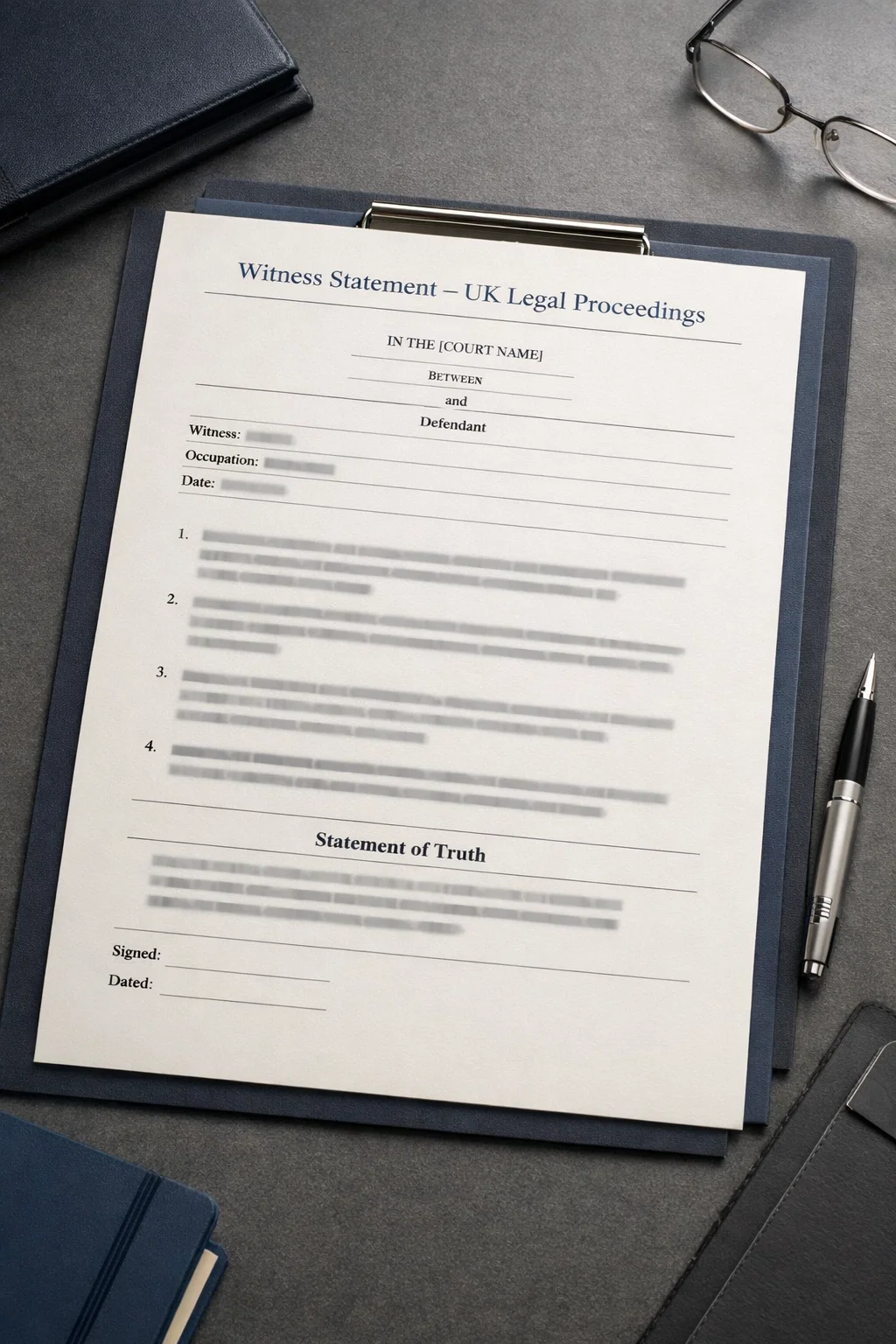
Sample Possession Hearing Witness Statement
Below is an example of how a landlord’s witness statement should be structured for a possession claim based on rent arrears. This follows the format required by CPR Part 32 and Practice Direction 32.
Claim No: A12BC345
Northampton County Court
BETWEEN:
JOHN SMITH (Claimant)
and
SARAH JONES (Defendant)
WITNESS STATEMENT OF JOHN SMITH
I, JOHN SMITH, of 10 High Street, Northampton, NN1 1AA, landlord, will say as follows:
INTRODUCTION
1. I am the Claimant in this matter and the landlord of the property at 15 Oak Road, Northampton NN2 2BB (“the Property”).
2. I make this witness statement in support of my claim for possession of the Property based on rent arrears.
3. The facts in this statement are within my own knowledge unless otherwise stated.
BACKGROUND
4. On 1 January 2024, I entered into an Assured Shorthold Tenancy Agreement with the Defendant for the Property. A copy of the tenancy agreement is exhibited as Exhibit JS1.
5. The tenancy commenced on 1 January 2024 for an initial fixed term of 12 months.
6. The monthly rent was £1,200, payable in advance on the 1st day of each month.
7. I protected the Defendant’s deposit of £1,400 with the Deposit Protection Service on 5 January 2024. A copy of the deposit protection certificate is exhibited as Exhibit JS2.
RENT ARREARS
8. The Defendant paid rent on time for January and February 2024.
9. On 1 March 2024, the rent for March became due but was not paid.
10. On 8 March 2024, I sent an email to the Defendant requesting payment. A copy of this email is exhibited as Exhibit JS3.
11. The Defendant replied on 10 March 2024 stating she had “temporary financial difficulties” and would pay “as soon as possible”. A copy of her email is exhibited as Exhibit JS4.
12. Despite this assurance, no payment was received for March.
13. On 1 April 2024, the rent for April also became due but was not paid. The total arrears were now £2,400.
14. On 5 April 2024, I sent a formal letter giving the Defendant 7 days to pay the arrears. A copy of this letter is exhibited as Exhibit JS5.
15. The Defendant did not respond to this letter and did not make any payment.
16. The arrears continued to accumulate. As at the date of this statement, the total rent arrears are £7,200 (six months). A full arrears schedule is exhibited as Exhibit JS6.
POSSESSION PROCEEDINGS
17. On 15 August 2024, I served a Section 8 Notice seeking possession on Ground 8. A copy of the Section 8 Notice is exhibited as Exhibit JS7.
18. The Defendant did not vacate the Property following the notice period.
19. On 15 October 2024, I issued this claim for possession.
CURRENT POSITION
20. As at today’s date, the Defendant remains in occupation and has not made any rent payments since February 2024.
21. The total rent arrears now stand at £7,200.
22. I have attempted to resolve this matter without court proceedings but the Defendant has failed to engage or make any payments.
STATEMENT OF TRUTH
I believe that the facts stated in this witness statement are true. I understand that proceedings for contempt of court may be brought against anyone who makes, or causes to be made, a false statement in a document verified by a statement of truth without an honest belief in its truth.
Signed: ___________________________
Full name: JOHN SMITH
Dated: ___________________________
Official Sources & Further Reading
- CPR Part 32 — Evidence (justice.gov.uk)
- Practice Direction 32 — Witness Statements (justice.gov.uk)
- Court Template for Witness Statements (justice.gov.uk)
- Shelter: Evidence in Civil Claims and Housing Cases
The Truth About “Free” Legal Template Sites (What You’re Really Signing Up For)
Most websites offering a “free legal template” follow the same pattern:
- You click because it’s advertised as free
- You spend 10–15 minutes answering questions
- At the very end, you must create an account or start a “free trial”
- Your card is required upfront
- The subscription auto-renews at £29–£39 per month
This isn’t a free template — it’s a subscription service. Many people only realise after being charged £300–£400 over the year.
Why These “Free” Templates Are a Legal Risk
- Outdated wording: not aligned with current UK law
- Missing mandatory clauses: required for legal validity
- No compliance guidance: leaving users without legal context
- No structured checklist: no way to verify the document works
- Not kept updated: often unchanged when legislation changes
One incorrect clause can weaken or invalidate the entire document.
Hidden Problem: Many “Free Template” Sites Aren’t Even UK-Based
Another major issue is that many free or auto-subscription template sites operate outside the UK and use documents originally drafted for the US legal system. These are then loosely adapted for “international use,” which creates serious problems:
- Incorrect terminology: taken from US contract law
- Missing UK statutory references: essential legal requirements omitted
- Non-applicable clauses: terms that don’t apply under UK legislation
- Legal conflicts: risks breaching UK consumer, employment, or GDPR rules
Why Templates UK Does the Opposite
- Drafted by UK professionals: written by experienced business & legal experts
- UK-law only: no US crossover or generic “international” templates
- One-time price from £10: no subscriptions, no renewals
- Full preview: see the exact document before buying
- Lifetime access: free lifetime updates included
My Templates Dashboard
All purchased templates are stored in your personal My Templates page, organised by category.
When we update a template for UK law changes, the new version appears automatically in your dashboard — free, forever.
Build a growing library of UK legal documents across every area of your business and personal life.
Transparent Pricing
From £10 per template — with free lifetime usage and free lifetime updates. No subscriptions. No renewals. No auto-billing.
Not ready to buy? Use our free interactive checklists to guide your own document — no payment required.
No tricks. No trials. No hidden fees. Just the exact UK-specific legal document you came for — at the price we told you upfront.
Build your own bespoke document with our Witness Statement Template. Preview the full document before buying — only pay when you’re happy with it.
Get Every Template in One Bundle
The UK Legal Templates Ultimate Bundle includes 91 templates across every category — one purchase, lifetime updates, no subscriptions.
Explore Template Bundles by Category
One purchase, lifetime updates, no subscriptions.
- Business Complete Suite — 37 templates, £120 (smaller packs available)
- Landlord Ultimate Bundle — 28 templates, £99 (smaller packs available)
- Complete Family Pack — 18 templates, £65 (smaller packs available)
- Complete Estate Pack — 8 templates, £38 (smaller packs available)
Explore the Master Business Legal Templates Pillar Guide
The complete overview of 37 essential UK business templates.
UK Business Legal Templates – Complete Master Guide
Explore All Templates UK Pillar Guides
- Family Law Documents Guide UK
- Wills & Estate Planning Guide UK
- Residential Landlord Documents Guide UK
- Employment Documents Guide UK
- How to Set Up a Business in the UK – Legal Guide
- Website Legal Documents UK – Compliance Guide
- Financial & Commercial Contracts UK – Protection Guide
- Commercial Office Lease Guide UK
- Digital & IP Agreements Guide UK
Related Guides
- Evidence Bundle Template Guide UK
- Section 8 Notice Guide UK
- Section 21 Notice Guide UK
- Breach of Tenancy Guide UK
Free Legal Templates & Interactive Checklists
Access all our free UK legal templates, checklists and downloadable PDFs.
Last updated: February 2026
Disclaimer: This guide provides general UK legal information, not legal advice. Laws are current as of February 2026.
Frequently Asked Questions: Witness Statement UK
How do I write a simple witness statement?
Start with a heading containing the case details (case number, court name, parties). Then write your introduction: “I, [Name], of [Address], will say as follows:” followed by numbered paragraphs in chronological order. State only facts you personally know — not opinions. Reference any documents as exhibits (Exhibit [Initials]1, 2, 3). End with the statement of truth, your signature, and the date.
How do I give a good witness statement?
Be truthful, specific, relevant, and objective. Use exact dates, times, and amounts rather than vague approximations. Write in first person (“I saw…”), stick to facts you personally witnessed, organise events chronologically, and keep the statement concise. Don’t leave out unfavourable facts — it’s better you address them than the opponent reveals them.
How do I write a powerful witness statement?
State facts clearly with specific dates, times, and amounts. Reference documentary evidence as exhibits for every key fact. Organise chronologically to show a clear timeline. Include direct quotes where relevant (“The tenant said ‘…'”). Anticipate the opponent’s case and address it factually rather than leaving gaps they can exploit.
Do you have to give a witness statement in the UK?
If you’re a party to the proceedings (landlord or tenant in a possession claim), yes — your witness statement serves as your evidence-in-chief under CPR Part 32. Without one, you cannot give oral evidence at trial without the court’s permission. Third-party witnesses (neighbours, colleagues) are not automatically required unless the court issues a witness summons.
How do I write an official witness statement?
Follow the format required by Practice Direction 32: formal heading with case details, witness details (name, address, occupation), first-person account with numbered paragraphs, chronological facts, exhibits referenced using the [Initials][Number] format, statement of truth with the prescribed wording, and your signature and date. Type it in a standard font (11–12pt) with 2.5cm margins.
Do I need a witness for my tenancy agreement?
No. UK tenancy agreements don’t require witnesses to be legally binding. An Assured Shorthold Tenancy is valid if signed by the landlord and tenant, contains the required terms, and complies with statutory requirements such as deposit protection and Right to Rent checks. Witnessing is only legally required for deeds (property transfers, lasting powers of attorney).
What should I not put in a witness statement?
Don’t include opinions (“I think the tenant is dishonest”), hearsay (“Someone told me…”), legal arguments (“This breaches Ground 8”), speculation (“I believe the tenant will…”), emotional language (“I am furious”), irrelevant personal details, or privileged information such as without-prejudice settlement discussions. Stick to facts you personally witnessed, with dates, times, and documentary evidence.
Does a witness statement for court need to be notarised?
No. UK witness statements require only a signed statement of truth — no notary, solicitor witnessing, or commissioner for oaths. Affidavits (sworn statements before a solicitor) are only required for specific court applications such as search orders and freezing injunctions (PD32, para 1.4). For possession hearings, use the standard witness statement format.
What should a landlord’s witness statement look like?
Typed in standard font (11–12pt), with proper margins (2.5cm), headed with case details, introduction stating your name and capacity as landlord, numbered paragraphs throughout, exhibits referenced (JS1, JS2…), statement of truth, signature and date. Include tenancy details, rent payment history, arrears evidence, breach incidents, statutory compliance proof (deposit, gas, EPC), and possession notice details. Typically 3–8 pages.
What is the witness statement format for a possession hearing?
Heading with case details, introduction (your role and capacity), background (tenancy details with the agreement as an exhibit), chronological events (arrears accumulation or breach incidents with specific dates), resolution attempts (warning letters, meetings), current position summary, statement of truth, signature and date. Attach exhibits in order (Exhibit [Initials]1, 2, 3).
: { “@type”: “Answer”, “text”: “Typed in standard font with proper margins, headed with case details, numbered paragraphs, exhibits referenced, statement of truth, signature and date. Include tenancy details, rent history, arrears evidence, statutory compliance proof and possession notice details. Typically 3-8 pages.” } }, { “@type”: “Question”, “name”: “What is the witness statement format for a possession hearing?”, “acceptedAnswer”: { “@type”: “Answer”, “text”: “Heading with case details, introduction stating your role, background with tenancy details and exhibit, chronological events with dates, resolution attempts, current position summary, statement of truth, signature and date. Attach exhibits in order.” } } ] }