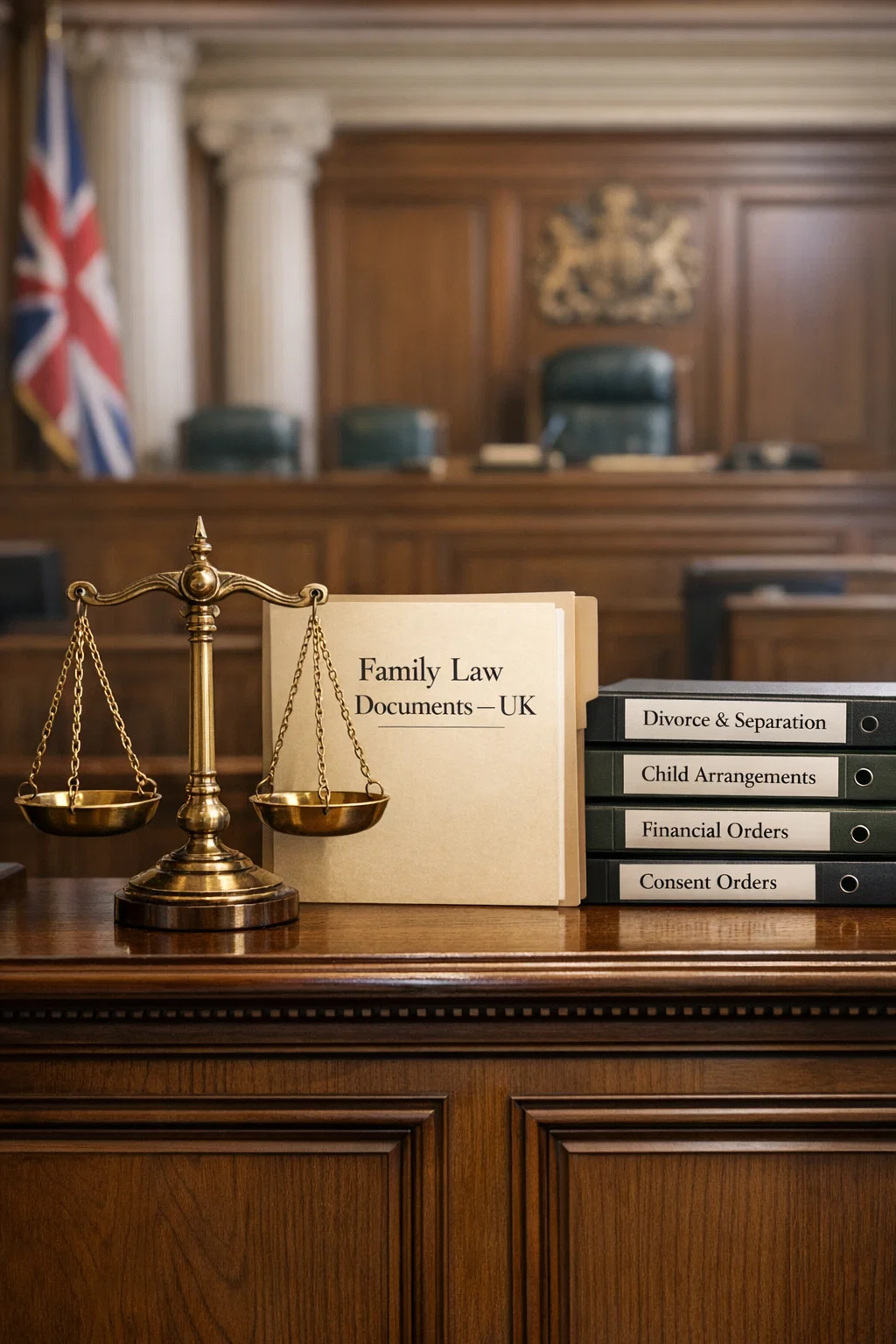
Protect Your Assets • 3 Templates + Editor & Interview Versions • Save 33% vs Buying Individually
One-Time Payment (£20) • No Subscriptions • Instant Access
Marriage & Relationship Agreements
Are Prenuptial Agreements Legally Binding in the UK?
No — prenuptial agreements are not automatically legally binding in the UK. However, courts will give a prenup “decisive weight” if it meets certain conditions established in the landmark case of Radmacher v Granatino (2010). This means a properly drafted prenup will strongly influence how assets are divided on divorce, even though a judge retains discretion to depart from it. For a prenup to be upheld by UK courts, it must meet these requirements: both parties must have received independent legal advice, there must be full and frank financial disclosure, the agreement must be signed at least 21-28 days before the wedding, neither party must have been under duress or undue pressure, and the terms must be fair at the time of divorce. If any of these conditions are not met, the court may disregard the prenup entirely. The Law Commission recommended in 2014 that prenuptial agreements should become legally binding through “qualifying nuptial agreements” legislation. While this has not yet been enacted, family lawyers expect reform in the coming years. In the meantime, a properly drafted prenup remains the strongest protection for pre-marital assets. Related template: Prenuptial Agreement TemplateHow Much Does a Prenup Cost UK?
A prenuptial agreement typically costs between £500-£5,000 in the UK, depending on complexity and whether both parties use solicitors. Simple prenups for couples with straightforward finances cost £500-£1,500. Complex prenups involving businesses, trusts, or international assets cost £2,000-£5,000 or more. Both parties should have independent legal advice, which means two sets of legal fees. Related template: Prenuptial Agreement TemplateCan You Get a Prenup After Getting Married?
Yes — this is called a postnuptial agreement (postnup). A postnup serves the same purpose as a prenup but is signed after marriage. UK courts treat postnups similarly to prenups under the Radmacher principles. However, a postnup may receive slightly less weight because the dynamics of negotiation change once parties are already married. The same requirements apply: independent legal advice, full disclosure, no duress, and fair terms. Related template: Post-Nuptial Agreement TemplateWhat Makes a Prenup Invalid UK?
A prenup may be invalid or given reduced weight if: one or both parties did not receive independent legal advice, there was no full financial disclosure, it was signed too close to the wedding (under 21 days), one party was pressured or coerced into signing, the terms are manifestly unfair at the time of divorce, circumstances have significantly changed since signing (such as the birth of children), or the agreement was not properly witnessed and executed as a deed. Related template: Prenuptial Agreement TemplateDo Cohabiting Couples Have Legal Rights UK?
No — cohabiting couples have very limited legal rights in the UK, regardless of how long they have lived together. There is no such thing as “common law marriage” in English law. This means unmarried partners have no automatic rights to each other’s property, pensions, or inheritance if the relationship ends or one partner dies. As of 2025, over 3.6 million couples cohabit in the UK, making it the fastest-growing family type. Yet 49% mistakenly believe they have the same rights as married couples. The government has announced a consultation on cohabitation law reform for 2025, but until new legislation passes, cohabiting couples must take proactive steps to protect themselves. A cohabitation agreement allows unmarried couples to set out how property, finances, and assets will be divided if they separate. Unlike prenups, cohabitation agreements are enforceable as contracts through the civil courts (not family courts). They can cover property ownership, mortgage contributions, household bills, savings, pensions, debts, and arrangements for any children. Related template: Cohabitation Agreement TemplateWhat Happens If My Partner Dies and We’re Not Married UK?
If your partner dies without a will and you are not married or in a civil partnership, you have no automatic right to inherit anything under the intestacy rules. The deceased’s estate passes to their children, parents, or other blood relatives instead. You may be able to make a claim under the Inheritance (Provision for Family and Dependants) Act 1975, but this requires court proceedings and is not guaranteed. To protect yourself: ensure your partner has a valid will naming you as a beneficiary, consider joint ownership of property as joint tenants (which passes automatically on death), ensure life insurance policies name you as beneficiary, and consider a cohabitation agreement that addresses what happens on death. Related template: Cohabitation Agreement TemplateChildren & Parenting Documents
What Is a Child Arrangement Order UK?
A child arrangement order is a court order that determines where a child will live, who they will spend time with, and when contact will take place. Child arrangement orders replaced the old “residence orders” and “contact orders” in 2014 under the Children and Families Act. The order is legally binding and must be followed by both parents. You can apply for a child arrangement order if you are the child’s parent, someone with parental responsibility, a grandparent or other relative (with court permission), or someone the child has lived with for at least three years. Before applying to court, you must attend a Mediation Information and Assessment Meeting (MIAM) unless an exemption applies. Related template: Child Arrangement Agreement TemplateHow Long Does a Child Arrangement Order Take UK?
A child arrangement order typically takes 3-12 months from application to final order, depending on complexity. The timeline breaks down as: MIAM attendance (1-2 weeks), court application processing (4-6 weeks to first hearing), CAFCASS safeguarding checks (2-4 weeks), potential CAFCASS report if ordered (12-16 weeks), and final hearing if agreement cannot be reached. According to GOV.UK, the average is approximately 10 months, though straightforward cases agreed through mediation can be resolved in weeks. Related template: Child Arrangement Agreement TemplateIs a Child Arrangement Order Legally Binding UK?
Yes — a child arrangement order is legally binding and enforceable through the courts. If one parent breaches the order (for example, by refusing contact), the other parent can apply for enforcement. Consequences for breach include: a warning notice, unpaid work requirement, compensation for losses, fines, and in serious cases, imprisonment for contempt of court. However, courts are reluctant to enforce orders through punishment where this would harm the child. Related template: Child Arrangement Agreement TemplateChild Arrangement Order vs Parenting Plan – What’s the Difference?
A parenting plan is a voluntary, non-legally binding agreement between parents about how they will raise their children after separation. A child arrangement order is a legally binding court order. Parenting plans are suitable when parents can cooperate and communicate effectively. Child arrangement orders are necessary when parents cannot agree or when one parent is not complying with informal arrangements. Related template: Parenting Plan TemplateCan a Mother Stop a Father Seeing His Child UK?
No — a mother cannot legally stop a father from seeing his child without a court order. UK law presumes that children benefit from a relationship with both parents. If a mother is preventing contact, the father can apply for a child arrangement order. The court will only refuse contact if there is evidence that contact would harm the child, such as proven domestic abuse, substance abuse, or safeguarding concerns. Related template: Child Arrangement Agreement TemplateHow Does an Unmarried Father Get Parental Responsibility UK?
An unmarried father can get parental responsibility in four ways: being named on the child’s birth certificate (automatic for births registered after 1 December 2003 in England and Wales), entering into a parental responsibility agreement with the mother, obtaining a parental responsibility order from the court, or marrying the child’s mother. Without parental responsibility, a father has no legal right to make decisions about his child’s education, medical treatment, religion, or name. Related template: Parental Responsibility Agreement TemplateCan Parental Responsibility Be Taken Away UK?
Parental responsibility can only be removed by a court order in very limited circumstances. A mother’s parental responsibility can only end through adoption or a parental order (in surrogacy). A father who acquired parental responsibility through marriage cannot have it removed except through adoption. A father who acquired parental responsibility through other means (birth certificate, agreement, or court order) can have it removed by court order, but courts are extremely reluctant to do this. Parental responsibility is not removed simply because a parent has no contact with the child or fails to pay child maintenance. Related template: Parental Responsibility Agreement TemplateIs a Private Child Maintenance Agreement Legally Binding UK?
No — a private child maintenance agreement (also called a family-based arrangement) is not automatically legally binding. This means if one parent stops paying, the other cannot enforce the agreement through the courts. However, you can make a private agreement legally binding by having it incorporated into a consent order by the family court, or by including it as part of a financial order on divorce. The alternative is using the Child Maintenance Service (CMS), which provides legally enforceable calculations. The CMS can deduct payments directly from wages, take money from bank accounts, and use bailiffs to collect unpaid maintenance. From February 2024, the £20 CMS application fee was removed. Related template: Child Maintenance Agreement TemplateCMS vs Private Child Maintenance Agreement – Which Is Better?
Private agreements offer: flexibility on amount and payment method, no fees, ability to include extras like school fees or holiday costs, and preservation of a cooperative relationship. CMS arrangements offer: legal enforceability, guaranteed calculation method, collection service if needed, and enforcement powers against non-payment. Choose a private agreement if you trust each other and can communicate. Choose CMS if there is conflict, history of non-payment, or you need enforcement protection. Related template: Child Maintenance Agreement TemplateCan I Take My Child Abroad Without Father’s Consent UK?
It depends on your circumstances. If you have a child arrangement order stating the child lives with you, you can take them abroad for up to 28 days without the other parent’s consent (unless the order says otherwise). For longer trips or if there is no order, you need written consent from everyone with parental responsibility. Taking a child abroad without proper consent is child abduction under the Child Abduction Act 1984, which carries up to 7 years imprisonment. When travelling, carry: a travel consent letter signed by the non-travelling parent, the child’s birth certificate, proof of your relationship to the child, and copies of any court orders. Some countries (particularly USA, South Africa, and Canada) have strict requirements and may require notarised consent letters. Related template: Travel Consent Letter TemplateSeparation & Divorce Documents
What Is a Separation Agreement UK?
A separation agreement is a written contract between separating couples that sets out how they will divide finances, property, and responsibilities. It can be used by married couples who want to separate before divorcing, unmarried couples who are ending their relationship, or couples who cannot or do not want to divorce for religious, financial, or personal reasons. Couples formalising a split without divorce use a separation agreement template UK to record finances, property and child arrangements. Related template: Separation Agreement TemplateIs a Separation Agreement Legally Binding UK?
No — a separation agreement is not automatically legally binding in the same way as a court order. However, it is a contract, so it can be enforced through the civil courts like any other contract. More importantly, if you later divorce, the court will give significant weight to a separation agreement when deciding the financial settlement, provided: both parties received independent legal advice, there was full financial disclosure, the agreement was freely entered into, and the terms remain fair. To make your separation agreement more robust, have it drafted as a deed, ensure both parties sign in front of independent witnesses, and later convert it into a consent order when you divorce. Related template: Separation Agreement TemplateSeparation Agreement vs Divorce – What’s the Difference?
A separation agreement does not end your marriage. You remain legally married, which means: you cannot remarry, you may retain certain pension and inheritance rights, and financial claims against each other remain open. A divorce legally ends the marriage and, when combined with a financial order, severs financial ties between you. If you have a separation agreement and later divorce, the agreement can form the basis of your financial consent order. Related template: Separation Agreement TemplateWhat Is Form E Divorce UK?
Form E is the standard financial statement used in divorce proceedings. It requires both parties to provide comprehensive disclosure of their income, assets, liabilities, and financial needs. Form E covers: personal details and marriage information, property and contents, bank accounts and savings, investments and shares, insurance policies, business interests, pensions, income and earning capacity, financial needs and expenses, and what order you are seeking. You must attach supporting documents including bank statements, payslips, tax returns, mortgage statements, pension valuations, and property valuations. Failing to provide accurate Form E disclosure is contempt of court and can result in financial penalties, costs orders, or the settlement being set aside. Related template: Divorce Financial Disclosure TemplateWhat Is a Clean Break Order UK?
A clean break order is a financial order that ends all future financial claims between divorcing spouses. Once sealed by the court, neither party can make further claims against the other’s income, assets, or estate. Clean break orders are suitable when: both parties can meet their own needs independently, there are sufficient assets to divide fairly now, and neither party needs ongoing spousal maintenance. A clean break does not affect child maintenance obligations, which continue regardless. The court will only approve a clean break if it is satisfied the settlement is fair and both parties can meet their reasonable needs. Related template: Financial Settlement Agreement TemplateHow Is Spousal Maintenance Calculated UK?
There is no fixed formula for spousal maintenance in the UK. The court considers: the income and earning capacity of both parties, financial needs and obligations, the standard of living during the marriage, the age of each party, the length of the marriage, contributions made by each party (including non-financial contributions like childcare), and any conduct that would be inequitable to disregard. Spousal maintenance can be: for a fixed term (to allow the recipient to become financially independent), for joint lives (until either party dies or the recipient remarries), or nominal (a small amount that keeps the claim open for variation). The trend is towards term orders and clean breaks where possible. Related template: Spousal Maintenance Agreement TemplateChild Arrangements Pack
Lifetime Access • Free Updates • 30-Day Money-Back Guarantee
Name Change Documents
How Do I Change My Name by Deed Poll UK?
You can change your name by deed poll if you are 16 or over. A deed poll is a legal document declaring that you are abandoning your old name and adopting a new name for all purposes. You do not need a solicitor — you can create your own deed poll using the correct wording, sign it in front of two independent witnesses (aged 18+), and use it immediately to update your records. Related template: Adult Deed Poll TemplateEnrolled vs Unenrolled Deed Poll – What’s the Difference?
An unenrolled deed poll is a private document that is not registered anywhere. It is just as legally valid as an enrolled deed poll and is accepted by virtually all UK organisations including the Passport Office, DVLA, banks, and HMRC. An enrolled deed poll is registered with the Royal Courts of Justice and published in The London Gazette, making your name change a matter of public record. Less than 1% of name changes are enrolled. Choose unenrolled for: privacy, speed (immediate), lower cost, and most purposes. Choose enrolled for: official public record, certain foreign countries that require it, or personal preference for additional formality. The enrolment fee is £50.32 as of 2025. Related template: Adult Deed Poll TemplateCan I Change My Child’s Surname Without Father’s Consent UK?
No — you cannot change a child’s surname without consent from everyone with parental responsibility, unless you have a court order permitting it. If both parents have parental responsibility (which is automatic if the father is named on the birth certificate after December 2003), both must consent. If the father refuses, you must apply for a Specific Issue Order (using Form C100) asking the court to authorise the name change. The court will only permit a name change if it is in the child’s best interests. Related template: Child Deed Poll TemplateDeed Poll vs Statutory Declaration – Which Do I Need?
A deed poll is the standard method for changing your name in the UK. A statutory declaration is a formal sworn statement made before a solicitor or commissioner for oaths. Some organisations and foreign countries require a statutory declaration instead of a deed poll. Statutory declarations are also used when you need to prove certain facts about your identity or circumstances. For most UK name changes, a deed poll is sufficient and cheaper. Related template: Statutory Declaration TemplateWho Do I Need to Notify of a Name Change UK?
After changing your name, you should notify: HM Passport Office (apply for new passport), DVLA (update driving licence), HMRC (update tax records), your bank and building society, your employer and pension providers, your GP and NHS records, the electoral register, utility companies, insurance providers, credit card companies, and any professional bodies or regulatory organisations. You will need to send each organisation a certified copy of your deed poll or the original. Related template: Name Change Notification Letter TemplateOther Family Documents
Who Gets the Pets in a Divorce UK?
Under UK law, pets are classified as property (chattels), not family members. This means they are treated like any other possession in divorce proceedings. The court will not make orders about pet custody or visitation in the way it does for children. Factors that may influence who keeps a pet include: who purchased or adopted the pet, who has primarily cared for the pet, whose name is on vet records and microchip registration, and who has the most suitable living arrangements. To avoid disputes, couples can agree pet arrangements in a separation agreement or create a specific pet custody agreement covering: where the pet will live, shared time arrangements, responsibility for vet bills and insurance, and what happens if one party relocates. Related template: Family Pet Custody Agreement TemplateWhat Is a Dependency Declaration UK?
A dependency declaration (also called a certificate of dependency or declaration of financial dependency) is a formal statement confirming that one person is financially dependent on another. It is commonly used for: visa and immigration applications, student finance applications, insurance claims, pension nominations, and certain benefit claims. The declaration typically states the nature of the relationship, the extent of financial dependency, and may need to be witnessed or notarised depending on the organisation requiring it. Related template: Dependency Declaration TemplateFrequently Asked Questions: Family Law Documents UK
Do I Need a Solicitor for Family Law Documents?
No — you do not legally need a solicitor for most family law documents. However, for certain documents (particularly prenups, postnups, and complex financial settlements), having independent legal advice significantly increases the likelihood that the agreement will be upheld by a court. For straightforward documents like deed polls, travel consent letters, and basic parenting plans, a professionally drafted template is sufficient.Can Family Law Documents Be Changed After Signing?
Yes — most family law documents can be varied by agreement if both parties consent. Court orders (like child arrangement orders and financial consent orders) can be varied by applying to the court if circumstances have significantly changed. Separation agreements and cohabitation agreements should include review clauses specifying when and how they can be updated.What Happens If My Ex Refuses to Sign a Family Law Document?
If your ex refuses to sign a voluntary agreement (such as a separation agreement or parenting plan), your options depend on the document type. For child arrangements, you can apply for a court order. For financial matters in divorce, you can apply for a contested financial order. For cohabitation disputes, you may need to bring civil proceedings under the Trusts of Land and Appointment of Trustees Act 1996 (TOLATA).How Long Are Family Law Documents Valid?
Validity periods vary: deed polls are valid indefinitely once signed, child arrangement orders last until the child turns 16 (or 18 for “lives with” provisions), parental responsibility agreements last until the child turns 18, financial consent orders are permanent unless varied by court, and prenups/postnups should be reviewed every 3-5 years or when circumstances significantly change.Do Family Law Documents Need to Be Witnessed?
Requirements vary by document type: deed polls require two independent witnesses aged 18+, parental responsibility agreements must be signed at court, separation agreements should be signed as deeds with witnesses for enforceability, and consent letters may need witnessing or notarisation depending on use. Always check the specific requirements for each document type.Can I Use a Template for Family Law Documents?
Yes — professionally drafted templates are suitable for most family law documents, provided they are UK-specific and compliant with current law. Templates are ideal for: deed polls, travel consent letters, parenting plans, basic cohabitation agreements, and notification letters. For complex matters involving significant assets, international elements, or previous court orders, professional legal advice is recommended.Summary: Your Complete Family Law Documents Checklist
Family law documents protect your relationships, children, finances, and identity through every stage of family life. Getting these documents right prevents costly disputes, protects your rights, and ensures your wishes are legally enforceable. For marriage and relationships: use a prenuptial or postnuptial agreement if you want to protect pre-marital assets, and a cohabitation agreement if you live together without marrying. For children: parental responsibility agreements establish fathers’ rights, child arrangement orders protect contact, parenting plans coordinate co-parenting, travel consent letters enable international travel, and child maintenance agreements ensure financial support. For separation and divorce: separation agreements protect you before divorce, Form E ensures full financial disclosure, financial consent orders divide assets permanently, and clean break orders sever future claims. For name changes: deed polls are quick and effective, statutory declarations provide formal sworn evidence, and notification letters update your records. Next step: Browse our free compliance checklists for each document type, or explore our complete range of family law templates.The Truth About "Free" Legal Template Sites (What You're Really Signing Up For)
Most websites offering a "free legal template" follow the same pattern:
- You click because it's advertised as free
- You spend 10–15 minutes answering questions
- At the very end, you must create an account or start a "free trial"
- Your card is required upfront
- The subscription auto-renews at £29–£39 per month
This isn't a free template – it's a subscription service. Many people only realise after being charged £300–£400 over the year.
Why These "Free" Templates Are a Legal Risk
- Outdated wording: not aligned with current UK law
- Missing mandatory clauses: required for legal validity
- No compliance guidance: leaving users without legal context
- No structured checklist: no way to verify the document works
- Not kept updated: often unchanged when legislation changes
One incorrect clause can weaken or invalidate the entire document.
Hidden Problem: Many "Free Template" Sites Aren't Even UK-Based
Another major issue is that many free or auto-subscription template sites operate outside the UK and use documents originally drafted for the US legal system. These are then loosely adapted for "international use," which creates serious problems:
- Incorrect terminology: taken from US contract law
- Missing UK statutory references: essential legal requirements omitted
- Non-applicable clauses: terms that don't apply under UK legislation
- Legal conflicts: risks breaching UK consumer, employment, or GDPR rules
Why Templates UK Does the Opposite
- Drafted by UK professionals: written by experienced business & legal experts
- UK-law only: no US crossover or generic "international" templates
- One-time price from £10.00: no subscriptions, no renewals
- Full preview: see the exact document before buying
- Lifetime access: free lifetime updates included
My Templates Dashboard
All purchased templates are stored in your personal My Templates page, organised by category.
Updated versions appear in your dashboard when we release them – free, forever.
Build a growing library of UK legal documents across every area of your business and personal life.
Transparent Pricing
From £10.00 per template – with free lifetime usage and free lifetime updates. No subscriptions. No renewals. No auto-billing.
Not ready to buy? Use our free interactive checklists to guide your own document – no payment required.
No tricks. No trials. No hidden fees. Just the exact UK-specific legal document you came for – at the price we told you upfront.
Get the Largest Bundle — UK Legal Templates Ultimate Bundle
The UK Legal Templates Ultimate Bundle includes 91 templates across every category – one purchase, lifetime updates, no subscriptions.
Explore Template Bundles by Category
One purchase, lifetime updates, no subscriptions.
- Business Complete Suite – 37 templates, £199 (smaller packs available)
- Landlord Ultimate Bundle – 28 templates, £115 (smaller packs available)
- Renters' Rights Essential Pack – 26 templates, £99 (built for the Renters' Rights Act 2025)
- Complete Family Pack – 18 templates, £99 (smaller packs available)
- Complete Estate Pack – 8 templates, £161 (smaller packs available)
Browse Template Libraries
Explore our complete collection of professional templates by category.
- Residential Property Library – 28 templates
- Business Library – 25 templates
- Family & Relationships Library – 18 templates
- Employment Library – 17 templates
- Health & Safety Library – 10 templates
- Wills & Estate Library – 9 templates
- Construction & Trades Library – 2 templates
- Vehicle Sales Library – 2 templates
- Employee Templates Library – 2 templates
Explore the Master Business Legal Templates Pillar Guide
The complete overview of 37 essential UK business templates.
UK Business Legal Templates – Complete Master Guide
Explore All Templates UK Pillar Guides
- Family Law Documents Guide UK
- Wills & Estate Planning Guide UK
- Residential Landlord Documents Guide UK
- Employment Documents Guide UK
- How to Set Up a Business in the UK – Legal Guide
- Website Legal Documents UK – Compliance Guide
- Financial & Commercial Contracts UK – Protection Guide
- Commercial Office Lease Guide UK
- Digital & IP Agreements Guide UK
Free Legal Templates & Interactive Checklists
Access all our free UK legal templates, checklists and downloadable PDFs.
Last updated: July 2026
Disclaimer: This guide provides general UK legal information, not legal advice. Laws are current as of July 2026.