Updated: March 2026 • Based on UK Law
The Renters’ Rights Act 2025 (Royal Assent 27 October 2025) fundamentally changes eviction law from 1 May 2026:
- Section 21 abolished — No more “no-fault” evictions
- Section 8 becomes the ONLY eviction route for all tenancies
- Ground 8 reformed — Now requires 3 months’ arrears (up from 2) with 4 weeks’ notice (up from 2)
- Ground 10/11 notice period — Increased to 4 weeks (up from 2)
- All tenancies become periodic — Fixed terms abolished
See affected templates: Late Rent Letter Pack | Section 8 Particulars Statement | AST Agreement | Breach of Tenancy Letter
What Is a Late Rent Letter?
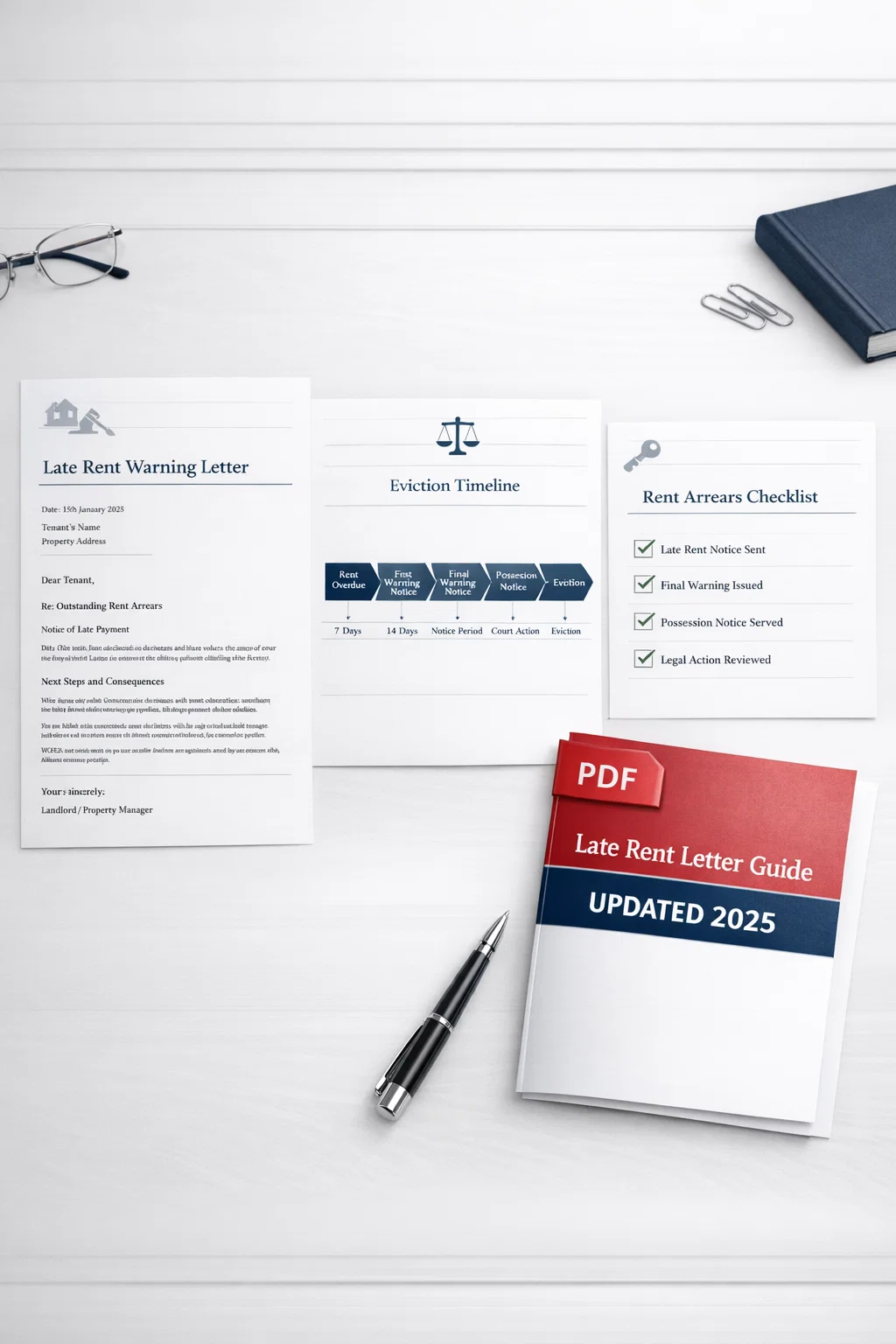
A late rent letter is formal written correspondence from a landlord to a tenant regarding overdue rent. Letters follow an escalation sequence — friendly reminder, formal warning, final notice, and legal action. Proper documentation strengthens Section 8 eviction proceedings and county court rent recovery claims under UK tenancy law.This guide covers rent arrears letter escalation, Section 8 grounds, Pre-Action Protocol compliance, and debt recovery steps for UK landlords. Free checklist.
One missed payment rarely destroys a tenancy. What destroys it is silence — the landlord who waits three months before sending a single letter, then wonders why the court grants the tenant more time to pay.
Rent arrears are the leading cause of residential possession claims in England, with landlords filing over 91,000 claims in 2025 alone. The median time from claim to actual repossession is now 27 weeks — and climbing.
✓ Late Rent Letter Pack Template
Build your late rent letters using our guided questions or classic editor — preview every clause before buying.
→ Late Rent Letter Pack Template
Prefer to do it yourself? Use our checklist as a basic guide.
How Long Can You Be Late on Rent in the UK?
There is no legal “grace period” for late rent in the UK. Rent is due on the date specified in the tenancy agreement, and any payment received after this date constitutes rent arrears.
Most landlords allow 3–7 days before taking action. Eviction proceedings under Section 8 Ground 8 (mandatory) require at least 2 months’ arrears currently — rising to 3 months’ arrears from 1 May 2026 under the Renters’ Rights Act 2025.
Rent Arrears Timescales
| Days Late | Arrears Level | Landlord Action |
|---|---|---|
| 1–3 days | Minor delay | Informal reminder (text/email/call) |
| 4–7 days | Early arrears | Friendly payment reminder letter (1st letter) |
| 8–14 days | Developing arrears | Formal warning letter (2nd letter) |
| 15–30 days | Significant arrears | Final warning before legal action (3rd letter) |
| 56+ days (8 weeks) | Mandatory ground (current) | Section 8 notice — Ground 8 (2 weeks’ notice) |
| 91+ days (3 months)* | Mandatory ground (from May 2026) | Section 8 notice — Ground 8 (4 weeks’ notice) |
*From 1 May 2026 under the Renters’ Rights Act 2025. Current threshold is 2 months (8 weeks) with 2 weeks’ notice.
Section 8 Ground 8 (Mandatory Eviction)
Ground 8 applies when rent arrears meet the threshold both at the date of serving the Section 8 notice AND at the date of the possession hearing.
The court must grant possession if both conditions are met — there is no judicial discretion. However, tenants frequently reduce arrears just below the threshold before the hearing, defeating the mandatory ground.
Ground 10/11 (Discretionary Eviction)
Ground 10: Any rent arrears at date of notice and hearing. Ground 11: Persistent late payment (even if currently paid up). Both are discretionary — the court decides whether possession is reasonable.
Notice period: currently 2 weeks, rising to 4 weeks from 1 May 2026.
This is where your paper trail matters most. A documented history of warning letters, payment demands, and failed payment plans significantly increases the likelihood of a possession order under discretionary grounds.
How Do You Write a Warning Letter to a Tenant for Late Rent?
Use formal business letter format with landlord letterhead, date the letter and reference the tenancy agreement, state the exact arrears amount and dates missed, request immediate payment within a specified deadline, and explain consequences of non-payment.
Send via email AND recorded delivery post. This creates dual evidence of service — essential if the matter reaches court.
3-Stage Escalation Sequence
Late rent warning letters follow a 3-stage escalation:
Stage 1: Friendly Payment Reminder (Days 4–7)
- Purpose: Polite reminder assuming genuine oversight
- Tone: Friendly, understanding, non-confrontational
- Reference missed payment and due date
- State exact amount outstanding
- Assume good faith (“perhaps this has been overlooked”)
- Request payment within 7 days
- Provide payment methods and reference
- Offer to discuss if tenant has difficulties
Stage 2: Formal Warning Letter (Days 8–14)
- Purpose: Formal notice that arrears are serious
- Tone: Professional, firm, factual
- Reference previous reminder (date sent)
- State total arrears including any additional missed payments
- Reference tenancy agreement clause on rent payment
- Warn that legal action may be taken if not paid
- Set clear deadline (7–14 days from letter date)
- Mention potential eviction proceedings
- Offer payment plan option with conditions
Stage 3: Final Notice Before Legal Action (Days 15–30)
- Purpose: Last opportunity before eviction proceedings
- Tone: Formal, serious, legally precise
- Reference all previous correspondence (dates)
- State total arrears amount
- State this is final notice before legal proceedings
- Specify exact deadline for payment (typically 7 days)
- Warn Section 8 notice will be served if not paid
- Mention county court proceedings and costs liability
- No payment plan offers — payment in full only
Tenancy Correspondence Pack
7 Templates • Save 50% vs Buying Individually
Lifetime Access • Free Updates • 30-Day Money-Back Guarantee
How Quickly Can a Landlord Evict You in the UK?
The fastest eviction timeline in the UK is approximately 6–7 months from first missed payment to bailiff enforcement — and that assumes everything goes perfectly.
The median time from landlord possession claim to actual repossession is now 27 weeks (approximately 6.5 months) according to Ministry of Justice statistics for 2025. This is the longest median wait in over two decades, excluding the pandemic backlog.
Eviction Timeline (Ground 8 — From May 2026)
| Stage | Timeframe | Action |
|---|---|---|
| Months 1–3 | 3 months | Rent arrears accumulate to 3+ months (Ground 8 threshold) |
| Month 3 | Day 1 | Serve Section 8 notice (4 weeks’ notice period) |
| Month 4 | After 4 weeks | File possession claim with county court |
| Months 5–6 | 4–8 weeks later | Possession hearing — court grants possession order (14–28 days to vacate) |
| Month 7 | If tenant doesn’t leave | Apply for bailiff warrant of possession |
| Months 8–10 | 4–12 weeks later | Bailiff eviction (6–8 month average delay in London) |
Total time (best case from May 2026): 7–10 months.
Why Evictions Take Longer Than Expected
- Court backlogs: Hearing delays of 8–12 weeks common, particularly in London courts
- Tenant defences: Challenging notice validity, requesting suspended orders, counterclaims for disrepair
- Procedural errors: Incorrect notices requiring re-service — adds 2+ months
- Suspended possession orders: Court allows tenant to pay arrears over time instead of granting outright possession
- Bailiff delays: County court bailiff waits of 6–8 months in London boroughs
Commercial Property — Different Rules
Commercial tenancies have separate procedures:
- CRAR (Commercial Rent Arrears Recovery): Allows seizure of goods after 7 days arrears when £750+ is owed
- Forfeiture clauses: May allow re-entry in some lease agreements — legal advice essential before exercising
- No Housing Act protection: Faster possession proceedings available
Can a Landlord Sue for Unpaid Rent in the UK?
Yes. Landlords can sue for unpaid rent through county court money claims. Claims can include all outstanding rent arrears, interest at 8% per annum (statutory rate), court fees, and legal costs if awarded by the court.
Claims can be made while the tenant still occupies the property or after they have left. The limitation period is 6 years from when the arrears arose.
County Court Money Claim Process
Step 1: Pre-Action Protocol
- Send Letter Before Action giving 30 days to pay arrears
- Include detailed breakdown of arrears and interest calculation
- Warn of court proceedings and costs liability
- Offer payment plan discussion (recommended)
Step 2: Issue County Court Claim
- File claim online via Money Claim Online (MCOL) or paper form N1
- Court issue fee: £35 (claims up to £300) to £455 (claims up to £10,000), or 5% for higher claims up to £10,000 maximum
- Tenant served with claim form — 14 days to respond
Step 3: Tenant Response Options
- No response: Default judgment awarded to landlord automatically
- Admission: Tenant admits debt, proposes payment plan
- Part admission: Tenant admits some arrears, disputes the amount
- Defence: Tenant denies owing rent (e.g., rent paid, disrepair offset)
Step 4: Judgment and Enforcement
If judgment is granted, landlords can enforce via attachment of earnings (deductions from wages), charging orders (secured against property), bailiff warrant (seize and sell goods), or third-party debt orders (freeze bank accounts).
Practical Recovery Challenges
A judgment is only as good as the tenant’s ability to pay.
- No assets: Judgment is unenforceable if tenant has nothing to seize
- Unemployed: Cannot attach earnings with no employment
- Disappeared: Enforcement impossible if tenant cannot be located
- Cost vs recovery: Legal costs may exceed arrears for smaller amounts
Many rent arrears judgments are never fully recovered. Landlords should weigh costs against likelihood of successful recovery before pursuing court action.
What Is an Example of a Late Rent Letter?
Late rent letters follow a 3-stage escalation from friendly reminders to legal warnings. Each letter should be dated, reference the tenancy, state exact arrears amount, specify payment deadline, explain consequences, and be sent via email plus recorded delivery.
Example 1: Friendly Payment Reminder (Stage 1 — Days 4–7)
[Landlord’s Name]
[Landlord’s Address]
[Phone/Email]
[Date]
[Tenant’s Name]
[Property Address]
Dear [Tenant’s Name],
RE: RENT PAYMENT REMINDER — [PROPERTY ADDRESS]
I am writing to remind you that your rent payment for [Month] in the amount of £[Amount] was due on [Due Date] but has not yet been received.
If you have already sent payment, please disregard this letter. If payment is still outstanding, please arrange immediate payment using the following details:
Payment Details:
Account Name: [Name]
Sort Code: [XX-XX-XX]
Account Number: [XXXXXXXX]
Reference: [Property Address or Tenant Name]
If you are experiencing financial difficulties and are unable to pay the full amount immediately, please contact me within 7 days to discuss a payment arrangement.
Yours sincerely,
[Signature]
[Landlord’s Name]
Example 2: Formal Warning Letter (Stage 2 — Days 8–14)
[Landlord’s Name]
[Landlord’s Address]
[Phone/Email]
[Date]
[Tenant’s Name]
[Property Address]
SENT VIA EMAIL AND RECORDED DELIVERY
Dear [Tenant’s Name],
RE: FORMAL WARNING — RENT ARREARS — [PROPERTY ADDRESS]
Further to my previous letter dated [Date of Stage 1 Letter], your rent remains unpaid and you are now in arrears.
Arrears Summary:
Rent due [Month 1]: £[Amount] (Due: [Date])
Rent due [Month 2] (if applicable): £[Amount] (Due: [Date])
Total Outstanding: £[Total Amount]
Under Clause [X] of your tenancy agreement dated [Tenancy Start Date], you agreed to pay rent of £[Monthly Amount] on the [date] of each month. This obligation has not been met.
If the outstanding rent is not paid in full within 14 days of this letter, I may take further action, which may include:
- Serving a Section 8 Notice seeking possession of the property
- Commencing county court proceedings for rent recovery and possession
- Pursuing you for all legal costs incurred
Payment must be received by: [Date — 14 days from letter date]
If you are unable to pay the full amount but can commit to a structured payment plan, please contact me within 7 days to discuss options.
Yours sincerely,
[Signature]
[Landlord’s Name]
Example 3: Final Notice Before Legal Action (Stage 3 — Days 15–30)
[Landlord’s Name]
[Landlord’s Address]
[Phone/Email]
[Date]
[Tenant’s Name]
[Property Address]
SENT VIA EMAIL AND RECORDED DELIVERY
Dear [Tenant’s Name],
RE: FINAL NOTICE — LEGAL PROCEEDINGS — RENT ARREARS — [PROPERTY ADDRESS]
Despite my previous letters dated [Stage 1 Date] and [Stage 2 Date], you have failed to pay the outstanding rent arrears or contact me to discuss payment arrangements.
Current Arrears Position:
Rent due [Month 1]: £[Amount]
Rent due [Month 2]: £[Amount]
Rent due [Month 3] (if applicable): £[Amount]
Total Outstanding: £[Total Amount]
THIS IS YOUR FINAL NOTICE.
Unless the full outstanding amount of £[Total] is paid within 7 days of the date of this letter (by [Deadline Date]), I will commence legal proceedings without further warning.
Legal action may include:
- Service of Section 8 Notice seeking possession
- County court possession proceedings
- County court money claim for all rent arrears plus interest at 8% per annum
- Recovery of all court fees and legal costs
A county court judgment (CCJ) against you will remain on your credit file for 6 years and may significantly impact your ability to rent another property, obtain credit, or pass employment credit checks.
Payment must be received in full by: [Date — 7 days from letter]
Yours sincerely,
[Signature]
[Landlord’s Name]
Tenant to Landlord: Advance Notice of Late Payment
If you’re a tenant who will be late with rent, proactive communication is essential. Contacting your landlord before the payment becomes overdue significantly reduces the likelihood of formal action.
[Your Name]
[Property Address]
[Email/Phone]
[Date]
[Landlord’s Name]
[Landlord’s Address]
Dear [Landlord’s Name],
RE: ADVANCE NOTICE — RENT PAYMENT DELAY — [PROPERTY ADDRESS]
I am writing to inform you that due to [brief reason], I will be unable to pay my rent of £[Amount] on the due date of [Due Date]. I understand this does not meet the terms of my tenancy agreement and apologise for the inconvenience.
I can confirm that:
- The full rent of £[Amount] will be paid by [Specific Date — within 7–14 days]
- This is a one-time delay due to [specific circumstance]
- All future rent payments will be made on time
I value this tenancy and want to resolve this as cooperatively as possible. Please let me know if the proposed payment date is acceptable.
Yours sincerely,
[Signature]
[Your Name]
Frequently Asked Questions: Late Rent Letters UK
How long can you be late on rent in the UK?
There is no legal grace period for late rent in the UK. Rent is due on the date specified in the tenancy agreement, and any payment after this date constitutes arrears. Most landlords allow 3–7 days before taking action. Eviction proceedings under Ground 8 require at least 3 months’ arrears from May 2026 (currently 2 months).
How quickly can a landlord evict you in the UK?
Realistic eviction timeline is 7–10 months from first missed payment to bailiff enforcement. The median time from landlord claim to repossession is 27 weeks (2025 MOJ statistics). This includes notice periods, court hearing delays, and bailiff waiting times.
How do you write a warning letter for late rent payment?
Use formal business letter format, date the letter, state exact arrears amount and dates missed, request payment within a specified deadline (7–14 days), explain consequences of non-payment, and send via email and recorded delivery. Follow a 3-stage escalation: friendly reminder, formal warning, final notice.
Can a landlord sue for unpaid rent in the UK?
Yes. Landlords can sue for unpaid rent through county court money claims. Claims can include all outstanding arrears, interest at 8% per annum, court fees, and legal costs. The limitation period is 6 years. Process: Letter Before Action → Court claim → Judgment → Enforcement.
What letters can you send to a tenant that is 7 days late in a commercial property?
For commercial properties: friendly payment reminder (days 1–7), formal demand for rent (7+ days), CRAR warning notice if £750+ owed (after 7 days), and forfeiture notice if the lease contains a forfeiture clause. Commercial tenancies have different protections than residential.
How to tell landlord rent will be late?
Contact your landlord proactively before the due date. Explain a brief reason for the delay, propose a specific payment date within 7–14 days, confirm this is a one-time occurrence, and offer a payment plan if needed. Written notice (email is fine) demonstrates good faith and significantly reduces the likelihood of formal action.
What is the longest you can be late on rent?
There is no maximum “allowed” period. Practically: 3 months’ arrears triggers mandatory eviction ground (from May 2026), 3–4 months typically results in possession proceedings being issued, and 7–10 months total from first arrears to actual eviction. Landlords can serve a Section 8 notice as soon as the arrears threshold is met.
The Truth About “Free” Legal Template Sites (What You’re Really Signing Up For)
Most websites advertising a “free legal template” follow the same pattern. You click because it’s free. You spend 10–15 minutes filling in questions.
And right at the end — only after you’ve invested your time — you’re hit with “Create your account first,” “Start your 7-day trial,” or “Card required — auto-renews at £29–£39 a month.”
This isn’t a template. This is a subscription funnel.
Why These “Free” Templates Are a Legal Risk
- Outdated wording not aligned with current UK law
- Missing mandatory clauses required for legal validity
- Generic content copied from US or non-UK templates
- No guidance on requirements
- No structured checklist to verify the document works
Hidden Problem: Many “Free Template” Sites Aren’t UK-Based
- Incorrect terminology taken from US contract law
- Missing UK statutory references — essential legal requirements omitted
- Non-applicable clauses that don’t apply under UK legislation
- Legal conflicts risking breach of UK consumer, employment, or GDPR rules
Why Templates UK Does the Opposite
- Drafted by UK professionals — written by experienced business and legal experts
- UK-law only — no US crossover or generic “international” templates
- One-time price from £10 — no subscriptions, no renewals
- Full preview — see the exact document before buying
- Two versions included — Editor + Interview formats
- Lifetime access — free lifetime updates included, including all Renters’ Rights Act 2025 changes
My Templates Dashboard
After purchase, access all your templates from your My Templates dashboard — download, re-download, and access updates anytime.
Transparent Pricing
One-time price from £10 per template. No hourly rates. No hidden fees. No subscriptions.
Not ready to buy? Start with our free late rent letter checklist to see if it covers what you need.
No tricks. No trials. No hidden fees. Just the exact UK-specific legal document you came for — at the price we told you upfront.
Build your own bespoke Late Rent Letter Pack — preview every template before buying and only pay when you’re happy with it.
Get Every Template in One Bundle
The UK Legal Templates Ultimate Bundle includes all 91 templates across every category — one purchase, every template, free lifetime updates including all future law changes.
Explore Template Bundles by Category
- Business Complete Suite — 37 templates (smaller packs available)
- Landlord Ultimate Bundle — 28 templates (smaller packs available)
- Complete Family Pack — 18 templates (smaller packs available)
- Complete Estate Pack — 8 templates (smaller packs available)
Master Business Legal Templates Pillar Guide
UK Business Legal Templates — Complete Guide (37 Templates)
All Templates UK Pillar Guides
- Family Law Documents Guide UK
- Wills & Estate Planning Guide UK
- Residential Landlord Documents Guide UK
- Employment Documents Guide UK
- How to Set Up a Business — Legal Guide
- Website Legal Documents UK
- Financial & Commercial Contracts UK
- Commercial Office Lease Guide UK
- Digital & IP Agreements Guide UK
Related Guides
- Section 8 Notice Guide UK
- Breach of Tenancy Letter Guide UK
- Assured Shorthold Tenancy Guide UK
- Renters’ Rights Act 2025 Guide UK
Free Legal Templates & Interactive Checklists
Access all our free UK legal templates, checklists and downloadable PDFs.
Last updated: March 2026
Disclaimer: This guide provides general UK legal information for England only, not legal advice. Laws current as of March 2026 — Renters’ Rights Act 2025 main provisions take effect 1 May 2026. Always verify current requirements with official sources before serving notices or commencing legal proceedings.