Updated: May 2026 • Based on UK Law
How to Evict a Tenant in the UK (2026)
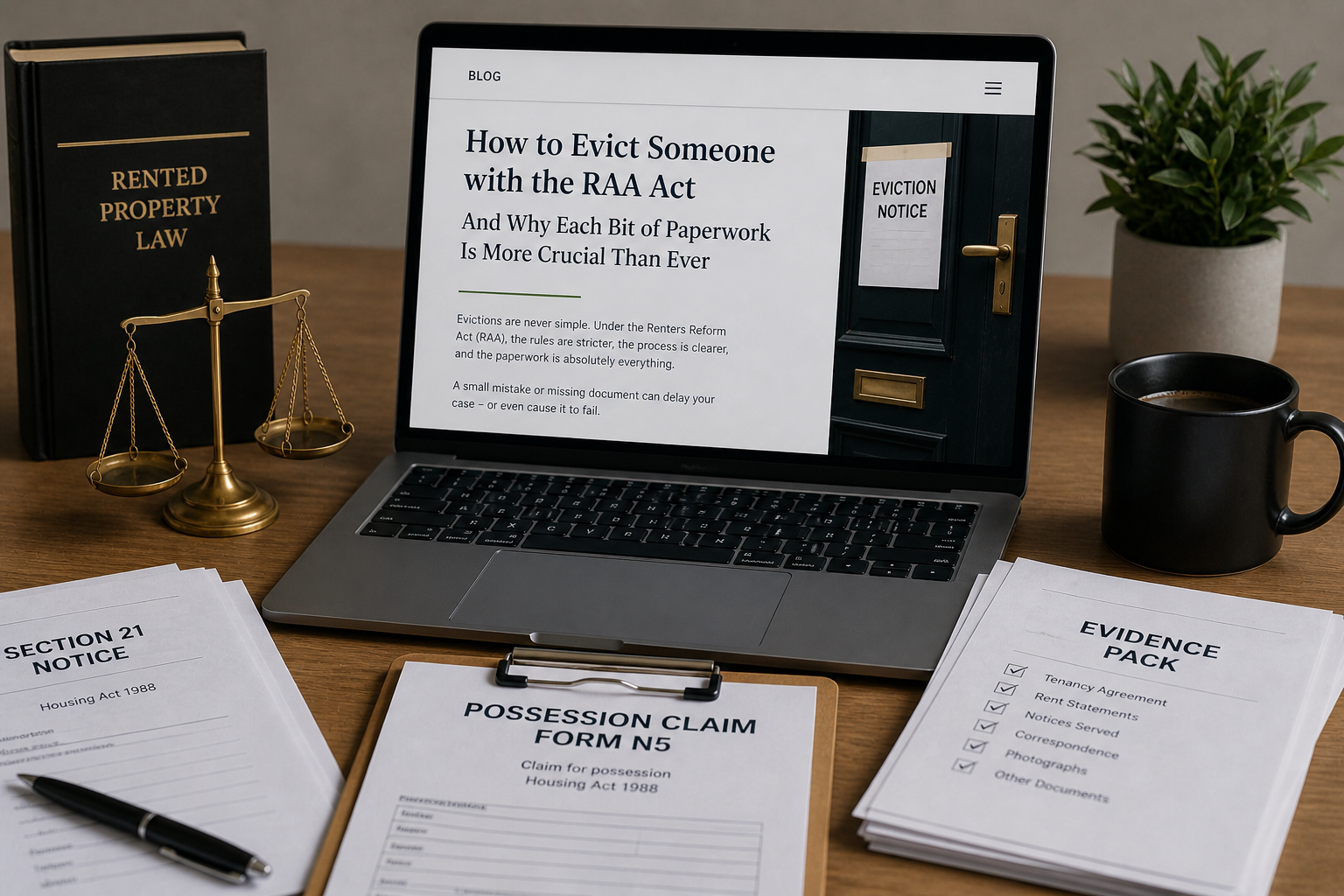
From 1 May 2026, landlords in England can only evict tenants through Section 8 of the Housing Act 1988. Section 21 “no-fault” evictions are abolished under the Renters’ Rights Act 2025. Every eviction now requires specific legal grounds and evidence to convince a judge.
This guide covers Section 8 grounds, the evidence courts expect, and why your paper trail from day one determines success or failure.
Two landlords. Same tenant problem. Completely different outcomes.
Landlord A has a tenant who stopped paying rent four months ago.
He kept no records.
No tenancy agreement that meets the new rules. No late rent letters. No evidence of arrears beyond a bank statement.
He serves a Section 8 notice on Form 3A citing Ground 8 (mandatory rent arrears).
At the hearing, the judge asks for the paper trail.
There isn’t one.
No Written Statement of Terms. No Information Sheet delivery receipt.
No dated correspondence showing the tenant was notified.
The claim is dismissed on procedural grounds. The tenant stays.
The landlord starts again — months of delay, thousands in lost rent.
Landlord B has the same situation.
But she has a compliant tenancy agreement, a signed Information Sheet receipt, and a deposit protection notice.
Four dated late rent letters. A completed Section 8 Evidence Builder with a chronological timeline.
Her witness statement references every document.
Her evidence bundle is paginated and indexed.
The judge grants possession. The tenant leaves. Total cost: £99 for the document pack plus the court fee.
The difference wasn’t the law. It was the paperwork.
✓ Renters’ Rights Essential Pack — 26 Templates, Move-In to Court
Every document a landlord needs under the Renters’ Rights Act 2025 — tenancy setup, compliance records, correspondence, and court documents. One form at a time, from the day the tenant moves in to the day you stand in front of a judge. £99, lifetime access, free lifetime updates.
→ Get the Renters’ Rights Essential Pack
📋 Full landlord checklist for the Renters’ Rights Act 2026 →
On What Grounds Can You Evict a Tenant in the UK?
The Renters’ Rights Act 2025 expanded the Section 8 grounds from 17 to 37 — covering 20 mandatory and 17 discretionary grounds.
Mandatory grounds — if you prove the ground, the court must grant possession:
- Ground 1 — landlord or close family member wants to move in (4 months’ notice, not available in first 12 months)
- Ground 1A — landlord intends to sell the property (4 months’ notice, not available in first 12 months)
- Ground 2 — mortgage lender needs to repossess
- Ground 6 — landlord intends to substantially redevelop the property
- Ground 8 — serious rent arrears (at least 3 months’ arrears at notice and at hearing)
- Ground 8A — repeated rent arrears (arrears in at least 3 of the past 5 quarters)
Discretionary grounds — the court decides whether possession is reasonable:
- Ground 10 — some rent arrears (any amount, court considers circumstances)
- Ground 12 — breach of tenancy terms
- Ground 14 — antisocial behaviour or nuisance
- Ground 14A — domestic abuse by a partner
Every ground requires evidence. The stronger your paper trail, the stronger your case.
Phase 1: Tenancy Setup — The Foundation
Your ability to evict starts on the day the tenant moves in.
If you don’t set up the tenancy correctly, the court can block your possession claim — regardless of how strong your grounds are.
From 1 May 2026, you need:
- Assured Periodic Tenancy Agreement — the new standard. No more fixed-term ASTs. This is the contract that governs the entire tenancy
- Written Statement of Terms — required for all new tenancies from 1 May 2026 (before signing) and for existing oral tenancies by 31 May 2026. Not required if you already have a written tenancy agreement — serve the Information Sheet instead. Fines up to £7,000
- Information Sheet Delivery Receipt — proof you served the government’s Information Sheet. Deadline: 31 May 2026 for existing tenants. Without it, you cannot seek possession under most grounds
- Deposit Protection Notice — the court cannot make a possession order if the deposit isn’t protected. Penalties: 1–3x the deposit amount
- Right to Rent Check — immigration verification before the tenancy starts. Fines up to £10,000 per tenant for non-compliance
- Tenant Reference Form — not legally required, but a proper vetting process reduces the chance of problems later
- Guarantor Agreement — if the tenant has a guarantor, this must be in writing to be enforceable
- Inventory & Schedule of Condition — protects your deposit claim at the end of the tenancy
- Smoke & CO Alarm Test Record — mandatory test on day one. Fines up to £5,000
- Tenant Welcome Pack — pulls all mandatory documents into one professional handover with covering letter and compliance checklist
Every one of these is included in the Renters’ Rights Essential Pack.
Phase 2: Ongoing Management — Building the Evidence Trail
Most eviction cases aren’t won or lost in court. They’re won or lost in the months beforehand — based on whether you documented what happened.
The ongoing management documents you need:
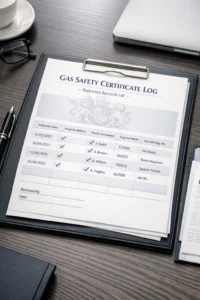
- Gas Safety Certificate Log — annual CP12 tracking. Courts check this
- Electrical Safety Certificate (EICR) / EPC Register — compliance tracking with renewal dates
- Maintenance Log — repair requests, contractor records, and response times. If the tenant counterclaims disrepair, this is your defence
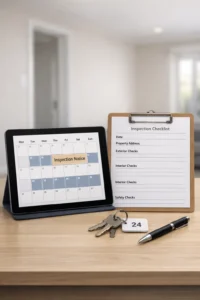
- Property Inspection Notice — 24-hour written notice before entry. Without it, you’re trespassing
- Property Inspection Report — room-by-room condition recording. Dated evidence of the property’s state
- Pet Addendum — if you’ve approved a pet, the conditions must be in writing
None of this feels urgent when things are going well.
All of it becomes critical the moment things go wrong.
Phase 3: When Things Go Wrong — Correspondence That Creates Evidence
Before you can serve a Section 8 notice, you need to show the court you acted reasonably.
That means dated, written correspondence at every stage:
- Pet Permission Form — mandatory response under the RRA. You must respond in writing within 28 days. If you don’t, silence risks being treated as deemed consent
- Late Rent Letter Pack — four escalating letters, from friendly reminder to formal demand. Each one creates a dated record for your rent arrears evidence file. Essential for Grounds 8, 8A, and 10
- Breach of Tenancy Letter — formal notice with remedy period. Essential for Ground 12
- Property Damage Letter — formal notification with repair requirements and cost recovery. Supports deposit claims and possession grounds
- Nuisance / ASB Warning — formal warning with incident records and escalation path. Essential for Ground 14
- End of Tenancy Confirmation — if the tenant leaves voluntarily, this records the handover terms and prevents disputes
A judge wants to see that you gave the tenant fair warning and a reasonable chance to put things right before you started eviction proceedings.
Undated WhatsApp messages don’t cut it. Formal letters do.
Phase 4: Court — The Documents That Win Your Case
Section 21 was a paper exercise. Section 8 is a courtroom exercise.
Every contested possession claim now requires a formal hearing. There is no accelerated paper-based route under the new rules.
You need:
- Section 8 Notice — Evidence Builder — builds your Form 3A statement ground by ground with timeline and document references. This is the foundation of your court application
- Witness Statement — CPR Part 32 format with statement of truth and exhibit references. The judge reads this before the hearing
- Evidence Bundle — paginated index, exhibit labels, chronological document organisation. Every letter, notice, and record you’ve created during the tenancy goes in here
- Landlord Defence Statement — if the tenant counterclaims (disrepair, deposit disputes), this is your structured response in court format
This is where every document from Phase 1, 2, and 3 comes together.
The late rent letters become exhibits. The inspection reports become evidence. The tenancy agreement proves the terms.
If you didn’t create them, you can’t exhibit them. And if you can’t exhibit them, the judge has nothing to work with.
Frequently Asked Questions
How hard is it to evict someone in the UK?
Harder than it was. Section 21 is gone.
Every eviction now requires specific grounds, evidence, and a court hearing.
The process takes 4–6 months from first notice to possession order — longer if contested.
The difficulty isn’t the law. It’s the evidence. Landlords with proper documentation succeed. Landlords without it don’t.
Can a tenant be evicted immediately?
No. Even in the most serious cases, the landlord must serve notice and apply to court.
The shortest notice period is 2 weeks (for antisocial behaviour under Ground 14).
Only a court bailiff can physically remove a tenant.
Changing the locks, removing belongings, or cutting off utilities is illegal eviction — a criminal offence.
What’s the easiest way to evict a tenant?
There is no easy way. But there is a straightforward way.
Set up the tenancy correctly from day one. Document everything. Send formal letters when issues arise. Build the evidence file before you need it.
When you serve the Section 8 notice, your case is already built.
How do you get rid of someone who won’t move out?
Through the courts. There is no legal shortcut.
Serve a Section 8 notice on Form 3A. Wait for the notice period to expire.
Apply to the county court for a possession order. If the tenant still won’t leave, apply for a warrant of possession — only a court bailiff can enforce it.
Any attempt to remove a tenant without a court order is illegal eviction under the Protection from Eviction Act 1977.
How to evict a protected tenant?
Protected tenancies (under the Rent Act 1977) have extremely limited grounds for possession.
These tenancies are rare — they predate January 1989.
If you have one, seek specialist legal advice. The rules are entirely different from assured tenancies.
The Truth About “Free” Legal Template Sites (What You’re Really Signing Up For)
Most websites offering a “free legal template” follow the same pattern:
- You click because it’s advertised as free
- You spend 10–15 minutes answering questions
- At the very end, you must create an account or start a “free trial”
- Your card is required upfront
- The subscription auto-renews at £29–£39 per month
This isn’t a free template – it’s a subscription service. Many people only realise after being charged £300–£400 over the year.
Why These “Free” Templates Are a Legal Risk
- Outdated wording: not aligned with current UK law
- Missing mandatory clauses: required for legal validity
- No compliance guidance: leaving users without legal context
- No structured checklist: no way to verify the document works
- Not kept updated: often unchanged when legislation changes
One incorrect clause can weaken or invalidate the entire document.
Hidden Problem: Many “Free Template” Sites Aren’t Even UK-Based
Many free or auto-subscription template sites operate outside the UK.
They use documents drafted for the US legal system, then loosely adapted for “international use,” which creates serious problems:
- Incorrect terminology: taken from US contract law
- Missing UK statutory references: essential legal requirements omitted
- Non-applicable clauses: terms that don’t apply under UK legislation
- Legal conflicts: risks breaching UK consumer, employment, or GDPR rules
Why Templates UK Does the Opposite
- Drafted by UK professionals: written by experienced business & legal experts
- UK-law only: no US crossover or generic “international” templates
- One-time price from £10: no subscriptions, no renewals
- Full preview: see the exact document before buying
- Lifetime access: free lifetime updates included
My Templates Dashboard
All purchased templates are stored in your personal My Templates page, organised by category.
When we update a template for UK law changes, the new version appears automatically in your dashboard — free, forever.
Build a growing library of UK legal documents across every area of your business and personal life.
Transparent Pricing
From £10 per template — with free lifetime usage and free lifetime updates. No subscriptions. No renewals. No auto-billing.
Not ready to buy? Use our free interactive checklists to guide your own document — no payment required.
No tricks. No trials. No hidden fees. Just the exact UK-specific legal document you came for — at the price we told you upfront.
Get the complete landlord document set: Renters’ Rights Essential Pack — 26 templates, £99.
Get Every Template in One Bundle
The UK Legal Templates Ultimate Bundle includes 91 templates across every category — one purchase, lifetime updates, no subscriptions.
Explore Template Bundles by Category
One purchase, lifetime updates, no subscriptions.
- Business Complete Suite — 37 templates, £199 (smaller packs available)
- Landlord Ultimate Bundle — 33 templates, £120 (smaller packs available)
- Complete Family Pack — 18 templates, £65 (smaller packs available)
- Complete Estate Pack — 8 templates, £49 (smaller packs available)
Explore the Master Business Legal Templates Pillar Guide
The complete overview of 37 essential UK business templates.
UK Business Legal Templates — Complete Master Guide
Explore All Templates UK Pillar Guides
- Family Law Documents Guide UK
- Wills & Estate Planning Guide UK
- Residential Landlord Documents Guide UK
- Employment Documents Guide UK
- How to Set Up a Business in the UK — Legal Guide
- Website Legal Documents UK — Compliance Guide
- Financial & Commercial Contracts UK — Protection Guide
- Commercial Office Lease Guide UK
- Digital & IP Agreements Guide UK
Related Guides
- Landlord Checklist for the Renters’ Rights Act 2026
- Renters’ Rights Essential Pack — 26 Templates for Landlords
- Information Sheet Landlord Guide UK
- Residential Landlord Documents Guide UK
Free Legal Templates & Interactive Checklists
Access all our free UK legal templates, checklists and downloadable PDFs.
Last updated: May 2026
Disclaimer: This guide provides general UK legal information, not legal advice. Laws are current as of May 2026.