Updated: March 2026 • Based on UK Law
What Makes a Will Legally Valid in the UK?
Under the Wills Act 1837, a valid will in England and Wales must be made by someone aged 18 or over, of sound mind, in writing, signed by the testator, and witnessed by two independent adults who are both present at the time of signing and are not beneficiaries.
This guide explains the exact legal requirements for a valid will, witness rules, and common mistakes that invalidate UK wills. Free compliance checklist included.
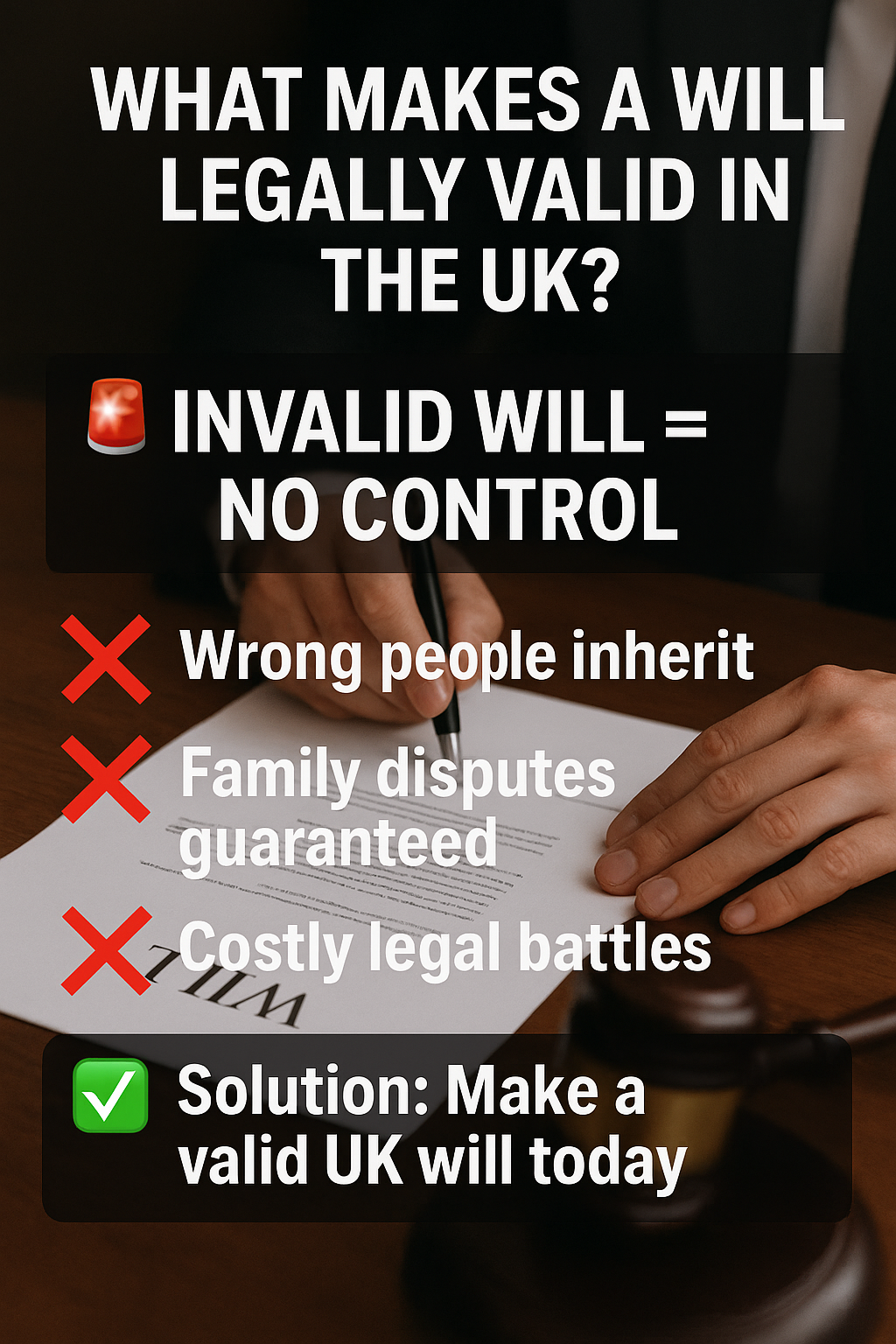
A will that fails to meet these requirements can be challenged in court, leaving your estate to be distributed under intestacy rules — potentially cutting out unmarried partners, stepchildren, or close friends entirely.
✓ Will Template (England & Wales)
Answer simple guided questions — your will is built for you. Includes executor appointments, guardian provisions for minor children, specific gifts, residuary estate distribution and witness requirements. Structured following Wills Act 1837 requirements. Preview every clause before buying — only pay when you’re happy with it. One-time price from £10.
Prefer to write your own? Download the free DIY checklist →
The Legal Requirements for a Valid Will
Under the Wills Act 1837, a will is only valid in England and Wales if it meets the following criteria:
- Age: You must be at least 18 years old
- Capacity: You must be of sound mind, meaning you understand what a will is, what assets you own, and who may expect to benefit
- Voluntary: The will must be made freely, without pressure or undue influence from anyone else
- Written: The will must be in writing (handwritten, typed, or printed)
- Signature: You must sign the will yourself (or someone can sign for you in your presence and at your direction)
- Witnesses: Your signature must be made or acknowledged in the presence of two witnesses, and they must also sign the will
If any of these requirements are not met, the entire will is invalid. Your estate would then pass under intestacy rules — potentially to people you did not intend to benefit.
Who Can Be a Witness?
Choosing the right witnesses is crucial. The rules are:
- Witnesses must be at least 18 years old
- They must be present together when you sign (or acknowledge your signature)
- Witnesses cannot benefit from your will — if they, or their spouse or civil partner, are named as beneficiaries, their gift will be void under Section 15 of the Wills Act 1837
Tip: Use people who have no interest in your estate — for example, friends, neighbours, or colleagues.
Use our Free Last Will Compliance Checklist to ensure you meet all witness and signing requirements.
Testamentary Capacity: The Mental Capacity Test
A will is only valid if the testator had “testamentary capacity” at the time of making it. The leading case is Banks v Goodfellow (1870), which established that the testator must:
- Understand what a will is and the effect of making one
- Understand the extent of their estate — a general awareness of their assets
- Understand the claims of people who might reasonably expect to benefit
- Not be suffering from a mental disorder that influences their decisions about who should inherit
A person with a diagnosed condition such as dementia can still make a valid will — provided they have capacity at the time of signing. In borderline cases, a medical practitioner may assess capacity and provide a written statement (sometimes called a “golden rule” assessment).
The Attestation Clause: Why It Matters
An attestation clause is the statement at the end of a will confirming how it was signed and witnessed. While not strictly required by the Wills Act 1837, it creates a legal presumption that the will was properly executed.
Without an attestation clause, the burden falls on the executor to prove the will was signed correctly — which can cause delays and additional costs during probate.
A proper attestation clause typically confirms that the testator signed in the presence of both witnesses, and that both witnesses then signed in the presence of the testator.
Execution Errors That Invalidate a Will
Most invalid wills fail because of errors in the signing and witnessing process — not because of what’s written inside them:
- Only one witness present — both must be in the room together when you sign. A will witnessed by one person at a time is invalid
- Witness is a beneficiary — their gift is automatically void under Section 15 of the Wills Act 1837. Their spouse’s gift is also void
- Testator did not sign — or signed but not in front of the witnesses. The signature must be made or acknowledged in their joint presence
- No attestation clause — while not strictly required, its absence means the executor must provide separate evidence that execution was correct, causing delays and costs at probate
For other common mistakes — including the effect of marriage, divorce, ambiguous wording, and failing to revoke old wills — see our Last Will and Testament UK guide.
Grounds for Challenging a Will
A will can be contested on the following grounds:
- Lack of testamentary capacity — the testator did not understand what they were doing
- Undue influence — someone pressured the testator into making or changing the will
- Fraud or forgery — the will or signature is not genuine
- Failure to meet Section 9 requirements — improper signing or witnessing
- Lack of knowledge and approval — the testator did not know or approve of the contents
Additionally, under the Inheritance (Provision for Family and Dependants) Act 1975, certain people — including spouses, children, and financial dependants — can claim that the will does not make reasonable financial provision for them.
A properly executed will with a clear attestation clause and evidence of capacity significantly reduces the risk of a successful challenge.
Free Will Planning Resources
Before writing your will, use these free tools to get organised:
- Free Last Will Compliance Checklist — ensure your will meets all legal requirements
- Free Asset Inventory Worksheet — list everything you own and owe
- Free Beneficiary Planner — decide who gets what
- Free Executor Information Pack — help your executor understand their role
Complete Wills Pack
Best Value Bundle • 4 Templates + Editor & Interview Versions • Save 55% vs Buying Individually
Lifetime Access • Free Updates • 30-Day Money-Back Guarantee
Frequently Asked Questions
Is a handwritten will valid in the UK?
Yes. A handwritten will is valid in England and Wales — but it must still meet all Section 9 requirements, including being signed and witnessed by two independent adults. Unlike some US states, the UK does not give special status to handwritten wills. The main risk is legibility and ambiguity.
Does a will need to be notarised in the UK?
No. There is no requirement for notarisation, solicitor involvement, or court registration. A will is valid when it is in writing, signed by the testator, and witnessed by two independent adults — nothing more.
Can someone with dementia make a valid will?
Potentially, yes. A diagnosis of dementia does not automatically prevent someone from making a valid will. The key question is whether they had testamentary capacity at the time of signing — meaning they understood the nature and effect of making a will, the extent of their assets, and the people who might expect to benefit. A medical assessment at the time of signing (the “golden rule”) can provide evidence of capacity.
What happens if my will is invalid?
If a will is found to be invalid, the estate is distributed under the intestacy rules as if no will existed. This means unmarried partners inherit nothing, stepchildren are excluded, and the court determines who receives what according to a fixed statutory order.
Is this Will Template legally binding?
Yes. When completed and signed correctly, this creates a legally recognised Last Will and Testament under the law of England and Wales. Our template includes professional legal structure, all required clauses, and proper signing and witness requirements. High-value or complex situations? Some customers opt for solicitor review before signing.
The Truth About “Free” Legal Template Sites (What You’re Really Signing Up For)
Most websites offering a “free legal template” follow the same pattern:
- You click because it’s advertised as free
- You spend 10–15 minutes answering questions
- At the very end, you must create an account or start a “free trial”
- Your card is required upfront
- The subscription auto-renews at £29–£39 per month
This isn’t a free template – it’s a subscription service. Many people only realise after being charged £300–£400 over the year.
Why These “Free” Templates Are a Legal Risk
- Outdated wording: not aligned with current UK law
- Missing mandatory clauses: required for legal validity
- No compliance guidance: leaving users without legal context
- No structured checklist: no way to verify the document works
- Not kept updated: often unchanged when legislation changes
One incorrect clause can weaken or invalidate the entire document.
Hidden Problem: Many “Free Template” Sites Aren’t Even UK-Based
Another major issue is that many free or auto-subscription template sites operate outside the UK and use documents originally drafted for the US legal system. These are then loosely adapted for “international use,” which creates serious problems:
- Incorrect terminology: taken from US contract law
- Missing UK statutory references: essential legal requirements omitted
- Non-applicable clauses: terms that don’t apply under UK legislation
- Legal conflicts: risks breaching UK consumer, employment, or GDPR rules
Why Templates UK Does the Opposite
- Drafted by UK professionals: written by experienced business & legal experts
- UK-law only: no US crossover or generic “international” templates
- One-time price from £10: no subscriptions, no renewals
- Full preview: see the exact document before buying
- Lifetime access: free lifetime updates included
My Templates Dashboard
All purchased templates are stored in your personal My Templates page, organised by category.
When we update a template for UK law changes, the new version appears automatically in your dashboard — free, forever.
Build a growing library of UK legal documents across every area of your business and personal life.
Transparent Pricing
From £10 per template — with free lifetime usage and free lifetime updates. No subscriptions. No renewals. No auto-billing.
Not ready to buy? Use our free interactive checklists to guide your own document — no payment required.
No tricks. No trials. No hidden fees. Just the exact UK-specific legal document you came for — at the price we told you upfront.
Build your own bespoke document with our Last Will and Testament Template. Preview the full contract before buying — only pay when you’re happy with it.
Get Every Template in One Bundle
The UK Legal Templates Ultimate Bundle includes 91 templates across every category — one purchase, lifetime updates, no subscriptions.
Explore Template Bundles by Category
One purchase, lifetime updates, no subscriptions.
- Business Complete Suite — 37 templates, £120 (smaller packs available)
- Landlord Ultimate Bundle — 28 templates, £99 (smaller packs available)
- Complete Family Pack — 18 templates, £65 (smaller packs available)
- Complete Estate Pack — 8 templates, £38 (smaller packs available)
Explore the Master Business Legal Templates Pillar Guide
The complete overview of 37 essential UK business templates.
UK Business Legal Templates — Complete Master Guide
Explore All Templates UK Pillar Guides
- Family Law Documents Guide UK
- Wills & Estate Planning Guide UK
- Residential Landlord Documents Guide UK
- Employment Documents Guide UK
- How to Set Up a Business in the UK — Legal Guide
- Website Legal Documents UK — Compliance Guide
- Financial & Commercial Contracts UK — Protection Guide
- Commercial Office Lease Guide UK
- Digital & IP Agreements Guide UK
Related Guides
- Last Will and Testament UK: Requirements, Rules and Common Questions
- How to Make a Will UK: Step-by-Step Guide
- What Happens If You Don’t Have a Will?
- Codicil to Will Guide UK
Free Legal Templates & Interactive Checklists
Access all our free UK legal templates, checklists and downloadable PDFs.
Last updated: March 2026
Disclaimer: This guide provides general UK legal information, not legal advice. Laws are current as of March 2026.