Updated: March 2026 • Based on UK Law
How Do You Make a Will in the UK?
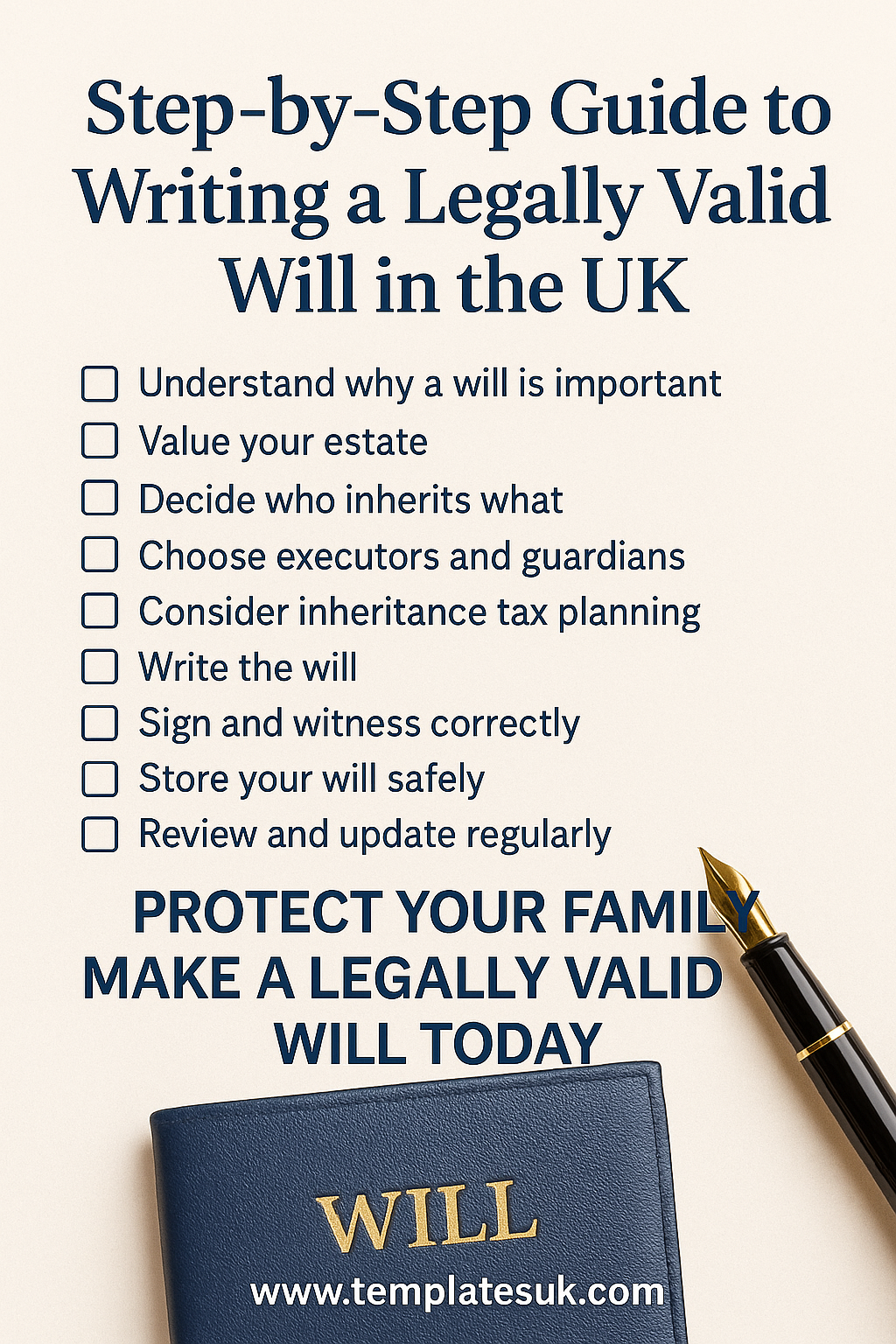
To make a valid will in England and Wales, you need to choose your beneficiaries, appoint executors and guardians, put your wishes in writing, then sign in the presence of two independent witnesses. This guide walks you through each step.
This step-by-step guide walks you through making a will in the UK — from gathering documents to signing correctly. Free will checklist included.
Without a valid will, your estate passes under intestacy rules. Your unmarried partner could inherit nothing, your children may be placed with a court-appointed guardian, and your family could face costly legal disputes lasting months or years.
✓ Will Template (England & Wales)
Answer simple guided questions — your will is built for you. Includes executor appointments, guardian provisions for minor children, specific gifts, residuary estate distribution and witness requirements. Structured following Wills Act 1837 requirements. Preview every clause before buying — only pay when you’re happy with it. One-time price from £15.00
Prefer to write your own? Download the free DIY checklist →
Why Do I Need a Will in the UK?
A will gives you legal control over what happens to your money, property, possessions, and digital assets after your death.
Without one, the Intestacy Rules (Administration of Estates Act 1925) decide everything — and they often produce outcomes that don’t match what families expect or want.
Key reasons to make a will:
- Protect unmarried partners: Intestacy rules do not recognise cohabiting partners — they inherit nothing regardless of how long you’ve lived together
- Choose guardians for children: Without a named guardian, the court decides who raises your children under 18
- Prevent family disputes: Clear instructions reduce the risk of costly legal battles and delayed estate distribution
- Reduce Inheritance Tax: Proper planning can significantly reduce the IHT bill on your estate
- Include stepchildren and friends: Only a will can leave assets to people outside your immediate blood relatives
What Do I Need Before Writing a Will?
Before you start writing, gather information about your assets, debts, and the people you want to include. This preparation makes the process faster and ensures you don’t forget anything important.
Assets to list:
- Property and land (including ownership shares)
- Bank accounts, savings, and ISAs
- Investments, shares, and bonds
- Pensions and life insurance policies
- Vehicles, jewellery, and valuables
- Digital assets (cryptocurrency, domain names, online accounts)
Debts to list:
- Mortgages and secured loans
- Credit cards and personal loans
- Outstanding bills and taxes
Use our Free Asset Inventory Worksheet to organise everything in one place.
How Do I Decide Who Inherits?
You have complete freedom to leave your assets to anyone you choose — family, friends, charities, or organisations. Consider three categories:
- Specific gifts (legacies): Particular items or fixed sums to named people — “My gold watch to my son James” or “£5,000 to Cancer Research UK”
- Residuary estate: Everything left after debts, taxes, and specific gifts — usually the bulk of your estate, often split between main beneficiaries
- Substitute beneficiaries: Who inherits if your first choice dies before you — prevents the gift failing
Our Free Beneficiary Planner helps you map out who gets what before you start writing.
Who Should I Choose as Executor?
An executor is the person responsible for carrying out your will — collecting assets, paying debts and taxes, and distributing the estate to beneficiaries.
Choose someone who is trustworthy, organised, and willing to take on the responsibility.
You can appoint:
- A family member or friend (most common)
- A professional executor (solicitor or bank — they charge fees)
- Multiple executors (up to four can act together)
Consider naming a substitute executor in case your first choice is unable or unwilling to act.
Download our Free Executor Information Pack to help your chosen executor understand their responsibilities.
How Do I Appoint Guardians for My Children?
If you have children under 18, your will should name guardians who will care for them if both parents die. Without this, the court decides — potentially appointing someone you wouldn’t have chosen.
When choosing guardians, consider:
- Their relationship with your children
- Their values and parenting style
- Their age, health, and financial stability
- Their willingness to take on the role
- Proximity to your children’s school and friends
Always discuss guardianship with your chosen person before naming them in your will.
Can I Reduce Inheritance Tax With My Will?
Yes — proper will planning can significantly reduce or eliminate Inheritance Tax (IHT). The current nil-rate band is £325,000, with an additional £175,000 residence nil-rate band if you leave your home to direct descendants.
Tax-efficient strategies include:
- Spouse exemption: Assets left to a spouse or civil partner are usually tax-free
- Charitable gifts: Reduce IHT rate from 40% to 36% by leaving 10%+ to charity
- Trusts: Can protect assets and provide tax benefits in certain circumstances
- Lifetime gifts: Gifts made more than seven years before death are usually tax-free
For complex estates or significant IHT liability, consider professional tax advice. For a detailed explanation of the 7-year rule, taper relief, and exempt gifts, see our Last Will and Testament UK guide.
How Do I Sign and Witness a Will Correctly?
A will must be signed and witnessed correctly to be legally valid under the Wills Act 1837. Getting this wrong invalidates the entire document — so follow these requirements precisely:
- You must be 18 or over and of sound mind
- The will must be in writing (typed or handwritten)
- You must sign the will in the presence of two witnesses who are both present at the same time
- Both witnesses must then sign in your presence
- Witnesses must add their names, addresses, and occupations
Critical rule: Witnesses cannot be beneficiaries or married/civil partners of beneficiaries. If they are, the gift to them is void (though the rest of the will remains valid).
Good witness choices include neighbours, work colleagues, or friends who aren’t receiving anything in your will.
For a deeper look at testamentary capacity, attestation clauses, and grounds for challenging a will, see our guide to UK will validity.
Where Should I Store My Will?
Store your original signed will somewhere secure but accessible to your executors after your death. Options include:
- At home: In a fireproof safe or secure location — tell your executors exactly where
- With a solicitor: They’ll store it securely (usually for a fee)
- Probate Service: Government will storage facility (£11 fee)
- Bank safe deposit box: Secure but can be difficult for executors to access
Keep a copy for reference but clearly mark it as a copy — only the original is valid for probate.
When Should I Update My Will?
Review your will after any major life event and at least every three to five years. Events that should trigger a review include:
- Marriage: Automatically revokes any existing will (unless made in contemplation of marriage)
- Divorce: Doesn’t revoke your will but treats your ex-spouse as if they died before you
- Birth or adoption of children/grandchildren
- Death of a beneficiary or executor
- Significant changes in assets (buying/selling property, inheritance)
- Changes in relationships (estrangement, reconciliation)
- Moving to a different country
Minor changes can be made by codicil (a formal amendment), but significant changes usually require a new will.
Free Will Planning Resources
Before writing your will, use these free tools to get organised:
- Free Last Will Compliance Checklist — ensure your will meets all legal requirements
- Free Asset Inventory Worksheet — list everything you own and owe
- Free Beneficiary Planner — decide who gets what
- Free Executor Information Pack — help your executor understand their role
Complete Wills Pack
Everything You Need • 4 Templates + Editor & Interview Versions • Save 55% vs Buying Individually
Lifetime Access • Free Updates • 30-Day Money-Back Guarantee*
Frequently Asked Questions
Do I need a solicitor to make a will?
Most customers complete this confidently without one. Our template includes step-by-step guidance, all standard clauses, and professional formatting. Consider solicitor review if you have high financial stakes, complex circumstances, or you want extra peace of mind. Your choice based on your situation.
What format does the will template come in?
You get two versions — an Editor version (fill in the blanks yourself) and an Interview version (answer guided questions and the document is built for you). Both produce the same professionally drafted will. The template is delivered as an instant download, fully editable, with lifetime updates included.
How long does it take to make a will?
With our guided template, most people complete their will in 15 to 30 minutes — provided they’ve gathered their asset information, beneficiary details, and executor choices beforehand. The signing and witnessing process takes just a few minutes.
Can I make a will online?
You can create the content of your will online using a guided template. However, the final document must be printed, signed by hand, and witnessed by two independent adults to be valid under UK law. Electronic signatures are not currently accepted for wills in England and Wales.
What happens if I die without a will?
Your estate is distributed under the intestacy rules — a fixed statutory formula that does not consider your wishes. Unmarried partners inherit nothing. Stepchildren are excluded. The court appoints an administrator to handle the estate. For a full breakdown of who inherits under intestacy, see our Last Will and Testament UK guide.
The Truth About “Free” Legal Template Sites (What You’re Really Signing Up For)
Most websites offering a “free legal template” follow the same pattern:
- You click because it’s advertised as free
- You spend 10–15 minutes answering questions
- At the very end, you must create an account or start a “free trial”
- Your card is required upfront
- The subscription auto-renews at £29–£39 per month
This isn’t a free template – it’s a subscription service. Many people only realise after being charged £300–£400 over the year.
Why These “Free” Templates Are a Legal Risk
- Outdated wording: not aligned with current UK law
- Missing mandatory clauses: required for legal validity
- No compliance guidance: leaving users without legal context
- No structured checklist: no way to verify the document works
- Not kept updated: often unchanged when legislation changes
One incorrect clause can weaken or invalidate the entire document.
Hidden Problem: Many “Free Template” Sites Aren’t Even UK-Based
Another major issue is that many free or auto-subscription template sites operate outside the UK and use documents originally drafted for the US legal system. These are then loosely adapted for “international use,” which creates serious problems:
- Incorrect terminology: taken from US contract law
- Missing UK statutory references: essential legal requirements omitted
- Non-applicable clauses: terms that don’t apply under UK legislation
- Legal conflicts: risks breaching UK consumer, employment, or GDPR rules
Why Templates UK Does the Opposite
- Drafted by UK professionals: written by experienced business & legal experts
- UK-law only: no US crossover or generic “international” templates
- One-time price from £10: no subscriptions, no renewals
- Full preview: see the exact document before buying
- Lifetime access: free lifetime updates included
My Templates Dashboard
All purchased templates are stored in your personal My Templates page, organised by category.
When we update a template for UK law changes, the new version appears automatically in your dashboard — free, forever.
Build a growing library of UK legal documents across every area of your business and personal life.
Transparent Pricing
From £10 per template — with free lifetime usage and free lifetime updates. No subscriptions. No renewals. No auto-billing.
Not ready to buy? Use our free interactive checklists to guide your own document — no payment required.
No tricks. No trials. No hidden fees. Just the exact UK-specific legal document you came for — at the price we told you upfront.
Build your own bespoke document with our Last Will and Testament Template. Preview the full contract before buying — only pay when you’re happy with it.
Get Every Template in One Bundle
The UK Legal Templates Ultimate Bundle includes 91 templates across every category — one purchase, lifetime updates, no subscriptions.
Explore Template Bundles by Category
One purchase, lifetime updates, no subscriptions.
- Business Complete Suite — 37 templates, £120 (smaller packs available)
- Landlord Ultimate Bundle — 28 templates, £99 (smaller packs available)
- Complete Family Pack — 18 templates, £65 (smaller packs available)
- Complete Estate Pack — 8 templates, £38 (smaller packs available)
Explore the Master Business Legal Templates Pillar Guide
The complete overview of 37 essential UK business templates.
UK Business Legal Templates — Complete Master Guide
Explore All Templates UK Pillar Guides
- Family Law Documents Guide UK
- Wills & Estate Planning Guide UK
- Residential Landlord Documents Guide UK
- Employment Documents Guide UK
- How to Set Up a Business in the UK — Legal Guide
- Website Legal Documents UK — Compliance Guide
- Financial & Commercial Contracts UK — Protection Guide
- Commercial Office Lease Guide UK
- Digital & IP Agreements Guide UK
Related Guides
- UK Will Validity: What Makes a Will Legally Binding?
- Last Will and Testament UK: Requirements, Rules and Common Questions
- Mirror Wills Guide UK
- Letter of Wishes Guide UK
Free Legal Templates & Interactive Checklists
Access all our free UK legal templates, checklists and downloadable PDFs.
Last updated: March 2026
Disclaimer: This guide provides general UK legal information, not legal advice. Laws are current as of March 2026.