Updated: February 2026 • England & Wales • Based on UK Law
A landlord discovers three large wall holes, a wine-stained carpet, and a cracked bathroom tile at check-out. Total repair cost: £595. The deposit covers £400. They send a letter to the former tenant demanding the £195 shortfall — no inventory reference, no before-and-after photos, no professional quotes attached.
The tenant disputes it. The deposit scheme adjudicator awards nothing — because the landlord couldn’t prove what condition the property was in before the tenancy started. No check-in inventory, no evidence, no claim.
This guide covers how to write property damage letters that actually work, the difference between fair wear and tear and tenant damage, letter before action requirements, the betterment rule, and the small claims court process from filing to enforcement.
What Is Property Damage in UK Tenancy Law?
Property damage refers to physical harm to rental property beyond fair wear and tear, caused by tenant negligence, misuse, or deliberate actions. Landlords can claim compensation through deposit deductions or county court claims under the tenancy agreement terms.This guide covers damage reports, fair wear and tear, deposit deductions, and letters before action. Free property damage checklist included.
✓ Property Damage Letter Pack
Answer simple guided questions — your letter is built for you. Includes damage notification, letter before action, fair wear guidance and betterment calculators. Preview before buying — only pay when you’re happy with it. From £10, one-time.
→ Build Your Property Damage Letter
Prefer to write your own? Download the free DIY checklist →
The most common errors landlords make are: not documenting property condition at check-in with a professional inventory, claiming for pre-existing damage, and pursuing uneconomic court claims where repair costs are less than legal fees.
The distinction between fair wear and tear (unavoidable deterioration from normal use) and tenant damage (avoidable harm from negligence or misuse) determines whether landlords can recover costs. Courts and deposit adjudicators apply strict evidential standards — before-and-after photographic comparisons, professional repair quotes, and proportionate cost calculations accounting for betterment.
Without proper documentation, even legitimate damage claims fail.
FREE Property Damage Notice Compliance Checklist
Legal Requirements for Damage Claims & Repair Notices
How to Write a Letter to a Tenant About Damages
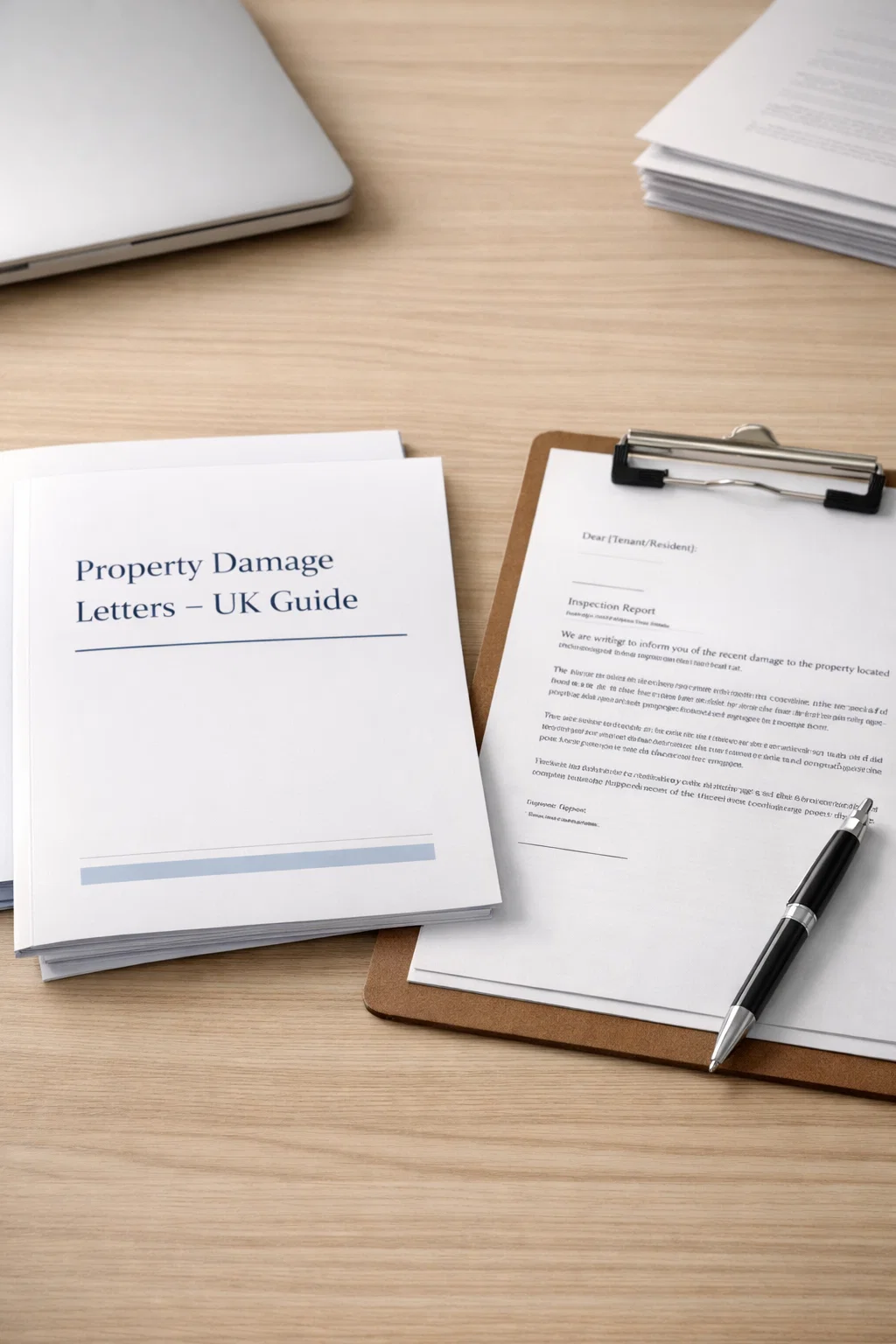
A property damage letter should use formal business format with landlord letterhead, reference the tenancy agreement and inventory report, describe specific damage with photographic evidence, distinguish damage from fair wear and tear, state repair costs with professional quotes, request payment within a specified deadline (typically 14–28 days), explain consequences of non-payment (deposit deduction or court claim), and be sent via email plus recorded delivery for proof of service.
What Should a Property Damage Report Include?
A property damage report documents specific harm to rental property discovered during the tenancy or at check-out. For each damaged item, record the location (room and specific item), a detailed description with measurements, photographic evidence from multiple angles, comparison to the check-in inventory showing original condition, likely cause if known, and estimated repair costs with quotes.
Professional inventory clerks should conduct check-out reports — their evidence carries significantly more weight with adjudicators than landlord-prepared reports.
How Should the Report Be Structured?
Header information: property address, report date, who conducted the inspection, tenancy dates, tenant names, and report type (mid-tenancy or check-out).
Room-by-room damage documentation: for each item, record the location, item description, damage description, check-in condition (with inventory page reference), photographic evidence references, fair wear assessment, repair required, and estimated cost.
Damage summary table:
| Room | Item Damaged | Repair Cost |
|---|---|---|
| Living room | Wall holes (3 locations) | £150 |
| Main bedroom | Carpet stain (red wine, 30cm diameter) | £280 |
| Kitchen | Broken cabinet door hinge | £45 |
| Bathroom | Cracked bathroom tile (shower area) | £120 |
| TOTAL DAMAGE COSTS | £595 | |
Supporting evidence: check-in inventory (dated, signed by tenant), check-out photographs (date-stamped), professional repair quotes (minimum 1, ideally 2–3), and invoices for completed repairs if work already done.
What Is Fair Wear and Tear vs Tenant Damage UK?
Fair wear and tear is unavoidable deterioration from normal residential use over time — light carpet traffic marks, minor wall scuffs, paint fading from sunlight. Tenant damage is avoidable harm caused by negligence, misuse, or deliberate actions — carpet stains, large wall holes, broken fixtures, pet damage.
Landlords cannot charge for fair wear. They can charge for damage — but only with proper evidence and betterment adjustments.
What’s the Legal Definition?
The leading case is Haskell v Marlow [1928] 2 KB 45, where Talbot J defined fair wear and tear as “the reasonable use of the house by the tenant and the ordinary operation of natural forces.”
The key principles: deterioration must be inevitable from normal use, the tenant is not expected to leave the property in better condition than they received it, age and quality of items are considered (luxury carpets wear differently from cheap ones), length of tenancy matters (1-year vs 5-year expectations differ), and the tenant’s care obligations don’t extend to preventing natural ageing.
Fair Wear vs Damage — Item by Item
| Item | Fair Wear and Tear ✓ | Tenant Damage ✗ |
|---|---|---|
| Carpets | Light traffic marks in hallways, slight flattening, minor colour fading from sunlight | Stains (wine, food, pet urine), burns, rips/tears, pet scratches, excessive soiling |
| Walls | Minor scuff marks (under 2cm), slight discolouration, small picture hook holes (under 5mm) | Large holes (>5mm), graffiti/writing, unauthorised painting, gouges, impact damage |
| Wooden floors | Light surface scratches from furniture, minor wear in traffic areas | Deep gouges, water damage from spills, pet scratches, excessive scratching |
| Kitchen worktops | Light scratches from normal food prep, slight discolouration | Burn marks, deep cuts from knives, severe staining, chips/cracks |
| Bathroom fixtures | Limescale buildup (hard water areas), slight grout discolouration, minor sealant deterioration | Cracked tiles, broken toilet seat, damaged bath enamel, severe mould from ventilation neglect |
| Kitchen appliances | Internal wear from normal use, external scuff marks | Broken parts, excessive grease buildup from neglect, burned-on food residue |
| Garden | Seasonal growth variation, natural plant death, lawn wear in high-use areas | Complete neglect (1ft+ overgrowth), dead plants from lack of watering, deliberate damage |
| Doors/windows | Minor loosening of hinges, slight warping from weather, small scratches | Broken handles, cracked glass, holes from kicking, damaged locks from forced entry |
What Is the Betterment Rule?
Betterment occurs when a landlord improves the property beyond its original condition and tries to charge the tenant. This is not allowed — by deposit adjudicators or courts.
If a 10-year-old carpet is damaged, the landlord cannot charge full replacement cost for a new carpet. They must account for the carpet’s age and remaining useful life (depreciation). The formula is: Fair charge = Replacement cost × (Remaining useful life ÷ Expected total life).
Example: Sofa damaged beyond repair by bleach spill. Replacement cost: £800. Age at damage: 4 years. Expected life: 8 years. Remaining life: 4 years. Fair charge: £800 × (4 ÷ 8) = £400.
Other unlawful betterment examples: replacing old magnolia paint with a different colour and charging the tenant for the upgrade, or replacing basic laminate flooring with expensive oak after the tenant damaged the laminate.
Use our professionally drafted Property Damage Letter Pack with fair wear guidance and betterment calculators — or start with the free checklist.
Is a Letter Before Action a Legal Requirement in the UK?
Yes. Under the Pre-Action Protocol for Debt Claims (Practice Direction on Pre-Action Conduct), landlords must send a formal letter before action giving 30 days to pay or respond before issuing county court proceedings for property damage compensation.
Failure to follow the pre-action protocol can result in court costs penalties, claim strike-out, or adverse costs orders — even if the landlord wins the case.
How Serious Is a Letter Before Action?
Very serious — it’s the final step before court proceedings and demonstrates the landlord’s intention to pursue legal action. Courts expect parties to attempt settlement before litigation.
Tenants who ignore letters before action face: a county court claim being filed, a court judgment affecting their credit rating for 6 years, liability for the landlord’s court fees, and potential enforcement through bailiffs, attachment of earnings, or charging orders.
What Must a Letter Before Action Include?
Clear identification: claimant (landlord) full name and address, defendant (tenant) full name and last known address, property address, tenancy dates.
Claim summary: total amount claimed, nature of claim (property damage compensation), legal basis (breach of tenancy agreement and common law damages).
Detailed breakdown: each item of damage with cost, reference to evidence (photos, quotes, inventory), calculation showing damage cost minus deposit held equals amount owed.
Supporting documents: list of attached evidence (don’t send originals), inventory reports, photographs, repair quotes/invoices, relevant tenancy agreement clauses.
Payment deadline: 30 days from the letter date (minimum required), payment methods accepted, bank details for transfer.
Consequences warning: court proceedings will be issued if not paid, county court judgment will affect credit rating, additional costs will be claimed (court fees, interest, legal costs).
Settlement opportunity: willingness to discuss payment plans, contact details for negotiation.
Is It Worth Suing a Tenant for Damages UK?
Suing a tenant for property damage is only worthwhile when: the damage costs significantly exceed the deposit (typically £500+ shortfall), the tenant has identifiable income or assets to satisfy a judgment, repair costs have actually been incurred (not just estimated), strong photographic evidence exists distinguishing damage from fair wear, and betterment adjustments have been applied.
What Are the Court Costs?
| Claim Value | Court Fee | Hearing Fee |
|---|---|---|
| Up to £300 | £35 | £27 |
| £300.01–£500 | £50 | £59 |
| £500.01–£1,000 | £70 | £85 |
| £1,000.01–£1,500 | £80 | £123 |
| £1,500.01–£3,000 | £115 | £181 |
| £3,000.01–£5,000 | £205 | £346 |
| £5,000.01–£10,000 | £455 | £346 |
Source: GOV.UK Civil Court Fees EX50 (current as of February 2026). Enforcement costs (e.g. warrant of control) are additional — typically £110+ per application.
When Should You Sue — and When Should You Not?
Consider court action if: damage costs exceed £500 after the deposit deduction, you have strong before-and-after photographic evidence, you have professional invoices for completed repairs (not just estimates), the tenant is employed with a traceable address, and betterment adjustments have already been applied.
Think carefully before suing if: damage costs are under £300 (court fees and time investment may exceed recovery), evidence is weak (no before photos, only estimates), the tenant is unemployed or on benefits only, the tenant has disappeared with no forwarding address, the claim includes betterment (new-for-old), or the damage could reasonably be argued as fair wear and tear.
Enforcement is the practical challenge. Even with a court judgment, you need the tenant to actually pay — and many judgments require further enforcement applications (warrant of control, attachment of earnings, charging order) which each carry additional fees. For small amounts under £300, landlords often find it more economical to accept the loss and improve documentation for future tenancies.
Tenancy Correspondence Pack
7 Templates • Save 50% vs Buying Individually
Lifetime Access • Free Updates • 30-Day Money-Back Guarantee
Property Damage Small Claims Court Process UK
Property damage claims under £10,000 are handled through the small claims track in county court. The process runs from pre-action through to enforcement.
Step 1: Pre-action (30 days minimum). Send the letter before action, give 30 days to pay or respond, attempt settlement or payment plan negotiation, and gather all evidence.
Step 2: File the claim. Complete the claim form online (Money Claim Online) or on paper (Form N1). State the claim amount plus interest (8% statutory rate). Pay the court fee. Provide the tenant’s current address.
Step 3: Service on defendant. The court serves the claim form on the tenant by post. The tenant must respond within 14 days (can request a 14-day extension).
Step 4: Defendant response. The tenant either admits the claim and pays (or proposes a payment plan), defends the claim (files Form N9B stating reasons), or doesn’t respond (you request default judgment — automatic win without a hearing).
Step 5: Directions questionnaire. If defended, both parties complete a questionnaire about the case — whether expert evidence is needed, witnesses to call, availability for hearing.
Step 6: Hearing allocated. The court sets a hearing date, typically 3–5 months from the defence being filed. Both parties exchange evidence 14 days before the hearing.
Step 7: The hearing. Small claims hearings are informal — district judge, no wigs or gowns, typically 30–60 minutes. Both parties present their case personally (no lawyers needed). Bring three copies of your evidence bundle (court, opponent, yourself).
Step 8: Judgment. The judge decides on the day or reserves judgment. Awards may be for the full amount, a partial amount, or the claim may be dismissed entirely. In small claims, each side usually pays their own costs — but the winner recovers the court fees paid.
Step 9: Enforcement. If the tenant doesn’t pay the judgment voluntarily, you’ll need to apply for enforcement — warrant of control (bailiff), attachment of earnings, charging order on property, or third-party debt order (freezing bank account). Each enforcement method requires a separate application and fee.
What Do Courts Look at in Damage Claims?
Judges in property damage cases focus on: whether the check-in inventory proves the property was in better condition before the tenancy, whether photographic evidence shows clear deterioration beyond normal use, whether repair costs are reasonable (supported by professional quotes), whether betterment has been properly accounted for, and whether the landlord followed the pre-action protocol correctly.
Common tenant defences include: “the damage is fair wear and tear”, “the damage was pre-existing”, “the repair costs are excessive”, and “the landlord is claiming betterment”. Strong before-and-after evidence answers all of these.
Official Sources & Further Reading
The Truth About “Free” Legal Template Sites (What You’re Really Signing Up For)
Most websites offering a “free legal template” follow the same pattern:
-
- You click because it’s advertised as free
-
- You spend 10–15 minutes answering questions
-
- At the very end, you must create an account or start a “free trial”
-
- Your card is required upfront
-
- The subscription auto-renews at £29–£39 per month
This isn’t a free template — it’s a subscription service. Many people only realise after being charged £300–£400 over the year.
Why These “Free” Templates Are a Legal Risk
-
- Outdated wording: not aligned with current UK law
-
- Missing mandatory clauses: required for legal validity
-
- No compliance guidance: leaving users without legal context
-
- No structured checklist: no way to verify the document works
-
- Not kept updated: often unchanged when legislation changes
One incorrect clause can weaken or invalidate the entire document.
Hidden Problem: Many “Free Template” Sites Aren’t Even UK-Based
Another major issue is that many free or auto-subscription template sites operate outside the UK and use documents originally drafted for the US legal system. These are then loosely adapted for “international use,” which creates serious problems:
-
- Incorrect terminology: taken from US contract law
-
- Missing UK statutory references: essential legal requirements omitted
-
- Non-applicable clauses: terms that don’t apply under UK legislation
-
- Legal conflicts: risks breaching UK consumer, employment, or GDPR rules
Why Templates UK Does the Opposite
-
- Drafted by UK professionals: written by experienced business & legal experts
-
- UK-law only: no US crossover or generic “international” templates
-
- One-time price from £10: no subscriptions, no renewals
-
- Full preview: see the exact document before buying
-
- Lifetime access: free lifetime updates included
My Templates Dashboard
All purchased templates are stored in your personal My Templates page, organised by category.
When we update a template for UK law changes, the new version appears automatically in your dashboard — free, forever.
Build a growing library of UK legal documents across every area of your business and personal life.
Transparent Pricing
From £10 per template — with free lifetime usage and free lifetime updates. No subscriptions. No renewals. No auto-billing.
Not ready to buy? Use our free interactive checklists to guide your own document — no payment required.
No tricks. No trials. No hidden fees. Just the exact UK-specific legal document you came for — at the price we told you upfront.
Build your own bespoke document with our Property Damage Letter Pack. Preview the full document before buying — only pay when you’re happy with it.
Get Every Template in One Bundle
The UK Legal Templates Ultimate Bundle includes 91 templates across every category — one purchase, lifetime updates, no subscriptions.
Explore Template Bundles by Category
One purchase, lifetime updates, no subscriptions.
-
- Business Complete Suite — 37 templates, £120 (smaller packs available)
-
- Landlord Ultimate Bundle — 28 templates, £99 (smaller packs available)
-
- Complete Family Pack — 18 templates, £65 (smaller packs available)
-
- Complete Estate Pack — 8 templates, £38 (smaller packs available)
Explore the Master Business Legal Templates Pillar Guide
The complete overview of 37 essential UK business templates.
UK Business Legal Templates – Complete Master Guide
Explore All Templates UK Pillar Guides
Related Guides
Free Legal Templates & Interactive Checklists
Access all our free UK legal templates, checklists and downloadable PDFs.
Last updated: February 2026
Disclaimer: This guide provides general UK legal information, not legal advice. Laws are current as of February 2026.
Frequently Asked Questions: Property Damage Letters UK
How do I write a letter to a tenant about damages?
Use formal format with landlord letterhead, reference the tenancy agreement and inventory, describe specific damage with photographic evidence, distinguish it from fair wear and tear, state repair costs with professional quotes, request payment within 14–28 days, and send via email plus recorded delivery for proof of service.
How do I write a property damage report?
Document each item room by room: date of discovery, location, detailed description with measurements, photographic evidence, comparison to check-in inventory showing original condition, likely cause, and estimated repair costs with professional quotes. Professional inventory clerks provide the strongest evidential weight with adjudicators.
What is fair wear and tear vs tenant damage UK?
Fair wear and tear is unavoidable deterioration from normal use — light carpet traffic marks, minor wall scuffs, paint fading. Tenant damage is avoidable harm from negligence or misuse — stains, large holes, pet damage, broken fixtures. Landlords cannot charge for fair wear but can charge for damage, with betterment adjustments applied for the age of items.
Can a landlord deduct property damage from the deposit?
Yes, landlords can deduct reasonable repair costs for tenant-caused damage that exceeds fair wear and tear. They must provide photographic evidence, professional repair quotes, betterment adjustments for aged items, and follow the deposit protection scheme’s dispute process if the tenant challenges the deduction.
Is a letter before action a legal requirement in the UK?
Yes. Under the Pre-Action Protocol for Debt Claims, landlords must send a formal letter before action giving 30 days to pay or respond before issuing county court proceedings. The letter must include a full evidence breakdown and warn of court consequences. Failure to follow the protocol can result in costs penalties even if the landlord wins the case.
How serious is a letter before action?
Very serious — it’s the final step before court proceedings. Tenants who ignore it face a county court claim being filed, a judgment affecting their credit rating for 6 years, liability for court fees and costs, and potential enforcement through bailiffs or attachment of earnings.
Is it worth suing a tenant for damages UK?
Only when damage costs exceed £500 after the deposit deduction, the tenant has income or assets, you have strong photographic evidence, and betterment adjustments have been applied. Court fees, time investment (typically 10–18 hours), and enforcement costs can make small claims uneconomical. Consider writing off amounts under £300 and improving documentation for future tenancies instead.
How long do I have to claim property damage UK?
Six years from the date the damage was discovered, under the Limitation Act 1980. However, deposit schemes typically require claims within 3 months of the tenancy ending for deposit disputes, evidence deteriorates over time, and tenant addresses become untraceable. Claim promptly after check-out for the best chance of success.
What evidence do I need for a property damage claim?
Essential evidence includes: a check-in inventory showing original condition (dated, signed by tenant), a check-out report documenting the damage, before-and-after photographic comparisons, professional repair quotes or invoices, the tenancy agreement (tenant’s maintenance clauses), and betterment calculations for aged items showing depreciation has been accounted for.
What is the property damage small claims court process UK?
Send a letter before action (30 days), file the claim online or on Form N1, pay the court fee (£35–£455 depending on claim value), the court serves the tenant who has 14–28 days to respond. If defended, a hearing is allocated (typically 3–5 months later). Both parties attend an informal hearing before a district judge. Timeline from filing to judgment: approximately 4–8 months. Enforcement costs are additional if the tenant doesn’t pay voluntarily.