Updated: February 2026 • Based on UK Law
A landlord in Manchester rents a two-bedroom flat to a couple. He checks the main tenant’s passport — British, no problem. He doesn’t check the partner. Six months later, the Home Office visits. The partner has no immigration status. The landlord receives a £3,000 civil penalty — for failing to check one person.
He’s not unusual. Roughly 42% of private landlords admit to not conducting proper Right to Rent checks. The ones who get caught face penalties averaging £2,847 per breach, and in serious cases, criminal prosecution carrying up to 5 years imprisonment.
The check itself takes 10 minutes. The consequences of skipping it can last a lifetime.
What Is a Right to Rent Check?
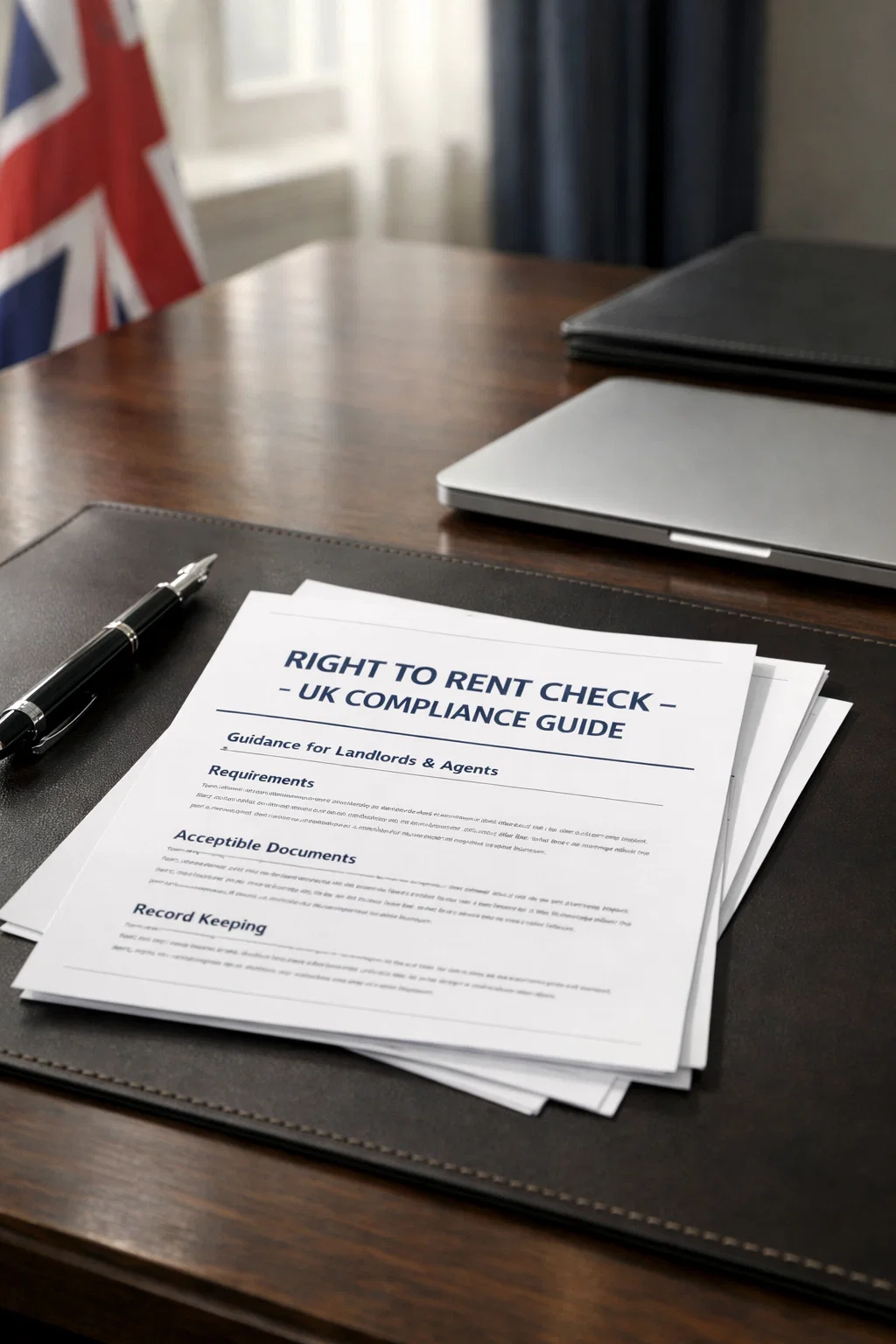
A Right to Rent check is a mandatory immigration verification that landlords must conduct before allowing adults to occupy residential property in England under the Immigration Act 2014. Landlords face civil penalties up to £3,000 per illegal occupant or criminal prosecution (up to 5 years imprisonment) for renting without verifying legal immigration status.
This guide covers legal obligations, verification process, acceptable documents and penalties, with a free interactive checklist and PDF download.
✓ Right to Rent Check Template (England)
Answer guided questions — your Right to Rent verification is built for you. Compliant checking procedures and document checklists included. Free updates when we update for law changes or improvements — at no extra cost. From £10, no subscriptions.
→ Build Your Right to Rent Check
Prefer to write your own? Download the free DIY checklist →
What Is a Right to Rent Check in the UK?
Quick Answer: A legal requirement under the Immigration Act 2014 where landlords must verify that all adult occupiers (aged 18+) have permission to live in the UK before allowing them to rent residential property in England. Compliant checks establish a statutory excuse against penalties.
Where Does This Law Apply?
The Right to Rent scheme was introduced by the Immigration Act 2014 and came into force on 1 February 2016 across England. It makes it a criminal offence to rent residential property to someone who does not have legal immigration status.
Landlords must check immigration documents before the tenancy starts and conduct follow-up checks for those with time-limited permission. The scheme does not apply in Scotland, Wales or Northern Ireland.
The Legal Framework at a Glance
| Element | Requirement | Legal Basis |
|---|---|---|
| Who must check | All landlords (private, agents, local authorities) in England | Immigration Act 2014, s.22 |
| What must be checked | Immigration status of ALL adults (18+) occupying property | Immigration Act 2014, s.21 |
| When to check | Before start of tenancy (before occupier moves in) | Code of Practice 2022 |
| Follow-up checks | When time-limited permission expires (every 12 months minimum) | Immigration Act 2014, s.23 |
| Civil penalty | Up to £3,000 per illegal occupier (first offence) | Immigration Act 2014, s.23 |
| Criminal offence | Unlimited fine + up to 5 years imprisonment (knowing/reckless breach) | Immigration Act 2014, s.33A |
| Geographic scope | England only (not Scotland, Wales, Northern Ireland) | Immigration Act 2014, s.39 |
Why Should Landlords Care?
- Legal compliance: Mandatory requirement — no exceptions for ignorance
- Penalty avoidance: £3,000 civil penalty per illegal occupier (£9,000+ for multiple occupiers)
- Criminal prosecution risk: Up to 5 years imprisonment for knowing or reckless breaches
- Statutory excuse: Compliant checks provide a legal defence against penalties
- Property confiscation: Proceeds of Crime Act applies to rental income from illegal letting
- Business reputation: Criminal convictions end landlord careers permanently
Why Should Tenants Care?
- Legal residency proof: Demonstrates right to live in the UK
- Tenancy access: Cannot rent legally without passing checks
- Immigration compliance: Ensures visa conditions are being followed
- Document verification: Confirms identity documents are valid and genuine
Key Takeaway: Right to Rent checks are legally mandatory in England under the Immigration Act 2014. Landlords face penalties up to £3,000 per breach (civil) or 5 years imprisonment (criminal). Proper checks before tenancy starts establish a statutory excuse against prosecution.
How Do I Check Someone’s Right to Rent in the UK?
Quick Answer: Request original acceptable identity and immigration documents, examine them in person (or via certified IDSP), verify they’re genuine and belong to the person, take clear copies, record the check date, and retain copies securely for the duration of tenancy plus 12 months. For online checks, use the Home Office online service with the tenant’s share code.
The Five-Step Process
Step 1 — Request Documents Before Tenancy Starts
- Ask ALL adults (18+) who will occupy the property for acceptable documents
- Provide a list of acceptable documents (see table below)
- Request original documents — not photocopies
- Schedule a document check meeting (in person or via IDSP)
- Inform the tenant this is a legal requirement, not discretionary
Step 2 — Examine Original Documents
- Check documents in the presence of the tenant (or via video link with IDSP)
- Verify the document is original — look for security features, watermarks, holograms
- Check the photograph matches the person presenting the document
- Verify date of birth matches the person’s apparent age
- Check the document has not expired (or note expiry date for time-limited permission)
- Ensure the document appears genuine — not forged or tampered with
Step 3 — Take Clear Copies
- Copy the ENTIRE document — all pages showing any information
- For passports: copy the page with photograph, personal details, expiry date, and any visa or entry stamp pages
- For Biometric Residence Permits (BRP): copy both sides of the card
- For UK birth certificates: copy the entire certificate
- Ensure copies are clear and legible — test before the tenant leaves
Step 4 — Record the Check
- Write on copies: date check conducted and landlord/agent signature
- Record what documents were checked (passport number, BRP number, etc.)
- Note whether the check establishes unlimited or time-limited right to rent
- If time-limited: note expiry date and schedule a follow-up check
Step 5 — Store Copies Securely
- Retain copies for the duration of tenancy PLUS 12 months after tenancy ends
- Store securely — locked filing cabinet or encrypted digital storage
- Comply with UK GDPR data protection requirements
- Limit access to authorised persons only
- Produce copies if requested by Home Office enforcement
Does the Check Have to Be Done in Person?
No. Since December 2022, landlords have three checking methods available.
1. Manual in-person check (traditional)
Landlord or agent meets the tenant face-to-face, examines original physical documents, and takes photocopies or scans. Works for ALL document types. Establishes statutory excuse if compliant.
2. Home Office online checking service
Tenant generates a share code via gov.uk/prove-right-to-rent. Landlord enters the share code and tenant’s date of birth on the Home Office service. System confirms right to rent status and any expiry date.
Only works for BRP holders, eVisa holders and some visa holders — does NOT work for British or Irish passports, birth certificates, or naturalisation certificates.
3. Identity Service Provider (IDSP) video check
A certified IDSP conducts a video call with the tenant, verifies document authenticity using technology, and provides the landlord with a verification certificate.
List of certified IDSPs available at gov.uk/government/publications/identity-service-providers.
Key Takeaway: Right to Rent checks involve examining original documents, verifying genuineness, taking copies, and recording check dates. Checks can be done in person, via Home Office online service (with share code), or via certified IDSP video verification.
What Checks Are Done When Renting in the UK?
Quick Answer: Landlords typically conduct multiple checks — but Right to Rent is the only one that’s legally mandatory in England. Everything else (credit checks, employment verification, previous landlord references) is voluntary best practice.
Mandatory vs Best Practice — What’s the Difference?
| Check Type | Legal Status | Purpose |
|---|---|---|
| Right to Rent Check | MANDATORY (England only) — Immigration Act 2014 | Verify legal permission to live in UK, avoid £3,000 penalty/prosecution |
| Tenant Referencing | BEST PRACTICE (voluntary but standard) | Assess tenant suitability, payment reliability, rental history |
| Credit Check | BEST PRACTICE (voluntary) | Check financial history, CCJs, defaults, bankruptcy |
| Affordability Assessment | BEST PRACTICE (voluntary) | Verify income supports rent (typically 2.5–3x monthly rent) |
| Employment Verification | BEST PRACTICE (voluntary) | Confirm employment status, income stability |
| Previous Landlord Reference | BEST PRACTICE (voluntary) | Check rental payment history, property care, disputes |
| Guarantor Check | BEST PRACTICE (if guarantor required) | Verify guarantor affordability, creditworthiness |
| Proof of Address | BEST PRACTICE (voluntary) | Verify current address, identity confirmation |
Most professional landlords and letting agents conduct full referencing to minimise tenancy failure risk — but only Right to Rent carries legal penalties for non-compliance. See our Tenant Reference Form Guide for complete referencing requirements.
Key Takeaway: Right to Rent is the only legally mandatory pre-tenancy check in England. Other checks (tenant referencing, credit, employment) are voluntary best practice. Landlords must conduct Right to Rent before tenancy starts to avoid penalties.
Do British Citizens Need a Right to Rent Check?
Quick Answer: Yes. The law requires landlords to check ALL adults (18+) before they occupy property — including British citizens. British citizens have unlimited right to rent and pass checks by providing a UK passport, birth certificate with NI document, or certificate of naturalisation.
What About Different Nationalities and Immigration Statuses?
| Nationality/Status | Right to Rent | Acceptable Documents |
|---|---|---|
| British Citizen | UNLIMITED (no follow-up checks) | UK passport, birth certificate + NI document, naturalisation certificate |
| Irish Citizen | UNLIMITED (Common Travel Area rights) | Irish passport, Irish passport card |
| Settled Status (EUSS) | UNLIMITED (no follow-up checks) | Share code from Home Office online service (eVisa) |
| Pre-Settled Status (EUSS) | TIME-LIMITED (expires after 5 years) | Share code from Home Office online service (eVisa) |
| Indefinite Leave to Remain | UNLIMITED (no follow-up checks) | BRP card, passport with ILR stamp/vignette, share code |
| Work/Student Visa | TIME-LIMITED (check required when visa expires) | BRP card, passport with visa, share code |
| Asylum Seeker (pending) | TIME-LIMITED (if granted permission to rent) | Positive Verification Notice from Home Office |
| No Legal Status | NO RIGHT TO RENT (cannot legally rent) | Cannot pass Right to Rent check — landlord must refuse |
Key Takeaway: British citizens DO need Right to Rent checks. The law requires checks on ALL adults regardless of nationality. British citizens have unlimited right to rent and pass checks with a UK passport, birth certificate, or naturalisation certificate.
Landlord Essentials Pack
Complete Landlord Protection • 8 Templates + Editor & Interview Versions • Save 50% vs Buying Individually
Lifetime Access • Free Updates • 30-Day Money-Back Guarantee*
What Do You Need to Prove Right to Rent in the UK?
Quick Answer: Original acceptable documents from the Home Office approved list. British and Irish citizens need a UK or Irish passport, birth certificate plus NI document, or naturalisation certificate. Non-UK nationals need a passport with valid visa, Biometric Residence Permit, or share code from the Home Office online service.
How Do You Prove Your Right to Stay?
Provide documents showing UK immigration permission: British or Irish passport, Biometric Residence Permit showing visa type and expiry, share code from gov.uk/prove-right-to-rent for eVisa or digital status holders, passport with valid UK visa stamp or vignette, certificate of naturalisation or registration as a British citizen, or Positive Verification Notice from the Home Office (asylum seekers with permission to rent).
Not sure of your status? Check online at gov.uk/view-prove-immigration-status, generate a share code to prove your status to landlords, or contact the Home Office Resolution Centre if your status is unclear.
List A — Unlimited Right to Rent (No Follow-Up Check Needed)
- UK Passport: Current or expired within last 2 years
- Irish Passport or Passport Card: Current or expired within last 2 years
- UK Birth Certificate: Issued within 3 months of birth + official document with National Insurance number (P45, P60, payslip, benefits letter)
- Certificate of Registration/Naturalisation as British Citizen
- Current Biometric Immigration Document (BRP): Showing indefinite leave to remain or no time limit
- Current Passport: Endorsed showing holder is exempt from immigration control, indefinite leave to remain, or no time limit
- Certificate of Entitlement to Right of Abode: In current or expired passport
- EU Settlement Scheme (EUSS) Settled Status: Prove via share code from Home Office online service
List B — Time-Limited Right to Rent (Follow-Up Check Required)
- Current Passport with Valid UK Visa: Work visa, student visa, family visa, etc.
- Current Biometric Residence Permit (BRP): Showing limited leave to remain with expiry date
- EU Settlement Scheme (EUSS) Pre-Settled Status: Prove via share code (valid 5 years, requires follow-up check)
- Frontier Worker Permit
- Immigration Status Document: With Home Office endorsement showing limited leave
- Positive Verification Notice: From Home Office (asylum seekers with permission to rent)
- Certificate of Application (COA): Less than 6 months old, issued by Home Office (asylum seekers)
What Documents Are NOT Acceptable?
- Driving licence (UK or foreign) — not acceptable
- EU national ID cards — no longer acceptable post-Brexit (except Irish passport cards)
- Bank statements, utility bills — not acceptable
- Expired passports (unless UK/Irish expired less than 2 years ago)
- Photocopies or scanned documents — must see originals (or use online/IDSP check)
- Foreign birth certificates — not acceptable
- Marriage certificates — not acceptable
How Long Does Your Statutory Excuse Last?
| Document Type | Statutory Excuse Duration | Follow-Up Check Required |
|---|---|---|
| List A (unlimited) | Duration of tenancy (no expiry) | No — single check sufficient |
| List B (time-limited) | Until document expiry date OR 12 months (whichever sooner) | Yes — check before expiry or every 12 months |
| Ongoing positive verification | 6 months from check date | Yes — every 6 months if asylum claim ongoing |
Key Takeaway: Acceptable documents fall into List A (unlimited right — UK passport, ILR, settled status) or List B (time-limited — visas, BRP, pre-settled status). List A requires one check only. List B requires follow-up checks when permission expires or every 12 months.
Frequently Asked Questions: Right to Rent Checks UK
What is a right to rent check in the UK?
A mandatory immigration status verification that landlords must conduct before allowing adults to occupy residential property in England. Landlords face civil penalties up to £3,000 per illegal occupant or criminal prosecution (up to 5 years imprisonment) if they rent to someone without legal immigration status.
How do I check someone’s right to rent in the UK?
Request original acceptable identity and immigration documents, examine them in person or via certified IDSP, verify they’re genuine and belong to the person, take clear copies of entire documents, record the check date, and retain copies securely. Alternatively, use the Home Office online service with the tenant’s share code.
Do British citizens need a right to rent check?
Yes. The law requires checks on ALL adults (18+) regardless of nationality. British citizens have unlimited right to rent and pass checks with a UK passport, birth certificate plus National Insurance document, or naturalisation certificate.
Does a right to rent check have to be done in person?
No. Checks can be done in person (traditional document examination), via Home Office online checking service (requires tenant’s share code), or via certified Identity Service Provider (IDSP) using video verification. IDSPs have been available for remote checks since December 2022.
What checks are done when renting in the UK?
Landlords typically conduct Right to Rent immigration check (mandatory by law in England), tenant referencing (credit checks, employment verification), affordability assessment, identity verification, and guarantor checks if required. Right to Rent is the only legally mandatory check — all others are best practice.
What do you need to prove right to rent in the UK?
Original acceptable documents from the Home Office approved list: UK or Irish passport, UK birth certificate plus National Insurance document, naturalisation certificate, passport with valid visa, Biometric Residence Permit (BRP), or share code from the Home Office online service for eVisa holders.
How do I check a tenant’s right to rent in the UK?
Request documents before the tenancy starts, examine originals in person or via IDSP, verify they’re genuine, take copies of entire documents, record the check date on copies, and store securely for the duration of tenancy plus 12 months. For online checks, use the Home Office service with the tenant’s share code.
How do you prove your right to stay in the UK?
Provide documents showing UK immigration permission: British or Irish passport, Biometric Residence Permit showing visa type and expiry, share code from gov.uk/prove-right-to-rent for eVisa holders, passport with valid UK visa stamp or vignette, or certificate of naturalisation.
How do I check if I have the right to reside in the UK?
Review your visa or BRP expiry date, check your immigration status online at gov.uk/view-prove-immigration-status, generate a share code to prove your status, or contact the Home Office Resolution Centre if your status is unclear. Settled status, pre-settled status, or indefinite leave to remain all confirm your right to reside.
What is the right to rent law in the UK?
The Right to Rent scheme was introduced by the Immigration Act 2014 and came into force on 1 February 2016 across England. It makes it a criminal offence to rent residential property to someone without legal immigration status. The scheme does not apply in Scotland, Wales or Northern Ireland.
The Truth About “Free” Legal Template Sites (What You’re Really Signing Up For)
Most websites offering a “free legal template” follow the same pattern:
- You click because it’s advertised as free
- You spend 10–15 minutes answering questions
- At the very end, you must create an account or start a “free trial”
- Your card is required upfront
- The subscription auto-renews at £29–£39 per month
This isn’t a free template — it’s a subscription service. Many people only realise after being charged £300–£400 over the year.
Why These “Free” Templates Are a Legal Risk
- Outdated wording: not aligned with current UK law
- Missing mandatory clauses: required for legal validity
- No compliance guidance: leaving users without legal context
- No structured checklist: no way to verify the document works
- Not kept updated: often unchanged when legislation changes
One incorrect clause can weaken or invalidate the entire document.
Hidden Problem: Many “Free Template” Sites Aren’t Even UK-Based
Another major issue is that many free or auto-subscription template sites operate outside the UK and use documents originally drafted for the US legal system. These are then loosely adapted for “international use,” which creates serious problems:
- Incorrect terminology: taken from US contract law
- Missing UK statutory references: essential legal requirements omitted
- Non-applicable clauses: terms that don’t apply under UK legislation
- Legal conflicts: risks breaching UK consumer, employment, or GDPR rules
Why Templates UK Does the Opposite
- Drafted by UK professionals: written by experienced business & legal experts
- UK-law only: no US crossover or generic “international” templates
- One-time price from £10: no subscriptions, no renewals
- Full preview: see the exact document before buying
- Lifetime access: free lifetime updates included
My Templates Dashboard
All purchased templates are stored in your personal My Templates page, organised by category.
When we update a template for UK law changes, the new version appears automatically in your dashboard — free, forever.
Build a growing library of UK legal documents across every area of your business and personal life.
Transparent Pricing
From £10 per template — with free lifetime usage and free lifetime updates. No subscriptions. No renewals. No auto-billing.
Not ready to buy? Use our free interactive checklists to guide your own document — no payment required.
No tricks. No trials. No hidden fees. Just the exact UK-specific legal document you came for — at the price we told you upfront.
Build your own bespoke document with our Right to Rent Check Template. Preview the full document before buying — only pay when you’re happy with it.
Get Every Template in One Bundle
The UK Legal Templates Ultimate Bundle includes 91 templates across every category — one purchase, lifetime updates, no subscriptions.
Save with Residential Landlord Bundle Packs
Get multiple residential property templates at discounted rates:
- Ultimate Bundle — All 28 templates for £99 (save £181)
- Essentials Pack — 8 core templates for £40 (save £40)
- Correspondence Pack — 7 letter templates for £35 (save £35)
- Eviction Pack — 6 eviction documents for £30 (save £30)
- Management Pack — 7 management documents for £35 (save £35)
View all landlord bundle options →
Explore Template Bundles by Category
One purchase, lifetime updates, no subscriptions.
- Business Complete Suite — 37 templates, £120 (smaller packs available)
- Landlord Ultimate Bundle — 28 templates, £99 (smaller packs available)
- Complete Family Pack — 18 templates, £65 (smaller packs available)
- Complete Estate Pack — 8 templates, £38 (smaller packs available)
Explore the Master Business Legal Templates Pillar Guide
The complete overview of 37 essential UK business templates.
UK Business Legal Templates — Complete Master Guide
Explore All Templates UK Pillar Guides
- Family Law Documents Guide UK
- Wills & Estate Planning Guide UK
- Residential Landlord Documents Guide UK
- Employment Documents Guide UK
- How to Set Up a Business in the UK — Legal Guide
- Website Legal Documents UK — Compliance Guide
- Financial & Commercial Contracts UK — Protection Guide
- Commercial Office Lease Guide UK
- Digital & IP Agreements Guide UK
Related Guides
- Assured Shorthold Tenancy Guide UK
- Tenant Reference Form Guide UK
- Inventory & Schedule of Condition Guide UK
- Guarantor Agreement Guide UK
Free Legal Templates & Interactive Checklists
Access all our free UK legal templates, checklists and downloadable PDFs.
Last updated: February 2026
Disclaimer: This guide provides general UK legal information, not legal advice. Laws are current as of February 2026.
rent law in the UK?”, “acceptedAnswer”: { “@type”: “Answer”, “text”: “The Right to Rent scheme was introduced by the Immigration Act 2014 and came into force on 1 February 2016 across England. It makes it a criminal offence to rent to someone without legal immigration status. Does not apply in Scotland, Wales, or Northern Ireland.” } } ] }