Updated: 28th May 2026 • Based on UK Law
Quick Navigation:
What Is a Lodger Agreement?
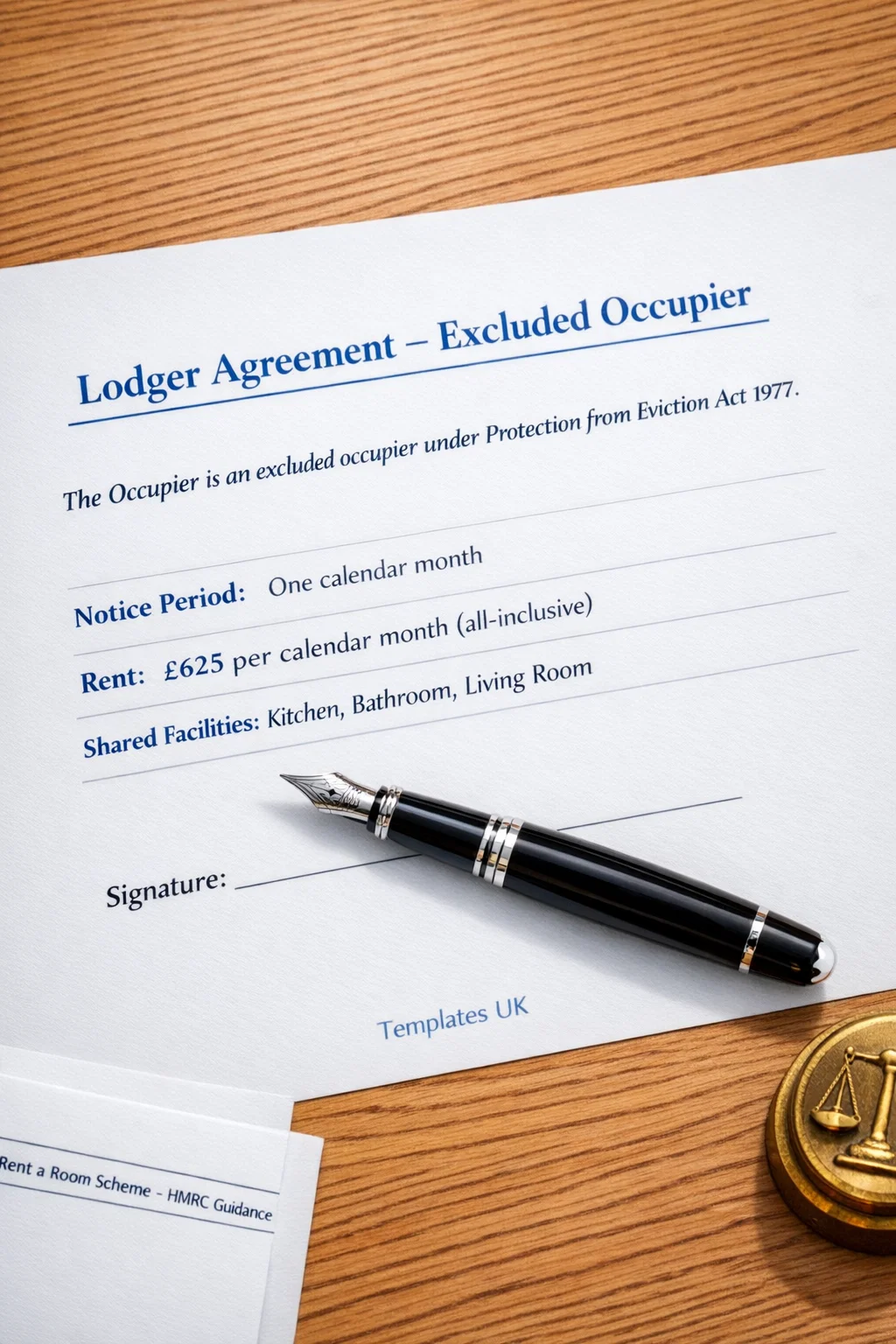
A lodger agreement is a legally binding contract between a resident homeowner and a lodger who rents a room in the homeowner’s property. Unlike tenancies, lodgers are “excluded occupiers” with limited legal protections, allowing eviction with reasonable notice without court orders under the Protection from Eviction Act 1977.
This guide covers legal requirements, eviction rights, tax benefits, rent rules, and key agreement elements, with a free interactive lodger agreement checklist.
✓ Lodger Agreement Template (England & Wales)
Answer simple guided questions — your lodger agreement is built for you. Includes room terms, house rules, notice periods, deposit handling, rent payment schedule and legal requirements. From £10 one-time — no subscriptions, no hidden fees. Free lifetime access and free updates.
Prefer to write your own? Download the free DIY checklist →
A homeowner rents out their spare room to a friend’s colleague. No written agreement — just a handshake and a monthly bank transfer. Six months later the lodger stops paying, refuses to leave, and claims they’re a tenant with full Housing Act protection.
Without a written lodger agreement, the homeowner has no documented proof of the arrangement, no agreed notice period, and no clear basis for eviction. What should have been a simple “reasonable notice” situation becomes weeks of uncertainty — and potential legal costs.
This guide covers everything homeowners and lodgers need to know about lodger agreements in England — including why the legal distinction between a lodger and a tenant matters more than most people realise.
What Does “Lodger” Mean in the UK?
A lodger in the UK is someone who rents a room in a property where the owner also lives and shares common areas such as the kitchen, bathroom, or living room. Lodgers are classified as “excluded occupiers” under the Protection from Eviction Act 1977, giving them significantly fewer legal rights than tenants.
The key legal requirement for someone to be a lodger (rather than a tenant) is that the homeowner must be resident in the same property. This is known as a “resident landlord” situation. The homeowner does not need to share every room, but there must be shared use of at least some common facilities.
What Is a Lodger in Legal Terms?
In legal terms, a lodger is an “excluded occupier” or “licensee” who has permission to occupy a room in the homeowner’s residence but does not have exclusive possession of any part of the property. This means the homeowner retains the right to access all areas of the property, including the lodger’s room (with reasonable notice for non-emergencies).
The distinction between a lodger and a tenant is critical because it determines:
- Eviction rights: Lodgers can be evicted with reasonable notice (no court order required); tenants require Section 21 or Section 8 notices and court proceedings
- Deposit protection: Not mandatory for lodgers (though recommended); mandatory for tenants under government schemes
- Notice periods: “Reasonable notice” for lodgers (typically linked to rent payment period); minimum 2 months for tenants (Section 21)
- Right to exclusive possession: Lodgers do not have it; tenants do
- Statutory protections: Limited for lodgers; extensive for tenants under Housing Act 1988
The case of Street v Mountford [1985] established the test for distinguishing tenancies from licenses: if someone has exclusive possession of accommodation for a term at a rent, they are a tenant regardless of what the agreement is called. Lodgers fail this test because they lack exclusive possession due to the resident landlord sharing the property.
What Is a Lodger Agreement in the UK?
A lodger agreement in the UK is a written contract between a resident homeowner and a lodger setting out the terms of the arrangement, including rent amount, payment dates, notice period, house rules, and what facilities are shared. While not legally required, written agreements prevent disputes and provide clear evidence of the arrangement.
Unlike Assured Shorthold Tenancy agreements which must comply with extensive statutory requirements (deposit protection, gas certificates, EPC ratings, etc.), lodger agreements are more flexible. However, they should still be comprehensive and clearly drafted to avoid ambiguity.
What Are the Key Elements of a Room Agreement?
Essential elements of a lodger agreement include:
- Parties: Full names and addresses of homeowner and lodger
- Property details: Full address and description of the room being let
- Rent: Amount, payment frequency, payment method, and whether utilities/council tax are included
- Deposit: Amount (typically 4-6 weeks’ rent), how it will be held, and deduction terms
- Term: Start date and whether it’s fixed-term or periodic (rolling)
- Notice period: How much notice either party must give to end the arrangement (typically one rental period)
- Shared facilities: What areas and facilities the lodger can use (kitchen, bathroom, living room, garden)
- House rules: Smoking policy, guests policy, noise restrictions, cleaning responsibilities
- Utilities and bills: What’s included in rent vs. what lodger pays separately
- Homeowner access: Right to access lodger’s room (with reasonable notice)
- Restrictions: No subletting, no illegal activity, no alterations without permission
- Termination rights: Circumstances allowing immediate termination (e.g., serious breach)
Use our professionally drafted Lodger Agreement Template to ensure all essential elements are covered.
How to Write a Legally Binding Rental Agreement?
To create a legally binding lodger agreement:
1. Use clear, unambiguous language — Avoid legal jargon; make terms understandable to both parties
2. Include all essential terms — Rent, deposit, notice period, shared facilities, house rules
3. Be specific about rent and deposit — State exact amounts, payment dates, and payment methods
4. Define the arrangement correctly — Make clear the lodger is an excluded occupier, not a tenant
5. Sign and date — Both parties should sign and date the agreement; each party keeps a copy
6. Attach inventory — Document the room’s condition and any furnishings provided
7. Review house rules — Discuss and agree on all rules before signing
Oral agreements are legally binding but difficult to prove. Written agreements provide crucial evidence if disputes arise about rent, notice periods, or house rules. Courts will enforce written agreements if they are clear, fair, and properly executed by both parties. Our lodger agreement template covers all essential elements including rent terms, deposit handling, house rules, and notice periods.
What Is the Difference Between a Lodger and a Tenant in the UK?
The main difference is that lodgers live in a property where the homeowner also resides and shares common areas, while tenants have exclusive possession of a property where the landlord does not live. This distinction determines eviction rights, deposit protection requirements, and legal protections available.
| Feature | Lodger (Excluded Occupier) | Tenant (AST) |
|---|---|---|
| Landlord residence | Landlord lives in property | Landlord does not live in property |
| Exclusive possession | No exclusive possession | Has exclusive possession |
| Legal status | Excluded occupier/licensee | Assured Shorthold Tenant |
| Eviction process | Reasonable notice only (no court order required) | Section 21/8 notice + court proceedings required |
| Minimum notice period | Reasonable notice (typically one rent period) | Minimum 2 months (Section 21) |
| Deposit protection | Not required (but recommended) | Mandatory (government-approved scheme) |
| Right to Rent checks | Not required | Mandatory |
| Gas safety certificate | Not required (though homeowner still has duty of care) | Mandatory |
| EPC rating | Not required | Mandatory (minimum rating E) |
| Homeowner access to room | Yes (with reasonable notice) | Limited (only with permission or emergency) |
| Protection from illegal eviction | Limited (covered by Protection from Eviction Act but with exceptions) | Full protection (illegal eviction is criminal offence) |
The resident landlord exception significantly reduces the lodger’s rights. If the homeowner stops living in the property (e.g., moves out permanently), the lodger may automatically become a tenant with full statutory protections. This is why it’s crucial for homeowners to maintain residence in the property while letting rooms.
Do I Need an Agreement for a Lodger?
Legally, you are not required to have a written agreement for a lodger. Oral agreements are valid. However, written agreements are strongly recommended because they provide clear evidence of the arrangement’s terms, prevent disputes, protect both parties’ interests, and are essential for claiming tax relief under the Rent a Room Scheme.
Benefits of Having a Written Lodger Agreement:
- Evidence of terms: Clear proof of rent amount, payment dates, and notice period if disputes arise
- House rules enforcement: Documented rules on smoking, guests, noise, cleaning provide basis for eviction if breached
- Tax compliance: HMRC may request evidence of the arrangement when claiming Rent a Room relief
- Deposit protection: Written record of deposit amount and deduction terms prevents disputes
- Notice period clarity: Both parties know exactly how much notice is required to end arrangement
- Professionalism: Shows you take the arrangement seriously and protects both parties
- Inventory record: Attached inventory documents room condition and reduces deposit disputes
Risks of Relying on Oral Agreements:
- Memory disputes: Parties remember different terms months later
- Eviction delays: Lodger claims longer notice period was agreed orally
- Rent disputes: Disagreements over whether utilities were included
- Tax complications: Difficulty proving arrangement qualifies for Rent a Room relief
- Deposit deductions: No documented agreement on what constitutes damage vs. fair wear and tear
While homeowners can evict lodgers with reasonable notice regardless of whether there’s a written agreement, having written terms makes the process smoother and provides stronger legal evidence if the lodger refuses to leave and court action becomes necessary.
How Much Should a Lodger Pay?
Lodger rent varies based on location, room size, facilities provided, and what’s included (utilities, internet, council tax). In London, lodgers typically pay £600-£1,200 per month; outside London, £300-£700 per month. Rent is usually “all-inclusive” covering utilities, council tax, and internet to simplify arrangements.
Factors Affecting Lodger Rent:
- Location: London/South East commands premium; regional cities less; rural areas lowest
- Room size and quality: Double vs. single; ensuite vs. shared bathroom; furnished vs. unfurnished
- Facilities included: Private bathroom, parking, garden access increase value
- Bills included: All-inclusive (utilities, council tax, internet) vs. rent-only arrangements
- House quality: Modern, well-maintained properties command higher rent
- Transport links: Proximity to stations, bus routes, employment centers
- Exclusive use: Sole use of bathroom vs. shared facilities
Typical Rent Ranges (2025):
| Location | Basic Room (Shared Bathroom) | Premium Room (Ensuite) |
|---|---|---|
| Central London | £800-£1,200 pcm | £1,200-£1,600 pcm |
| Outer London | £600-£900 pcm | £900-£1,200 pcm |
| South East (e.g., Brighton, Oxford) | £500-£750 pcm | £750-£1,000 pcm |
| Regional Cities (e.g., Manchester, Birmingham) | £400-£650 pcm | £650-£900 pcm |
| Other Areas | £300-£500 pcm | £500-£700 pcm |
All-Inclusive vs. Rent-Only:
All-inclusive arrangements (covering utilities, council tax, internet) are most common for lodgers because they:
- Simplify payment arrangements (single monthly payment)
- Avoid disputes over utility usage
- Make budgeting easier for lodgers
- Reduce administrative burden for homeowners
Rent-only arrangements (lodger pays separate utility bills) are rare and typically only used when:
- Lodger uses significantly more utilities than average
- Property has separate meters for lodger’s room
- Homeowner wants to pass through exact costs
Research local market rates using SpareRoom, OpenRent, and Rightmove to ensure your rent is competitive. Overpricing reduces demand; underpricing may attract unsuitable lodgers or leave money on the table, especially if you could stay within the £7,500 annual Rent a Room allowance.
What Is the Lodger Scheme in the UK?
The “Rent a Room Scheme” (commonly called the “lodger scheme”) is an HMRC tax relief allowing homeowners to earn up to £7,500 per year (tax year 2025/26) tax-free from letting furnished accommodation in their only or main residence. Income above this threshold is taxable as property income.
This is one of the most significant financial benefits of taking in a lodger rather than letting a property separately as a landlord.
What Are the Benefits of a Lodger Agreement?
Key benefits of the Rent a Room Scheme for homeowners:
- Tax-free income: Earn up to £7,500/year completely tax-free (equivalent to ~£10,700 gross income for higher-rate taxpayers)
- Help with mortgage: Extra income can cover significant portion of mortgage payments
- Flexibility: Can opt out of the scheme if expenses exceed the allowance (claim actual expenses instead)
- No complex tax returns: If income under £7,500, simply tick a box on self-assessment
- Covers multiple lodgers: Total income from all lodgers combined gets the allowance (not per lodger)
Rent a Room Scheme Rules:
Eligibility requirements:
- Your only or main residence: Must let rooms in the property you live in as your main home
- Furnished accommodation: Room must be furnished (bed, wardrobe, desk at minimum)
- You must live there too: Cannot claim relief if you move out and rent entire property
- Residential property: Applies to houses, flats, apartments (not B&Bs or guest houses run as businesses)
How it works:
If your total rental income from lodgers is £7,500 or less per year, you can claim the allowance and pay no tax on it. You simply tick the Rent a Room relief box on your self-assessment tax return.
If your income exceeds £7,500, you can choose either:
- Option 1: Claim the £7,500 allowance and pay tax on the excess (no expenses deductible)
- Option 2: Opt out of the scheme and claim actual expenses (mortgage interest, repairs, utilities, etc.) against your gross rental income
You choose the option that gives the lowest tax bill. For most homeowners with modest expenses, the £7,500 allowance is more beneficial than claiming expenses.
Example Calculation:
Scenario 1: Income below threshold
- Monthly rent from lodger: £600
- Annual rental income: £7,200
- Tax due: £0 (within £7,500 allowance)
Scenario 2: Income above threshold (Option 1)
- Monthly rent from lodger: £800
- Annual rental income: £9,600
- Tax-free allowance: £7,500
- Taxable income: £2,100
- Tax due (20% basic rate): £420
Scenario 2: Income above threshold (Option 2 – actual expenses)
- Annual rental income: £9,600
- Actual expenses (utilities, mortgage interest proportion, wear and tear): £3,200
- Taxable income: £6,400
- Tax due (20% basic rate): £1,280
In this example, Option 1 (£7,500 allowance) results in lower tax (£420 vs. £1,280).
More information: HMRC Rent a Room Scheme guidance
Landlord Essentials Pack
Complete Landlord Protection • 8 Templates + Editor & Interview Versions • Save 50% vs Buying Individually
Lifetime Access • Free Updates • 30-Day Money-Back Guarantee*
The Truth About “Free” Legal Template Sites (What You’re Really Signing Up For)
Most websites offering a “free legal template” follow the same pattern:
- You click because it’s advertised as free
- You spend 10–15 minutes answering questions
- At the very end, you must create an account or start a “free trial”
- Your card is required upfront
- The subscription auto-renews at £29–£39 per month
This isn’t a free template — it’s a subscription funnel. Many people only realise after being charged £300–£400 over the year.
Why These “Free” Templates Are a Legal Risk
- Outdated wording: not aligned with current UK law
- Missing mandatory clauses: required for legal validity
- No compliance guidance: leaving users without legal context
- No structured checklist: no way to verify the document works
- Not kept updated: often unchanged when legislation changes
One incorrect clause can weaken or invalidate the entire document.
Hidden Problem: Many “Free Template” Sites Aren’t Even UK-Based
Another major issue is that many free or auto-subscription template sites operate outside the UK and use documents originally drafted for the US legal system. These are then loosely adapted for “international use,” which creates serious problems:
- Incorrect terminology: taken from US contract law
- Missing UK statutory references: essential legal requirements omitted
- Non-applicable clauses: terms that don’t apply under UK legislation
- Legal conflicts: risks breaching UK consumer, employment, or GDPR rules
Why Templates UK Does the Opposite
- Drafted by UK professionals: written by experienced business and legal experts
- UK-law only: no US crossover or generic “international” templates
- £10 one-time price: no subscriptions, no renewals
- Full preview: see the exact document before buying
- Two versions included: Editor + Interview formats
- Lifetime access: free lifetime updates included
- Free compliance checklist: included with every document
No tricks. No trials. No hidden fees. Just the exact UK-specific legal document you came for — at the price we told you upfront.
Get the professionally drafted Lodger Agreement and get it right the first time.
Explore the Master Legal Templates Pillar Guide
The complete overview of 37 essential UK business templates and all legal categories:
UK Business Legal Templates – Complete 2025 Master Guide
Explore All Templates UK Pillar Guides
- Residential Property & Landlord Legal Guide UK
- Employment Documents Guide UK
- How to Set Up a Business in the UK – Legal Guide
- Website Legal Documents UK – Compliance Guide
- Financial & Commercial Contracts UK – Protection Guide
- Commercial Office Lease Guide UK
- Digital & IP Agreements Guide UK
- Wills & Estate Planning Guide UK
Related Guides
- Lodger Agreement Template — Build Yours Now
- Assured Shorthold Tenancy Guide UK
- Tenant Reference Form Guide UK
- Inventory & Schedule of Condition Guide UK
- Guarantor Agreement Guide UK
Save with Residential Landlord Bundle Packs
Get multiple residential property templates at discounted rates:
- Ultimate Bundle — All 28 templates for £99 (save £181)
- Essentials Pack — 8 core templates for £40 (save £40)
- Correspondence Pack — 7 letter templates for £35 (save £35)
- Eviction Pack — 6 eviction documents for £30 (save £30)
- Management Pack — 7 management documents for £35 (save £35)
View all landlord bundle options →
Free Legal Templates & Interactive Checklists
Access all our free UK legal templates, checklists and downloadable PDFs.
Last updated: 28th May 2026
Disclaimer: This guide provides general UK legal information, not legal advice. Laws are current as of 28th May 2026.
Frequently Asked Questions: Lodger Agreement UK
What does “lodger” mean in the UK?
A lodger is someone who rents a room in a property where the owner also lives and shares common areas such as the kitchen or bathroom. Lodgers are classified as “excluded occupiers” under the Protection from Eviction Act 1977, giving them significantly fewer legal rights than tenants because the homeowner is resident.
What is a lodger agreement?
A lodger agreement is a written contract between a resident homeowner and a lodger setting out rent, payment terms, notice period, house rules, and shared facilities. While not legally required, written agreements prevent disputes and provide clear evidence of the arrangement’s terms for both parties.
What is a lodger in legal terms?
In legal terms, a lodger is an “excluded occupier” or “licensee” who has permission to occupy a room but does not have exclusive possession of any part of the property. The homeowner retains the right to access all areas including the lodger’s room (with reasonable notice for non-emergencies).
What is the difference between a lodger and a tenant in the UK?
Lodgers live in a property where the homeowner also resides; tenants have exclusive possession where the landlord does not live. This means lodgers can be evicted with reasonable notice without court orders, while tenants require Section 21/8 notices and court proceedings. Lodgers have no deposit protection requirement; tenants do.
Do I need an agreement for a lodger?
Legally no, but it is strongly recommended. Written agreements provide clear evidence of rent, notice period, and house rules, prevent disputes, and are essential for claiming tax relief under the Rent a Room Scheme. Oral agreements are valid but difficult to prove if disputes arise.
How much should a lodger pay?
Lodger rent varies by location: London £600-£1,200 pcm; regional cities £400-£650 pcm; other areas £300-£500 pcm. Rent is typically “all-inclusive” covering utilities, council tax, and internet. Research local market rates using SpareRoom and Rightmove to price competitively.
What is the lodger scheme in the UK?
The “Rent a Room Scheme” allows homeowners to earn up to £7,500 per year tax-free from letting furnished accommodation in their main residence. This is an HMRC tax relief that makes taking in lodgers highly tax-efficient. Income above £7,500 is taxable as property income.
What are the benefits of a lodger agreement?
Written lodger agreements provide evidence of terms, prevent disputes over rent and notice periods, enable tax compliance for Rent a Room relief, document house rules for enforcement, and protect both parties’ interests. They also create professional arrangements and reduce the risk of misunderstandings.
What are the key elements of a room agreement?
Essential elements include: parties’ names and addresses, property details, rent amount and payment terms, deposit amount, start date and term, notice period, shared facilities, house rules, utilities inclusion, homeowner access rights, and termination conditions. Clear documentation of these prevents future disputes.
How to write a legally binding rental agreement?
Use clear language, include all essential terms (rent, deposit, notice period, house rules), be specific about payment details, define the lodger as an excluded occupier, sign and date the agreement, attach an inventory, and ensure both parties keep copies. Written agreements are enforceable in court if disputes arise.
What is a lodger agreement in the UK?
A lodger agreement is a contract between a resident homeowner and a lodger for renting a room in the homeowner’s property. It sets out rent, payment terms, notice periods, house rules, and shared facilities. Unlike ASTs, lodger agreements are not governed by extensive statutory requirements but should still be comprehensive and written.