Updated: May 2026 • Based on UK Law
What Is the Employment Rights Act 2025?
The Employment Rights Act 2025 is the biggest overhaul of UK employment law in a generation. Phased across 2026–2027, it brings day-one SSP and family leave rights, simplified trade union recognition, six-year leave records, and unfair dismissal protection from six months’ service.
This guide covers what the ERA 2025 changed, which documents employers must update, and how to get compliant with one pack.
A growing recruitment agency hires three consultants in April 2026.
Same contracts they’ve used since 2019. Same handbook. Same disciplinary procedure.
One consultant raises a grievance after six weeks.
The agency starts a disciplinary process — but the procedure doesn’t follow the current ACAS Code.
The consultant goes to tribunal.
The written statement is incomplete — missing the right to join a trade union, now mandatory.
The handbook doesn’t cover day-one SSP or the new whistleblowing rules.
Award: compensation plus a 25% uplift for failing to follow proper procedure.
Total cost of updating every document before this happened? £120.
The Employment Rights Act 2025 didn’t change one thing. It changed everything.
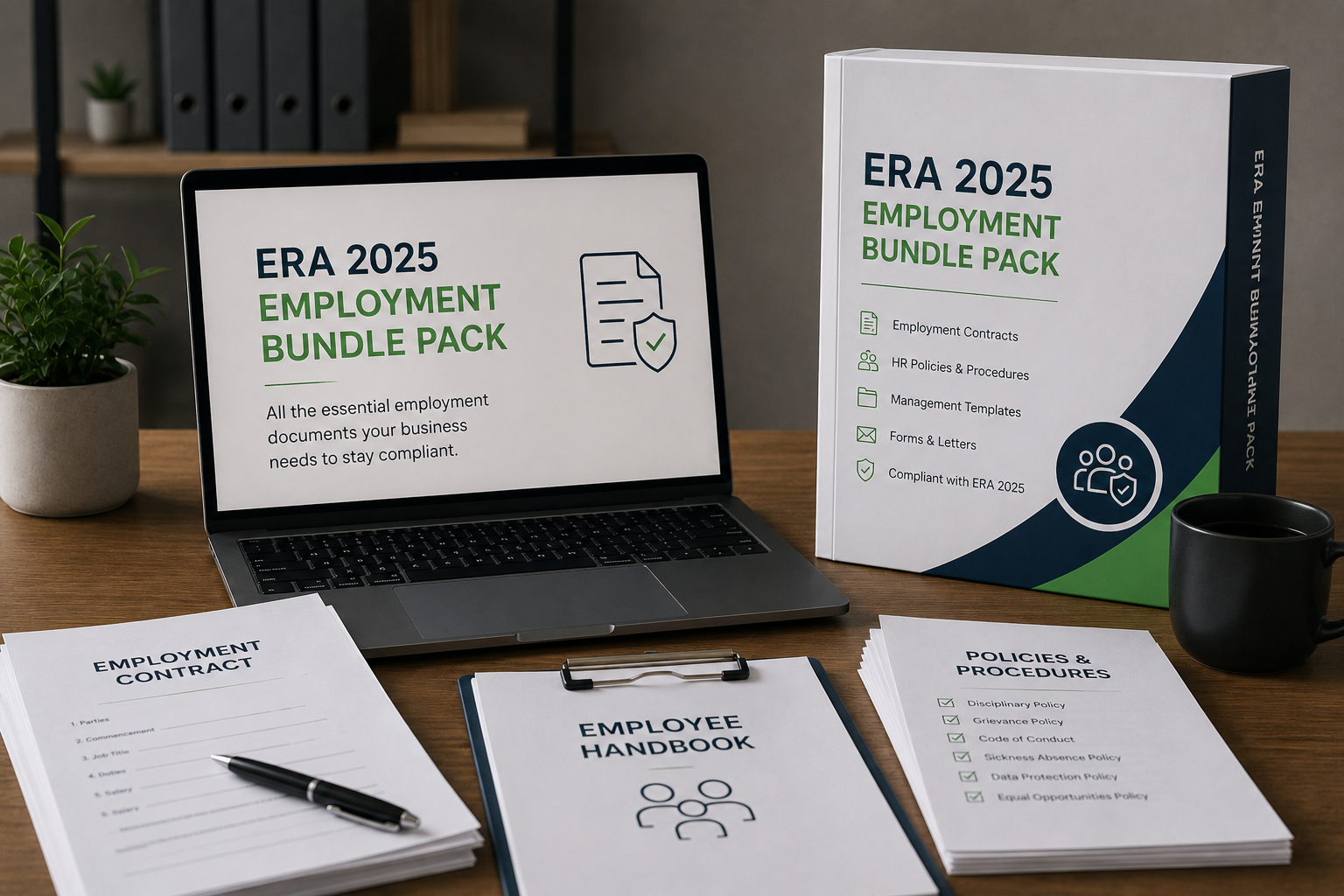
✓ ERA 2025 Compliance Pack — 12 Templates, £120
Every employment document updated for the Employment Rights Act 2025. Build each document with guided questions or the classic editor — plus the new Annual Leave & Holiday Pay Tracker. Preview every clause before buying — only pay when you’re happy with it. £120 one-time, lifetime access, free lifetime updates.
→ Get the ERA 2025 Compliance Pack
Full legal detail: Employment Rights Act 2025 — Complete Guide →
What Are the New Employment Laws in the UK?
The Employment Rights Act 2025 received Royal Assent in December 2025.
It’s being phased in across 2026 and 2027.
The biggest overhaul of UK employment law in a generation.
For the full legal breakdown, see our Employment Rights Act 2025 — Complete Guide.
What Changed in April 2026?
The first major wave took effect on 6 April 2026:
- Day-one paternity leave — no qualifying period
- Day-one unpaid parental leave — previously required one year’s service
- SSP from day one — three waiting days abolished, lower earnings limit removed
- Sexual harassment as whistleblowing — disclosures now qualify as protected under PIDA
- Collective redundancy penalties doubled — maximum protective award increased to 180 days’ pay
- Trade union recognition simplified — lower membership thresholds
- Right to join a trade union — must be included in the written statement
- Annual leave record-keeping — from 6 April 2026, employers must keep annual leave and holiday pay records for at least six years; failure is a criminal offence enforced by the new Fair Work Agency
- Fair Work Agency launched — new enforcement body with power to bring tribunal claims on behalf of workers
If your documents were last updated before April 2026, they don’t cover any of this.
What’s Coming in 2027?
The second wave is even bigger:
- Unfair dismissal qualifying period reduced to 6 months — from 1 January 2027. Currently two years
- Unfair dismissal compensation cap removed — awards become unlimited
- Fire and rehire banned — automatically unfair from 1 January 2027
- Enhanced sexual harassment duties — employers must take “all reasonable steps” (October 2026)
- Third-party harassment — employer liability for harassment by customers and suppliers (October 2026)
- Zero hours contract reforms — guaranteed hours, shift notice, cancellation pay (2027)
- Bereavement leave — including pregnancy loss (2027)
Our templates cover both the April 2026 and January 2027 changes.
Free lifetime updates mean they’ll be updated again when each phase takes effect.
Can I Be Fired Without Warning?
From 1 January 2027, the answer changes significantly.
Currently, employees need two years’ service to claim unfair dismissal.
From January 2027, that drops to six months.
Employers can no longer dismiss new hires without consequence after their first few months.
A documented disciplinary procedure, a Performance Improvement Plan, and a clear paper trail become essential.
The compensation cap is also being removed — awards become unlimited.
Documentation is now the single most important protection against tribunal claims.
The 12 Documents Every Employer Must Update
Each template in the pack covers a specific part of the employment lifecycle:
1. Written Statement of Employment Particulars.
Day-one right since April 2020. The ERA 2025 adds mandatory content — including the right to join a trade union.
2. Employment Contract.
Must reflect updated SSP rules, revised family leave rights, and the new unfair dismissal landscape.
3. Zero Hours Agreement.
Major reforms coming in 2027 — guaranteed hours, shift notice, and cancellation compensation.
4. Employee Handbook.
Must cover updated family leave, SSP changes, sexual harassment whistleblowing, and trade union rights.
5. Disciplinary Procedure.
With the six-month qualifying period from January 2027, every dismissal needs a documented ACAS-compliant process.
6. Grievance Procedure.
Sexual harassment disclosures are now whistleblowing — meaning a harassment grievance triggers automatic protections.
7. Performance Improvement Plan.
Documented performance management is essential evidence for any capability dismissal. No PIP = weak defence.
8. Job Offer Letter.
With unfair dismissal protection from six months, the terms you agree at offer stage matter more than ever.
9. Apprenticeship Agreement.
Updated for ERA 2025 day-one rights. Covers training, qualifications, working hours, and supervision.
10. Settlement Agreement.
6-page pack — cover letter, full agreement, and adviser certificate. With unlimited compensation from 2027, properly documented exits are critical.
11. Freelance Contract.
With ERA 2025 strengthening worker protections, proper documentation of genuine self-employment is more important than ever.
12. Annual Leave & Holiday Pay Tracker.
New for 6 April 2026: the Employment Rights Act 2025 makes it a legal duty to keep annual leave and holiday pay records for at least six years — failure is a criminal offence enforced by the new Fair Work Agency. Unlike the other templates, this is one online portal (no separate editor or interview version): add your whole team once, book leave by date range with hours worked out automatically, log overtime and sickness, see live entitlement and remaining balances, and export the statutory six-year record. Already bought the pack? It appears free in your My Templates page.
What Are the Three Most Important HR Laws?
Every HR function in the UK is built on three pillars:
1. Employment Rights Act 1996 (as amended by ERA 2025).
Written statements, unfair dismissal, redundancy, flexible working, whistleblowing, and family leave.
2. Equality Act 2010.
Discrimination, harassment, and equal pay across nine protected characteristics.
3. Health and Safety at Work etc. Act 1974.
Duty of care, risk assessments, and workplace safety.
Every template in the ERA 2025 Compliance Pack is structured following these three Acts.
Frequently Asked Questions
Are UK employment laws changing?
Yes — fundamentally.
The Employment Rights Act 2025 is the biggest overhaul in a generation. Changes are phased across April 2026, October 2026, and January 2027.
What are the new employee rights in the UK 2026?
Day-one paternity leave, day-one unpaid parental leave, SSP from day one, sexual harassment as whistleblowing, and simplified trade union recognition.
From January 2027: unfair dismissal protection from six months’ service and unlimited compensation.
Do I need to update my employment contracts?
If they were drafted before April 2026, yes.
Written statements must now include the right to join a trade union.
Contracts must reflect day-one SSP, updated family leave, and the new dismissal rules.
Can I buy individual templates instead of the pack?
Yes. Each template is available individually from £20.
But the pack saves you £120 — 12 templates for £120 instead of £240.
What if employment law changes again?
Free lifetime updates — we monitor UK law changes and updated versions appear in your My Templates dashboard at no extra cost.
The Truth About “Free” Legal Template Sites (What You’re Really Signing Up For)
Most websites offering a “free legal template” follow the same pattern:
- You click because it’s advertised as free
- You spend 10–15 minutes answering questions
- At the very end, you must create an account or start a “free trial”
- Your card is required upfront
- The subscription auto-renews at £29–£39 per month
This isn’t a free template – it’s a subscription service. Many people only realise after being charged £300–£400 over the year.
Why These “Free” Templates Are a Legal Risk
- Outdated wording: not aligned with current UK law
- Missing mandatory clauses: required for legal validity
- No compliance guidance: leaving users without legal context
- No structured checklist: no way to verify the document works
- Not kept updated: often unchanged when legislation changes
One incorrect clause can weaken or invalidate the entire document.
Hidden Problem: Many “Free Template” Sites Aren’t Even UK-Based
Many free or auto-subscription template sites operate outside the UK.
They use documents drafted for the US legal system, then loosely adapted for “international use,” which creates serious problems:
- Incorrect terminology: taken from US contract law
- Missing UK statutory references: essential legal requirements omitted
- Non-applicable clauses: terms that don’t apply under UK legislation
- Legal conflicts: risks breaching UK consumer, employment, or GDPR rules
Why Templates UK Does the Opposite
- Drafted by UK professionals: written by experienced business & legal experts
- UK-law only: no US crossover or generic “international” templates
- One-time price from £10: no subscriptions, no renewals
- Full preview: see the exact document before buying
- Lifetime access: free lifetime updates included
My Templates Dashboard
All purchased templates are stored in your personal My Templates page, organised by category.
When we update a template for UK law changes, the new version appears automatically in your dashboard — free, forever.
Build a growing library of UK legal documents across every area of your business and personal life.
Transparent Pricing
From £10 per template — with free lifetime usage and free lifetime updates. No subscriptions. No renewals. No auto-billing.
Not ready to buy? Use our free interactive checklists to guide your own document — no payment required.
No tricks. No trials. No hidden fees. Just the exact UK-specific legal document you came for — at the price we told you upfront.
Get every employment document in one pack: ERA 2025 Compliance Pack — 12 templates, £120.
Get Every Template in One Bundle
The UK Legal Templates Ultimate Bundle includes 91 templates across every category — one purchase, lifetime updates, no subscriptions.
Explore Template Bundles by Category
One purchase, lifetime updates, no subscriptions.
- Business Complete Suite — 37 templates, £199 (smaller packs available)
- Landlord Ultimate Bundle — 33 templates, £120 (smaller packs available)
- Complete Family Pack — 18 templates, £65 (smaller packs available)
- Complete Estate Pack — 8 templates, £49 (smaller packs available)
Explore the Master Business Legal Templates Pillar Guide
The complete overview of 37 essential UK business templates.
UK Business Legal Templates — Complete Master Guide
Explore All Templates UK Pillar Guides
- Family Law Documents Guide UK
- Wills & Estate Planning Guide UK
- Residential Landlord Documents Guide UK
- Employment Documents Guide UK
- How to Set Up a Business in the UK — Legal Guide
- Website Legal Documents UK — Compliance Guide
- Financial & Commercial Contracts UK — Protection Guide
- Commercial Office Lease Guide UK
- Digital & IP Agreements Guide UK
Related Guides
- Employment Rights Act 2025 — Complete Guide
- Employment Documents Guide UK
- Settlement Agreement Guide UK
- How to Set Up a Business in the UK — Legal Guide
Free Legal Templates & Interactive Checklists
Access all our free UK legal templates, checklists and downloadable PDFs.
Last updated: May 2026
Disclaimer: This guide provides general UK legal information, not legal advice. Laws are current as of May 2026.
![Internship Agreement UK Guide 2026: Legal Requirements, National Minimum Wage & Employment Rights [Complete Compliance Suite] - Templates UK](https://templatesuk.com/wp-content/uploads/2025/10/intern-200x300.webp)