Updated: May 2026 • Based on UK Law
What Is a Written Statement of Employment?
A written statement of employment particulars is a legal document setting out the main terms of an employee’s job — pay, hours, holiday, notice period, and workplace. Required under the Employment Rights Act 1996, it must be provided on or before the employee’s first day of work.
This guide covers what a written statement must include, how it differs from an employment contract, and what changed under the ERA 2025.
An employee starts on Monday. No written statement is provided.
The employer assumes the offer letter covers it.
It doesn’t.
Three months later, a dispute arises over notice periods. The employee says one month. The employer says one week.
There’s nothing in writing.
The employee brings a tribunal claim. The tribunal awards two to four weeks’ additional pay — automatically — for the missing written statement.
That’s before the actual dispute is even heard.
A written statement isn’t optional. It’s a day-one legal requirement. And getting it wrong costs more than getting it right.
✓ Written Statement of Employment Template (UK)
Answer guided questions or use the classic editor — your written statement is built for you. Covers all mandatory particulars under the Employment Rights Act 1996, updated for ERA 2025 changes including trade union rights. Preview every clause before buying — only pay when you’re happy with it.
→ Build Your Written Statement
Need all 11 employment documents? The ERA 2025 Compliance Pack includes this template plus contracts, handbooks, disciplinary and grievance procedures, PIPs, offer letters, and settlement agreements — £99, lifetime access, free lifetime updates.
What Must a Written Statement Include?
The Employment Rights Act 1996 (Section 1) sets out the mandatory contents.
These must be provided in a single document on or before the first day:
- Employer’s name
- Employee’s name
- Date employment began
- Date continuous employment began (if different)
- Job title or description of work
- Pay — amount, frequency, and method
- Working hours — including any variable or flexible arrangements
- Holiday entitlement — including public holidays and holiday pay
- Place of work
- Probationary period — duration and conditions (added April 2020)
- Training requirements — mandatory training and who pays (added April 2020)
- Right to join a trade union — added under ERA 2025
Additional terms can be provided within two months:
- Sick pay and procedure
- Pension arrangements
- Notice periods
- Collective agreements
- Disciplinary and grievance procedures
Is It a Legal Requirement to Have a Contract of Employment?
Yes and no.
An employment contract exists from the moment someone starts work — even if nothing is written down.
But a written statement of particulars is legally required.
Since 6 April 2020, it must be provided on or before day one — to all employees and workers.
Failure to provide one doesn’t make the employment invalid.
But it gives the employee an automatic right to additional compensation (two to four weeks’ pay) if they bring any tribunal claim.
What Are the Four Types of Employment Contracts?
1. Permanent (full-time or part-time).
Ongoing employment with no fixed end date. Full employment rights apply.
2. Fixed-term.
Employment for a specific period or until a specific task is completed. Same rights as permanent employees after four years’ continuous service.
3. Zero hours.
No guaranteed hours. The ERA 2025 introduces major reforms in 2027 — guaranteed hours based on hours worked, shift notice, and cancellation compensation.
4. Casual / agency.
Irregular work patterns, often through an agency. After 12 weeks in the same role, agency workers get equal treatment on pay and conditions.
All four types require a written statement from day one.
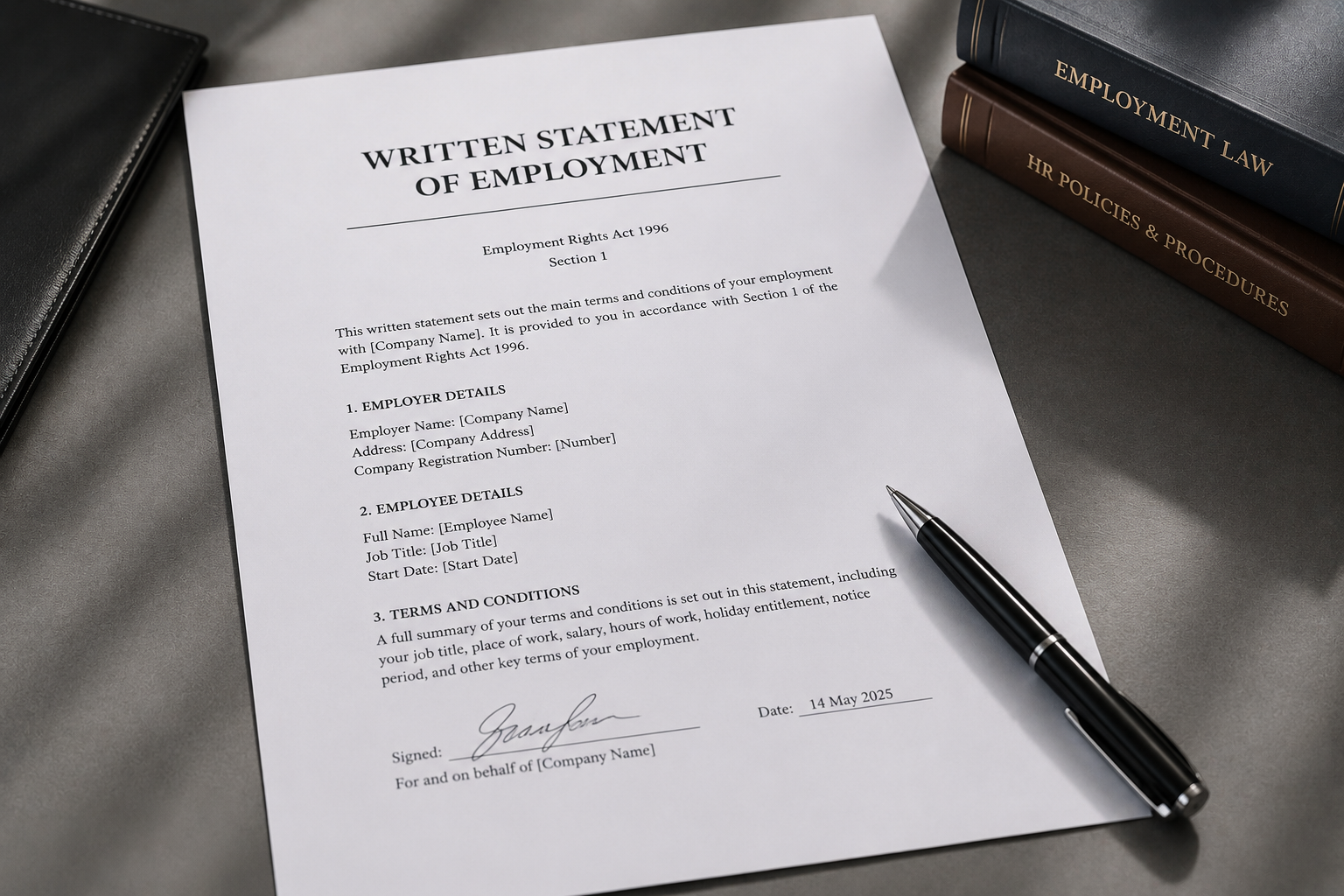
What Does a Written Statement Look Like?
There is no prescribed format.
It can be a standalone document or incorporated into a full employment contract.
What matters is that every mandatory term is included and the document is given to the employee on or before day one.
A typical written statement runs 3–5 pages and covers each statutory term under a clear heading.
Our template generates a professional, ERA 2025-compliant written statement from guided questions — covering every mandatory particular.
What Changed Under the ERA 2025?
The Employment Rights Act 2025 adds new mandatory content to written statements.
From April 2026, the statement must include:
- Right to join a trade union — new mandatory term
- Updated SSP information — reflecting day-one entitlement and removal of waiting days
- Updated family leave rights — day-one paternity and unpaid parental leave
If your written statement template was last updated before April 2026, it’s missing these terms.
That makes it non-compliant — and gives any employee an automatic uplift at tribunal.
For the full breakdown of every ERA 2025 change, see our Employment Rights Act 2025 — Complete Guide.
ERA 2025 Employment Pack — All 11 Templates
Complete Employment Toolkit • Contracts, Handbooks, Disciplinary, Grievance, Settlement & More • Save 49% vs Buying Individually
Lifetime Access • Free Updates • 30-Day Money-Back Guarantee*
Frequently Asked Questions
What are standard terms in an employment agreement?
Beyond the statutory minimum, most employment agreements also include confidentiality clauses, restrictive covenants, IP ownership, bonus and commission terms, and expenses policy.
The written statement covers the legal minimum. A full contract adds the commercial terms.
What happens if I don’t provide a written statement?
The employment is still valid.
But if the employee brings any tribunal claim, the tribunal can award two to four weeks’ additional pay — automatically — for the missing statement.
Do I need a separate written statement and contract?
No. Most employers combine both into one document.
As long as the document includes every mandatory particular, it satisfies the legal requirement.
Does this apply to workers as well as employees?
Yes. Since April 2020, the right to a written statement extends to workers — not just employees.
That includes zero hours workers, casual staff, and agency workers.
The Truth About “Free” Legal Template Sites (What You’re Really Signing Up For)
Most websites offering a “free legal template” follow the same pattern:
- You click because it’s advertised as free
- You spend 10–15 minutes answering questions
- At the very end, you must create an account or start a “free trial”
- Your card is required upfront
- The subscription auto-renews at £29–£39 per month
This isn’t a free template – it’s a subscription service. Many people only realise after being charged £300–£400 over the year.
Why These “Free” Templates Are a Legal Risk
- Outdated wording: not aligned with current UK law
- Missing mandatory clauses: required for legal validity
- No compliance guidance: leaving users without legal context
- No structured checklist: no way to verify the document works
- Not kept updated: often unchanged when legislation changes
One incorrect clause can weaken or invalidate the entire document.
Hidden Problem: Many “Free Template” Sites Aren’t Even UK-Based
Many free or auto-subscription template sites operate outside the UK.
They use documents drafted for the US legal system, then loosely adapted for “international use,” which creates serious problems:
- Incorrect terminology: taken from US contract law
- Missing UK statutory references: essential legal requirements omitted
- Non-applicable clauses: terms that don’t apply under UK legislation
- Legal conflicts: risks breaching UK consumer, employment, or GDPR rules
Why Templates UK Does the Opposite
- Drafted by UK professionals: written by experienced business & legal experts
- UK-law only: no US crossover or generic “international” templates
- One-time price from £10: no subscriptions, no renewals
- Full preview: see the exact document before buying
- Lifetime access: free lifetime updates included
My Templates Dashboard
All purchased templates are stored in your personal My Templates page, organised by category.
When we update a template for UK law changes, the new version appears automatically in your dashboard — free, forever.
Build a growing library of UK legal documents across every area of your business and personal life.
Transparent Pricing
From £10 per template — with free lifetime usage and free lifetime updates. No subscriptions. No renewals. No auto-billing.
Not ready to buy? Use our free interactive checklists to guide your own document — no payment required.
No tricks. No trials. No hidden fees. Just the exact UK-specific legal document you came for — at the price we told you upfront.
Build your own bespoke document with our Written Statement of Employment Template. Preview the full contract before buying — only pay when you’re happy with it.
Get Every Template in One Bundle
The UK Legal Templates Ultimate Bundle includes 91 templates across every category — one purchase, lifetime updates, no subscriptions.
Explore Template Bundles by Category
One purchase, lifetime updates, no subscriptions.
- Business Complete Suite — 37 templates, £199 (smaller packs available)
- Landlord Ultimate Bundle — 33 templates, £120 (smaller packs available)
- Complete Family Pack — 18 templates, £65 (smaller packs available)
- Complete Estate Pack — 8 templates, £49 (smaller packs available)
Explore the Master Business Legal Templates Pillar Guide
The complete overview of 37 essential UK business templates.
UK Business Legal Templates — Complete Master Guide
Explore All Templates UK Pillar Guides
- Family Law Documents Guide UK
- Wills & Estate Planning Guide UK
- Residential Landlord Documents Guide UK
- Employment Documents Guide UK
- How to Set Up a Business in the UK — Legal Guide
- Website Legal Documents UK — Compliance Guide
- Financial & Commercial Contracts UK — Protection Guide
- Commercial Office Lease Guide UK
- Digital & IP Agreements Guide UK
Related Guides
- Employment Rights Act 2025 — Complete Guide
- ERA 2025 Compliance Pack — 11 Templates
- Employment Documents Guide UK
- Job Offer Letter Guide UK
Free Legal Templates & Interactive Checklists
Access all our free UK legal templates, checklists and downloadable PDFs.
Last updated: May 2026
Disclaimer: This guide provides general UK legal information, not legal advice. Laws are current as of May 2026.