Updated: July 2026 • Based on UK Law • England Only
What Is Grounds for Possession Pre-Selection?
A pre-selection is the statutory grounds a landlord selects in the new Assured Periodic Tenancy (APT) — replacing the AST from 1 May 2026 — or in a Written Statement of Terms.
Under the Renters’ Rights Act 2025, advance notice genuinely matters for some grounds — most importantly Ground 4A (student HMO). This guide shows which grounds depend on what you set out at the start, and which are available automatically.
This guide covers which grounds genuinely matter at the start of the tenancy, which are optional to disclose, and which are available automatically with no advance-notice rule. Free interactive checklist included.
For student HMO landlords, miss Ground 4A and you lose the ability to recover the property for the next academic year. For most other grounds, possession does not depend on what you selected at the start.
✓ Select the right grounds from day one
Our Assured Periodic Tenancy Template walks you through every ground with plain-English explanations and tier-based pre-selection. Preview the full agreement before buying — only pay when you’re happy.
→ Already have an oral or unwritten tenancy? Use our Written Statement of Terms Template to bring it up to date for 1 May 2026.
Not sure where to start with all the new RRA paperwork? Our free Renters’ Rights Compliance Checklist maps every document, deadline, and obligation in one place.
Why Pre-Selection Matters Now
Section 21 is gone. From 1 May 2026, the only way out of an assured periodic tenancy is Section 8 — and Section 8 only works if you have a valid ground.
The same shift applies to rent — increases must now go through the statutory Section 13 Form 4A rent increase notice process.
Some grounds are available to every landlord automatically. Others must be flagged in writing at the start of the tenancy.
Miss the flag, and the ground is lost — sometimes permanently.
The most common example: a student HMO landlord who fails to include Ground 4A cannot recover the property for the next academic year. The students get to stay, indefinitely.
The tenancy agreement you sign on day one decides what you can do on day 365.
The Three Tiers: A Plain-English Decision Framework
Not every ground needs to be included. Not every ground is optional. There are three distinct tiers.
Understanding the difference is the difference between a clean possession claim and a tenant who can’t be moved.
⚠️ The legal commentary is divided.
Specialist legal publications (Pinsent Masons, Burges Salmon) treat several Section 8 grounds as requiring advance notice. Government guidance is less explicit. Where there is doubt, the safer course for a landlord is to include the ground.
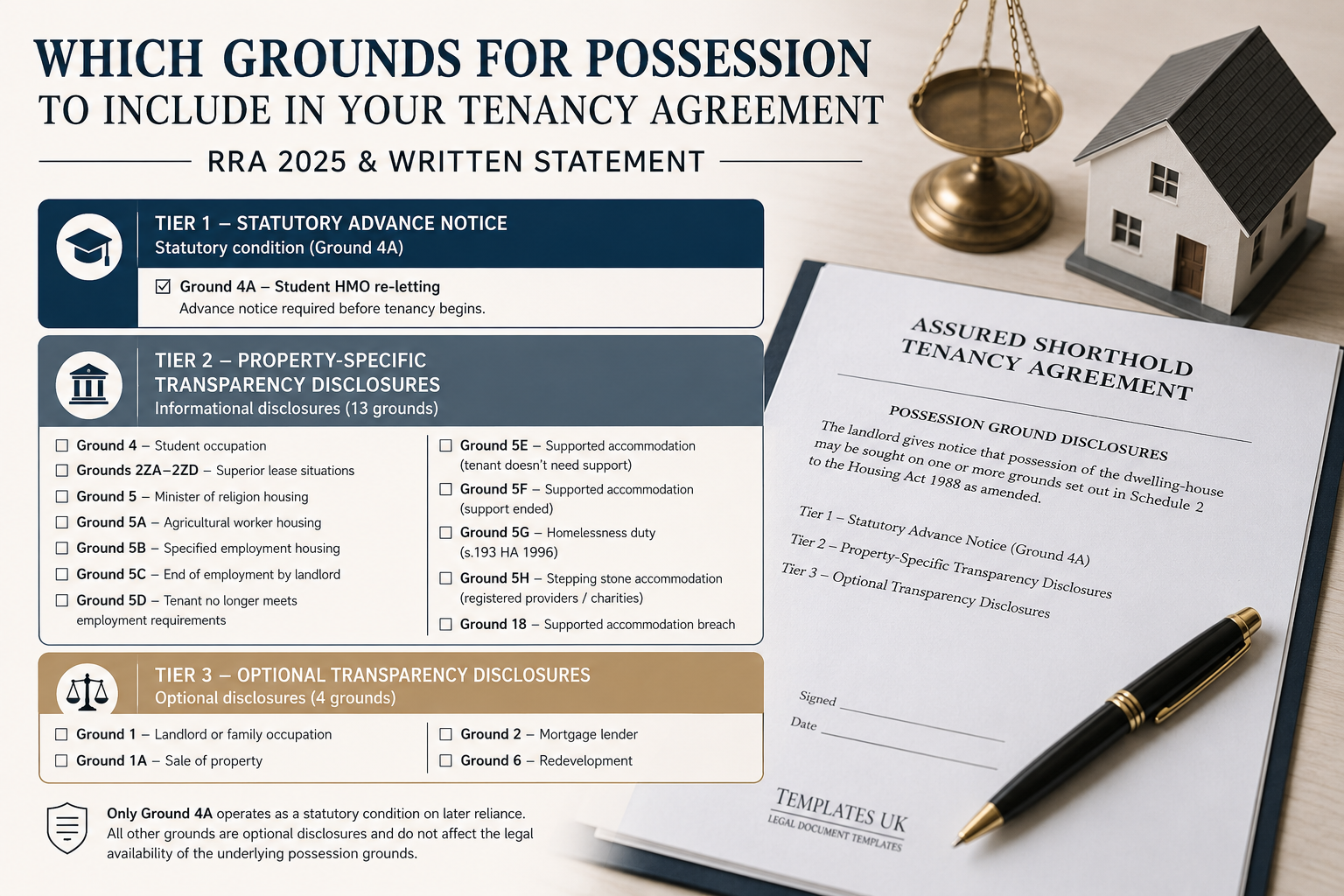
🎓 Tier 1 — Statutory Advance Notice (Ground 4A)
This is the only ground in the entire framework where advance notice operates as a clear statutory condition of reliance.
Without serving notice on the tenant before the tenancy begins, a landlord’s ability to rely on Ground 4A for the next academic year may be lost.
Ground 4A — Student HMO Re-Letting
What it does: Allows the landlord to recover possession between 1 June and 30 September so the property can be re-let to the next year’s student intake.
Who it’s for: Landlords letting an HMO to full-time students.
Conditions:
-
- The property is a House in Multiple Occupation (3+ tenants sharing toilet, bathroom or kitchen)
-
- All occupants are full-time students
-
- Possession is sought within the 1 June–30 September window
-
- The tenancy was not signed more than 6 months before move-in
-
- The landlord served advance notice of intention to rely on Ground 4A
⚠️ Critical for student landlords.
If you let to students and don’t include Ground 4A, you cannot recover the property at the end of the academic year. Your students become permanent periodic tenants. This is the single most important ground for any student HMO landlord to include.
🏛️ Tier 2 — Property-Specific Transparency Disclosures
These grounds depend on the specific character or use of the property.
Disclosing them at the start helps the tenant understand the property’s status from day one, and provides evidential clarity later if possession is needed.
Where there is doubt about whether non-disclosure carries a penalty, the safer course is to include where the property’s purpose matches the ground.
Ground 4 — Student Occupation
Preserves the right to recover possession where the property is needed for future student occupants. Distinct from 4A — Ground 4 is the broader status protection for student-let properties.
Grounds 2ZA–2ZD — Superior Lease Situations
Use these if you don’t own the freehold and your right to let the property comes from a head lease, agricultural tenancy, or registered provider arrangement.
Without them, if the superior lease ends, you may have no route to recover possession from your tenant.
Ground 5 — Minister of Religion Housing
Only relevant where the property is owned by a religious body and may be needed for a new minister.
Grounds 5A–5D — Employment-Related Housing
-
- Ground 5A: Agricultural worker housing — farm or estate property intended for agricultural workers
-
- Ground 5B: Specified employment housing — property held for someone meeting specific employment criteria
-
- Ground 5C: End of employment by landlord — common for live-in staff, school caretakers, on-site managers
-
- Ground 5D: Tenant no longer meets employment requirements
Grounds 5E–5H — Supported & Specialised Accommodation
-
- Ground 5E: Property held for supported accommodation where tenant doesn’t need support
-
- Ground 5F: Supported accommodation where support has ended or property no longer suitable
-
- Ground 5G: Homelessness duty ended (section 193 Housing Act 1996)
-
- Ground 5H: Stepping stone accommodation — registered providers and charities only
Ground 18 — Supported Accommodation Breach
Allows possession where the tenant is not engaging with the support services attached to a supported tenancy arrangement.
⚖️ Tier 3 — Optional Transparency Only
These four grounds carry no statutory or enforceable requirement of advance notice under the Renters’ Rights Act 2025.
Some landlords still choose to disclose them for transparency, to set tenant expectations early, or to reduce later dispute friction.
Disclosure here is informational only and does not affect the underlying availability of the ground if you ever need to use it.
Ground 1 — Landlord or Family Occupation
The landlord (or a parent, grandparent, sibling, child, or grandchild) intends to live in the property as their principal home.
Key restriction: Cannot be relied on in the first 12 months of the tenancy, regardless of whether you included it.
The 12-month protection runs from the start of the tenancy — and if you use Ground 1, you cannot re-let or market the property for 12 months after.
Ground 1A — Sale of Property
New ground introduced by the Renters’ Rights Act 2025. Allows possession where the landlord intends to sell.
Key restriction: Cannot be relied on in the first 12 months. After possession, the property cannot be re-let or marketed for 12 months — only sold or left empty.
Marketing or re-letting in breach of this restriction is a financial penalty offence under the Act.
Ground 2 — Mortgage Lender
Applies where the property is mortgaged and the lender requires vacant possession to enforce its security.
Under the RRA 2025, the mortgage no longer needs to predate the tenancy, and prior notice to the tenant is no longer required.
The notice period has increased from 2 months to 4 months.
Ground 6 — Redevelopment
The landlord intends to demolish or substantially reconstruct the property, and the work cannot reasonably be carried out with the tenant in occupation.
Examples include back-to-brick refurbishments, EPC-driven major works, or extensions requiring vacant possession.
Notice period is 4 months. Prior notice to the tenant is no longer required under the RRA 2025.
The Grounds You Don’t Need to Include at All
Several grounds are available to every landlord automatically and don’t appear in the tier list because there’s no decision to make.
Always Available — No Pre-Selection Needed
-
- Ground 7A: Serious anti-social behaviour (prior notice requirement removed by RRA 2025 — can be issued immediately when the ground is met)
-
- Ground 7B: No right to rent — tenant disqualified from renting due to immigration status (mandatory; available by operation of law)
-
- Ground 8: Mandatory rent arrears (3 months’ arrears at notice and hearing — 4 weeks’ notice)
-
- Grounds 10 & 11: Discretionary rent arrears (4 weeks’ notice)
-
- Ground 12: Breach of tenancy obligations (unchanged from Housing Act 1988)
-
- Ground 13: Property deterioration
-
- Ground 14: Discretionary anti-social behaviour
-
- Ground 14A: Domestic abuse — available to social landlords and registered providers only, so it does not apply to a standard private let
-
- Ground 14ZA: Riot offence — a tenant or adult occupant convicted of a serious offence during a riot
-
- Ground 15: Deterioration of furniture in a furnished let
-
- Ground 17: False statement inducing landlord to grant the tenancy
These grounds are part of every assured periodic tenancy by operation of law. You don’t need to disclose, include, or pre-select.
The Decision Process — A Simple Framework
Most landlords agonise over this far longer than they need to. Here’s the four-step decision process.
Step 1: Is the property let to students?
If yes, and the property is an HMO with 3+ full-time students, include Ground 4A. Also include Ground 4. Don’t skip this.
Step 2: Do you own the freehold outright?
If no — you’re letting under a head lease, an agricultural tenancy, or as a registered provider — include the relevant Ground 2ZA–2ZD.
Step 3: Does the property have a specific purpose?
Religious housing? Agricultural worker housing? Staff accommodation? Supported accommodation? Include the matching Tier 2 ground.
Step 4: Anything in Tier 3 you want to flag?
Planning to sell within a few years? Family member might need the property? Mortgage on the property? Major refurbishment planned?
Tier 3 disclosures are transparency-only — they don’t affect your legal rights — but they can soften the conversation later when you need to act.
What About Existing Tenancies?
The pre-selection rules apply to new tenancies signed on or after 1 May 2026.
Existing assured shorthold tenancies that convert to periodic on 1 May 2026 are subject to transitional provisions — but landlords with student HMOs already in occupation should pay close attention.
A modified Ground 4A applies to specified student tenancies during the transition, even if the property is not technically an HMO.
To rely on this transitional Ground 4A, the landlord must have issued a written statement of intention to rely on Ground 4A by 31 May 2026.
✓ Have an oral or unwritten tenancy?
By 31 May 2026, every existing assured tenancy that isn’t already in writing needs a Written Statement of Terms. Our Written Statement of Terms Template covers every mandatory clause and includes the same tiered grounds pre-selection.
Preview every clause before purchase. £10 one-off. No subscription.
Common Mistakes Landlords Make
Mistake 1: Selecting Every Ground “Just in Case”
Some landlords think more selections equals more protection. It doesn’t.
Including Ground 5A on a residential city-centre flat that has nothing to do with agriculture creates an inconsistency that any half-decent housing solicitor will spot in court.
Include what applies. Leave the rest.
Mistake 2: Skipping Ground 4A for a Student Let
The single most expensive error in this whole framework.
If you let a 4-bed student HMO and don’t include Ground 4A, you lose the right to recover the property at year-end. The students stay. Your business model breaks.
Mistake 3: Assuming Ground 1 Lets You Reclaim Quickly
Ground 1 cannot be used in the first 12 months of a tenancy regardless of whether you included it.
It’s also 4 months’ notice — not 2. The Renters’ Rights Act doubled the notice period.
Mistake 4: Forgetting the Superior Lease Grounds
If you’re a leaseholder letting a flat on a sub-tenancy, and your head lease has 15 years left, you need Ground 2ZA or 2ZB included.
Without it, when your head lease ends, you have no statutory mechanism to recover the property from the tenant — leaving you exposed to a claim from the freeholder.
Mistake 5: Treating It as a One-Time Decision
If your circumstances change — you take a new mortgage, you start planning a sale, the property converts to supported accommodation — review the pre-selection at the next tenancy renewal.
You can’t retrospectively add grounds to an existing tenancy. The pre-selection locks in at signing.
What Happens if You Get It Wrong
The consequences depend on which tier you missed.
-
- Missed Ground 4A: Lost academic year. Students remain until they choose to leave. No statutory route to recover for the next intake.
-
- Missed Tier 2 ground: Where legal commentary treats the ground as requiring advance notice, possession may be challenged, and a financial penalty for non-disclosure is possible.
-
- Missed Tier 3 ground: No legal consequence. Possession remains available. You may face a more difficult conversation with the tenant when you first raise the ground.
The asymmetry is sharp. Tier 1 omission is catastrophic. Tier 3 omission is cosmetic. Tier 2 sits somewhere in between, with the safer course being to disclose.
The Written Statement of Terms Connection
The pre-selection is set out in your tenancy agreement — or, where you don’t have a written tenancy agreement, in the Written Statement of Terms.
From 1 May 2026, every assured periodic tenancy needs a Written Statement of Terms before signing. The grounds pre-selection sits inside it.
Existing tenancies that are wholly or partly oral need a Written Statement of Terms served by 31 May 2026 — including, where relevant, the grounds disclosures.
A tenancy agreement that includes the full statutory information will normally double up as the Written Statement.
For oral or partial-written tenancies, the standalone Written Statement of Terms is the cleaner route.
Frequently Asked Questions
Do I have to include every ground in my tenancy agreement?
No. Only include the grounds that match your property and circumstances.
Including irrelevant grounds (like Ground 5A on a residential city flat) creates inconsistencies that can be challenged. The principle is “include what applies.”
What happens if I forget to include Ground 4A?
You cannot use Ground 4A to recover the property for the new academic year.
For student HMO landlords, this means the existing tenants can stay indefinitely as periodic tenants. No statutory route to recover for a new intake.
Can I add grounds to a tenancy agreement after signing?
Not for an existing tenancy. The pre-selection locks in at the start.
If the tenant agrees, you could enter into a new tenancy agreement with the updated pre-selection — but that creates a fresh tenancy with a new 12-month clock for Grounds 1 and 1A.
Are Grounds 1 and 1A really unavailable for the first 12 months?
Yes. Both Ground 1 (landlord/family occupation) and Ground 1A (sale) cannot be relied on until 12 months have passed from the start of the tenancy.
This restriction applies regardless of whether you included them in the agreement. The 12-month rule is statutory and cannot be contracted out of.
Do I need a tenancy agreement and a separate Written Statement of Terms?
Not normally. A properly drafted tenancy agreement will include all the Written Statement information.
The standalone Written Statement of Terms is for landlords with existing oral tenancies, or tenancies that are only partly in writing, who need to bring them up to date for 1 May 2026.
Is this tenancy agreement legally binding?
Yes. When completed and signed correctly, our tenancy agreement creates a legally recognised assured periodic tenancy under the law of England.
It includes professional legal structure, all mandatory Written Statement of Terms clauses, the three-tier grounds pre-selection, and proper signing requirements.
High-value or complex situations? Some customers opt for solicitor review before signing.
Do I need a solicitor to fill in the pre-selection?
Most landlords complete this confidently without one. Our template walks you through each tier with plain-English explanations and worked examples.
Consider solicitor review if you have high-value properties, mixed-use lets, multiple grounds applying simultaneously, or registered provider arrangements.
The Truth About "Free" Legal Template Sites (What You're Really Signing Up For)
Most websites offering a "free legal template" follow the same pattern:
- You click because it's advertised as free
- You spend 10–15 minutes answering questions
- At the very end, you must create an account or start a "free trial"
- Your card is required upfront
- The subscription auto-renews at £35–£42 per month
This isn't a free template – it's a subscription service. Many people only realise after being charged £300–£400 over the year.
Why These "Free" Templates Are a Legal Risk
- Outdated wording: not aligned with current UK law
- Missing mandatory clauses: required for legal validity
- No compliance guidance: leaving users without legal context
- No structured checklist: no way to verify the document works
- Not kept updated: often unchanged when legislation changes
One incorrect clause can weaken or invalidate the entire document.
Hidden Problem: Many "Free Template" Sites Aren't Even UK-Based
Another major issue is that many free or auto-subscription template sites operate outside the UK and use documents originally drafted for the US legal system. These are then loosely adapted for "international use," which creates serious problems:
- Incorrect terminology: taken from US contract law
- Missing UK statutory references: essential legal requirements omitted
- Non-applicable clauses: terms that don't apply under UK legislation
- Legal conflicts: risks breaching UK consumer, employment, or GDPR rules
Why Templates UK Does the Opposite
- Drafted by UK professionals: written by experienced business & legal experts
- UK-law only: no US crossover or generic "international" templates
- One-time price from £10.00: no subscriptions, no renewals
- Full preview: see the exact document before buying
- Lifetime access: free lifetime updates included
My Templates Dashboard
All purchased templates are stored in your personal My Templates page, organised by category.
Updated versions appear in your dashboard when we release them – free, forever.
Build a growing library of UK legal documents across every area of your business and personal life.
Transparent Pricing
From £10.00 per template – with free lifetime usage and free lifetime updates. No subscriptions. No renewals. No auto-billing.
Not ready to buy? Use our free interactive checklists to guide your own document – no payment required.
No tricks. No trials. No hidden fees. Just the exact UK-specific legal document you came for – at the price we told you upfront.
Build your own bespoke document with our Assured Periodic Tenancy Template. Preview the full contract before buying – only pay when you're happy with it.
Get the Largest Bundle — UK Legal Templates Ultimate Bundle
The UK Legal Templates Ultimate Bundle includes 91 templates across every category – one purchase, lifetime updates, no subscriptions.
Explore Template Bundles by Category
One purchase, lifetime updates, no subscriptions.
- Business Complete Suite – 37 templates, £199 (smaller packs available)
- Landlord Ultimate Bundle – 29 templates, £115 (smaller packs available)
- Renters' Rights Essential Pack – 26 templates, £99 (built for the Renters' Rights Act 2025)
- Complete Family Pack – 18 templates, £99 (smaller packs available)
- Complete Estate Pack – 10 templates, £161 (smaller packs available)
Browse Template Libraries
Explore our complete collection of professional templates by category.
- Residential Property Library – 28 templates
- Business Library – 25 templates
- Family & Relationships Library – 18 templates
- Employment Library – 17 templates
- Health & Safety Library – 10 templates
- Wills & Estate Library – 13 templates
- Construction & Trades Library – 2 templates
- Vehicle Sales Library – 2 templates
- Employee Templates Library – 2 templates
Explore the Master Business Legal Templates Pillar Guide
The complete overview of 37 essential UK business templates.
UK Business Legal Templates – Complete Master Guide
Explore All Templates UK Pillar Guides
- Family Law Documents Guide UK
- Wills & Estate Planning Guide UK
- Residential Landlord Documents Guide UK
- Employment Documents Guide UK
- How to Set Up a Business in the UK – Legal Guide
- Website Legal Documents UK – Compliance Guide
- Financial & Commercial Contracts UK – Protection Guide
- Commercial Office Lease Guide UK
- Digital & IP Agreements Guide UK
Related Guides
- Landlord Checklist for the Renters' Rights Act 2026
- Landlord Documents UK — The Complete Paper Trail After May 2026
- Government Information Sheet for Landlords UK
- Section 13 / Form 4A Rent Increase Notice Guide
Free Legal Templates & Interactive Checklists
Access all our free UK legal templates, checklists and downloadable PDFs.
Last updated: July 2026
Disclaimer: This guide provides general UK legal information, not legal advice. Laws are current as of July 2026.
The legal commentary on which grounds require advance notice is divided between specialist publications; where there is doubt, the safer course is to disclose.
Always verify current requirements with official sources. Existing customers can access the updated template free in their My Templates page.