Updated: April 2026 • Based on UK Law
What Is a Subcontractor Agreement in Construction?
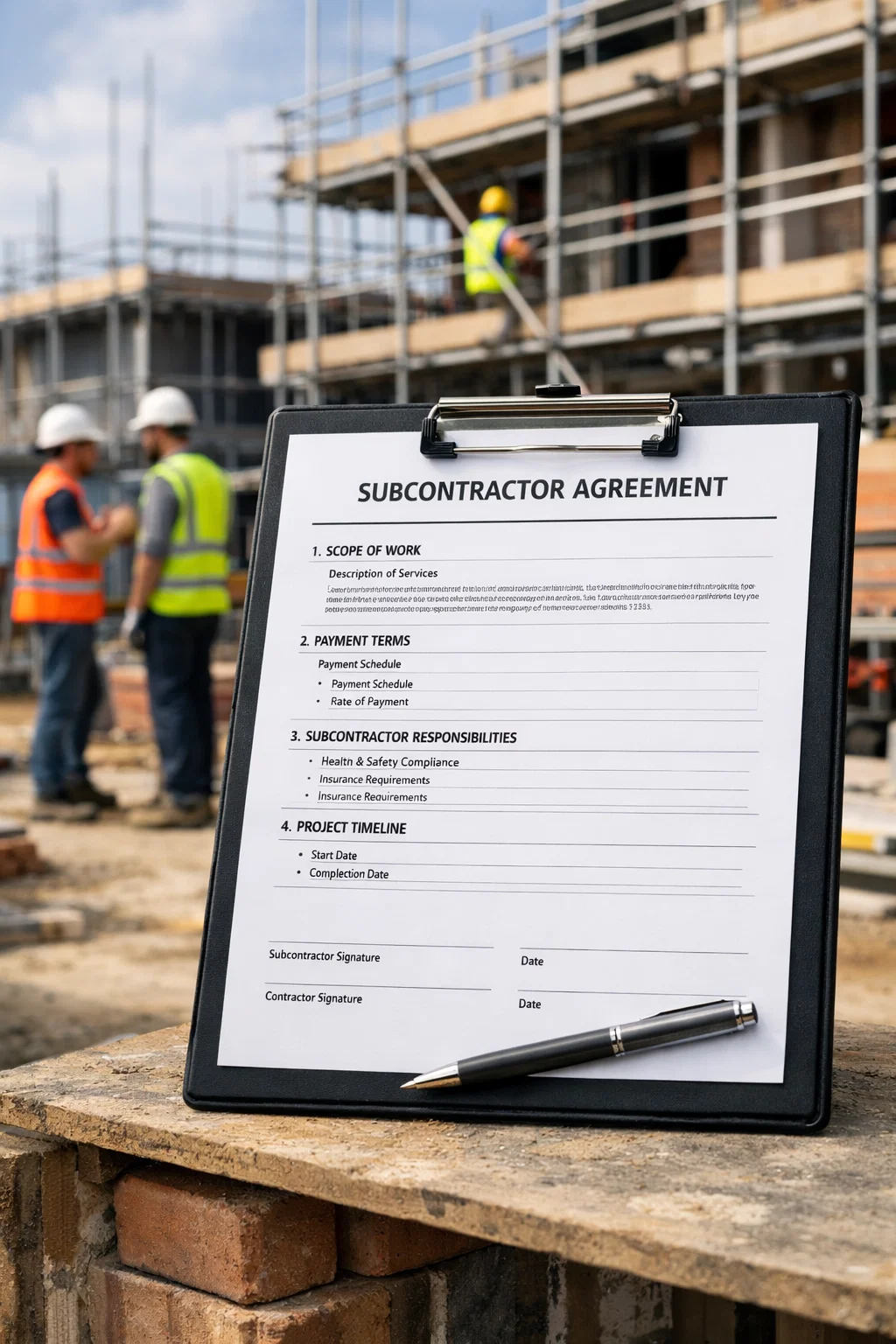
A subcontractor agreement is a legally binding contract between a main contractor and a subcontractor setting out the scope of work, payment terms, timelines, quality standards, and liability. It governs the relationship for a specific project or package of works within a larger construction contract.
This guide covers what a subcontractor agreement must include, who is liable, JCT contracts, CIS rules, and subcontractor types.
A main contractor hires a plastering subcontractor for a £40,000 package on a residential development.
No written agreement. Just a handshake and a price.
The work falls behind schedule. The finish quality is poor. The client withholds payment from the main contractor.
The main contractor wants to back-charge the subcontractor — but there’s no written scope of works, no completion date, and no defects clause.
He has no contractual basis to withhold, deduct, or terminate.
The subcontractor walks off site. The main contractor pays someone else to finish the work — and absorbs the cost.
A written agreement would have defined the scope, the deadline, and the right to back-charge.
Without one, the main contractor carries all the risk.
✓ Subcontractor Agreement — Construction (UK)
Answer guided questions or use the classic editor — your subcontractor agreement is built for you. Covers scope of works, payment terms, CIS deductions, programme and completion, quality and defects, insurance, indemnities, termination, and dispute resolution. Structured following UK construction and contract law. Preview every clause before buying — only pay when you’re happy with it.
Do You Need a Subcontractor Agreement?
There is no legal requirement to have a written subcontractor agreement.
A verbal agreement is technically binding — but almost impossible to enforce when things go wrong.
Without a written agreement, you have no contractual basis to:
-
- Withhold payment for defective work
-
- Back-charge for delays or rework
-
- Enforce a completion deadline
-
- Require insurance or indemnity cover
-
- Terminate for poor performance
-
- Protect yourself against claims from the client
The Housing Grants, Construction and Regeneration Act 1996 (the “Construction Act”) also requires certain payment provisions.
These include the right to stage payments, payment notices, and adjudication.
Without a written agreement incorporating these, the Scheme for Construction Contracts fills the gaps — and those default terms may not favour you.
What Should Be Included in a Subcontractor Agreement?
A proper construction subcontractor agreement should cover:
-
- Scope of works — what exactly the subcontractor is responsible for, referencing drawings, specifications, or bills of quantities
-
- Contract sum and payment terms — the price, how and when payments are made, retention, and CIS deductions
-
- Programme and completion — start date, completion date, key milestones, and liquidated damages for delay
-
- Variations — how changes to the scope are agreed and priced
-
- Quality and defects — workmanship standards, inspection rights, defects liability period, and the right to back-charge
-
- Insurance — public liability, employers’ liability, and professional indemnity where applicable
-
- Health and safety — compliance with the main contractor’s site rules and CDM 2015 obligations
-
- Indemnities — the subcontractor indemnifies the main contractor against claims arising from their work
-
- Termination — grounds for termination by either party and the consequences
-
- Dispute resolution — adjudication (mandatory under the Construction Act), mediation, or arbitration
Who Is Responsible for Subcontractors’ Work in the UK?
The main contractor.
To the client, the main contractor is responsible for all work on site — whether performed by their own team or by subcontractors.
If a subcontractor’s work is defective, the client holds the main contractor liable.
The main contractor then has to recover the loss from the subcontractor.
That’s only possible with a written agreement that includes defects clauses and indemnities.
This is why a “back-to-back” subcontract matters.
It mirrors the obligations in the main contract down to the subcontractor.
Any risk the main contractor carries from the client is passed to the party actually doing the work.
What Are the Three Types of Subcontractors?
1. Domestic subcontractors.
Selected and appointed directly by the main contractor.
The main contractor chooses who to use and manages the relationship. This is the most common type.
2. Named subcontractors.
The client specifies which subcontractor should be used (or provides a shortlist).
The main contractor enters into the contract with them and retains contractual responsibility.
3. Nominated subcontractors.
The client selects and appoints the subcontractor, and the main contractor is required to engage them.
Less common now — JCT removed nomination provisions from its 2005 suite onwards due to complex liability issues.
What Is a JCT Contract?
JCT stands for the Joint Contracts Tribunal.
It produces standard-form construction contracts used on approximately 70% of UK building projects.
The JCT suite includes main contracts, subcontracts, and supporting documents covering most procurement routes and project sizes.
The main JCT contract families are:
-
- Standard Building Contract (SBC) — large, complex projects with detailed specifications
-
- Design and Build Contract (DB) — where the contractor takes on design responsibility
-
- Intermediate Building Contract (IC) — medium-complexity projects without specialist installations
-
- Minor Works Contract (MW) — smaller, straightforward projects
-
- Major Project Contract (MP) — large projects where the contractor bears greater risk
Each family has corresponding subcontract forms — so the subcontract terms align with the main contract.
What Are the 5 Elements of a Construction Contract?
Every enforceable construction contract contains five core elements:
1. Offer and acceptance.
One party offers to do work for a price. The other accepts. This can be formal (signed contract) or informal (exchange of emails).
2. Consideration.
Something of value exchanged — usually money for work. Without consideration, there is no contract.
3. Intention to create legal relations.
Both parties must intend the agreement to be legally binding. In commercial construction, this is presumed.
4. Capacity.
Both parties must have the legal capacity to enter into a contract — they must be of sound mind, of age, and not acting under duress.
5. Certainty of terms.
The essential terms — scope, price, and timeline — must be clear enough to be enforceable. Vague or incomplete terms can render a contract void.
What Are the Requirements of a Subcontractor?
In the UK construction industry, a subcontractor typically needs:
-
- CIS registration — register with HMRC to receive payments at 20% deduction instead of 30%
-
- Public liability insurance — most main contractors require a minimum of £1–5 million cover
-
- Employers’ liability insurance — legally mandatory if the subcontractor has any employees
-
- CSCS card — required for site access on most UK construction sites
-
- Relevant trade qualifications — Gas Safe, NICEIC, FGAS, or equivalent depending on the trade
-
- Health and safety competence — SSSTS, SMSTS, or equivalent management qualifications for supervisory roles
-
- Right to work — evidence that all workers are legally entitled to work in the UK
From April 2026, CIS contractors must also file nil returns in months with no subcontractor payments — or notify HMRC of inactivity in advance.
Frequently Asked Questions
What is a standard subcontractor agreement?
A standard subcontractor agreement is a pre-drafted contract covering the typical terms for construction subcontracting.
That means scope, price, programme, quality, insurance, and termination.
JCT publishes standard-form subcontracts designed to work with its main contracts.
Our template provides the same coverage in a more accessible format — with both Interview and Editor modes.
What contracts are used in UK construction?
JCT contracts are used on approximately 70% of UK building projects.
Other standard forms include NEC (New Engineering Contract), FIDIC (international projects), and ICE (civil engineering).
Many smaller projects use bespoke agreements drafted specifically for the job.
Can a subcontractor work without a written agreement?
Legally, yes. A verbal agreement is binding.
Practically, it’s a serious risk.
Without written terms, disputes over scope, quality, payment, and completion become almost impossible to resolve.
What is the CIS deduction rate?
20% for registered subcontractors. 30% for unregistered subcontractors.
Deductions count as advance payments towards the subcontractor’s tax and National Insurance.
The Truth About “Free” Legal Template Sites (What You’re Really Signing Up For)
Most websites offering a “free legal template” follow the same pattern:
-
- You click because it’s advertised as free
-
- You spend 10–15 minutes answering questions
-
- At the very end, you must create an account or start a “free trial”
-
- Your card is required upfront
-
- The subscription auto-renews at £29–£39 per month
This isn’t a free template – it’s a subscription service. Many people only realise after being charged £300–£400 over the year.
Why These “Free” Templates Are a Legal Risk
-
- Outdated wording: not aligned with current UK law
-
- Missing mandatory clauses: required for legal validity
-
- No compliance guidance: leaving users without legal context
-
- No structured checklist: no way to verify the document works
-
- Not kept updated: often unchanged when legislation changes
One incorrect clause can weaken or invalidate the entire document.
Hidden Problem: Many “Free Template” Sites Aren’t Even UK-Based
Many free or auto-subscription template sites operate outside the UK.
They use documents drafted for the US legal system, then loosely adapted for “international use,” which creates serious problems:
-
- Incorrect terminology: taken from US contract law
-
- Missing UK statutory references: essential legal requirements omitted
-
- Non-applicable clauses: terms that don’t apply under UK legislation
-
- Legal conflicts: risks breaching UK consumer, employment, or GDPR rules
Why Templates UK Does the Opposite
-
- Drafted by UK professionals: written by experienced business & legal experts
-
- UK-law only: no US crossover or generic “international” templates
-
- One-time price from £10: no subscriptions, no renewals
-
- Full preview: see the exact document before buying
-
- Lifetime access: free lifetime updates included
My Templates Dashboard
All purchased templates are stored in your personal My Templates page, organised by category.
When we update a template for UK law changes, the new version appears automatically in your dashboard — free, forever.
Build a growing library of UK legal documents across every area of your business and personal life.
Transparent Pricing
From £10 per template — with free lifetime usage and free lifetime updates. No subscriptions. No renewals. No auto-billing.
Not ready to buy? Use our free interactive checklists to guide your own document — no payment required.
No tricks. No trials. No hidden fees. Just the exact UK-specific legal document you came for — at the price we told you upfront.
Build your own bespoke document with our Subcontractor Agreement — Construction Template. Preview the full contract before buying — only pay when you’re happy with it.
Get Every Template in One Bundle
The UK Legal Templates Ultimate Bundle includes 91 templates across every category — one purchase, lifetime updates, no subscriptions.
Explore Template Bundles by Category
One purchase, lifetime updates, no subscriptions.
-
- Business Complete Suite — 37 templates, £199 (smaller packs available)
-
- Landlord Ultimate Bundle — 33 templates, £120 (smaller packs available)
-
- Complete Family Pack — 18 templates, £65 (smaller packs available)
-
- Complete Estate Pack — 8 templates, £49 (smaller packs available)
Explore the Master Business Legal Templates Pillar Guide
The complete overview of 37 essential UK business templates.
UK Business Legal Templates — Complete Master Guide
Explore All Templates UK Pillar Guides
Related Guides
Free Legal Templates & Interactive Checklists
Access all our free UK legal templates, checklists and downloadable PDFs.
Last updated: April 2026
Disclaimer: This guide provides general UK legal information, not legal advice. Laws are current as of April 2026.