Updated: June 2026 • Based on UK Law
What Do You Need to Install EV Chargers in the UK?
Installing EV and V2H chargers in the UK is notifiable electrical work. Installers need core electrical qualifications, a dedicated EV charging award, competent-person scheme registration, and must notify the DNO and follow BS 7671 and the Smart Charge Points Regulations.
This guide covers EV charger installer qualifications, UK EV laws, DNO approval and Building Regulations, plus the installer contract you need on every job.
A sole-trader electrician fits a 7kW charger on a Friday afternoon. No written contract — just a verbal price.
The customer asks for “a couple of extra sockets while you’re here.”
Then a second visit. Then a third. None of it priced in writing.
The final invoice arrives. The customer disputes it — they “never agreed to that much.”
There’s no record of who was responsible for the DNO notification.
No agreed payment stages. No scope. No liability cap.
The installer is out of pocket — and exposed.
A written installation contract would have prevented every part of this. It costs less than a single callout.
✓ EV & V2H Battery Installation Contract — £25
A complete installer-to-client contract covering scope of works, staged payments, warranties, DNO notification and cancellation rights.
Build it with guided questions or the classic editor.
Preview every clause before buying — only pay when you’re happy.
Pay once and own it forever. Lifetime access, no subscriptions.
→ Get the EV & V2H Installation Contract
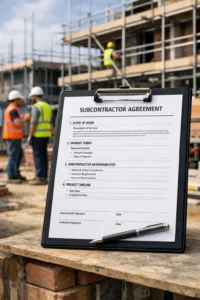
Hiring subcontractors? See our Construction Subcontractor Agreement →
What Qualifications Do I Need to Install EV Chargers?
To install EV chargers professionally in the UK, you need two layers of qualification.
1. Core electrical competence.
-
- NVQ Level 3 Diploma in Electrical Installation (or equivalent)
-
- 18th Edition Wiring Regulations (BS 7671), kept current with amendments
2. A dedicated EV charging qualification.
The recognised award is the City & Guilds 2921 series.
Most commonly that’s the 2921-34 Level 3 Award for domestic and small commercial EV charging.
It covers load assessment, smart charger configuration, earthing and PME fault protection.
Plus competent-person scheme registration.
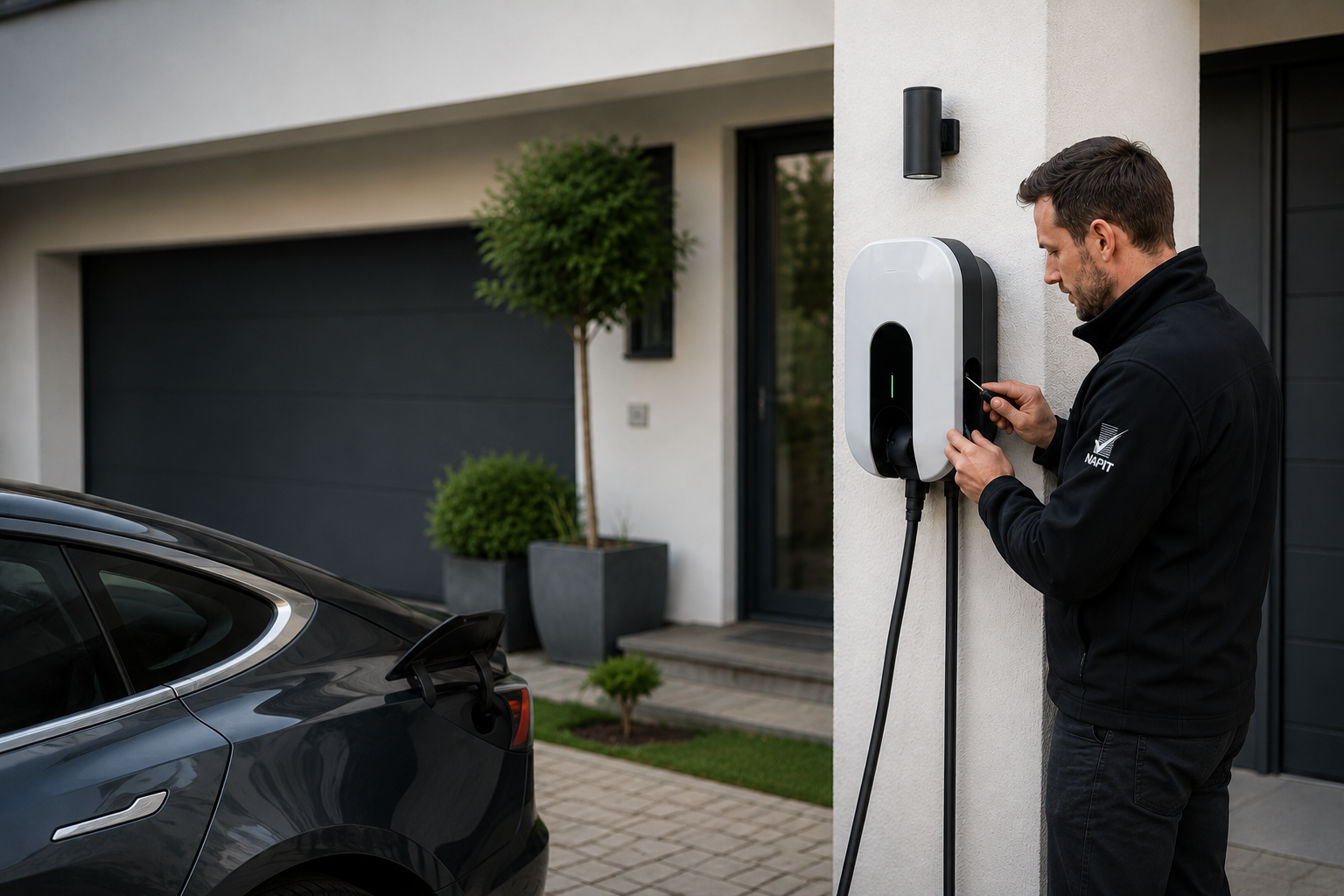
To self-certify your work, register with a Part P scheme such as NICEIC, NAPIT or Stroma (Certsure).
For government grant-funded jobs, you also need OZEV-approved installer status.
Coming 1 October 2026: under updated EAS rules, each person physically installing a charge point is expected to hold their own Level 3 EV qualification — not just the firm.
Can a Qualified Electrician Install an EV Charger in the UK?
Yes — but being a qualified electrician alone is not the full picture.
EV chargers draw sustained high loads.
A 7.4kW unit pulls around 32A continuously — far more than everyday appliances.
That brings load management, smart functionality and earthing arrangements a general electrician may not be trained in.
So can any electrician install one? In practice, no.
The dedicated 2921 award exists precisely because EV charging sits beyond standard installation work.
It is also what schemes like NICEIC and NAPIT, and OZEV grant approval, expect you to hold.
If you offer this service, your client contract should record your registrations and certification responsibilities clearly.
Is It Legal to Install Your Own EV Charger in the UK?
EV charger installation is notifiable work under Part P of the Building Regulations.
That means it must either be done by a registered competent person, or notified to local authority building control for inspection.
A homeowner attempting a DIY install faces real risks:
-
- Building control exposure: unnotified notifiable work can breach the regulations
-
- Insurance issues: uncertified electrical work can affect home insurance
-
- Warranty problems: manufacturers require installation to their instructions by a competent person
-
- No DNO notification: the grid operator is left unaware of the new load
This is exactly why customers use registered installers.
As the professional, you carry the certification and notification duties — and a written contract is how you set out who is responsible for what.
What Is the EV Law in the UK?
Several rules govern EV charger installation. The main ones to know:
The Electric Vehicles (Smart Charge Points) Regulations 2021.
New home and workplace chargers must have smart functionality — a pre-set charging schedule and a random delay of up to 10 minutes.
Non-smart chargers can no longer be sold for new installations.
Building Regulations Part S (England).
In force since June 2022, new dwellings with associated parking must have an EV charge point.
BS 7671 (18th Edition), Section 722.
Sets the wiring and protection requirements specific to EV charging, including PME and open-PEN fault protection.
Part P notification and planning.
The work is notifiable.
Most wall-mounted chargers are permitted development, but listed buildings and conservation areas can need permission.
Do You Need DNO Approval to Install an EV Charger?
The Distribution Network Operator (DNO) must be notified of every new EV charger.
The route depends on the load.
Standard single-phase chargers (connect and notify).
For a typical charger within the property’s supply limits, the installer usually notifies the DNO after commissioning — often within 28 days.
Higher loads (apply and connect).
Where total demand exceeds the supply limit, or for three-phase work, approval is needed before installation begins.
Bidirectional V2H and V2G.
These export power, so they count as generation and storage.
Exporting above 3.68kW per phase generally needs G99 approval first.
The DNO may also apply export limiting (G100) or restrict export in constrained areas.
Approval can take 30–60 working days, so it belongs in your schedule — and in your contract.
Can I Have Two EV Chargers at Home in the UK?
Yes — two-car households increasingly ask for it.
The limit is the property’s electrical supply, not the law.
A standard 100A single-phase supply has finite headroom once you add a shower, heat pump or solar.
Two 7kW chargers running together can push total demand past that ceiling.
The usual solution is dynamic load management — balancing the chargers against the rest of the load.
Either way, the DNO must be notified, and a three-phase upgrade may be the answer for higher combined loads.
For installers, this is a scope and pricing question — both best fixed in writing before work starts.
How Much Does It Cost to Get an EV Charger Installed at Home in the UK?
In 2026, a standard 7kW home charger installation typically costs £800–£1,200, covering the unit and labour.
Complex jobs run higher — long cable runs, consumer unit upgrades or groundworks can push it past £2,000.
Three-phase upgrades for 22kW charging add several thousand pounds and are rarely needed for homes.
V2H is a different tier — bidirectional hardware alone often runs into thousands before installation.
For installers, the lesson is margin protection.
Two quotes for “the same” job can differ by hundreds because of the property, not the charger.
A clear scope, staged payments and a variations clause are what keep a fixed-price quote profitable.
Why Every EV & V2H Installer Needs a Written Contract
Qualifications get you on site. A contract protects you once you’re there.
Most installer disputes come down to the same few gaps:
-
- Scope creep: “while you’re here” requests with no variations clause
-
- Payment disputes: no agreed deposit or staged schedule
-
- DNO confusion: no written record of who notifies the network operator
-
- Warranty arguments: unclear workmanship versus manufacturer cover
-
- Cancellation rights: for work sold at a distance or in the home, missing the required cancellation notice can extend a customer’s right to cancel to 12 months
Our EV & V2H Battery Installation Contract is a 17-section agreement built for exactly this.
It sets out the scope of works, system specification and staged payment schedule.
It also covers workmanship and manufacturer warranties, and DNO notification responsibility.
It includes cancellation rights, a liability limit, force majeure and dispute resolution for England and Wales.
It is structured following the Consumer Rights Act 2015 and the Consumer Contracts Regulations 2013, with reference to BS 7671.
Build it once with guided questions or the classic editor, then reuse it for every job — there’s no limit on the contracts you can produce.
Frequently Asked Questions
Do EV charger installers need to be NICEIC or NAPIT registered?
To self-certify under Part P, yes — you register with a competent-person scheme such as NICEIC, NAPIT or Stroma.
Without it, each job must be notified to local authority building control, which adds cost and delay.
Is the City & Guilds 2921 qualification mandatory?
It is the recognised industry award and is expected by competent-person schemes and OZEV.
From 1 October 2026, updated EAS rules move toward each installer holding their own Level 3 EV qualification.
Does the installer handle DNO notification, or the homeowner?
In practice the installer handles it as part of the job.
Putting that responsibility in writing avoids the most common after-the-fact dispute.
Does a V2H installation need different approval to a standard charger?
Usually, yes. Because V2H exports power, it counts as generation and storage.
Export above 3.68kW per phase generally needs DNO approval before installation, unlike a standard connect-and-notify charger.
Do I need a written contract for every EV installation?
It is strongly advisable. One purchase of our EV & V2H Installation Contract gives you a reusable template for every job.
Generate a fresh contract per client by changing the details — no recurring fees.
The Truth About “Free” Legal Template Sites (What You’re Really Signing Up For)
Most websites offering a “free legal template” follow the same pattern:
-
- You click because it’s advertised as free
-
- You spend 10–15 minutes answering questions
-
- At the very end, you must create an account or start a “free trial”
-
- Your card is required upfront
-
- The subscription auto-renews at £29–£39 per month
This isn’t a free template – it’s a subscription service. Many people only realise after being charged £300–£400 over the year.
Why These “Free” Templates Are a Legal Risk
-
- Outdated wording: not aligned with current UK law
-
- Missing mandatory clauses: required for legal validity
-
- No compliance guidance: leaving users without legal context
-
- No structured checklist: no way to verify the document works
-
- Not kept updated: often unchanged when legislation changes
One incorrect clause can weaken or invalidate the entire document.
Hidden Problem: Many “Free Template” Sites Aren’t Even UK-Based
Many free or auto-subscription template sites operate outside the UK.
They use documents drafted for the US legal system, then loosely adapted for “international use,” which creates serious problems:
-
- Incorrect terminology: taken from US contract law
-
- Missing UK statutory references: essential legal requirements omitted
-
- Non-applicable clauses: terms that don’t apply under UK legislation
-
- Legal conflicts: risks breaching UK consumer, employment, or GDPR rules
Why Templates UK Does the Opposite
-
- Drafted by UK professionals: written by experienced business & legal experts
-
- UK-law only: no US crossover or generic “international” templates
-
- One-time price from £10.00: no subscriptions, no renewals
-
- Full preview: see the exact document before buying
-
- Lifetime access: free lifetime updates included
My Templates Dashboard
All purchased templates are stored in your personal My Templates page, organised by category.
Updated versions appear in your dashboard when we release them — free, forever.
Build a growing library of UK legal documents across every area of your business and personal life.
Transparent Pricing
From £10.00 per template — with free lifetime usage and free lifetime updates. No subscriptions. No renewals. No auto-billing.
Not ready to buy? Use our free interactive checklists to guide your own document — no payment required.
No tricks. No trials. No hidden fees. Just the exact UK-specific legal document you came for — at the price we told you upfront.
Build your own bespoke document with our EV & V2H Battery Installation Contract. Preview the full contract before buying — only pay when you’re happy with it.
Explore the Master Business Legal Templates Pillar Guide
The complete overview of 37 essential UK business templates.
UK Business Legal Templates — Complete Master Guide
Explore All Templates UK Pillar Guides
Related Guides
Free Legal Templates & Interactive Checklists
Access all our free UK legal templates, checklists and downloadable PDFs.
Last updated: June 2026
Disclaimer: This guide provides general UK legal information, not legal advice. Laws are current as of June 2026.