Updated: April 2026 • Based on UK Law
What Is a First Aid Policy?
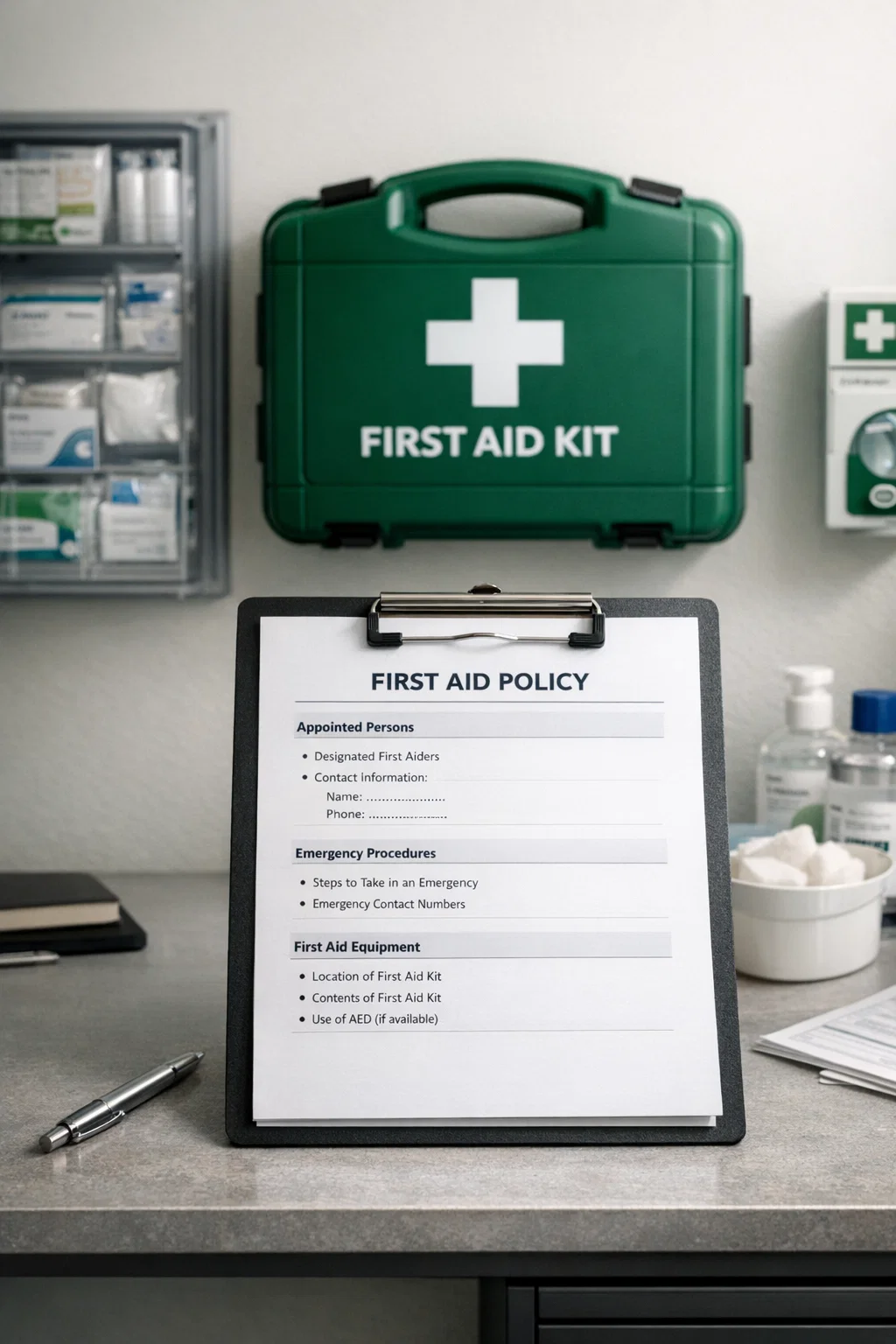
A first aid policy is a written document setting out how an employer will provide first aid in the workplace — covering equipment, trained personnel, emergency procedures, cover arrangements, and accident reporting. Required under the Health and Safety (First-Aid) Regulations 1981, it applies to all UK employers regardless of size.
This guide covers UK first aid law, how many first aiders you need, training requirements, and common questions about liability and pay.
Every UK employer must provide first aid — regardless of size.
Even a sole trader working from home has obligations.
✓ First Aid Policy Template (UK)
Answer guided questions or use the classic editor — your first aid policy is built for you. Covers first aid arrangements, appointed persons, equipment, training records, and emergency procedures. Structured following the Health and Safety (First-Aid) Regulations 1981. Preview every section before buying — only pay when you’re happy with it. One-time price from £10.
Need all 5 workplace essentials? Save 42% with the Workplace Essentials Pack — DSE Assessment, Manual Handling Risk Assessment, Working from Home Risk Assessment, Accident Report Form & First Aid Policy. Just £29, lifetime access, lifetime updates.
What Does a First Aid Policy Need to Include?
A first aid policy should cover:
-
- Who the appointed person or first aider is — names, locations, and contact details
-
- Where first aid equipment is kept — locations of all first aid kits and any specialist equipment
-
- Emergency procedures — how to call for help, what to do while waiting for an ambulance
-
- Training records — who is trained, what level, when certificates expire
-
- Cover arrangements — what happens when the first aider is on holiday or absent
-
- Accident reporting — how incidents are recorded and when RIDDOR reporting is required
The policy must be communicated to all employees.
Display a notice showing who the first aiders are, where the first aid kit is, and how to contact emergency services.
What Is the First Aid Law in the UK?
The primary legislation is the Health and Safety (First-Aid) Regulations 1981.
These require every employer to provide “adequate and appropriate” equipment, facilities, and personnel.
The goal is to ensure employees receive immediate attention if they are injured or become ill at work.
The Regulations apply to all workplaces — including those with five or fewer employees.
They also apply to the self-employed.
What counts as “adequate and appropriate” depends on your first aid needs assessment.
This is a review of your workplace hazards, workforce size, work patterns, and proximity to emergency medical services.
How Many First Aiders Do You Need in the UK?
There is no single number written into law.
The answer depends on your first aid needs assessment.
However, the HSE provides recommended minimum numbers:
Low-risk workplaces (offices, shops, libraries):
-
- Fewer than 25 employees — at least one appointed person
-
- 25–50 employees — at least one EFAW-trained first aider
-
- More than 50 employees — at least one FAW-trained first aider per 100 employees
Higher-risk workplaces (construction, manufacturing, warehouses, food processing):
-
- Fewer than 5 employees — at least one appointed person
-
- 5–50 employees — at least one FAW-trained first aider
-
- More than 50 employees — one additional FAW-trained first aider per 50 employees
You must also ensure cover during holidays, absences, and shift changes.
An appointed person manages first aid arrangements and calls the ambulance — but does not need formal first aid training.
An EFAW first aider (Emergency First Aid at Work) completes a one-day course.
A FAW first aider (First Aid at Work) completes a three-day course.
Can I Refuse to Be a First Aider at Work in the UK?
Yes.
There is no legal obligation on an employee to become a first aider.
The duty sits with the employer — not the employee.
An employer can ask you to take on the role, but they cannot force you.
If you do agree, the employer must provide (and pay for) your training. You should not be penalised for declining.
Can You Be Prosecuted for Offering First Aid in the UK?
This is a common concern — and the answer is reassuring.
In the UK, there is no specific “Good Samaritan” law.
But there is also no history of successful prosecution against someone who gave first aid in good faith.
The key legal principle is duty of care.
If you act reasonably, within your training, and in the best interests of the injured person, you are protected.
The risk of doing nothing is far greater — both morally and legally — than the risk of helping.
If you are a designated workplace first aider, your employer’s insurance covers you while acting in that role.
Do First Aiders Get Paid Extra in the UK?
There is no legal requirement for employers to pay first aiders extra.
Some employers offer a small allowance — typically £50–£200 per year — as recognition.
Others factor it into the job description or offer time off in lieu for training days.
What the employer must do is pay for the training itself and allow time during working hours to complete it.
What Are the Six Pack Regulations in the UK?
The “Six Pack” is an informal name for six key health and safety regulations introduced in 1992 to implement EU directives.
They are:
-
- Management of Health and Safety at Work Regulations 1999 (originally 1992) — risk assessments, competent persons, emergency procedures
-
- Workplace (Health, Safety and Welfare) Regulations 1992 — temperature, lighting, ventilation, sanitation, rest areas
-
- Health and Safety (Display Screen Equipment) Regulations 1992 — workstation assessments, eye tests, breaks
-
- Manual Handling Operations Regulations 1992 — avoid, assess, and reduce risk from lifting and carrying
-
- Provision and Use of Work Equipment Regulations 1992 (PUWER) — equipment must be suitable, maintained, and used safely
-
- Personal Protective Equipment at Work Regulations 1992 — PPE must be provided, maintained, and used correctly
The First Aid Regulations 1981 sit alongside these but are not part of the “Six Pack” — they predate them by over a decade.
Workplace Essentials Pack — All 5 Templates
Complete Workplace Toolkit • DSE, Manual Handling, Home Working, Accident Reporting & First Aid • Save 42% vs Buying Individually
Lifetime Access • Free Updates • 30-Day Money-Back Guarantee*
Frequently Asked Questions
What qualifications do you need to teach first aid in the UK?
First aid training organisations must be approved by the HSE (or an Ofqual-regulated awarding body).
Individual trainers typically need a current FAW certificate and a recognised teaching qualification (such as Level 3 Award in Education and Training).
Relevant practical experience is also required.
What must a first aid kit contain?
The HSE recommends a minimum of: sterile plasters, sterile eye pads, triangular bandages, safety pins, sterile wound dressings (medium and large), disposable gloves, and a guidance leaflet.
Your first aid needs assessment may identify additional items — such as burn dressings, eye wash, or a defibrillator.
How often should first aid training be renewed?
FAW certificates are valid for three years.
EFAW certificates are also valid for three years.
The HSE recommends annual refresher training to keep skills current between renewals.
What happens if my employer doesn’t provide first aid?
Failure to comply with the First Aid Regulations is a criminal offence.
The HSE can issue improvement notices, prohibition notices, or prosecute — with penalties including fines and, in serious cases, imprisonment.
The Truth About “Free” Legal Template Sites (What You’re Really Signing Up For)
Most websites offering a “free legal template” follow the same pattern:
-
- You click because it’s advertised as free
-
- You spend 10–15 minutes answering questions
-
- At the very end, you must create an account or start a “free trial”
-
- Your card is required upfront
-
- The subscription auto-renews at £29–£39 per month
This isn’t a free template – it’s a subscription service. Many people only realise after being charged £300–£400 over the year.
Why These “Free” Templates Are a Legal Risk
-
- Outdated wording: not aligned with current UK law
-
- Missing mandatory clauses: required for legal validity
-
- No compliance guidance: leaving users without legal context
-
- No structured checklist: no way to verify the document works
-
- Not kept updated: often unchanged when legislation changes
One incorrect clause can weaken or invalidate the entire document.
Hidden Problem: Many “Free Template” Sites Aren’t Even UK-Based
Many free or auto-subscription template sites operate outside the UK.
They use documents drafted for the US legal system, then loosely adapted for “international use,” which creates serious problems:
-
- Incorrect terminology: taken from US contract law
-
- Missing UK statutory references: essential legal requirements omitted
-
- Non-applicable clauses: terms that don’t apply under UK legislation
-
- Legal conflicts: risks breaching UK consumer, employment, or GDPR rules
Why Templates UK Does the Opposite
-
- Drafted by UK professionals: written by experienced business & legal experts
-
- UK-law only: no US crossover or generic “international” templates
-
- One-time price from £10: no subscriptions, no renewals
-
- Full preview: see the exact document before buying
-
- Lifetime access: free lifetime updates included
My Templates Dashboard
All purchased templates are stored in your personal My Templates page, organised by category.
When we update a template for UK law changes, the new version appears automatically in your dashboard — free, forever.
Build a growing library of UK legal documents across every area of your business and personal life.
Transparent Pricing
From £10 per template — with free lifetime usage and free lifetime updates. No subscriptions. No renewals. No auto-billing.
Not ready to buy? Use our free interactive checklists to guide your own document — no payment required.
No tricks. No trials. No hidden fees. Just the exact UK-specific legal document you came for — at the price we told you upfront.
Build your own bespoke document with our First Aid Policy Template. Preview the full contract before buying — only pay when you’re happy with it.
Get Every Template in One Bundle
The UK Legal Templates Ultimate Bundle includes 91 templates across every category — one purchase, lifetime updates, no subscriptions.
Explore Template Bundles by Category
One purchase, lifetime updates, no subscriptions.
-
- Business Complete Suite — 37 templates, £120 (smaller packs available)
-
- Landlord Ultimate Bundle — 28 templates, £99 (smaller packs available)
-
- Complete Family Pack — 18 templates, £65 (smaller packs available)
-
- Complete Estate Pack — 8 templates, £38 (smaller packs available)
Explore the Master Business Legal Templates Pillar Guide
The complete overview of 37 essential UK business templates.
UK Business Legal Templates — Complete Master Guide
Explore All Templates UK Pillar Guides
Related Guides
Free Legal Templates & Interactive Checklists
Access all our free UK legal templates, checklists and downloadable PDFs.
Last updated: April 2026
Disclaimer: This guide provides general UK legal information, not legal advice. Laws are current as of April 2026.