Updated: March 2026 • Based on UK Law
What Are Terms of Sale?
Terms of sale are the legal terms your customers agree to when they buy from you — whether online, in-store, or through B2B transactions. They cover payment, delivery, returns, liability, and disputes. Every UK business selling goods or services should have written terms structured following the Consumer Rights Act 2015.This guide covers UK terms of sale requirements, sale of goods law, contract validity, and consumer rights. Free terms of sale checklist included.
The terms you never wrote are the ones that cost you. When a dispute hits — and it will — the court doesn’t care what you meant. It cares what you documented.
✓ Terms of Sale Template
Build your terms of sale using our guided questions or classic editor — preview every clause before buying.
Prefer to do it yourself? Use our checklist as a basic guide.
What Are Standard Terms and Conditions in the UK?
Standard terms and conditions are pre-written legal provisions that govern the sale of goods or services. They establish rights, obligations, payment terms, delivery conditions, liability limits, and dispute resolution procedures under UK law.
The legal foundation stems from the Consumer Rights Act 2015, which requires goods to be of satisfactory quality, fit for purpose, and as described. Your terms must work within this statutory framework whilst adding provisions specific to your business.
Eight Core Components
| Core Component | Legal Purpose | Requirement Level |
|---|---|---|
| Payment Terms | When and how payment must be made | Mandatory under Late Payment Act |
| Delivery Conditions | Risk transfer and timescales | Required for Consumer Contracts Regs |
| Returns & Cancellation | Consumer rights period (14 days minimum) | Statutory under Consumer Rights Act |
| Limitation of Liability | Caps financial exposure | Subject to Unfair Contract Terms Act |
| Intellectual Property | Protects copyrights, trademarks, designs | Recommended |
| Data Protection | UK GDPR compliance for customer data | Legally required |
| Dispute Resolution | Jurisdiction and process | Mandatory for online sellers |
| Governing Law | Which UK law applies | Essential for enforceability |
Standard terms must be drafted in plain, intelligible language. For online retailers, the Consumer Contracts Regulations 2013 impose additional pre-contractual disclosure requirements — business identity, contact details, product specifications, total price including taxes, delivery costs, and payment arrangements.
Is an Agreement of Sale Legally Binding?
Yes — an agreement of sale is legally binding when it meets the essential requirements of a valid contract: offer, acceptance, consideration, intention to create legal relations, and certainty of terms.
The Sale of Goods Act 1979 provides the statutory foundation. A contract of sale exists when the seller transfers or agrees to transfer property in goods to the buyer for a monetary consideration called the price.
When Does a Contract Form?
For online sales: A binding contract typically forms when the seller confirms acceptance of the order — not when the customer clicks “buy now.” This distinction matters for inventory management and legal liability.
What Are the 5 Requirements of a Valid Contract?
Every valid UK contract requires five elements: offer, acceptance, consideration, intention to create legal relations, and certainty of terms.
- Offer: A clear, definite proposal capable of acceptance — product listings, price quotations, or formal tender documents. Advertisements are generally invitations to treat, not offers
- Acceptance: Unconditional agreement to all terms. A counter-offer destroys the original offer. Silence cannot constitute acceptance under English law
- Consideration: Something of value exchanged — typically payment for goods. Past consideration (something already done before the promise) is not valid
- Intention to create legal relations: Presumed in commercial agreements. Social and domestic arrangements carry no such presumption
- Certainty of terms: Essential terms (parties, subject matter, price, performance timing) must be sufficiently clear for the court to enforce
Financial & Commercial Pack — All 8 Templates
Service agreements, SLAs, terms of sale, client onboarding, debt recovery and more
Lifetime Access • Free Updates • 30-Day Money-Back Guarantee*
What Is the Sale of Goods Law in the UK?
UK sale of goods law operates through two frameworks: the Sale of Goods Act 1979 for B2B transactions, and the Consumer Rights Act 2015 for consumer sales. Both imply terms into every sale contract that cannot be excluded.
Five Implied Terms in Every Sale
- Satisfactory quality: Goods must meet the standard a reasonable person would consider acceptable — covering fitness, appearance, freedom from defects, safety, and durability
- Fitness for purpose: Goods must be suitable for any particular purpose the buyer made known to the seller
- As described: Goods must match their description — packaging, marketing materials, and verbal statements all count
- Right to sell: The seller must have legal authority to transfer ownership
- Sample match: Bulk goods must correspond with any sample provided
Risk and Property Transfer
Risk generally passes with ownership unless the parties agree otherwise. For consumer contracts, risk remains with the seller until goods are in the consumer’s physical possession — protecting buyers from transit losses.
Retention of title clauses (“Romalpa clauses”) allow sellers to retain ownership until full payment. These require careful drafting and must be incorporated into the contract before or at the time of sale.
What Are the Different Types of Terms of Sale?
UK terms of sale fall into four categories: standard form contracts, negotiated terms, international trade terms (Incoterms), and sector-specific terms.
- Standard form contracts: Pre-drafted terms applying uniformly to all transactions. Used by online retailers, subscription services, and consumer-facing businesses. Subject to fairness assessment under the Consumer Rights Act 2015
- Negotiated terms: Bespoke B2B arrangements where parties have roughly equal bargaining power. Greater flexibility but “battle of the forms” risk when both parties try to impose their standard terms
- International trade terms (Incoterms 2020): Standardised definitions for delivery obligations, risk transfer, and cost allocation in cross-border transactions — FOB, CIF, DDP, and others
- Sector-specific terms: Industry-regulated terms for construction (JCT contracts), financial services (FCA requirements), technology (SaaS terms), and government procurement (public contract regulations)
Do Customers Have to Agree to Terms and Conditions?
Yes — for terms to be enforceable, customers must have reasonable notice of them and an opportunity to review them before the contract forms.
For online sales, checkbox consent (“I agree to the terms and conditions”) with a hyperlink to the full document is the standard approach. The terms must be available before the customer completes the purchase.
How to Determine Terms of Sale
Determining your terms of sale requires assessing your business model, identifying applicable legislation, and drafting provisions that protect your interests whilst complying with UK consumer and commercial law.
- Step 1: Identify whether you’re B2C, B2B, or both — this determines which regulations apply
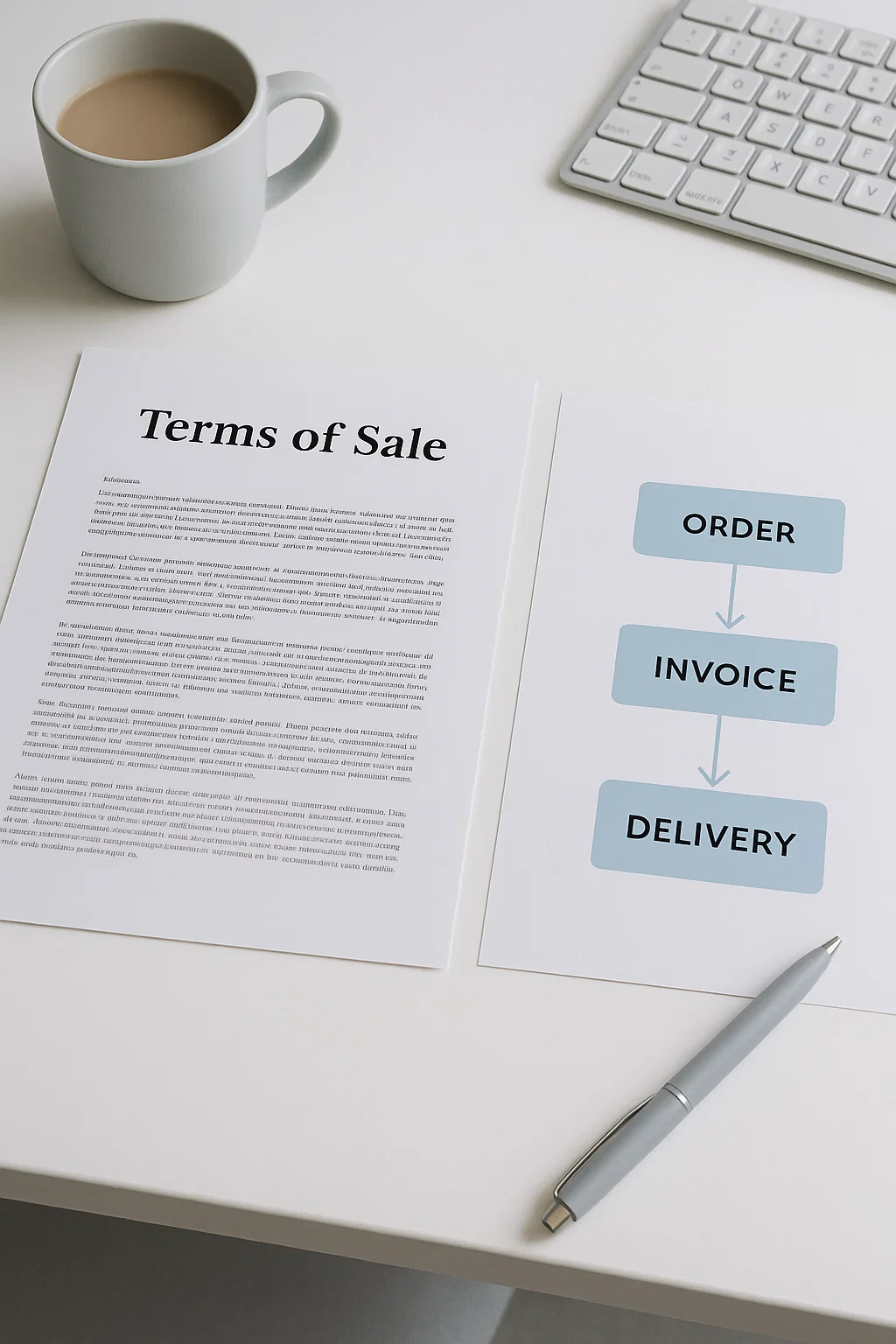
- Step 2: Map your sales process from order to delivery to returns — each stage needs contractual coverage
- Step 3: Include all eight core components (payment, delivery, returns, liability, IP, data protection, disputes, governing law)
- Step 4: Draft in plain English — the Consumer Rights Act requires intelligible language for consumer terms
- Step 5: Review against the Unfair Contract Terms Act 1977 and Consumer Rights Act 2015 fairness tests
- Step 6: Implement proper acceptance mechanisms and update whenever your business model changes
Frequently Asked Questions: Terms of Sale UK
Can terms of sale override statutory consumer rights?
No. Any clause attempting to exclude or reduce rights under the Consumer Rights Act 2015 is void and unenforceable. Statutory rights include satisfactory quality, fitness for purpose, as described, and the 14-day cancellation right for distance sales.
How long should terms of sale be?
Proportionate to complexity and risk. Consumer-facing terms typically range from 2,000–5,000 words. B2B terms often extend to 5,000–15,000 words due to greater complexity.
Clarity matters more than length — a concise, well-drafted document outperforms a lengthy one filled with legal jargon.
Do I need a solicitor to draft terms of sale?
Most businesses can start with a professionally drafted template covering standard clauses, then consider solicitor review for complex or high-value arrangements. This provides professional structure without the cost of bespoke drafting.
How often should I update my terms?
Review at least annually and update whenever your business model changes, new legislation takes effect, or you expand into new markets or sales channels. The UK’s evolving regulatory landscape — particularly post-Brexit — requires ongoing awareness of legislative developments.
What happens if my terms conflict with a customer’s purchase order?
A “battle of the forms” arises. Under English law, each party’s attempt to impose its terms constitutes a counter-offer. The “last shot rule” typically means the last set of terms sent before performance began governs.
Address this explicitly in your terms with a clause stating your terms prevail over any conflicting buyer terms.
The Truth About “Free” Legal Template Sites (What You’re Really Signing Up For)
Most websites advertising a “free legal template” follow the same pattern. You click because it’s free. You spend 10–15 minutes filling in questions.
And right at the end — only after you’ve invested your time — you’re hit with “Create your account first,” “Start your 7-day trial,” or “Card required — auto-renews at £29–£39 a month.”
This isn’t a template. This is a subscription funnel.
Why These “Free” Templates Are a Legal Risk
- Outdated wording not aligned with current UK law
- Missing mandatory clauses required for legal validity
- Generic content copied from US or non-UK templates
- No guidance on requirements
- No structured checklist to verify the document works
Hidden Problem: Many “Free Template” Sites Aren’t UK-Based
- Incorrect terminology taken from US contract law
- Missing UK statutory references — essential legal requirements omitted
- Non-applicable clauses that don’t apply under UK legislation
- Legal conflicts risking breach of UK consumer, employment, or GDPR rules
Why Templates UK Does the Opposite
- Drafted by UK professionals — written by experienced business and legal experts
- UK-law only — no US crossover or generic “international” templates
- One-time price from £10 — no subscriptions, no renewals
- Full preview — see the exact document before buying
- Two versions included — Editor + Interview formats
- Lifetime access — free lifetime updates included
My Templates Dashboard
After purchase, access all your templates from your My Templates dashboard — download, re-download, and access updates anytime.
Transparent Pricing
One-time price from £10 per template. No hourly rates. No hidden fees. No subscriptions.
Not ready to buy? Start with our free terms of sale checklist to see if it covers what you need.
No tricks. No trials. No hidden fees. Just the exact UK-specific legal document you came for — at the price we told you upfront.
Build your own bespoke Terms of Sale — preview every clause before buying and only pay when you’re happy with it.
Get Every Template in One Bundle
The UK Legal Templates Ultimate Bundle includes all 91 templates across every category — one purchase, every template, free lifetime updates including all future law changes.
Explore Template Bundles by Category
- Business Complete Suite — 37 templates (smaller packs available)
- Landlord Ultimate Bundle — 28 templates (smaller packs available)
- Complete Family Pack — 18 templates (smaller packs available)
- Complete Estate Pack — 8 templates (smaller packs available)
Master Business Legal Templates Pillar Guide
UK Business Legal Templates — Complete Guide (37 Templates)
All Templates UK Pillar Guides
- Family Law Documents Guide UK
- Wills & Estate Planning Guide UK
- Residential Landlord Documents Guide UK
- Employment Documents Guide UK
- How to Set Up a Business — Legal Guide
- Website Legal Documents UK
- Financial & Commercial Contracts UK
- Commercial Office Lease Guide UK
- Digital & IP Agreements Guide UK
Related Guides
- Terms of Business Guide UK
- Invoice Terms Guide UK
- Service Agreement Guide UK
- Debt Recovery Letters Guide UK
Free Legal Templates & Interactive Checklists
Access all our free UK legal templates, checklists and downloadable PDFs.
Last updated: March 2026
Disclaimer: This guide provides general UK legal information, not legal advice. Laws current as of March 2026. Sale of goods law is governed by the Consumer Rights Act 2015 (consumer sales) and Sale of Goods Act 1979 (B2B). Always verify current requirements with official sources.
Financial & Commercial Pack — All 8 Templates
Service agreements, SLAs, terms of sale, client onboarding, debt recovery and more
Lifetime Access • Free Updates • 30-Day Money-Back Guarantee*