Updated: February 2026 • Based on UK Law
A freelance web developer completes a £6,000 project and sends an invoice that says “payment due on receipt.” The client ignores it for 90 days. The developer tries to charge interest — but “payment due on receipt” has no definite breach date. The court rules the term is too vague to enforce. No interest. No compensation. £6,000 stuck in limbo.
Meanwhile, another developer invoices the same amount with “Payment due within 14 days of invoice date. Late payments incur interest at 8% above Bank of England base rate under the Late Payment of Commercial Debts Act 1998.” The client pays on day 12.
The difference? Seven words of precise wording. Over £23.4 billion in late payment debt is owed to UK small businesses at any given time — and poor invoice terms are the single biggest contributor.
What Are Invoice Terms in the UK?
Invoice terms are the contractual conditions governing payment between businesses — deadlines, accepted methods, late payment consequences, and VAT requirements. Under UK law, properly drafted invoice terms are legally binding and enforceable through the Late Payment of Commercial Debts Act 1998.
This guide covers payment deadlines, late fees, dispute clauses, and statutory interest. Free invoice terms checklist included.
✓ Invoice Terms Template (England & Wales)
Answer guided questions — your invoice terms are built for you. Covers payment deadlines, late payment interest, dispute procedures, and VAT requirements. No legal knowledge needed. Free updates included. From £10, no subscriptions.
Prefer to write your own? Download the free invoice terms compliance checklist →
How to Word Invoice Payment Terms
Quick Answer: Specify the exact number of days for payment, the date from which the period runs, accepted payment methods, and consequences of late payment including interest rates under the Late Payment of Commercial Debts (Interest) Act 1998.
The Three Critical Elements
Your invoice terms must communicate three things: when payment is due, how it should be made, and what happens if the deadline is missed.
Use specific language like “Payment is due within 30 days of the invoice date” rather than vague phrases like “payment due on receipt” — courts have found the latter difficult to enforce.
Which Date Triggers the Payment Period?
Options include “from the invoice date,” “from the date of delivery,” or “from the end of the month.” Each has different cash flow implications.
“Net 30 from end of month” (30 EOM) means payment is due 30 days after the last day of the month you issued the invoice — potentially extending your payment window by up to 60 days compared to “net 30 from invoice date.”
Specify Your Payment Methods
Modern terms typically state: “Payment should be made by bank transfer to the account details provided below. Cheques are not accepted unless agreed in writing in advance.”
For international transactions, specify the currency and whether the customer or you bear conversion or transfer fees.
The Late Payment Consequences Wording
Standard wording: “Late payments will incur interest at 8% above the Bank of England base rate per annum, as provided under the Late Payment of Commercial Debts (Interest) Act 1998. Additionally, a fixed compensation charge of £40, £70, or £100 (depending on debt value) will apply, plus reasonable debt recovery costs.”
This must appear on the invoice itself or in referenced terms of business.
Which Wording Actually Works in Court?
| Payment Term Wording | Legal Clarity | Enforcement Strength | Recommended Use |
|---|---|---|---|
| “Payment due on receipt” | Low — ambiguous timeframe | Weak — difficult to prove breach | Avoid — use specific days instead |
| “Payment due within 30 days of invoice date” | High — specific and measurable | Strong — clear breach date | Recommended for most B2B |
| “Net 30 days” | Medium — requires interpretation | Moderate — generally understood | Acceptable if industry standard |
| “Payment due 30 days from end of month” | High — unambiguous calculation | Strong — easy to calculate | Suitable for monthly billing |
| “Immediate payment required” | High — clear expectation | Strong — for cash sales | Best for point-of-sale or advance |
Construction Contracts — Extra Requirements
The Housing Grants, Construction and Regeneration Act 1996 (as amended) requires payment terms to specify when payment becomes due, the final date for payment, and the mechanism for determining the amount due. Missing these elements makes your terms unenforceable in construction disputes.
Early Payment Discounts — Get the Wording Right
Proper wording: “Full payment is due within 30 days of invoice date. A 2% discount is available if payment is received within 10 days of invoice date.”
The 30-day term is the obligation. The discount is an incentive — not an alternative payment term.
Consumer Invoices — Different Rules Apply
For B2C transactions, ensure compliance with the Consumer Rights Act 2015. Terms must be transparent, prominent, and not create unfair contract terms. Avoid aggressive debt recovery language and ensure late payment charges are genuinely pre-estimated losses rather than penalties.
Key Takeaway: Invoice payment terms must be specific — stating exact days and the date from which payment runs. Include statutory late payment interest rights. “Payment due on receipt” is too vague to enforce. “Payment due within 30 days of invoice date” creates a definite breach date courts will uphold.
What Are the Standard Invoice Terms in the UK?
Quick Answer: 30 days from invoice date for B2B transactions. Many businesses now use 14 or 7-day terms for smaller transactions. Larger corporate customers often negotiate 60 or 90-day terms, though these face increasing regulatory scrutiny.
Why 30 Days Became the Standard
The Late Payment Act established 30 days as a reasonable commercial payment period unless parties agree otherwise. It remains the most common baseline for B2B transactions.
What Different Industries Actually Use
Small businesses and freelancers increasingly adopt 14-day or 7-day terms, reflecting cash flow pressures and the ease of electronic payments.
Retail and hospitality use immediate payment or payment on delivery. Manufacturing and wholesale more commonly use 30 to 60-day terms, aligned with longer production cycles.
Professional services typically operate on 30-day terms, though practices vary. Law firms often bill monthly with 14–30 day deadlines. Creative agencies frequently request 50% upfront with the balance due within 14 days of completion.
Large Corporates — The Payment Squeeze
Large customers frequently impose 60 and 90-day terms despite regulatory pressure. The Prompt Payment Code commits signatories to pay 95% within 60 days — but compliance remains patchy.
Government Contracts — 30-Day Maximum
Public Contracts Regulations 2015 require public sector bodies to pay within 30 days and ensure main contractors pay subcontractors within 30 days — creating a 60-day maximum payment chain for government work.
Key Takeaway: Standard UK terms are 30 days, but shorter terms (7–14 days) are increasingly common for small businesses. Large corporate 60–90 day terms face growing scrutiny. Government contracts mandate 30-day payment chains.
What Are the Rules for Invoices in the UK?
Quick Answer: UK invoices must include your business name and address, unique invoice number, tax point date, description of goods or services, amounts excluding and including VAT, and (for VAT-registered businesses) your VAT registration number. Additional requirements apply for invoices over £250 and specific business types.
Where Do These Rules Come From?
The Value Added Tax Act 1994, VAT Regulations 1995, Companies Act 2006, and common law. Non-compliance results in HMRC penalties, inability to reclaim VAT, and weakened legal standing in disputes.
Business Name — It Must Be Exact
Use your name exactly as registered. Sole traders: full legal name (trading name can be added). Limited companies: full registered name including “Limited” or “Ltd”. Partnerships: all partner names or a statement of where the list can be inspected.
Your business address must be a physical location, not a PO Box alone.
Invoice Numbers — Why Gaps Are a Problem
The number must be unique. Sequential numbering is standard, though alphanumeric systems work too. HMRC may investigate gaps in invoice sequences as potential indicators of hidden income.
Description — “Services Rendered” Isn’t Good Enough
Generic descriptions are inadequate for tax purposes and create enforcement difficulties. Use specifics: “Website design services for homepage redesign project, 40 hours at £75/hour” rather than “services rendered.”
VAT Requirements for Registered Businesses
Include your VAT registration number. Show amounts both excluding and including VAT. State the VAT rate clearly. For mixed-rate items, break down each category separately.
Invoices under £250 qualify as simplified VAT invoices — showing only the total VAT-inclusive amount and rate.
Electronic Invoices and Making Tax Digital
E-invoices are fully valid provided they meet the same information requirements and the customer accepts electronic delivery. They must be stored in a format HMRC can access for at least six years.
Making Tax Digital (MTD) now applies to all VAT-registered businesses regardless of turnover, mandating digital record-keeping and electronic VAT return submission.
What Legally Must Be on an Invoice?
Quick Answer: Business name and address, unique invoice number, invoice date, customer name and address, clear description of goods/services, quantity and unit price, total excluding VAT, VAT amount and rate, total including VAT, payment terms, and (for VAT-registered businesses) your VAT registration number.
Mandatory by Statute — You’ll Be Penalised Without These
| Invoice Element | Legal Requirement | Applicable Law | Penalty for Omission |
|---|---|---|---|
| Business name and address | Mandatory | VAT Regulations 1995, Companies Act 2006 | HMRC penalties, customer can’t reclaim VAT |
| VAT registration number | Mandatory (if VAT-registered) | VAT Act 1994 | Customer can’t reclaim VAT, penalties up to £5,000 |
| Unique invoice number | Mandatory | VAT Regulations 1995 | HMRC penalties, invalid for VAT purposes |
| Invoice date | Mandatory | VAT Regulations 1995 | Disputes over payment period |
| Description of supply | Mandatory (sufficient detail) | VAT Regulations 1995 | Customer can’t reclaim VAT |
| VAT breakdown (rate + amount) | Mandatory (if VAT-registered) | VAT Regulations 1995 | Customer can’t reclaim VAT |
| Payment terms | Required for statutory interest rights | Late Payment Act 1998 | Can’t enforce statutory interest |
| Company registration number | Mandatory for invoices over £250 (Ltd companies) | Companies Act 2006 | Criminal offence, fines up to £1,000 |
The Tax Point — Not Always the Same as Invoice Date
Include the “tax point” if different from the invoice date. The tax point is when you made the supply — it determines which VAT period it falls into and can affect the VAT rate if rates have changed.
Pricing Breakdown — How to Show It
Show unit price or rate, quantity, discounts applied, subtotal excluding VAT, VAT rate and amount, and total including VAT. For mixed-rate supplies, show each rate category separately. Zero-rated and exempt supplies should be clearly identified — the distinction matters for input tax recovery.
Sector-Specific Requirements
Retailers with EPOS can issue simplified invoices for transactions under £250. Agricultural businesses on the flat rate scheme must indicate this. CIS contractors must show CIS deductions clearly.
International invoices require the customer’s VAT number (if applicable), delivery destination, and reason for zero-rating. Post-Brexit EU trade requires customs information and potentially export licences.
Key Takeaway: Missing mandatory elements can result in HMRC penalties and prevent customers from reclaiming VAT. The most common failures: missing VAT registration numbers, inadequate supply descriptions, and failure to maintain MTD-compliant records.
Are Payment Terms on an Invoice Legally Binding?
Quick Answer: Yes — if they form part of the contract between the parties. This occurs when the invoice reflects previously agreed terms, when the customer has accepted invoices with those terms before, or when the invoice follows an order and the customer doesn’t object.
How Payment Terms Become Binding
An invoice isn’t itself a contract — it’s a request for payment under an existing contractual relationship. Payment terms become binding when they form part of the underlying contract.
The strongest route: pre-contract agreement. Negotiate terms before work begins and reference them on every invoice.
What If No Formal Contract Exists?
Under the “battle of the forms” principle, the terms of whoever last submits their terms before performance usually prevail.
Course of dealing also works. If you’ve regularly invoiced a customer with specific terms and they’ve paid without objection — typically 3–5 previous transactions within 12–18 months — courts may find those terms incorporated.
The Statutory Default — When Nobody Agreed Anything
The Late Payment Act provides statutory terms when parties haven’t agreed. For B2B contracts with no specified payment date, payment becomes due 30 days after delivery of the invoice or the goods/services (whichever is later).
Consumer Transactions — Extra Protections
The Consumer Rights Act 2015 requires B2C payment terms to be transparent, prominent, and not unfair. A term creating significant imbalance is potentially unfair and unenforceable.
Are Invoice Terms Legally Binding?
Quick Answer: Yes — when properly incorporated into the contract. This covers payment terms, delivery conditions, liability limitations, retention of title, dispute resolution, and IP rights. But terms presented for the first time on an invoice sent after work is completed are generally not binding.
Timing Is Everything
The contract forms when both parties agree you’ll perform the work. Terms introduced afterwards on the invoice can’t unilaterally change that agreement.
Include terms in your quotation or order acknowledgement — not merely on the invoice itself. But if you consistently invoice with the same terms over an established trading relationship, courts may find them incorporated by course of dealing.
Specific Terms and Their Enforceability
Exclusion and limitation clauses must satisfy the Unfair Contract Terms Act 1977 (B2B) and Consumer Rights Act 2015 (B2C). You can never exclude liability for death or personal injury from negligence.
Retention of title clauses are generally enforceable but only if incorporated before delivery. A clause appearing on an invoice sent after delivery is too late.
IP terms stating rights remain with you until full payment should ideally be agreed before work commences.
Dispute resolution terms (arbitration or mediation clauses) are enforceable unless they unreasonably restrict access to justice. For consumer contracts, mandatory arbitration is likely unfair under the Consumer Rights Act.
Construction Contracts — Pay-When-Paid Is Dead
The Housing Grants, Construction and Regeneration Act 1996 requires payment terms to specify when payment becomes due and the final date for payment. “Pay when paid” clauses are generally unenforceable.
For maximum enforceability, reference your full terms of business on every invoice: “Payment subject to our Terms of Business, available at [URL] or on request.” Send terms with your first quotation and request acknowledgement.
Are 90-Day Payment Terms Legal?
Quick Answer: Legal if both parties agree — but face increasing regulatory scrutiny. The Late Payment Act establishes 30 days as the baseline, and terms significantly exceeding this may be challenged as grossly unfair to small suppliers.
Legal but Potentially “Grossly Unfair”
The Act allows longer terms but requires they’re not grossly unfair to the creditor. Whether 90 days crosses that line depends on relative bargaining positions, industry practice, and whether the terms were genuinely negotiated or imposed unilaterally.
Government and Prompt Payment Rules
Public Contracts Regulations 2015 mandate 30-day payment for government work. The Prompt Payment Code (voluntary) commits signatories to 60-day maximums.
Large companies (turnover over £36 million, balance sheet over £18 million, 250+ employees) must publish payment practice reports every six months — including average payment periods and the proportion paid within 30, 31–60, and 60+ days.
Every Payment Period — Legal Status at a Glance
| Payment Period | Legal Status | Government Position | Practical Considerations |
|---|---|---|---|
| 7–14 days | Fully legal and enforceable | Encouraged for small business | Ensures fast payment |
| 30 days | Fully legal, statutory default | Considered standard and fair | Most common B2B term |
| 60 days | Legal if genuinely agreed | Maximum under Prompt Payment Code | Common for large corporates |
| 90 days | Legal but may be “grossly unfair” | Discouraged, subject to scrutiny | Significant cash flow impact |
| 120+ days | Legal but likely “grossly unfair” | May trigger investigation | Unsustainable, reputational risk |
What Can You Do If Offered 90-Day Terms?
Negotiate shorter terms — particularly if you have specialist expertise. Request staged or advance payments for large projects. Factor invoices (sell to a finance company at a discount for immediate payment). Or refuse if the terms make the work commercially unviable.
For further guidance, see our Terms of Business Guide UK.
Key Takeaway: Payment terms are legally binding when incorporated into the contract. The Late Payment Act provides a statutory 30-day default. 90-day terms are legal but may be challenged as grossly unfair. Government contracts mandate 30-day payment. Large companies must publicly report their payment practices.
What Are the Requirements for an Invoice?
Quick Answer: Unique sequential number, business details (name, address, VAT number if registered), customer details, invoice date, itemised description, quantities and prices, subtotals, VAT breakdown by rate, total amount due, payment terms including due date, and accepted payment methods.
Business Identification
Full legal trading name, physical business address, VAT registration number if registered. Limited companies must show registration number and registered office on invoices over £250. Sole traders use their full legal name, adding “trading as” for a business name.
Transaction Details — Be Specific
Each line item should include a clear description, quantity in appropriate units, unit price, discounts, and line total. Provide detail like “Brand strategy consultation, 8 hours @ £150/hour” — not just “consultancy.”
VAT Information — The Full Breakdown
Show subtotal before VAT. Break down by rate (standard 20%, reduced 5%, zero-rated). Show the net amount, rate, and VAT amount for each category. VAT-exempt supplies should be marked “VAT exempt” — not just showing £0, as the distinction affects input tax recovery.
Payment Information
State the amount due, payment deadline (calculated from a specified date), and accepted methods with details. Include bank account name, sort code, account number, and payment reference (typically your invoice number).
Record-Keeping — Six Years Minimum
Retain copies of all issued invoices for at least six years. Under MTD, these must be kept digitally in a format accessible to HMRC.
Financial & Commercial Pack — All 8 Templates
Service agreements, SLAs, invoice terms, client onboarding, debt recovery and more
Lifetime Access • Free Updates • 30-Day Money-Back Guarantee*
What Are the Terms for an Invoice?
Quick Answer: The contractual conditions governing payment — when it’s due, how it should be made, consequences of late payment, early payment discounts, and conditions like retention of title, set-off rights, or disputed invoice procedures.
Payment Deadline Terms
Specify exactly when payment is due. Avoid ambiguous phrasing like “prompt payment” or “as soon as possible.” Use: “Payment due within 30 days of invoice date.”
Disputed Invoice Procedures
Well-drafted terms state: “If you dispute any amount, notify us in writing within 7 days of invoice date, specifying the disputed amount and reasons. Undisputed amounts remain payable by the due date.”
Set-Off and Deduction Restrictions
Many supplier terms prohibit set-off: “You may not withhold or set off any amounts against this invoice without our prior written consent.” These aren’t always enforceable against legitimate counterclaims, but they establish your position.
Currency and International Terms
Standard terms: “All amounts are stated in GBP and payment must be made in GBP. The customer bears all currency conversion costs and bank charges.”
Retention of Title
For goods suppliers: “Title to goods supplied remains with us until payment is received in full. Until then, goods are held as bailee and must be stored separately and identifiably.” More complex versions need specialist drafting.
For comprehensive guidance, see our Business Contracts UK guide.
What Are the 30-Day Payment Terms on an Invoice?
Quick Answer: Payment due within 30 calendar days from a specified date — typically the invoice date. Stated as “Payment due within 30 days of invoice date” or “Net 30.” Once the period expires, statutory interest and debt recovery rights become exercisable.
How to Calculate the Due Date
“Payment due within 30 days of invoice date” means 30 calendar days (not working days). Invoice on 15 January = due by 14 February. When the due date falls on a weekend or bank holiday, payment is generally due on the next working day.
“30 EOM” — A Different Calculation
“30 days from end of month” means 30 days after the last day of the month you issued the invoice. An invoice dated 15 January becomes due on 2 March — potentially adding weeks compared to “net 30 from invoice date.”
What Does “Net 30” Actually Mean?
Accounting shorthand: full amount due in 30 days, no discounts apply. Distinguished from “2/10 net 30” — 2% discount if paid within 10 days, otherwise full amount due within 30.
The Starting Date Matters
“30 days from invoice date” is clear and verifiable. “30 days from delivery” or “30 days from completion” create disputes about when delivery or completion occurred. For construction contracts, the Housing Grants Act 1996 requires you to specify the date — just saying “30 days” without more isn’t enforceable.
What Are the 20-Day Payment Terms?
Quick Answer: Payment due within 20 calendar days from the invoice date. Increasingly common among small businesses and freelancers. Fully legal — no statute mandates 30 days as a minimum. The Late Payment Act only establishes 30 as the default when parties haven’t agreed otherwise.
Why Shorter Terms Are Growing
Service providers, creative professionals, and small businesses that can’t extend 30-day credit are moving to 20-day terms. Some explicitly link pricing to terms: “Standard pricing applies for 20-day terms. For 30-day terms, prices increase by 2%.”
How to Transition Existing Customers
Provide advance notice and explanation. Ensure quotations, terms, and invoices all consistently state the 20-day requirement. Large corporate customers may resist — their accounts payable processes are often designed around 30 or 60-day cycles.
For guidance on implementing shorter terms, see our Client Onboarding Process Guide UK.
What Are the Terms on an Invoice?
Quick Answer: The contractual conditions governing the payment obligation and commercial relationship for that transaction — payment deadline, payment method, late payment consequences, dispute procedures, liability limitations, and any other conditions affecting rights and obligations.
Incorporating by Reference
Many businesses state: “Payment subject to our Terms of Business dated [date], available at [URL] or on request.” For this to be effective, the customer must have reasonable access to the full terms.
Invoice Terms vs Contract Terms — What’s the Difference?
The underlying contract governs what you supply, quality standards, delivery, and pricing. Invoice terms govern the payment mechanics. In a conflict, the contract typically prevails.
Sector-Specific Invoice Terms
Construction invoices include valuation dates, retention amounts, and payment notice references. Professional services invoices include time sheets or detailed breakdowns. Retail invoices include return rights and warranty information.
Consumer invoice terms must comply with the Consumer Rights Act 2015 — transparent, prominent, and fair.
What Terms Should Be on an Invoice?
Quick Answer: Payment due date from a clear reference point, accepted payment methods and banking details, late payment interest rate and fixed compensation, dispute notification procedures, contact information for queries, and reference to full terms of business.
What Goes Directly on the Invoice vs Referenced Terms
| Term Category | Essential Elements | Where to Include | Legal Importance |
|---|---|---|---|
| Payment deadline | Specific days from defined date | Directly on invoice | Critical — determines breach date |
| Payment method | Accepted methods, bank details, reference | Directly on invoice | Prevents disputes about valid payment |
| Late payment consequences | Interest rate, compensation, recovery costs | Invoice or referenced terms | Critical — enables debt recovery |
| Dispute procedures | Notification period, written requirement | Invoice or referenced terms | Maintains cash flow during disputes |
| Retention of title | Ownership retained until payment | Referenced terms (must precede delivery) | Protects against insolvency |
| Liability limitations | Scope, exclusions, financial caps | Referenced terms | Must be reasonable to enforce |
| Set-off restrictions | Prohibition on withholding amounts | Invoice or referenced terms | Prevents payment withholding |
Industry-specific terms may be essential. Construction businesses must include payment notice provisions. Consumer-facing businesses must include statutory cancellation rights. Export businesses reference Incoterms.
For comprehensive guidance, see our Setting Up a Business UK guide.
What Should Be the Terms and Conditions in an Invoice?
Quick Answer: Payment obligations (deadline, method, currency), consequences of non-payment (interest, fees, recovery costs), dispute resolution, liability limitations, retention of title for goods, and administrative matters like corrections and credit notes.
Payment Obligation Terms
Specify not just when payment is due, but what constitutes valid payment: “Payment is due within 30 days of invoice date. Payment is only effective when cleared funds are received in our bank account.”
For instalments: “Failure to pay any instalment by the due date renders the entire balance immediately due and payable.”
Partial Payment Allocation
Specify how partial payments are allocated: first to oldest outstanding charges, then to accrued interest and fees, then to the principal invoice amount.
Liability Limitations — What’s Enforceable
Limiting total liability to the invoice amount and excluding indirect losses is standard for B2B. But you can never limit liability for death or personal injury from negligence.
Administrative Terms
Cover invoice corrections, credit notes, and record retention. Retain all invoices and supporting documentation for at least six years.
For international transactions, address currency risk, jurisdiction, and governing law. Consider separate term sets for B2B and B2C if you deal with both.
What Is the Standard UK Invoice Format?
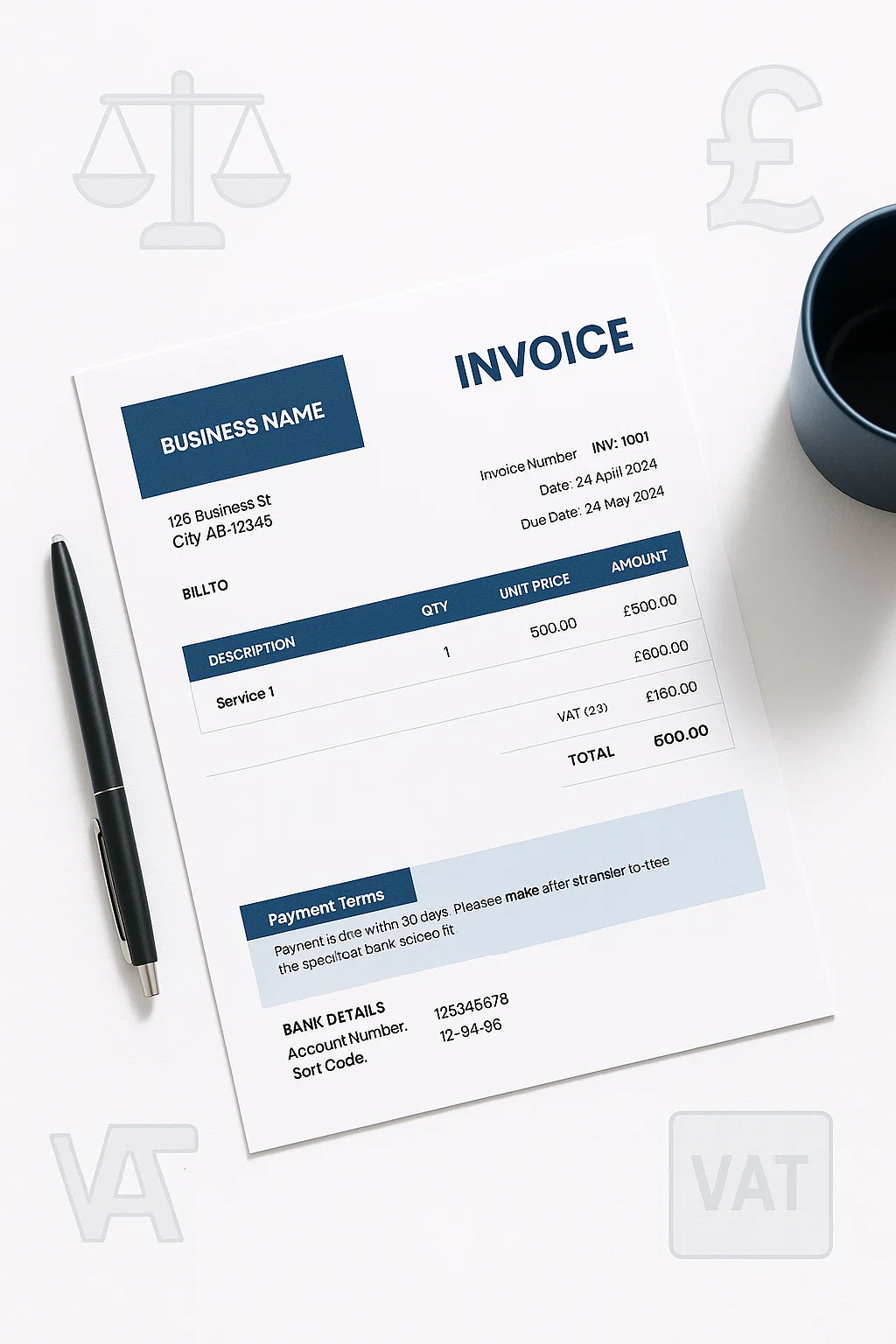
Quick Answer: Header with “INVOICE” title and business details, invoice number and date, customer details, itemised list with quantities and prices, subtotal before VAT, VAT breakdown by rate, total including VAT, payment terms, and bank account details.
The Standard Layout
No specific layout is mandated, but the conventional format organises information in this order: header (business details, number, date), customer details and delivery address, itemised charges in the body, totals and payment information at the bottom.
Invoice Identification
Unique invoice number, date, and (if different) tax point date — typically in the upper right corner. For recurring services, include the period covered. Include any customer reference or purchase order number.
The Totals Section
Subtotal before VAT, VAT broken down by rate, total including VAT. For mixed supplies, maintain separate subtotals for each rate category.
Electronic Invoices — PDF Best Practice
Create PDFs from your invoicing software rather than scanning paper invoices. Include metadata (business name, invoice number, creation date). Use clear, readable fonts (minimum 11pt), sufficient colour contrast, and logical reading order.
What Are 30/30/40 Payment Terms?
Quick Answer: A progressive payment schedule — 30% upfront before work begins, 30% at a midpoint milestone, 40% on completion. Common in construction, creative services, and consulting projects.
Key Takeaway: Comprehensive invoice terms cover payment deadline, method, late payment consequences, dispute procedures, set-off restrictions, retention of title, and liability limitations. Include essential terms directly on the invoice and reference your full Terms of Business for detailed provisions. The standard UK format organises information from header to totals to payment details.
Frequently Asked Questions: Invoice Terms UK
Can I charge interest on late payments to consumers?
Yes, but with restrictions. The Consumer Rights Act 2015 prohibits unfair terms creating significant imbalance. While B2B can use 8% above base rate, consumer terms should typically not exceed 3–4% above base rate. Any interest clause must be transparent, prominent, and in plain language.
What happens if I don’t include my VAT number on an invoice?
Your customer can’t reclaim the VAT they paid you, which may lead them to refuse payment. HMRC can impose penalties up to £5,000 for persistent failures. If you discover the omission, immediately issue a corrected invoice with the original reference.
Are digital invoices legally equivalent to paper invoices?
Yes — fully equivalent in UK law provided they meet the same information requirements and the recipient agrees to electronic delivery. You must maintain digital records accessible to HMRC for at least six years. MTD requires digital bookkeeping for all VAT-registered businesses.
Can a customer refuse to pay for defective work?
They can withhold payment for genuinely defective goods or services, but must provide specific details promptly. They can only withhold the portion related to the defective work — not the entire invoice. For consumers, the Consumer Rights Act 2015 provides broader rights including 30-day rejection.
How long can I pursue an unpaid invoice?
Six years from the date payment became due under the Limitation Act 1980 (England and Wales). The period can restart if the customer acknowledges the debt in writing or makes a part payment. Scotland has a five-year period under the Prescription and Limitation (Scotland) Act 1973.
Do I need different terms for international customers?
Yes. Specify currency and who bears conversion costs. Address VAT treatment (goods exported outside the UK are typically zero-rated; services follow place of supply rules). Include jurisdiction clauses and reference Incoterms for goods shipments.
The Truth About “Free” Legal Template Sites (What You’re Really Signing Up For)
Most websites offering a “free legal template” follow the same pattern:
-
- You click because it’s advertised as free
-
- You spend 10–15 minutes answering questions
-
- At the very end, you must create an account or start a “free trial”
-
- Your card is required upfront
-
- The subscription auto-renews at £29–£39 per month
This isn’t a free template — it’s a subscription service. Many people only realise after being charged £300–£400 over the year.
Why These “Free” Templates Are a Legal Risk
-
- Outdated wording: not aligned with current UK law
-
- Missing mandatory clauses: required for legal validity
-
- No compliance guidance: leaving users without legal context
-
- No structured checklist: no way to verify the document works
-
- Not kept updated: often unchanged when legislation changes
One incorrect clause can weaken or invalidate the entire document.
Hidden Problem: Many “Free Template” Sites Aren’t Even UK-Based
Another major issue is that many free or auto-subscription template sites operate outside the UK and use documents originally drafted for the US legal system. These are then loosely adapted for “international use,” which creates serious problems:
-
- Incorrect terminology: taken from US contract law
-
- Missing UK statutory references: essential legal requirements omitted
-
- Non-applicable clauses: terms that don’t apply under UK legislation
-
- Legal conflicts: risks breaching UK consumer, employment, or GDPR rules
Why Templates UK Does the Opposite
-
- Drafted by UK professionals: written by experienced business & legal experts
-
- UK-law only: no US crossover or generic “international” templates
-
- One-time price from £10: no subscriptions, no renewals
-
- Full preview: see the exact document before buying
-
- Lifetime access: free lifetime updates included
My Templates Dashboard
All purchased templates are stored in your personal My Templates page, organised by category.
When we update a template for UK law changes, the new version appears automatically in your dashboard — free, forever.
Build a growing library of UK legal documents across every area of your business and personal life.
Transparent Pricing
From £10 per template — with free lifetime usage and free lifetime updates. No subscriptions. No renewals. No auto-billing.
Not ready to buy? Use our free interactive checklists to guide your own document — no payment required.
No tricks. No trials. No hidden fees. Just the exact UK-specific legal document you came for — at the price we told you upfront.
Build your own bespoke document with our Invoice Terms Template. Preview the full document before buying — only pay when you’re happy with it.
Get Every Template in One Bundle
The UK Legal Templates Ultimate Bundle includes 91 templates across every category — one purchase, lifetime updates, no subscriptions.
Explore Template Bundles by Category
One purchase, lifetime updates, no subscriptions.
-
- Business Complete Suite — 37 templates, £120 (smaller packs available)
-
- Landlord Ultimate Bundle — 28 templates, £99 (smaller packs available)
-
- Complete Family Pack — 18 templates, £65 (smaller packs available)
-
- Complete Estate Pack — 8 templates, £38 (smaller packs available)
Explore the Master Business Legal Templates Pillar Guide
The complete overview of 37 essential UK business templates.
UK Business Legal Templates — Complete Master Guide
Explore All Templates UK Pillar Guides
Related Guides
Free Legal Templates & Interactive Checklists
Access all our free UK legal templates, checklists and downloadable PDFs.
Last updated: February 2026
Disclaimer: This guide provides general UK legal information, not legal advice. Laws are current as of February 2026.