Updated: December 2025 • Based on UK Law
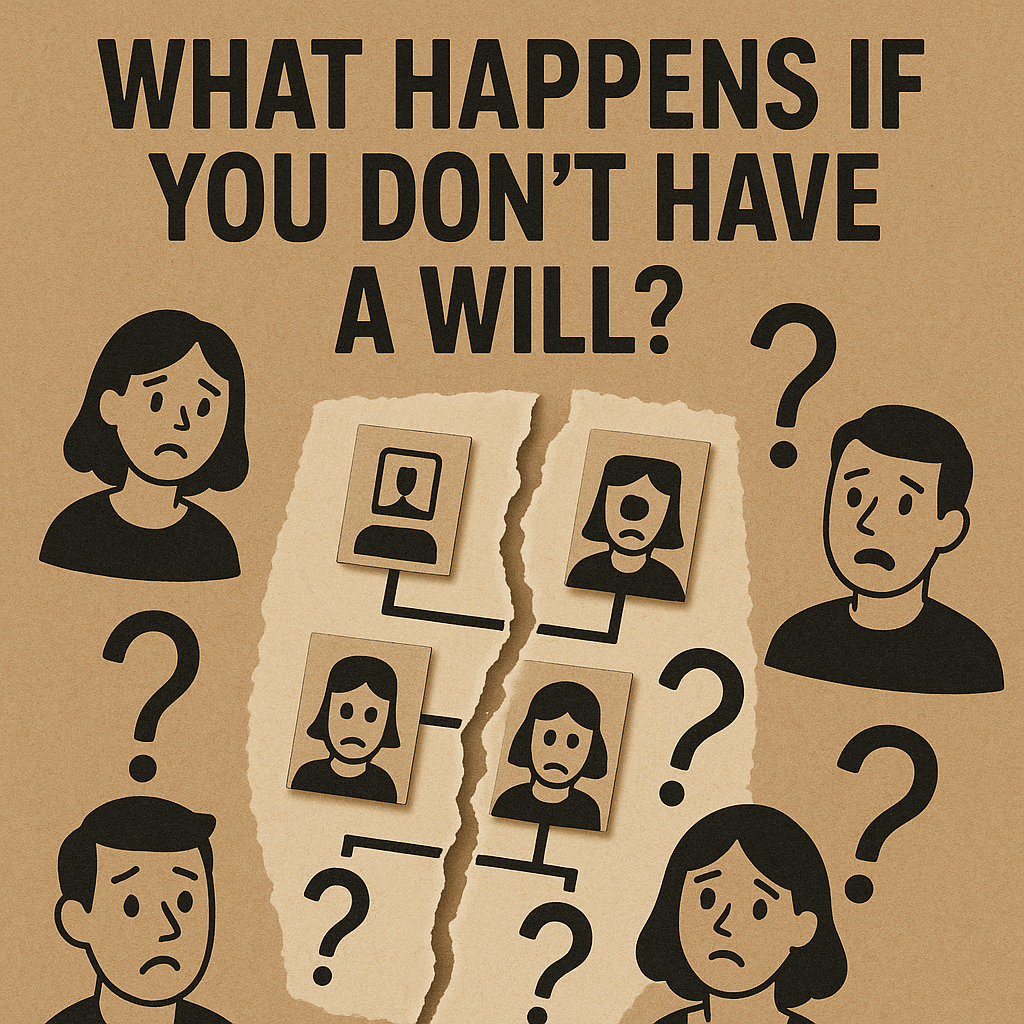
What Happens If You Die Without a Will?
Dying intestate means UK Intestacy Rules decide who inherits — not you. Unmarried partners get nothing. Free checklist included.
Without a valid will, you lose all control over who inherits your assets, who raises your children, and how your estate is managed. Partners of 20+ years can be left with nothing while estranged relatives inherit everything. One in three UK adults has no will — and their families often face costly disputes and devastating outcomes.
This guide explains exactly what happens under the Intestacy Rules and how to protect your family with a legally valid will. Use our free will compliance checklist to ensure your document meets all UK legal requirements.
FREE Estate Planning Essentials Checklist
Everything You Need Before Writing Your Will
What Does Dying Intestate Mean?
Dying intestate means dying without a valid will. When this happens, your money, property, and belongings are distributed according to a fixed set of rules — not your wishes, not your family’s needs, and certainly not what’s “fair.”
The law follows a rigid formula called the Intestacy Rules (Administration of Estates Act 1925) — and it doesn’t care about your personal situation. You cannot leave anything to unmarried partners, stepchildren, friends, or charities. The rules apply automatically and cannot be overridden without a valid will.
Who Inherits If You Die Without a Will in the UK?
The Intestacy Rules distribute your estate in a strict legal order. Here’s how it works in England and Wales:
If You’re Married or in a Civil Partnership
Your spouse receives the first £322,000 (the “statutory legacy”), all personal possessions, and half of the remaining estate. The other half passes to your children — even if they’re minors and the money must be held in trust until they turn 18.
If You Have an Unmarried Partner
They inherit nothing. Unmarried partners — including cohabiting couples of 20+ years — have no automatic inheritance rights under UK law. They may need to make a claim under the Inheritance (Provision for Family and Dependants) Act 1975, which is costly, time-consuming, and not guaranteed to succeed.
If You Have Children But No Spouse
Your children inherit your entire estate equally. If any child has died before you, their share passes to their children (your grandchildren). Children under 18 cannot receive their inheritance directly — it’s held in trust.
If You Have No Spouse or Children
The estate passes to your next closest blood relatives in strict order: parents first, then siblings (or their children if deceased), then half-siblings, then grandparents, then aunts and uncles. Stepchildren inherit nothing.
If No Relatives Can Be Found
The Crown (HM Treasury) inherits everything under a rule called “bona vacantia.” Your estate goes to the government rather than friends, partners, or causes you care about.
Can an Unmarried Partner Inherit Without a Will?
No — unmarried partners have no automatic inheritance rights in the UK, regardless of how long you’ve lived together or whether you have children together. This is one of the most common and devastating consequences of dying intestate.
An unmarried partner may be able to make a claim under the Inheritance (Provision for Family and Dependants) Act 1975 if they can prove they were financially dependent on the deceased. However, these claims are expensive (legal fees often exceed £10,000), take 12-24 months to resolve, and success is not guaranteed.
The only reliable way to protect an unmarried partner is to write a will naming them as a beneficiary.
What Happens to Children If Both Parents Die Without a Will?
If both parents die intestate, the court appoints a guardian for minor children. This decision is made by strangers based on legal criteria — not your wishes. The court may appoint a relative you would never have chosen, or place children with local authority care while guardianship is decided.
A will allows you to name trusted guardians, specify how children should be raised, and set conditions on when they receive their inheritance (for example, at age 25 rather than 18).
Do Stepchildren Inherit Under Intestacy Rules?
No — stepchildren have no inheritance rights under the Intestacy Rules unless they have been legally adopted. Even if you raised a stepchild from infancy and consider them your own, they inherit nothing without a valid will naming them as a beneficiary.
How Long Does Intestate Probate Take?
Intestate estates typically take 9-18 months to administer — significantly longer than estates with a valid will. The process involves applying for Letters of Administration (rather than probate), tracing all potential beneficiaries, and following strict legal procedures.
Complex family situations (multiple marriages, estranged relatives, disputed claims) can extend this to 2-3 years or more. During this time, assets are frozen and beneficiaries cannot access funds.
How Do I Avoid Dying Intestate?
Write a legally valid will. A will lets you:
- Decide exactly who inherits your assets
- Appoint executors you trust to manage your estate
- Name guardians for minor children
- Protect assets through trusts (for young beneficiaries or vulnerable adults)
- Leave gifts to unmarried partners, stepchildren, friends, and charities
- Reduce inheritance tax liability through proper planning
A valid will in England and Wales must be in writing, signed by the testator (you) in the presence of two independent witnesses, and those witnesses must also sign. The witnesses cannot be beneficiaries or married to beneficiaries.
Use our free will compliance checklist to ensure your document meets all legal requirements.
Free Will Planning Resources
Before writing your will, use these free tools to get organised:
- Free Last Will Compliance Checklist — ensure your will meets all legal requirements
- Free Asset Inventory Worksheet — list everything you own and owe
- Free Beneficiary Planner — decide who gets what
- Free Executor Information Pack — help your executor understand their role
Complete Wills Pack
Everything You Need • 4 Templates + Editor & Interview Versions • Save 55% vs Buying Individually
Lifetime Access • Free Updates • 30-Day Money-Back Guarantee*
The Truth About “Free” Legal Template Sites (What You’re Really Signing Up For)
Most websites offering a “free legal template” follow the same pattern:
- You click because it’s advertised as free
- You spend 10–15 minutes answering questions
- At the very end, you must create an account or start a “free trial”
- Your card is required upfront
- The subscription auto-renews at £29–£39 per month
This isn’t a free template — it’s a subscription funnel. Many people only realise after being charged £300–£400 over the year.
Why These “Free” Templates Are a Legal Risk
- Outdated wording: not aligned with current UK law
- Missing mandatory clauses: required for legal validity
- No compliance guidance: leaving users without legal context
- No structured checklist: no way to verify the document works
- Not kept updated: often unchanged when legislation changes
One incorrect clause can weaken or invalidate the entire document.
Hidden Problem: Many “Free Template” Sites Aren’t Even UK-Based
Another major issue is that many free or auto-subscription template sites operate outside the UK and use documents originally drafted for the US legal system. These are then loosely adapted for “international use,” which creates serious problems:
- Incorrect terminology: taken from US contract law
- Missing UK statutory references: essential legal requirements omitted
- Non-applicable clauses: terms that don’t apply under UK legislation
- Legal conflicts: risks breaching UK consumer, employment, or GDPR rules
Why Templates UK Does the Opposite
- Drafted by UK professionals: written by experienced business and legal experts
- UK-law only: no US crossover or generic “international” templates
- £10 one-time price: no subscriptions, no renewals
- Full preview: see the exact document before buying
- Two versions included: Editor + Interview formats
- Lifetime access: free lifetime updates included
- Free compliance checklist: included with every document
No tricks. No trials. No hidden fees. Just the exact UK-specific legal document you came for — at the price we told you upfront.
Get the professionally drafted Last Will and Testament Template and get it right the first time.
Explore the Wills & Estate Planning Pillar Guide
The complete overview of wills, trusts, and estate planning templates for UK individuals and families:
Wills & Estate Planning Guide UK – Complete 2025 Legal Guide
Explore All Templates UK Pillar Guides
- Employment Documents Guide UK
- How to Set Up a Business in the UK – Legal Guide
- Website Legal Documents UK – Compliance Guide
- Financial & Commercial Contracts UK – Protection Guide
- Commercial Office Lease Guide UK
- Digital & IP Agreements Guide UK
- Wills & Estate Planning Guide UK
Related Guides
- How to Make a Legally Valid Will in the UK
- What Makes a Will Legally Valid in the UK?
- Mirror Wills Guide UK
- Letter of Wishes Guide UK
Free Legal Templates & Interactive Checklists
Access all our free UK legal templates, checklists and downloadable PDFs.
Last updated: December 2025
Disclaimer: This guide provides general UK legal information, not legal advice. Laws are current as of December 2025.