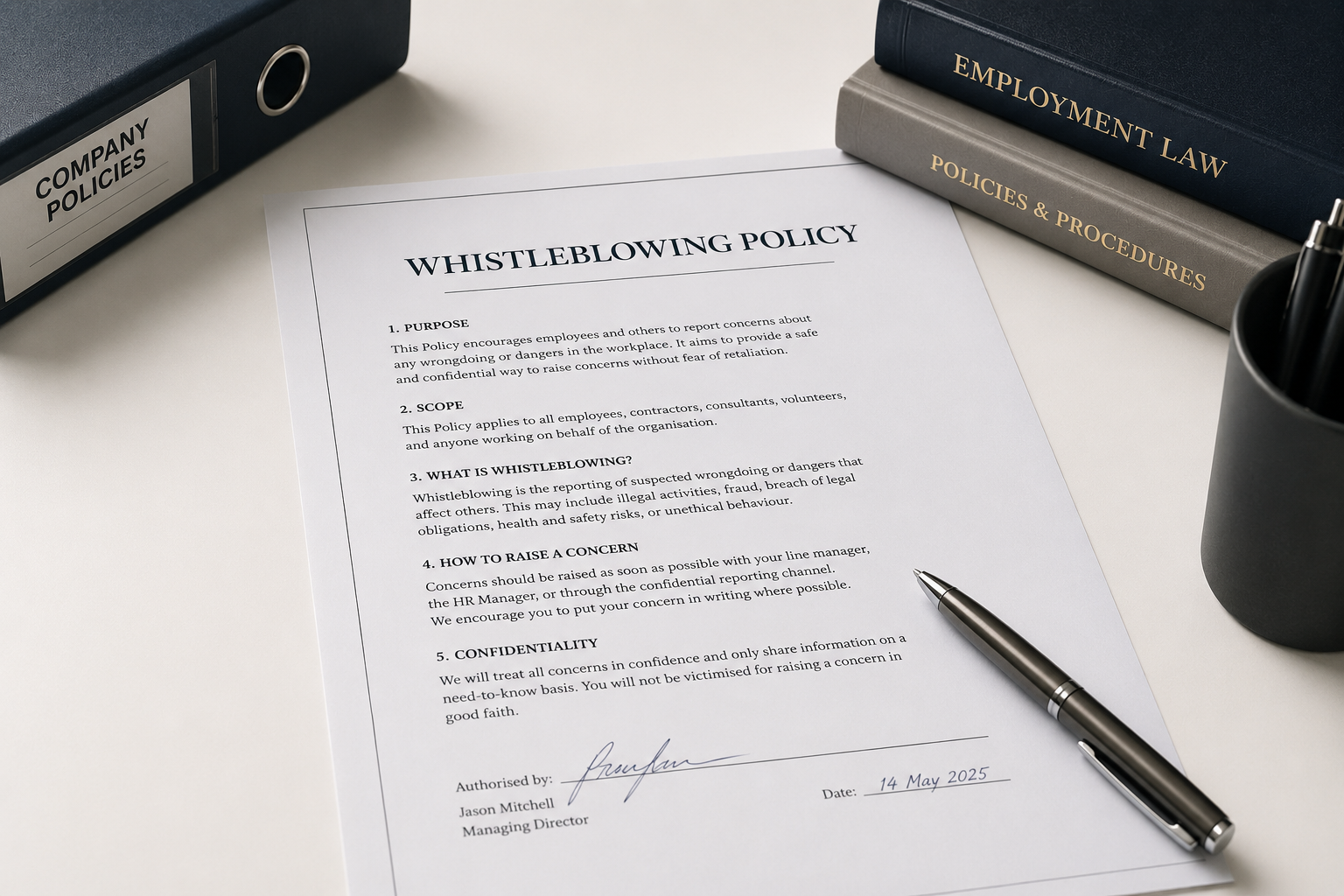
Updated: May 2026 • Based on UK Law • England, Wales & Scotland
What Is a Whistleblowing Policy?
A whistleblowing policy is a written procedure setting out how workers can raise public-interest concerns about wrongdoing — and how the employer responds.
Not legally mandatory in most UK businesses, but the strongest defence against uncapped tribunal awards and external whistleblower reports to regulators.
This guide covers whether a policy is mandatory, the 5 PIDA conditions, the new April 2026 ERA changes, and exactly what UK employers must do next.
From 6 April 2026, sexual harassment disclosures are explicitly protected under whistleblowing law — meaning every UK employer needs a current, fit-for-purpose policy.
Get the policy wrong and you face automatic-unfair-dismissal claims with no qualifying period and uncapped tribunal compensation.
✓ Get your whistleblowing policy ready for April 2026
Our Whistleblowing Policy Template covers PIDA protections, the new April 2026 sexual harassment provisions, reporting channels, investigation procedures, and anti-retaliation clauses.
Preview every clause before buying — only pay when you’re happy with it.
Is a Whistleblowing Policy Mandatory in the UK?
No — there is no legal duty on UK employers to have a written whistleblowing policy.
Gov.uk confirms employers are not legally required to act on a disclosure, and no statute imposes a hard duty to publish a policy.
But that’s not the whole story. Several factors mean most employers should have one in practice.
When You Do Have a Legal Obligation
-
- FCA-regulated firms: Banks, building societies, insurers, and major investment firms must have a whistleblowing policy under FCA rules (SYSC 18).
-
- NHS bodies: Standard policy required under the Freedom to Speak Up framework.
-
- Charities (large): Charity Commission guidance treats it as expected for charities with income above £10,000.
-
- Public sector bodies: Generally required by procurement and audit requirements.
-
- Listed companies: UK Corporate Governance Code expects a policy (comply-or-explain basis).
Why Every Other Employer Should Have One
Protected disclosure claims under PIDA carry uncapped compensation and apply from day one of employment.
A written policy with clear reporting channels reduces the risk of disclosures going external (regulator, media, MP) before the employer has a chance to respond.
It also provides documentary evidence that the employer takes wrongdoing seriously — useful in any tribunal claim or regulatory investigation.
Under the new failure-to-prevent-fraud offence (in force 1 September 2025), large organisations face corporate criminal liability unless they have “reasonable procedures”.
A robust whistleblowing policy is part of that defence.
What Is the Whistleblowing Law in the UK?
UK whistleblowing protection sits primarily within the Public Interest Disclosure Act 1998 (PIDA).
PIDA didn’t create a standalone statute — it inserted Part IVA into the Employment Rights Act 1996 (sections 43A–43L).
Workers who make a “protected disclosure” are protected from dismissal and from any detriment (such as bullying, demotion, or being passed over for promotion).
The Two Levels of Protection
-
- Automatically unfair dismissal: If the reason (or principal reason) for dismissal is a protected disclosure, the dismissal is automatically unfair. No two-year qualifying period applies.
-
- Detriment protection: Workers are protected from being subjected to any detriment because they made a protected disclosure. This applies to a wider group than just employees.
Compensation in successful claims is uncapped — the standard unfair dismissal cap does not apply.
Awards regularly exceed £100,000 in whistleblowing cases. The highest reported award is in the millions.
What Are the 5 Conditions of Whistleblowing?
For a disclosure to be protected under PIDA, it must meet five conditions.
Miss any one and the disclosure isn’t protected — meaning the worker has no whistleblowing claim if they’re dismissed or treated badly.
Condition 1 — Disclosure of Information
The worker must disclose information, not just express an opinion, allegation, or threat to disclose.
“I think the accounts are wrong” — not enough. “The accounts show £40,000 transferred to an unknown supplier on 3 March” — that’s information.
Condition 2 — Reasonable Belief in Truth
The worker must reasonably believe the information tends to show wrongdoing.
The disclosure doesn’t have to be proven true — but the belief must be reasonable. Malicious or knowingly false disclosures are not protected.
Condition 3 — Public Interest
The worker must reasonably believe the disclosure is in the public interest.
Personal grievances (your pay, your manager, your training) don’t usually qualify — those go through grievance procedures instead.
Condition 4 — Relevant Category of Wrongdoing
The information must relate to one of these six categories of wrongdoing:
-
- A criminal offence (fraud, theft, bribery, etc.)
-
- A breach of a legal obligation (employment law, GDPR, financial regulation)
-
- A miscarriage of justice
-
- A danger to the health or safety of any individual
-
- Damage to the environment
-
- The deliberate concealment of any of the above
From 6 April 2026: Sexual harassment is explicitly added to this list under the Employment Rights Act 2025.
Condition 5 — Made to the Right Person
The disclosure must be made to an appropriate recipient. PIDA recognises a tiered structure:
-
- Internal: The employer, or via the employer’s whistleblowing procedure (easiest threshold)
-
- Prescribed person: Statutory regulators on the gov.uk prescribed-persons list (HMRC, FCA, HSE, ICO, etc.)
-
- Wider disclosure: Media, MP, or others — only protected if specific conditions are met (e.g. employer would conceal evidence, threat of detriment)
The further from internal the disclosure goes, the harder it is to satisfy the protection conditions. A clear internal policy keeps disclosures in-house.
What Are the Changes in Whistleblowing in April 2026?
Two significant changes take effect on 6 April 2026.
1. Sexual Harassment Becomes a Protected Disclosure
The Employment Rights Act 2025 amends the Employment Rights Act 1996 to explicitly add sexual harassment to the list of recognised wrongdoing.
Workers reporting that sexual harassment has occurred, is occurring, or is likely to occur will fall squarely within whistleblowing protections.
Previously this protection existed only by interpretation — framed as a breach of legal obligations or a health and safety issue. From April 2026 it is codified.
What this means for employers: Your policy must reference sexual harassment as a category of wrongdoing covered.
If it doesn’t, you create evidential difficulty defending claims where workers say they didn’t know the route existed.
2. HMRC Strengthened Reward Scheme Launches
On 6 April 2026, HMRC’s new informant reward scheme goes live.
Informants who provide intelligence leading to recovery of tax of £1.5 million or more may receive a discretionary reward of up to 30% of the recovered amount.
For UK businesses, this is a step-change. Disgruntled employees with knowledge of tax irregularities now have a financial incentive to report directly to HMRC instead of internally.
A robust internal whistleblowing channel becomes the practical defence — giving workers a credible route to report concerns before they go external.
3. Failure-to-Prevent-Fraud (Already in Force Since September 2025)
Not new for 2026, but relevant context: the Economic Crime and Corporate Transparency Act 2023 created a “failure to prevent fraud” corporate offence.
Large organisations (250+ employees, £36m+ turnover, £18m+ balance sheet) face criminal liability unless they have “reasonable procedures” to prevent fraud.
A documented whistleblowing policy is a core part of those procedures. Without one, the defence is significantly weaker.
Can You Be Fired for Whistleblowing in the UK?
No — dismissing a worker because of a protected disclosure is automatically unfair.
Under section 103A of the Employment Rights Act 1996, dismissal for making a protected disclosure is automatically unfair regardless of length of service.
The standard two-year qualifying period for unfair dismissal does not apply. Day-one protection.
What Counts as “Because of” the Disclosure?
The disclosure must be the reason, or principal reason, for dismissal. Tribunals examine this carefully.
Common employer arguments that fail: “Performance issues” that only arose after the disclosure. “Restructuring” that affects only the discloser. “Cultural fit” with no documented prior concerns.
Tribunals look at timing, contemporaneous documents, and witness evidence to identify the real reason.
What Workers Can Claim
-
- Basic award: Up to £21,000 (statutory cap, 30 weeks’ pay)
-
- Compensatory award: Uncapped — covers loss of earnings, benefits, and future losses
-
- Injury to feelings: Vento bands up to £58,700 (top band)
-
- Aggravated damages: Where employer conduct was particularly bad
-
- Reinstatement order: Tribunal can order the worker back into the job
-
- Interim relief: Worker can apply within 7 days of dismissal to keep being paid until the hearing
This is why whistleblowing claims are among the most expensive for employers to lose. Awards regularly run into six figures.
Can You Fire a Whistleblower in the UK?
Yes, but only for genuine, unrelated reasons — and the burden is heavy.
An employee can be lawfully dismissed for misconduct, capability, or redundancy if those reasons are genuine and not connected to the disclosure.
But once a protected disclosure has been made, every subsequent decision involving that worker comes under tribunal scrutiny.
How to Manage the Risk
-
- Document everything contemporaneously: Performance issues should be documented as they arise, not after a disclosure
-
- Apply policies consistently: If you wouldn’t fire another employee for the same conduct, don’t fire the whistleblower
-
- Separate the decision-maker: Where possible, the person handling any disciplinary should not be the subject of the disclosure
-
- Get advice early: Speak to an employment specialist before any dismissal decision involving a worker who has made a disclosure
-
- Use your policy: A documented whistleblowing procedure shows the disclosure was handled properly, not punished
What Should a UK Whistleblowing Policy Include?
A policy that meets PIDA expectations and the April 2026 changes should cover the following sections.
-
- Scope: Who the policy applies to (employees, workers, contractors, agency staff, volunteers)
-
- Definition: What counts as whistleblowing, including the six categories of wrongdoing plus sexual harassment
-
- Reporting channels: At least two routes — line manager and an alternative (HR, designated officer, or external)
-
- Confidentiality: How the identity of the discloser will be protected
-
- Anonymous reports: Whether and how anonymous disclosures will be handled
-
- Investigation procedure: Timeline, who investigates, and what the worker can expect
-
- Anti-retaliation commitment: Clear statement that detriment or dismissal because of disclosure is prohibited
-
- External routes: Reference to the prescribed-persons list (HMRC, FCA, HSE, ICO, etc.)
-
- Support: Mention of independent sources (Protect, ACAS, trade union)
-
- Records: How disclosures will be logged and reviewed
Our Whistleblowing Policy Template includes all of these sections, structured following PIDA and the April 2026 ERA 2025 amendments.
Frequently Asked Questions
Is a whistleblowing policy mandatory in the UK?
No — there is no general legal duty to have a written whistleblowing policy in UK law.
However, FCA-regulated firms, NHS bodies, listed companies, and large charities are expected to have one.
From April 2026, sexual harassment is explicitly protected — making a current policy practical necessity.
Is it a legal requirement to have a whistleblowing policy in the UK?
For most UK employers, no. The Public Interest Disclosure Act 1998 protects whistleblowers but doesn’t require employers to publish a policy.
Specific regulated sectors (financial services, NHS, listed companies) have sector-specific requirements through FCA SYSC 18, NHS Freedom to Speak Up, and the UK Corporate Governance Code.
Can you be fired for whistleblowing in the UK?
No — dismissal because of a protected disclosure is automatically unfair under section 103A of the Employment Rights Act 1996.
Day-one protection applies (no two-year qualifying period), and compensation is uncapped. Workers can also apply for interim relief within 7 days to remain paid until the tribunal hearing.
Can you fire a whistleblower in the UK?
Yes — but only for genuine, unrelated reasons (misconduct, capability, redundancy) that aren’t connected to the disclosure.
The burden is heavy and tribunals scrutinise every decision after a disclosure has been made. Document everything contemporaneously and apply policies consistently.
What are the 5 conditions of whistleblowing?
For a disclosure to be protected under PIDA, it must meet five conditions:
-
- Disclose information (not just opinion or allegation)
-
- Be made with reasonable belief in its truth
-
- Be in the public interest
-
- Relate to a relevant category of wrongdoing
-
- Be made to the right person
Miss any one and the disclosure isn’t protected.
Can I get in trouble for being a whistleblower?
If the disclosure meets all 5 conditions of PIDA, no — you are legally protected from dismissal and detriment.
If the disclosure is malicious or knowingly false, protection does not apply.
The same is true if you breach criminal confidentiality obligations (e.g. Official Secrets Act) — those routes need legal advice before disclosure.
What are the changes in whistleblowing in April 2026?
From 6 April 2026, the Employment Rights Act 2025 explicitly adds sexual harassment to the categories of protected disclosure under whistleblowing law.
Also from 6 April 2026, HMRC’s Strengthened Reward Scheme launches, offering informants up to 30% of recovered tax on cases of £1.5m or more.
What is whistleblowing in the UK?
Whistleblowing is making a disclosure in the public interest about wrongdoing in the workplace.
It covers criminal offences, breaches of legal obligations, miscarriages of justice, health and safety dangers, environmental damage, deliberate concealment, and (from April 2026) sexual harassment.
What is the whistleblowing Act in the UK?
The Public Interest Disclosure Act 1998 (PIDA) is the principal whistleblowing statute. It inserted whistleblowing protections into Part IVA of the Employment Rights Act 1996.
Workers who make a protected disclosure cannot be dismissed or subjected to detriment for that disclosure. The protections apply from day one of employment.
Is our whistleblowing policy template legally binding?
Yes. When adopted by the employer and communicated to workers, our Whistleblowing Policy creates a clear contractual and procedural framework.
It is structured following PIDA and the April 2026 ERA 2025 amendments.
It includes professional legal structure, the six (post-April 2026) categories of wrongdoing, prescribed-person references, investigation procedures, and anti-retaliation commitments.
Some customers opt for solicitor review for complex sector-specific situations.
Do I need a solicitor to set up a whistleblowing policy?
Most UK employers complete a whistleblowing policy without one. Our template walks through every required section with plain-English guidance.
Consider solicitor review if you operate in a regulated sector (FCA, NHS, listed company) or have specific industry-specific reporting obligations.
The Truth About “Free” Legal Template Sites (What You’re Really Signing Up For)
Most websites offering a “free legal template” follow the same pattern:
-
- You click because it’s advertised as free
-
- You spend 10–15 minutes answering questions
-
- At the very end, you must create an account or start a “free trial”
-
- Your card is required upfront
-
- The subscription auto-renews at £29–£39 per month
This isn’t a free template – it’s a subscription service. Many people only realise after being charged £300–£400 over the year.
Why These “Free” Templates Are a Legal Risk
-
- Outdated wording: not aligned with current UK law
-
- Missing mandatory clauses: required for legal validity
-
- No compliance guidance: leaving users without legal context
-
- No structured checklist: no way to verify the document works
-
- Not kept updated: often unchanged when legislation changes
One incorrect clause can weaken or invalidate the entire document.
Hidden Problem: Many “Free Template” Sites Aren’t Even UK-Based
Another major issue is that many free or auto-subscription template sites operate outside the UK and use documents originally drafted for the US legal system. These are then loosely adapted for “international use,” which creates serious problems:
-
- Incorrect terminology: taken from US contract law
-
- Missing UK statutory references: essential legal requirements omitted
-
- Non-applicable clauses: terms that don’t apply under UK legislation
-
- Legal conflicts: risks breaching UK consumer, employment, or GDPR rules
Why Templates UK Does the Opposite
-
- Drafted by UK professionals: written by experienced business & legal experts
-
- UK-law only: no US crossover or generic “international” templates
-
- One-time price from £10: no subscriptions, no renewals
-
- Full preview: see the exact document before buying
-
- Lifetime access: free lifetime updates included
My Templates Dashboard
All purchased templates are stored in your personal My Templates page, organised by category.
When we update a template for UK law changes, the new version appears automatically in your dashboard — free, forever.
Build a growing library of UK legal documents across every area of your business and personal life.
Transparent Pricing
From £10 per template — with free lifetime usage and free lifetime updates. No subscriptions. No renewals. No auto-billing.
Not ready to buy? Use our free interactive checklists to guide your own document — no payment required.
No tricks. No trials. No hidden fees. Just the exact UK-specific legal document you came for — at the price we told you upfront.
Build your own bespoke document with our Whistleblowing Policy Template. Preview the full document before buying — only pay when you’re happy with it.
Get the Largest Bundle — UK Legal Templates Ultimate Bundle
The UK Legal Templates Ultimate Bundle includes 91 templates across every category — one purchase, lifetime updates, no subscriptions.
Explore Template Bundles by Category
One purchase, lifetime updates, no subscriptions.
-
- Business Complete Suite — 37 templates, £199 (smaller packs available)
-
- Landlord Ultimate Bundle — 33 templates, £120 (smaller packs available)
-
- Complete Family Pack — 18 templates, £65 (smaller packs available)
-
- Complete Estate Pack — 8 templates, £49 (smaller packs available)
Explore the Master Business Legal Templates Pillar Guide
The complete overview of 37 essential UK business templates.
UK Business Legal Templates — Complete Master Guide
Explore All Templates UK Pillar Guides
Related Guides
Free Legal Templates & Interactive Checklists
Access all our free UK legal templates, checklists and downloadable PDFs.
Last updated: May 2026
Disclaimer: This guide provides general UK legal information, not legal advice.
Laws current as of May 2026 — Employment Rights Act 2025 sexual harassment provisions take effect 6 April 2026. HMRC Strengthened Reward Scheme launches 6 April 2026.
Always verify current requirements with official sources. Existing customers receive the updated template free in their My Templates page.