Updated: March 2026 • Based on UK Law
What Is a Fire Risk Assessment?
A fire risk assessment is a structured evaluation of premises to identify fire hazards, assess who could be harmed, and determine what fire safety measures are needed. Under the Regulatory Reform (Fire Safety) Order 2005, it is a legal requirement for virtually all non-domestic premises in England and Wales.
This guide covers UK fire risk assessment law, who is responsible, what it must include, costs, review frequency, and British Standards.
Not having a fire risk assessment is a criminal offence. Fire and rescue authorities can issue enforcement notices, prosecute, and courts can impose unlimited fines — with imprisonment in the most serious cases.
✓ Fire Risk Assessment Template (UK)
Answer guided questions or use the classic editor — your fire risk assessment is built for you. Covers hazard identification, means of escape, fire detection, emergency procedures, and review scheduling. Structured following the Regulatory Reform (Fire Safety) Order 2005. Preview every section before buying — only pay when you’re happy with it. One-time price from £10.
→ Build Your Fire Risk Assessment
Need all 5 H&S templates? Save 42% with the H&S Starter Pack — Policy Statement, Risk Assessment, Fire Risk Assessment, COSHH Assessment & Lone Worker Policy. Just £29, lifetime access, lifetime updates.
What Is a Fire Risk Assessment in the UK?
A fire risk assessment is a systematic check of your premises to identify potential fire hazards, evaluate the risk they pose to people, and decide what measures are needed to prevent a fire or protect people if one breaks out.
It is not a one-off document. It is a living record that must be kept up to date and acted upon.
A proper fire risk assessment will cover:
-
- Sources of ignition — heaters, naked flames, electrical equipment, cooking appliances
-
- Sources of fuel — paper, wood, textiles, flammable liquids, packaging
-
- Sources of oxygen — air conditioning, ventilation, medical oxygen supplies
-
- People at risk — employees, visitors, contractors, disabled persons, sleeping occupants
-
- Existing fire safety measures — alarms, extinguishers, escape routes, signage, emergency lighting
The goal is not to eliminate every possible fire risk. The law requires you to reduce risk to a level that is “as low as reasonably practicable” — balancing the likelihood and severity of harm against the cost and difficulty of prevention.
Is a Fire Risk Assessment a Legal Requirement in the UK?
Yes. A fire risk assessment is a strict legal requirement under the Regulatory Reform (Fire Safety) Order 2005 (the “Fire Safety Order”) for virtually all non-domestic premises in England and Wales.
This includes:
-
- Offices, shops, and retail premises
-
- Factories, warehouses, and industrial units
-
- Restaurants, pubs, hotels, and hospitality venues
-
- Schools, colleges, and universities
-
- Care homes and healthcare premises
-
- Common areas of blocks of flats and HMOs
The only premises exempt are individual private dwellings — your own home, or a single flat with no shared common areas.
In Scotland, equivalent requirements apply under the Fire (Scotland) Act 2005. In Northern Ireland, the Fire Safety Regulations (Northern Ireland) 2010 apply.
The Fire Safety Order was amended by the Fire Safety Act 2021 and the Building Safety Act 2022, which extended duties to include the external walls, structure, and flat entrance doors of multi-occupied residential buildings.
Who Is the “Responsible Person” for Fire Safety?
The Fire Safety Order places the duty on the “responsible person” — the individual who has control over the premises. This is typically:
-
- The employer — if the premises are a workplace
-
- The owner or landlord — if the premises are not a workplace (e.g. common areas of flats)
-
- The occupier — anyone with control over the premises, such as a managing agent or facilities manager
If more than one person has control, all of them share the duty and must co-operate to ensure fire safety.
The responsible person can appoint a competent person to carry out the fire risk assessment — but the legal accountability always stays with them.
What Must a Fire Risk Assessment Cover?
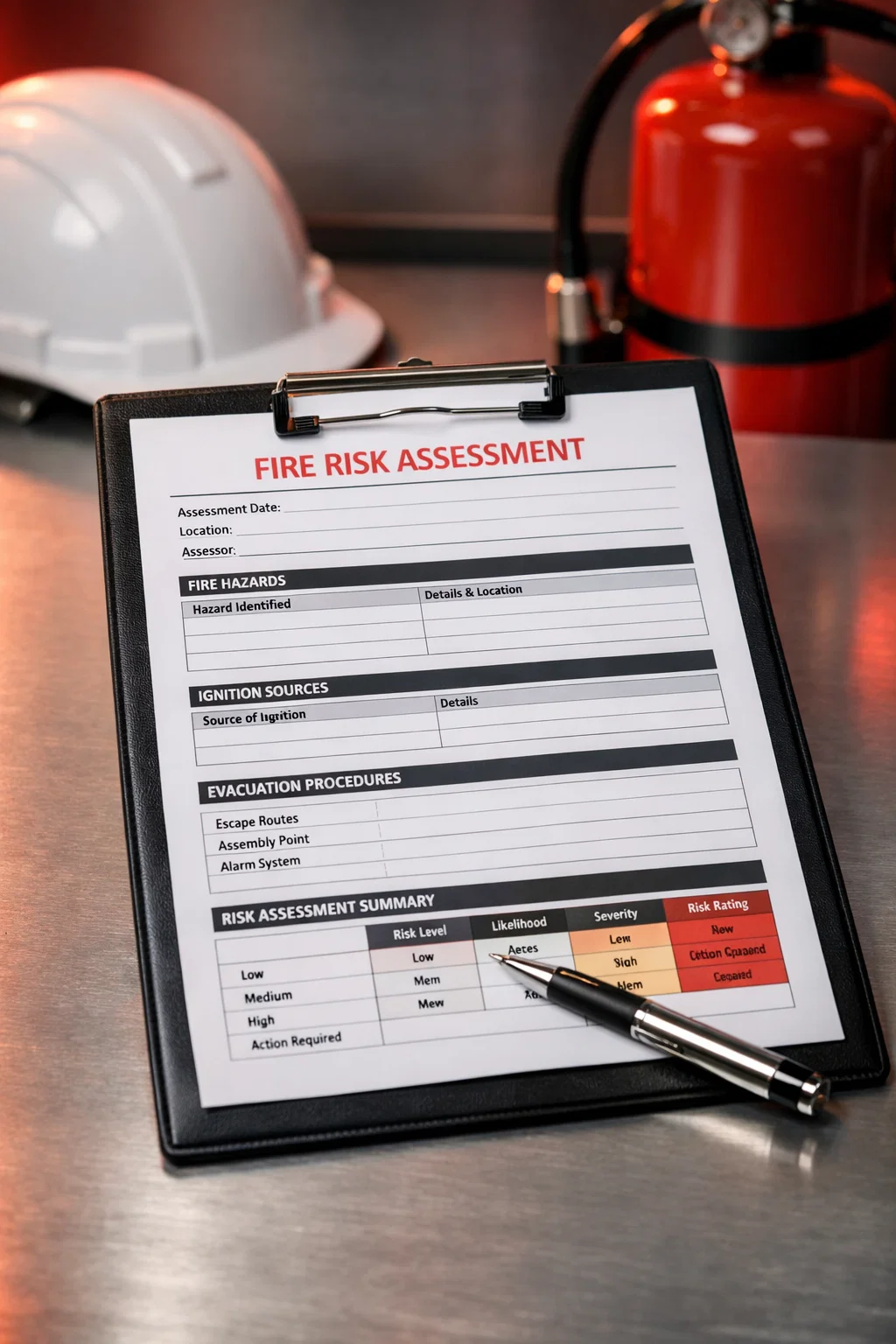
A “suitable and sufficient” fire risk assessment under UK law must address:
-
- Fire hazard identification — sources of ignition, fuel, and oxygen on the premises
-
- People at risk — employees, visitors, contractors, disabled persons, and anyone who sleeps on the premises
-
- Evaluation of risk — how likely a fire is to start and how serious the consequences could be
-
- Existing fire safety measures — detection, alarm systems, extinguishers, emergency lighting, signage, and compartmentation
-
- Means of escape — escape routes, exit doors, assembly points, and evacuation procedures
-
- Fire safety management — staff training, fire drills, maintenance of equipment, and record-keeping
-
- Significant findings — a clear record of hazards, who is at risk, and what action is needed
-
- An action plan — prioritised recommendations with timescales for completion
-
- A review date — when the assessment will next be checked
If your premises have five or more employees, the significant findings must be recorded in writing.
How to Get a Fire Risk Assessment in the UK
You have two options:
Do it yourself. If you are the responsible person for a small, low-risk premises and you have sufficient knowledge to identify fire hazards and evaluate risks, you can carry out your own fire risk assessment. The government publishes free guidance for different premises types on GOV.UK. Our Fire Risk Assessment Template provides a structured framework to guide you through every step.
Appoint a professional fire risk assessor. For larger, complex, or high-risk premises — such as multi-storey buildings, care homes, HMOs, or buildings where people sleep — a professional assessment is strongly recommended. Look for assessors registered with a UKAS-accredited scheme such as BAFE (British Approvals for Fire Equipment).
How Much Does a Fire Risk Assessment Cost in the UK?
If you carry out your own assessment using a structured template, the cost is minimal — from as little as £10 for a professionally drafted template.
If you appoint a professional fire risk assessor, costs vary significantly depending on the size and complexity of the premises:
-
- Small, single-storey premises (shop, small office) — typically £150 to £400
-
- Medium commercial premises (multi-floor office, restaurant, warehouse) — typically £400 to £800
-
- Large or complex premises (care homes, hotels, multi-storey residential blocks) — typically £800 to £1,500+
-
- High-rise or high-risk buildings — £1,500 to £2,500+
Prices in London and the South East typically run 20–40% higher than the national average.
Most assessors charge per job (not per hour), with the fee covering the site visit, report writing, and the action plan.
How Often Should a Fire Risk Assessment Be Reviewed in the UK?
The Fire Safety Order does not set a fixed legal timeframe. However, the law requires that your fire risk assessment is kept “under review” — meaning it must remain current and accurate at all times.
In practice, fire risk assessments should be reviewed:
-
- At least annually — this is widely accepted as the minimum standard
-
- After any fire, near miss, or false alarm
-
- When the premises change — refurbishment, extension, change of use, or change of layout
-
- When occupancy changes — more people, different working patterns, or vulnerable occupants
-
- When fire safety equipment changes — new alarm system, new extinguishers, changes to escape routes
-
- When legislation changes — new regulations or updated guidance
For higher-risk premises — care homes, HMOs, hotels, and buildings where people sleep — more frequent reviews may be appropriate.
What Is the British Standard for Fire Risk Assessment?
The recognised British Standard methodology for fire risk assessments depends on the type of premises:
For non-housing premises (offices, shops, factories, schools, restaurants): PAS 79-1:2020 — Fire risk assessment: Premises other than housing. Code of practice. This is the standard most professional fire risk assessors follow for workplace and commercial assessments.
For housing (blocks of flats, HMOs, sheltered housing): BS 9792:2025 — Fire risk assessment: Housing. Code of practice. This replaced the earlier PAS 79-2:2020, which has been withdrawn.
For building design and fire safety management: BS 9999:2017 — Code of practice for fire safety in the design, management and use of buildings. This covers the design of means of escape, fire detection, structural fire resistance, and ongoing fire safety management.
For assessor competence: BS 8674:2025 — Framework for competence of individual fire risk assessors. This new standard defines what “competent” means when appointing a fire risk assessor.
None of these standards are a legal requirement in themselves — but following them demonstrates compliance with the Fire Safety Order and provides a strong defence if your assessment is ever challenged.
What Happens If You Don’t Have a Fire Risk Assessment?
Failing to carry out a fire risk assessment — or having an inadequate one — is a criminal offence under the Fire Safety Order. Fire and rescue authorities are the main enforcing body, and they have significant powers:
-
- Enforcement notices: requiring you to remedy fire safety failings within a set timeframe
-
- Prohibition notices: immediately restricting or preventing use of premises where there is a serious risk to life
-
- Alterations notices: requiring you to notify the fire authority before making changes to premises
-
- Prosecution: unlimited fines and, for the most serious offences, up to two years’ imprisonment
Insurance implications are equally serious. If a fire occurs and your insurer discovers that no adequate fire risk assessment was in place, they can void your claim entirely — leaving you personally liable for all losses.
Health & Safety Starter Pack — All 5 Templates
Complete H&S Toolkit • Policy, Risk Assessments, Fire Safety, COSHH & Lone Worker • Save 42% vs Buying Individually
Lifetime Access • Free Updates • 30-Day Money-Back Guarantee*
Frequently Asked Questions
Can I do my own fire risk assessment?
Yes — if you are the responsible person for a small, low-risk, straightforward premises and have sufficient knowledge to identify fire hazards, evaluate risks, and implement safety measures. The assessment must still meet the “suitable and sufficient” standard required by the Fire Safety Order. For complex or high-risk premises, a professional assessor is strongly recommended.
Is a fire risk assessment different from a general workplace risk assessment?
Yes. A fire risk assessment is a separate legal requirement under the Regulatory Reform (Fire Safety) Order 2005. A general workplace risk assessment falls under the Management of Health and Safety at Work Regulations 1999. You need both. They can be done alongside each other, but the fire risk assessment must specifically cover fire hazards, means of escape, fire detection, and emergency procedures.
Do landlords need a fire risk assessment?
Yes — for the common areas of any multi-occupied residential building. This includes shared hallways, stairwells, and communal areas of blocks of flats, HMOs, and converted houses. The Fire Safety Act 2021 extended this to include the structure, external walls, and flat entrance doors of multi-occupied residential buildings.
What qualifications does a fire risk assessor need?
There are no legally mandated qualifications. However, the assessor must be “competent” — meaning they have sufficient training, experience, and knowledge to carry out the assessment properly. The new BS 8674:2025 standard defines competence levels for fire risk assessors. Look for assessors registered with BAFE or holding recognised qualifications such as the IFE (Institution of Fire Engineers) Level 4 Certificate.
Does the fire risk assessment need to be written down?
If your business has five or more employees, the significant findings must be recorded in writing. Even for smaller businesses, the Fire Safety Order requires that findings are recorded and acted upon. In practice, always document your fire risk assessment — it provides evidence of compliance and is the first thing a fire inspector will ask to see.
The Truth About “Free” Legal Template Sites (What You’re Really Signing Up For)
Most websites offering a “free legal template” follow the same pattern:
-
- You click because it’s advertised as free
-
- You spend 10–15 minutes answering questions
-
- At the very end, you must create an account or start a “free trial”
-
- Your card is required upfront
-
- The subscription auto-renews at £29–£39 per month
This isn’t a free template – it’s a subscription service. Many people only realise after being charged £300–£400 over the year.
Why These “Free” Templates Are a Legal Risk
-
- Outdated wording: not aligned with current UK law
-
- Missing mandatory clauses: required for legal validity
-
- No compliance guidance: leaving users without legal context
-
- No structured checklist: no way to verify the document works
-
- Not kept updated: often unchanged when legislation changes
One incorrect clause can weaken or invalidate the entire document.
Hidden Problem: Many “Free Template” Sites Aren’t Even UK-Based
Another major issue is that many free or auto-subscription template sites operate outside the UK and use documents originally drafted for the US legal system. These are then loosely adapted for “international use,” which creates serious problems:
-
- Incorrect terminology: taken from US contract law
-
- Missing UK statutory references: essential legal requirements omitted
-
- Non-applicable clauses: terms that don’t apply under UK legislation
-
- Legal conflicts: risks breaching UK consumer, employment, or GDPR rules
Why Templates UK Does the Opposite
-
- Drafted by UK professionals: written by experienced business & legal experts
-
- UK-law only: no US crossover or generic “international” templates
-
- One-time price from £10: no subscriptions, no renewals
-
- Full preview: see the exact document before buying
-
- Lifetime access: free lifetime updates included
My Templates Dashboard
All purchased templates are stored in your personal My Templates page, organised by category.
When we update a template for UK law changes, the new version appears automatically in your dashboard — free, forever.
Build a growing library of UK legal documents across every area of your business and personal life.
Transparent Pricing
From £10 per template — with free lifetime usage and free lifetime updates. No subscriptions. No renewals. No auto-billing.
Not ready to buy? Use our free interactive checklists to guide your own document — no payment required.
No tricks. No trials. No hidden fees. Just the exact UK-specific legal document you came for — at the price we told you upfront.
Build your own bespoke document with our Fire Risk Assessment Template. Preview the full contract before buying — only pay when you’re happy with it.
Get Every Template in One Bundle
The UK Legal Templates Ultimate Bundle includes 91 templates across every category — one purchase, lifetime updates, no subscriptions.
Explore Template Bundles by Category
One purchase, lifetime updates, no subscriptions.
-
- Business Complete Suite — 37 templates, £120 (smaller packs available)
-
- Landlord Ultimate Bundle — 28 templates, £99 (smaller packs available)
-
- Complete Family Pack — 18 templates, £65 (smaller packs available)
-
- Complete Estate Pack — 8 templates, £38 (smaller packs available)
Explore the Master Business Legal Templates Pillar Guide
The complete overview of 37 essential UK business templates.
UK Business Legal Templates — Complete Master Guide
Explore All Templates UK Pillar Guides
Related Guides
Free Legal Templates & Interactive Checklists
Access all our free UK legal templates, checklists and downloadable PDFs.
Last updated: March 2026
Disclaimer: This guide provides general UK legal information, not legal advice. Laws are current as of March 2026.