Updated: January 2026 • Based on UK Law
Quick Navigation:
Who Do You Have to Notify When You Change Your Name in the UK?
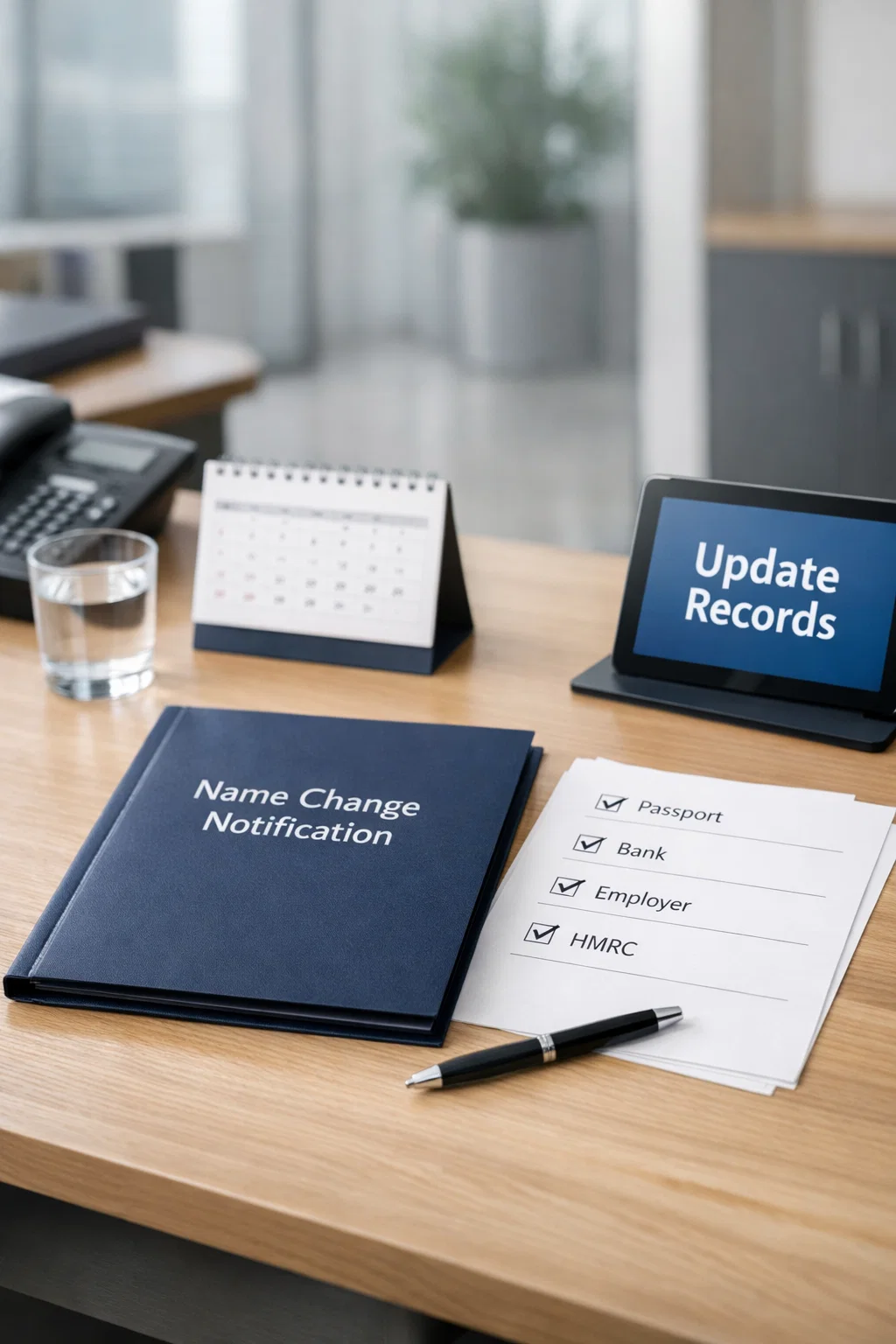
You must notify all organisations holding records in your name, including HM Passport Office, DVLA, HMRC, banks, employers, and the electoral register. There is no central registry — each organisation requires individual notification with your deed poll.
This guide covers notification requirements, required documents, timelines, and verification steps. Free name change checklist included.
✓ Free Name Change Notification Checklist
Interactive checklist covering government bodies (Passport Office, DVLA, HMRC, NHS), banks, insurers, employers, and utilities. Track your progress and download as PDF.
Prefer to get started now? Get the Name Change Notification Pack →
Missing key notifications causes serious problems. If you don’t notify HMRC, your tax records won’t match your other documents — potentially triggering investigations or delays in tax refunds. Failing to update your driving licence within a reasonable time can result in a £1,000 fine. Banks may freeze accounts if your ID no longer matches their records. Travelling with a passport in a different name from your tickets creates security issues at airports.
This comprehensive guide provides a complete list of every organisation you need to notify, what evidence each requires, how long updates take, and how to check if someone has legally changed their name in the UK.
FREE Name Change Notification Checklist
Every Organisation You Need to Inform After Changing Your Name
Who to Notify After Name Change (Priority-Based Breakdown)
You must inform every organisation that holds records in your name. There is no automatic system — you contact each one individually with your deed poll or marriage certificate. The key principle: if an organisation has your name on file, they need to know about the change.
Notification Priority Levels
| Priority | Timeframe | Organisations | Why First |
|---|---|---|---|
| Immediate | Week 1-2 | Passport Office, DVLA, Employer | Other organisations require updated photo ID |
| High | Month 1 | Bank, HMRC, GP, Electoral Register, Insurance | Financial and legal records must match ID |
| Standard | Months 2-3 | Utilities, Subscriptions, Memberships, Loyalty Cards | Less urgent but should be completed |
Start with passport (6-10 weeks processing) and driving licence (3 weeks). Banks typically require new photo ID in your new name before updating accounts, so these must come first. After updating your primary ID, notify your employer immediately (for payroll — your employment contract details will need updating), then HMRC, bank, and GP surgery.
Complete Notification Checklist
The complete list includes approximately 25-40 organisations for most people:
Government: Passport Office, DVLA (licence + V5C), HMRC, DWP (if receiving benefits), Student Loans Company, Land Registry, Electoral Register
Financial: Bank, building society, credit cards, mortgage lender, pension providers, investment accounts, premium bonds
Insurance: Home, car, life, travel, health, pet
Employment: Current employer HR, workplace pension, professional regulatory bodies
Utilities: Gas, electricity, water, council tax, TV licence, broadband, mobile phone
Healthcare: GP surgery, dentist, optician, hospital (if under ongoing care)
Personal: Loyalty cards, gym membership, subscriptions, clubs and societies
Self-employed: Companies House (if director), business bank accounts, professional indemnity insurance. Also update your freelance contracts, consultancy agreements, service agreements, and terms of business. If you have a business website, update your privacy policy and terms and conditions.
Estate Planning: While a name change doesn’t automatically invalidate your will, you should review it to ensure executors and beneficiaries can be clearly identified. Consider adding a codicil confirming your new name, or creating a new will if making other changes. If you own property jointly, update any declaration of trust with the Land Registry.
Finding Organisations You May Have Forgotten
Make a comprehensive list by reviewing: your wallet (every card), your email (search for account confirmations), your post (who sends you mail), your direct debits and standing orders (bank statement review), and any online accounts. Include old pension schemes from previous employers, investments set up years ago, and professional registrations. It’s better to over-notify than miss something.
Some organisations have specific legal timeframes. You must update your driving licence details with DVLA — while there’s no fixed deadline, failing to do so “as soon as possible” can result in a fine of up to £1,000. Your passport should be updated before any international travel. Electoral register updates are important before any election to ensure you can vote.
Special Cases & Common Questions
Do I Need to Notify the Post Office of a Name Change?
No — you do not need to notify the Post Office of a name change. The Post Office delivers mail based on the address, not the name. Mail addressed to your old name will still be delivered to your address. However, if you have a PO Box, you should update the registered name. If you use Royal Mail’s mail redirection service, you may want to ensure it covers both your old and new names during the transition period.
The exception is if you have a Post Office Card Account (used for receiving benefits) — in that case, contact the DWP to update your name, and the card account details will be updated accordingly. Post Office travel money services and Post Office credit cards are separate financial products and should be updated like any other financial account.
Complete notification pack: Name Change Notification Letter Pack — professional letter template to notify banks, DVLA, employers, HMRC, and any organisation of your legal name change.
Evidence & Proof of Name Change
What Evidence Is Needed for Name Change in the UK?
The primary evidence is your deed poll (or marriage certificate if changing name after marriage). Different organisations require different levels of evidence:
| Organisation | Evidence Required | Processing Time |
|---|---|---|
| HM Passport Office | Original deed poll (returned after processing) | 6-10 weeks |
| DVLA | Photocopy accepted + Form D1 | 3 weeks |
| Banks | Certified copy + new photo ID | 1-2 weeks |
| HMRC | Photocopy or phone notification | 4-6 weeks |
| GP/NHS | Photocopy accepted | 1-2 weeks |
| Utilities | Photocopy or phone notification | Immediate-1 week |
You should have: the original deed poll, 5-10 certified copies (certified by a solicitor, £3-£5 each), and photocopies for organisations that accept them.
Additional evidence typically required includes: current photo ID (passport or driving licence), proof of address dated within the last 3 months (utility bill, bank statement), and your birth certificate (showing your original name). Some organisations also require a covering letter explaining the name change and providing your account or reference numbers.
How Do I Get Proof of Name Change in the UK?
Your deed poll is the proof of name change. Once you have executed (signed and witnessed) your deed poll, that document itself is the legal proof. Keep the original safe — you will need it for passport and driving licence applications. For other organisations, use certified copies or good quality photocopies depending on their requirements.
If you changed your name by marriage, your marriage certificate is the proof. For divorce reversion to maiden name, use your decree absolute together with your marriage certificate (our Separation Agreement Guide covers the divorce process). For statutory declarations, the witnessed declaration is the proof. Whichever document evidences your name change, keep the original safe and use copies for notifications wherever possible.
Once you have updated your passport and driving licence, these documents also serve as proof of your current (new) name and can be used alongside the deed poll when updating other records.
Finding If Someone Changed Their Name
How to Find Out If Someone Changed Their Name in the UK?
Finding if someone changed their name in the UK is difficult because most name changes are private (unenrolled deed polls). There is no public register of name changes. The only publicly searchable name changes are enrolled deed polls, which are published in The London Gazette. Less than 1% of name changes are enrolled, so this search will miss most name changes.
To search enrolled deed polls: visit The London Gazette website (thegazette.co.uk), use the search function, and search for the person’s name. Enrolled deed polls are published as official notices. This search is free. However, remember that the vast majority of people use unenrolled deed polls which do not appear in any public record.
Can You Check If Someone Has Changed Their Name in the UK?
You cannot comprehensively check if someone has changed their name in the UK. There is no central register of name changes. Unenrolled deed polls (the most common type) are private documents — there is no requirement to register them anywhere, and no public record is created. The person simply uses their new name and updates their documents individually.
Limited checks you can make: search The London Gazette for enrolled deed polls (rare), check public records that might show both names (electoral register, Companies House if they’re a director), or conduct general internet searches. For legitimate purposes (legal proceedings, due diligence), a solicitor may be able to make additional enquiries, but there is no guaranteed way to discover an unenrolled name change.
Can You Find Out If Someone Has Changed Their Name in the UK?
You can find enrolled deed polls (published in The London Gazette) but not unenrolled deed polls. If someone wanted their name change to be publicly recorded, they would have paid £50.32 to enroll it with the Royal Courts of Justice. Most people specifically choose unenrolled deed polls because they want privacy — the name change is legally valid but not publicly searchable.
If you need to verify someone’s identity or previous names for legitimate purposes (employment checks, legal proceedings, property transactions), you should ask them directly to provide documentation of any previous names. For official purposes like DBS checks, the person is required to disclose previous names — they cannot hide a name change in formal vetting processes.
How Can You See If Someone Legally Changed Their Name?
You cannot see if someone legally changed their name unless they enrolled the deed poll (published in The Gazette) or they tell you. Legal name changes via unenrolled deed poll are entirely private. The person has no obligation to disclose previous names except in specific circumstances: DBS checks, court proceedings, certain regulated professions, and some immigration processes.
If you have a legitimate need to know (as an employer, landlord, or for legal proceedings), you can require the person to disclose previous names as part of your application or vetting process. They must answer honestly — providing false information in these contexts can have legal consequences. But you cannot independently discover a name change without their cooperation unless it was enrolled.
Frequently Asked Questions: Name Change Notifications UK
How long do I have to notify organisations of a name change?
There is no single legal deadline, but you should update documents “as soon as reasonably practicable.” For driving licences, DVLA expects updates promptly — failing to do so can result in a fine up to £1,000, though prosecutions are rare. Passports should be updated before international travel. Banks may freeze accounts if your ID doesn’t match, so update them as soon as you have new photo ID. Generally, aim to complete all essential notifications within 1-3 months.
Do I need to update my birth certificate after changing my name?
No — your birth certificate cannot be changed to show your new name (except in cases of adoption or gender recognition). Your birth certificate remains in your original name permanently. When asked for your birth certificate, you provide it together with your deed poll to show the connection between your birth name and current legal name. This is standard practice.
Can I notify organisations before my deed poll is complete?
No — you cannot update official records until you have a valid, executed deed poll. The deed poll must be signed and witnessed before you can use it. Once executed, it is immediately valid and you can begin notifications. Some organisations (like the Passport Office) require the original deed poll, so plan your notification sequence carefully.
What if an organisation won’t accept my deed poll?
This is rare but can happen. If an organisation refuses your deed poll: ask specifically why (wording issue, witness issue, etc.), check if they require the original rather than a copy, confirm if they need a certified copy rather than a photocopy, and ask if they require an enrolled deed poll (some banks and foreign institutions do). If the deed poll is properly executed, most refusals are due to administrative confusion — escalate to a supervisor if needed.
Do I need to notify organisations abroad?
If you have accounts, memberships, or records with organisations in other countries, yes. Foreign organisations may have different requirements — some only accept notarized documents or enrolled deed polls. Check with each organisation what they require. If you hold dual citizenship, you’ll need to update your foreign passport through the relevant embassy, which may have specific name change procedures.
What if I miss notifying an organisation?
Notify them as soon as you remember. There’s no penalty for late notification to most organisations — they simply update their records when you tell them. The exception is situations where the mismatch causes problems: incorrect tax records, insurance claims rejected due to name discrepancy, or inability to access accounts. Keep your old ID documents until all updates are confirmed, in case you need them for verification.
Do I need to notify my school or university?
If you’re currently enrolled, yes — notify the registrar to update your student records and ensure certificates are issued in your correct name. For past education, you can contact institutions to request replacement certificates in your new name, though this may involve fees. Your original certificates remain valid — you use them alongside your deed poll when applying for jobs or further education.
What about changing my child’s name?
Changing a child’s name requires a child deed poll signed by everyone with parental responsibility. The notification process is similar but involves schools, GP surgeries, child benefit, and any children’s savings accounts. In most cases, 16–17-year-olds can change their own name, though some organisations may still request parental confirmation. See our Child Deed Poll Guide for full requirements.
How do I update my name with Companies House?
If you’re a company director or person with significant control, file form CH01 (director name change) or update PSC details through your Companies House account. You’ll need to provide evidence of the name change. The update is usually processed within a few days. Failure to update Companies House records can result in penalties and issues with company compliance.
Use the Free Name Change Notification Checklist to track every organisation you need to notify and ensure nothing is missed.
Summary: Your Complete Name Change Notification Strategy
Changing your name requires notifying 25-40+ organisations individually — there is no central system. Start with passport and driving licence (you need new photo ID before most other organisations will update), then work through banks, HMRC, employer, healthcare, utilities, and all other accounts. Budget 2-3 months to complete all updates.
Keep your original deed poll safe for passport applications, use certified copies for organisations that require them, and photocopies for those that accept them. Track your notifications with a checklist to ensure nothing is missed. If an organisation refuses your deed poll, ask why and escalate if the refusal seems unjustified.
Save hours drafting letters — our Name Change Notification Letter Pack includes everything you need.
Name Change Pack
Complete Coverage • 4 Templates + Editor & Interview Versions • Save 38% vs Buying Individually
Lifetime Access • Free Updates • 30-Day Money-Back Guarantee
The Truth About “Free” Legal Template Sites (What You’re Really Signing Up For)
Most websites offering a “free legal template” follow the same pattern:
- You click because it’s advertised as free
- You spend 10–15 minutes answering questions
- At the very end, you must create an account or start a “free trial”
- Your card is required upfront
- The subscription auto-renews at £29–£39 per month
This isn’t a free template — it’s a subscription funnel. Many people only realise after being charged £300–£400 over the year.
Why These “Free” Templates Are a Legal Risk
- Outdated wording: not aligned with current UK law
- Missing mandatory clauses: required for legal validity
- No compliance guidance: leaving users without legal context
- No structured checklist: no way to verify the document works
- Not kept updated: often unchanged when legislation changes
One incorrect clause can weaken or invalidate the entire document.
Hidden Problem: Many “Free Template” Sites Aren’t Even UK-Based
Another major issue is that many free or auto-subscription template sites operate outside the UK and use documents originally drafted for the US legal system. These are then loosely adapted for “international use,” which creates serious problems:
- Incorrect terminology: taken from US contract law
- Missing UK statutory references: essential legal requirements omitted
- Non-applicable clauses: terms that don’t apply under UK legislation
- Legal conflicts: risks breaching UK consumer, employment, or GDPR rules
Why Templates UK Does the Opposite
- Drafted by UK professionals: written by experienced business and legal experts
- UK-law only: no US crossover or generic “international” templates
- £10 one-time price: no subscriptions, no renewals
- Full preview: see the exact document before buying
- Two versions included: Editor + Interview formats
- Lifetime access: free lifetime updates included
- Free compliance checklist: included with every document
No tricks. No trials. No hidden fees. Just the exact UK-specific legal document you came for — at the price we told you upfront.
Get the professionally drafted Name Change Notification Pack and get it right the first time.
Explore the Master Legal Templates Pillar Guide
The complete overview of 37 essential UK business templates.
UK Business Legal Templates – Complete 2025 Master Guide
Explore All Templates UK Pillar Guides
- Employment Documents Guide UK
- How to Set Up a Business in the UK – Legal Guide
- Website Legal Documents UK – Compliance Guide
- Financial & Commercial Contracts UK – Protection Guide
- Commercial Office Lease Guide UK
- Digital & IP Agreements Guide UK
- Wills & Estate Planning Guide UK
- Family Law Documents Guide UK
Related Guides
- Family Law Documents Guide UK
- Adult Deed Poll Guide UK
- Child Deed Poll Guide UK
- Statutory Declaration Guide UK
Free Legal Templates & Interactive Checklists
Access all our free UK legal templates, checklists and downloadable PDFs.
Last updated: January 2026
Disclaimer: This guide provides general UK legal information, not legal advice. Laws are current as of January 2026.