Updated: December 2025 • Based on UK Law
Quick Navigation:
What Is a Property Inspection Report?
A property inspection report is a written record documenting property condition during a landlord inspection. Records findings on maintenance, damage, cleanliness, safety compliance. Landlords typically inspect every 3-6 months with 24 hours written notice. Report includes photos, condition ratings, required repairs. Used for tracking condition changes, identifying maintenance needs, addressing tenant breach, supporting deposit deductions. Essential landlord documentation for AST management.
This guide covers inspection frequency, landlord rights, notice requirements, report contents, and documentation standards, with a free interactive template.
Approximately 68% of UK landlords conduct regular property inspections, yet common errors undermine their legal validity.
The most frequent mistakes are: giving inadequate notice (verbal notice or less than 24 hours written notice – makes inspection unlawful trespass), conducting inspections too frequently (monthly inspections deemed harassment unless justified by serious concerns), failing to document findings properly (no photos, vague descriptions, no date/time stamps – weakens deposit claims), entering without the tenant’s consent after giving notice (notice gives right to request entry, not automatic entry right), inspecting the tenant’s personal belongings (drawers, wardrobes, private papers – privacy violation), and confusing inspection types (mixing routine inspection with inventory check-out or Right to Rent verification).
Well-documented inspection reports protect the landlord’s property while respecting the tenant’s quiet enjoyment rights.
The legal framework under common law tenancy rights and Property Misdescriptions Act 2013 governs property inspections. A landlord has an implied right to inspect property to check condition and ensure the tenant’s compliance with tenancy obligations, but must balance this against the tenant’s right to quiet enjoyment.
Standard AST includes inspection clause granting the landlord access rights with reasonable notice.
Key principles:
Notice requirement – minimum 24 hours written notice specifying date, time, purpose of inspection (longer notice periods better practice – 48 hours or 7 days).
Reasonable frequency – typically 3-6 monthly inspections, more frequent only if justified (ongoing repairs, suspected damage, end of tenancy approaching).
Tenant consent required – notice requests access, the tenant can reasonably refuse inconvenient times.
Proper purpose – inspections must be for legitimate landlord purposes (checking condition, safety compliance, maintenance identification), not harassment or control.
FREE Landlord Compliance Checklist
Property Inspection Report Requirements Every UK Landlord Must Follow
What Is a Property Inspection Report?
A property inspection report is a written record created by a landlord (or property manager/letting agent) during routine property inspection.
What it documents:
(1) Overall property condition – general state of repair, cleanliness, maintenance standards.
(2) Specific findings – damage, wear and tear, repairs needed, safety issues, tenant breach.
(3) Photographic evidence – dated photos of key areas and any issues identified.
(4) Action items – repairs the landlord will arrange, issues the tenant must address, timeline for compliance.
(5) Comparison to baseline – changes since last inspection or original inventory.
Purpose of inspection report:
Legal documentation – evidence for deposit deductions, breach of tenancy claims, possession proceedings.
Maintenance tracking – systematic record of property deterioration and repair history.
Tenant communication – formal notification of issues requiring tenant action.
Insurance compliance – evidence of the landlord maintaining property to insurer standards.
Regulatory compliance – proof of safety checks (smoke alarms, carbon monoxide, electrical safety).
Not the same as:
Inventory and schedule of condition (detailed baseline at tenancy start).
Check-out inspection (final inspection at tenancy end).
Home buyer survey (structural survey for property purchase).
Right to Rent inspection (immigration status verification).
What Is a House Inspection in the UK?
House inspection in UK rental context means landlord’s periodic visit to check property condition during tenancy.
Typical inspection covers:
(1) External condition – roof, gutters, walls, windows, doors, garden/boundaries, shared areas.
(2) Internal condition – walls, ceilings, floors, fixtures, fittings, decoration, cleanliness.
(3) Utilities and systems – heating, plumbing, electrics, appliances (if landlord-provided).
(4) Safety compliance – smoke alarms, carbon monoxide detectors, gas safety, electrical safety, fire doors.
(5) Tenancy compliance – number of occupants, subletting check, unauthorized alterations, prohibited activities (smoking if banned, pets if not allowed).
Inspection process:
Pre-inspection – the landlord gives written notice (minimum 24 hours, typically 48 hours to 7 days).
During inspection – the landlord enters with the tenant present (preferred) or the tenant’s permission if absent, typically 30-60 minutes.
Post-inspection – the landlord prepares written report with photos, shares with the tenant, agrees actions/timeline.
Different from:
Inventory check-in (detailed baseline condition at tenancy start).
Check-out inspection (final assessment for deposit deductions).
Emergency access (immediate entry for emergency repairs without notice).
Accompanied viewings (showing property to prospective tenants/buyers with notice).
What Is a Standard Property Report?
Standard property report contains:
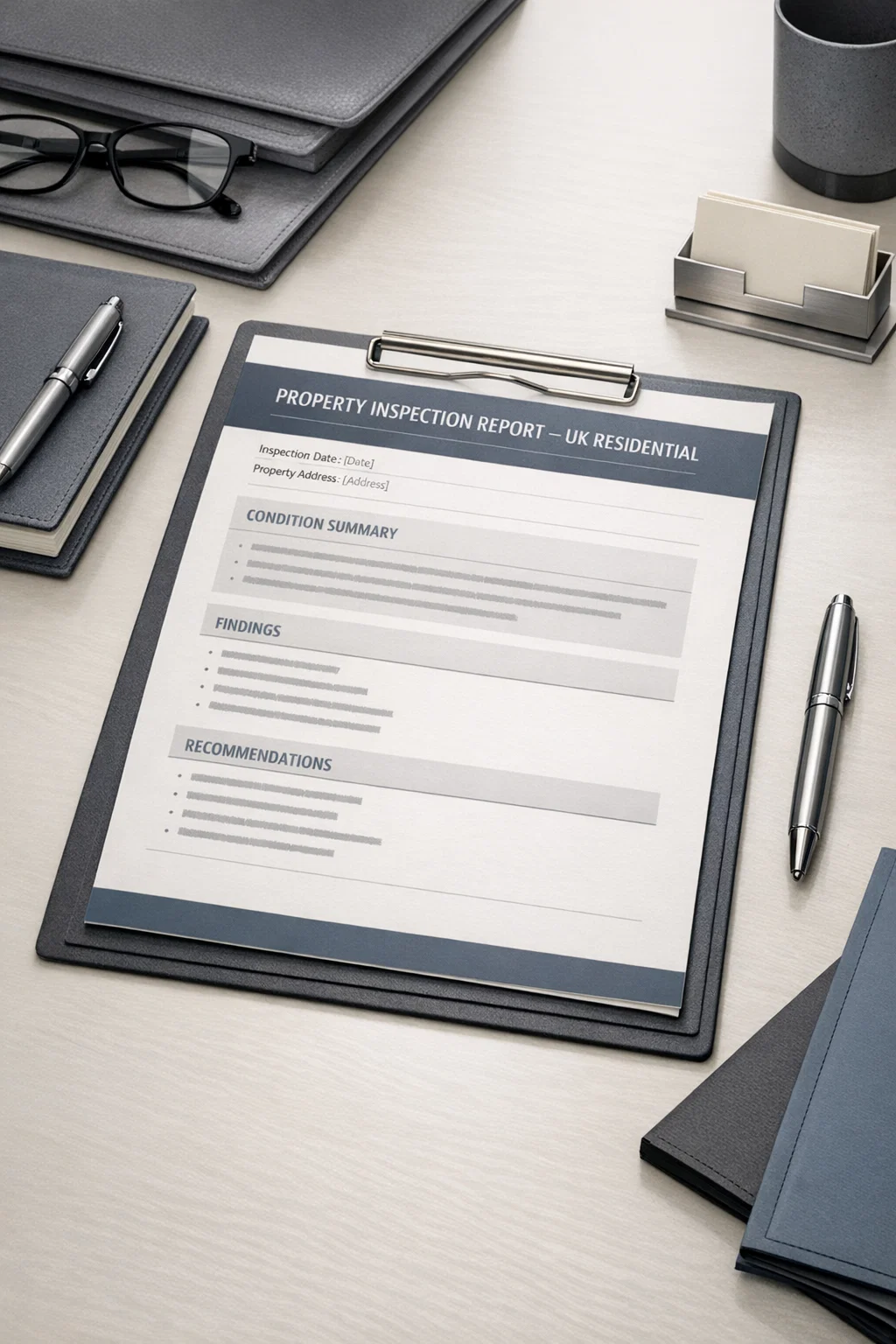
(1) Header section – property address, inspection date/time, inspector name, tenant names, inspection type (routine/requested/emergency).
(2) Overall condition summary – general assessment (excellent/good/satisfactory/poor), comparison to previous inspection.
(3) Room-by-room findings – each room assessed separately (kitchen, bathroom, bedrooms, living areas, hallway, external).
(4) Condition ratings – system for rating each area (1-5 scale or excellent/good/fair/poor).
(5) Specific issues identified – description, location, severity, cause (tenant damage vs wear and tear vs landlord maintenance).
(6) Photographic evidence – dated photos of each room plus close-ups of issues.
(7) Required actions – repairs the landlord will arrange (with timeline), issues the tenant must address (with deadline), safety concerns (immediate action).
(8) Previous issues follow-up – status of items from last inspection, compliance check.
(9) Recommendations – preventative maintenance, improvements, upcoming works.
(10) Signatures – landlord/inspector signature and date, tenant signature (if present), comments section for the tenant.
Format options:
Template inspection form – standardized checklist covering all areas systematically.
Digital app – inspection software with photo upload, ratings, automatic report generation.
Free-form report – narrative description with photos (less structured but more flexible).
Video walkthrough – recorded inspection with commentary (supplementary to written report).
Property Inspection Report Types:
| Inspection Type | Purpose | Frequency |
|---|---|---|
| Routine inspection | Regular condition check, maintenance identification, tenant compliance | Every 3-6 months (quarterly or biannually) |
| Mid-tenancy inspection | Comprehensive review halfway through fixed term | Once at 6 months (12-month tenancy) |
| Pre-renewal inspection | Condition check before deciding tenancy renewal | 1-2 months before fixed term ends |
| Check-out inspection | Final condition assessment, deposit deduction evidence | On tenancy end date (move-out day) |
| Emergency inspection | Urgent issue requiring immediate access (leak, fire, gas smell) | As needed (no notice if genuine emergency) |
| Complaint follow-up | Investigate tenant complaint, verify repair needed | Within 48 hours of complaint |
| Post-repair inspection | Verify repairs completed satisfactorily | After contractor work completed |
Use our professionally drafted Property Inspection Report Template with comprehensive room-by-room checklist and photo documentation — or start with our free Property Inspection Report Compliance Checklist.
How Often Should a Landlord Inspect Property in the UK?
Recommended inspection frequency: Every 3-6 months (quarterly or biannually) for routine inspections.
Factors affecting frequency:
(1) Tenancy length – shorter lets (6 months or less) typically one mid-term inspection, longer lets (12+ months) quarterly or biannual inspections.
(2) Property type – HMOs require more frequent (monthly common area checks, quarterly room inspections), single lets less frequent.
(3) Tenant history – established good tenants may accept 6-monthly, new/unknown tenants quarterly until trust established.
(4) Property age/condition – older properties needing regular maintenance checks quarterly, newer properties 6-monthly.
(5) Previous issues – history of damage/neglect justifies more frequent, pristine record allows less frequent.
Too frequent risks:
Harassment claims if monthly inspections without justification.
Breach of quiet enjoyment (tenant’s right to occupy peacefully).
Tenant complaint to local authority.
Relationship breakdown leading to notice.
Too infrequent risks:
Undetected damage worsening (small leak becoming major water damage).
Tenant breach continuing unchecked (subletting, overcrowding).
Maintenance issues causing disrepair claims.
Weakened deposit deduction claims (can’t prove when damage occurred).
Best practice: Start with quarterly inspections first 12 months, reduce to 6-monthly if the tenant maintains the property well, increase frequency only if concerns arise (missed rent, neighbour complaints, repair requests suggesting neglect).
How Often Are Property Inspections in the UK?
UK landlord inspection frequency statistics and practices:
Industry standard – 3-6 month intervals between routine inspections.
Letting agent-managed properties – typically quarterly inspections (every 3 months) included in management fee, agent conducts inspection and reports to the landlord.
Self-managing landlords – more variable, 6-monthly common, some annual only (risky).
Regulatory requirements:
No statutory minimum or maximum inspection frequency in England (unlike Scotland – maximum 4 inspections per 12 months under Private Housing (Tenancies) (Scotland) Act 2016).
HMO licensing conditions often specify quarterly inspections as license requirement.
Selective licensing schemes may mandate inspection frequency.
Insurance requirements:
Many landlord insurance policies require inspections every 6 months minimum.
Some specify quarterly for unoccupied periods or high-risk tenancies.
Failure to comply can void insurance claims.
What’s excessive:
Monthly inspections without justification (repairs ongoing, serious concerns).
Weekly inspections (only justified in exceptional circumstances like ongoing emergency repairs).
Multiple inspections same week (different contractors/viewings – should consolidate where possible).
What’s too infrequent:
Annual inspections only – undetected damage can worsen significantly.
No inspections entire tenancy – impossible to prove when damage occurred, makes deposit deductions very difficult.
Inspection Frequency Recommendations:
| Scenario | Recommended Frequency | Rationale |
|---|---|---|
| First 12 months (new tenant) | Every 3 months (quarterly) | Establish tenant care standards, identify issues early |
| Established good tenant | Every 6 months (biannual) | Balance inspection needs with quiet enjoyment |
| HMO property | Every 3 months minimum (quarterly) | License requirement, higher occupancy wear, safety compliance |
| Student property | Every 3 months (more at term start/end) | Higher turnover, party risk, shared responsibility issues |
| Older property (pre-1950s) | Every 3 months | Higher maintenance needs, aging systems require monitoring |
| Short-term let (6 months or less) | One mid-term inspection | Check-in + mid-term + check-out sufficient for short period |
| Tenant with previous issues | Every 2-3 months (justify in writing) | Document concerns, more frequent monitoring until resolved |
| Long-term tenant (5+ years excellent record) | Annual inspection acceptable | Trust established, tenant treats as own home |
How Much Notice Needs to Be Given for a Property Inspection?
Minimum legal notice requirement: 24 hours written notice.
Best practice: 48 hours to 7 days written notice.
Notice must specify:
(1) Exact date and time of inspection (e.g., “Tuesday 15 January 2025 at 2:00 PM”).
(2) Purpose of visit (“routine property inspection” or “inspect reported leak in bathroom”).
(3) Expected duration (“approximately 30-60 minutes”).
(4) Who will attend (“myself” or “myself and contractor” or “letting agent representative”).
(5) Request for access (“I request access to the property for this inspection”).
Notice delivery methods:
Email to the tenant’s provided email address (keep sent confirmation).
Text message if the tenant agreed to text communication in tenancy.
Recorded delivery letter (proof of delivery but takes 1-2 days).
Hand delivery through letterbox (take photo of notice through door slot).
Notice does NOT give automatic entry right – the tenant can refuse entry at proposed time and suggest alternative.
Emergency exception: Genuine emergencies (gas leak, fire, flood, break-in) allow immediate entry without notice if the tenant is unreachable and property/life at risk. Must be true emergency, not routine repair.
What’s inadequate notice:
Verbal notice only (phone call, text without written confirmation).
Less than 24 hours notice (e.g., “I’ll pop round tomorrow morning”).
Vague timing (“sometime next week” without specific date/time).
No notice at all (the landlord turning up unannounced).
Consequences of inadequate notice:
Trespass if the landlord enters without proper notice and consent.
Breach of quiet enjoyment.
The tenant can refuse entry and call police.
Damages claim possible if distress/loss caused.
Can a Tenant Refuse an Inspection in the UK?
Yes, a tenant can refuse inspection even after proper notice given.
Tenant’s right to refuse:
Inconvenient timing – the tenant can propose alternative date/time within reasonable period.
Personal circumstances – illness, work commitments, caring responsibilities.
Privacy concerns – temporary mess, personal items visible, guests present.
Lack of trust – if the landlord has a history of harassment or inappropriate behavior.
When refusal reasonable:
Proposed time genuinely inconvenient (tenant is at work, away, childcare commitments).
Too frequent inspections (weekly/fortnightly without justification).
Inadequate notice given (less than 24 hours).
Vague or suspicious purpose (“just want to check things”).
Multiple people attending unnecessarily.
When refusal unreasonable:
A tenant consistently refusing all proposed times over extended period (months).
No genuine reason given for refusal.
Blocking access for urgent repairs the tenant requested.
Suspicious circumstances suggesting tenant breach (subletting, damage, unauthorized alterations).
Landlord’s remedies if the tenant unreasonably refuses:
Serve formal access request under tenancy agreement terms.
If refusal continues, potential breach of tenancy (most ASTs require reasonable access).
Can serve Section 8 notice Ground 12 (persistent breach) if refusal serious and ongoing.
Can apply for injunction requiring access (extreme cases).
What landlord CANNOT do:
Force entry (criminal offence – trespass, possibly burglary).
Remove the tenant’s belongings.
Change locks to gain access.
Harass the tenant to gain entry.
Reduce services/threaten eviction without proper process.
What Should a Landlord Check During a Property Inspection?
Comprehensive inspection checklist:
(1) External areas:
Roof condition (tiles, gutters, fascias).
External walls (cracks, damp, rendering).
Windows and doors (seals, locks, frames, glass).
Garden/yard (boundaries, overgrown vegetation, rubbish accumulation).
Driveways/paths (trip hazards, drainage).
External lighting and security.
(2) Internal structure:
Walls (cracks, damp patches, mold, decoration condition).
Ceilings (water stains, cracks, sagging).
Floors (damaged boards, carpets, trip hazards).
Doors (operation, locks, damage).
Skirting/architraves (damage, gaps).
(3) Kitchen:
Appliances operation (if landlord-provided: cooker, fridge, washing machine).
Worktops (damage, burns, stains).
Cupboards/drawers (hinges, handles, cleanliness).
Sink/taps (leaks, blockages, limescale).
Extraction fan (operation, grease buildup).
Floor condition (tiles, vinyl, cleanliness).
(4) Bathroom:
Toilet (leaks, cracks, operation, cleanliness).
Bath/shower (seals, leaks, drainage, mold, damage).
Sink/taps (leaks, operation).
Tiles/grouting (cracked tiles, mold, missing grout).
Extraction fan (operation, mold prevention).
Floor condition (water damage, tiles).
(5) Bedrooms/living areas:
General condition (decoration, cleanliness, damage).
Carpets/flooring (stains, burns, damage).
Curtains/blinds (damage, operation, mold on curtains).
Radiators (operation, leaks).
Light fittings (operation, damage).
(6) Utilities:
Heating system (operation, servicing due).
Plumbing (leaks, water pressure, blockages).
Electrics (switches, sockets, consumer unit, trip switches).
Ventilation (windows open, extraction fans working).
(7) Safety compliance:
Smoke alarms (test operation, replace batteries if needed).
Carbon monoxide detectors (test operation).
Fire doors (not wedged open, self-closing mechanisms).
Escape routes (not blocked, keys available for locked exits).
Gas safety (annual CP12 certificate current).
(8) Tenancy compliance:
Number of occupants (check against tenancy agreement).
Subletting (unauthorized additional occupants).
Pets (if not permitted or undeclared).
Smoking (if prohibited – check for smoke odor/staining).
Unauthorized alterations (structural changes, additional locks, decoration without permission).
(9) General housekeeping:
Cleanliness levels (accumulated dirt, vermin evidence).
Rubbish management (overflowing bins, accumulated waste).
Condensation/ventilation (windows opened, mold growth).
General maintenance (minor repairs the tenant should report).
What Is the Biggest Red Flag in a Home Inspection?
Major red flags landlords should never ignore:
(1) Damp and mold:
Extensive mold growth (black mold on walls, ceilings, around windows).
Rising damp (tide marks on lower walls, peeling wallpaper at skirting level).
Penetrating damp (water stains from roof/wall leaks).
Condensation mold (caused by poor ventilation – the tenant’s lifestyle or property defects).
Action required: Investigate cause (structural issue vs the tenant’s ventilation habits), arrange specialist damp survey if extensive, repair structural defects, provide dehumidifiers/improve ventilation, warn the tenant of health risks.
(2) Structural damage:
Cracks in walls/ceilings (particularly diagonal cracks, cracks wider than 5mm, new cracks since last inspection).
Sagging ceilings or floors (indicates serious structural issues or water damage).
Bulging walls, subsidence signs.
Action required: Immediately engage structural engineer, notify buildings insurer, may require emergency works, inform the tenant of safety concerns.
(3) Electrical hazards:
Exposed wiring, scorch marks around sockets/switches.
Frequent tripping of circuit breakers.
DIY electrical work by the tenant (unauthorized and dangerous).
Smell of burning from electrical points.
Action required: Arrange emergency electrician inspection, may need to cut power to affected areas, prohibit use of damaged electrical items, arrange full EICR if significant concerns.
(4) Water damage:
Water stains on ceilings (active leak from above, roof or plumbing).
Pooling water/wet patches.
Rotten window frames/sills.
Water-damaged flooring (warped boards, lifting vinyl).
Action required: Identify and repair leak source urgently, assess extent of damage, arrange drying/dehumidification, check for secondary damage (rot, mold).
(5) Fire safety failures:
Missing or non-functional smoke alarms (landlord criminal offence).
Wedged-open fire doors.
Blocked escape routes.
Damaged/missing fire blankets in kitchen (HMOs).
Electrical overloading (multiple adapters, trailing cables).
Action required: Replace/repair smoke alarms immediately (legal requirement), remove door wedges, clear escape routes, warn the tenant of fire safety importance.
(6) Tenant conduct issues:
Evidence of subletting (extra beds, belongings, post for unknown persons).
Overcrowding (more occupants than permitted).
Illegal activities (drug paraphernalia, production equipment).
Extensive unauthorized alterations.
Action required: Investigate with a tenant meeting, serve breach notice if confirmed, may require Section 8 eviction if serious.
Property Management Pack
Essential Bundle • 7 Templates + Editor & Interview Versions • Save 50% vs Buying Individually
Lifetime Access • Free Updates • 30-Day Money-Back Guarantee
Are House Inspection Reports Public?
No, property inspection reports are private documents between the landlord and the tenant.
Not public information:
Routine inspection reports remain confidential to the landlord/agent and the tenant.
Not filed with any public authority.
Not available to prospective tenants or buyers.
Protected by data protection law (GDPR – personal data about the tenant’s occupation).
Who has access rights:
Landlord (creator of report).
Tenant (subject of report – entitled to copy under tenancy transparency).
Property manager/letting agent (if managing property).
Landlord’s insurer (if relevant to claim).
Court (if inspection report evidence in possession/deposit dispute).
Who does NOT have automatic access:
Prospective buyers (unless the landlord chooses to disclose).
Future tenants.
Neighbors.
General public.
Local authority (unless formal investigation underway).
Tenant data protection rights:
Right to copy of inspection report (must provide within 1 month under GDPR Article 15).
Right to correct inaccurate information in report.
Right to have sensitive personal data redacted.
Must consent before the report is shared with third parties (except legal requirements).
When reports may be disclosed:
Court proceedings (deposit disputes, possession claims, disrepair claims).
Local authority enforcement (HMO licensing checks, housing standards investigations).
Insurance claims (proving property condition or cause of damage).
Sale of property (buyer may request inspection history).
Data retention: Landlords should retain inspection reports for minimum 6 years after tenancy ends (limitation period for claims), longer if ongoing disputes or legal proceedings.
What Is a Property Inspection Report for UK Visa?
IMPORTANT: UK visa property inspection is COMPLETELY DIFFERENT from a landlord property inspection.
Visa inspection purpose:
For certain UK visa applications (family visas, spouse visas, settlement applications), applicants must prove adequate accommodation for family members.
Home Office requires property inspection report confirming property meets minimum space standards.
What visa inspection covers:
Room dimensions (adequate bedroom size for occupants).
Overall property size (overcrowding assessment).
Basic amenities (kitchen, bathroom facilities).
Property ownership or rental agreement.
Suitability for children if applicable.
Who conducts visa inspection:
Local authority Environmental Health Officer (official inspection).
Independent housing consultant (paid private inspection).
Applicant’s solicitor (prepares report with evidence).
Cost: £200-£500 for private inspection report, local authority may charge inspection fee or provide free service.
NOT the same as:
Landlord routine inspection (checking tenant compliance, property condition).
Inventory (baseline condition at tenancy start).
Home buyer survey (structural assessment for purchase).
Landlord inspection reports cannot be used for visa applications – different format, purpose, and requirements.
If a tenant requests visa inspection:
The landlord must allow access for official inspector with reasonable notice.
Cannot refuse genuine visa application inspection.
Separate to the landlord’s own inspection rights.
How to Document Property Inspection Findings?
Professional documentation standards:
(1) Preparation:
Use standardized template/form for consistency across inspections.
Pre-fill property/tenant details before arrival.
Charge devices (phone/camera, tablet if using inspection app).
Bring measuring tape, torch, ladder if needed for access.
(2) During inspection:
Work systematically room-by-room (same order every inspection for comparison).
Take wide-angle photos of each room (general condition).
Take close-up photos of specific issues (damage, wear, safety concerns).
Include date/time stamp on all photos (camera settings or app auto-stamp).
Use consistent condition ratings (1-5 scale or excellent/good/satisfactory/poor).
Write clear descriptions (specific not vague – “10cm crack in living room ceiling above window” not “ceiling damage”).
Note whether issue new since last inspection or ongoing.
(3) Photographic evidence:
Minimum 2-3 photos per room (wide angle showing layout).
5-10 photos per room if issues identified (different angles, close-ups).
Include context in photos (damaged item in situ, not just close-up).
Avoid the tenant’s personal belongings in photos (privacy).
Photograph meters (gas, electric, water) for utility verification.
(4) Comparison to previous:
Review previous inspection report during current inspection.
Note improvements or deterioration in each area.
Track ongoing issues (has the tenant addressed previous concerns?).
Identify new damage or wear patterns.
(5) Post-inspection:
Complete report within 24-48 hours while fresh in memory.
Add written summary/recommendations.
Share copy with the tenant within 7 days.
File report chronologically with other property documentation.
Schedule any required repairs.
Set calendar reminder for next inspection.
(6) Report sharing with the tenant:
Provide full copy of inspection report.
Highlight any issues requiring tenant action with deadline.
Invite the tenant’s comments/feedback on findings.
Confirm agreed actions and timelines in writing.
For systematic property condition tracking, see our Inventory & Schedule of Condition Guide covering baseline condition documentation at tenancy start.
The Truth About “Free” Legal Template Sites (What You’re Really Signing Up For)
Most websites offering a “free legal template” follow the same pattern:
- You click because it’s advertised as free
- You spend 10–15 minutes answering questions
- At the very end, you must create an account or start a “free trial”
- Your card is required upfront
- The subscription auto-renews at £29–£39 per month
This isn’t a free template — it’s a subscription funnel. Many people only realise after being charged £300–£400 over the year.
Why These “Free” Templates Are a Legal Risk
- Outdated wording: not aligned with current UK law
- Missing mandatory clauses: required for legal validity
- No compliance guidance: leaving users without legal context
- No structured checklist: no way to verify the document works
- Not kept updated: often unchanged when legislation changes
One incorrect clause can weaken or invalidate the entire document.
Hidden Problem: Many “Free Template” Sites Aren’t Even UK-Based
Another major issue is that many free or auto-subscription template sites operate outside the UK and use documents originally drafted for the US legal system. These are then loosely adapted for “international use,” which creates serious problems:
- Incorrect terminology: taken from US contract law
- Missing UK statutory references: essential legal requirements omitted
- Non-applicable clauses: terms that don’t apply under UK legislation
- Legal conflicts: risks breaching UK consumer, employment, or GDPR rules
Why Templates UK Does the Opposite
- Drafted by UK professionals: written by experienced business and legal experts
- UK-law only: no US crossover or generic “international” templates
- £10 one-time price: no subscriptions, no renewals
- Full preview: see the exact document before buying
- Two versions included: Editor + Interview formats
- Lifetime access: free lifetime updates included
No tricks. No trials. No hidden fees. Just the exact UK-specific legal document you came for — at the price we told you upfront.
Get the professionally drafted Property Inspection Report Template and get it right the first time.
Explore the Master Legal Templates Pillar Guide
The complete overview of 37 essential UK business templates and all legal categories:
UK Business Legal Templates – Complete 2025 Master Guide
Explore All Templates UK Pillar Guides
- Residential Property & Landlord Legal Guide UK
- Employment Documents Guide UK
- How to Set Up a Business in the UK – Legal Guide
- Website Legal Documents UK – Compliance Guide
- Financial & Commercial Contracts UK – Protection Guide
- Commercial Office Lease Guide UK
- Digital & IP Agreements Guide UK
- Wills & Estate Planning Guide UK
Related Guides
- Property Inspection Notice Guide UK (Giving Proper Notice Before Inspection)
- Inventory & Schedule of Condition Guide UK (Baseline Condition Documentation)
- Assured Shorthold Tenancy Guide UK (Landlord Inspection Rights)
- Property Damage Letter Guide UK (Addressing Damage Found During Inspection)
Save with Residential Landlord Bundle Packs
Get multiple residential property templates at discounted rates:
- Ultimate Bundle — All 28 templates for £99 (save £181)
- Essentials Pack — 8 core templates for £40 (save £40)
- Correspondence Pack — 7 letter templates for £35 (save £35)
- Eviction Pack — 6 eviction documents for £30 (save £30)
- Management Pack — 7 management documents for £35 (save £35)
View all landlord bundle options →
Free Legal Templates & Interactive Checklists
Access all our free UK legal templates, checklists and downloadable PDFs.
Last updated: December 2025
Disclaimer: This guide provides general UK legal information, not legal advice. Laws are current as of December 2025.
Frequently Asked Questions: Property Inspection Report UK
What is a property inspection report?
Written record documenting property condition during a landlord inspection. Contains: overall condition summary, room-by-room findings, condition ratings, photos, required repairs, tenant actions needed. Used for tracking condition, maintenance identification, tenant breach evidence, deposit claim support. Not same as inventory (baseline at tenancy start) or home buyer survey.
How often should a landlord inspect property in the UK?
Every 3-6 months (quarterly or biannual). New tenants: quarterly first 12 months. Established good tenants: 6-monthly. HMOs: quarterly minimum (license requirement). Too frequent (monthly without justification) = harassment. Too infrequent (annual or never) = undetected damage, weak deposit claims.
How often are property inspections in the UK?
Industry standard: 3-6 month intervals. Letting agents: quarterly inspections (every 3 months). Self-managing landlords: typically 6-monthly. No statutory minimum/maximum in England (Scotland limited to 4 inspections per 12 months). Insurance often requires 6-monthly minimum.
How much notice needs to be given for a property inspection?
Minimum: 24 hours written notice required by law. Best practice: 48 hours to 7 days. Notice must specify: exact date/time, purpose, duration, who attending. Methods: email, text (if agreed), recorded delivery. Notice requests access – does NOT give automatic entry right.
Can a tenant refuse an inspection in the UK?
Yes, a tenant can refuse inspection even after proper notice. Can refuse if: inconvenient timing, inadequate notice (less than 24 hours), too frequent inspections, vague purpose. The tenant can propose alternative times. Unreasonable ongoing refusal = potential breach. The landlord cannot force entry (criminal trespass).
What should a landlord check during a property inspection?
Check: external (roof, walls, windows, garden), internal structure (walls, ceilings, floors), kitchen (appliances, worktops, extraction), bathroom (tiles, seals, leaks, mold), utilities (heating, plumbing, electrics), safety compliance (smoke alarms, CO detectors), tenancy compliance (occupants, pets, alterations). Take photos of each room plus close-ups of issues.
What is the biggest red flag in a home inspection?
Major red flags: (1) Damp/mold (health hazard, structural damage), (2) Structural damage (cracks, sagging ceilings/floors), (3) Electrical hazards (exposed wiring, scorch marks), (4) Water damage (leaks, ceiling stains), (5) Fire safety failures (missing smoke alarms, blocked exits), (6) Tenant breach (subletting, overcrowding, unauthorized alterations). Require immediate action/investigation.
Are house inspection reports public?
No, inspection reports are private documents. Access: landlord, tenant, property manager, insurer, court (if dispute evidence). Not accessible to: prospective buyers/tenants, neighbors, public, local authority (unless investigation). Tenant entitled to copy under GDPR within 1 month. Retain 6+ years after tenancy ends.
What is a property inspection report for UK visa?
DIFFERENT from a landlord inspection. Visa inspection proves adequate accommodation for UK family/spouse visa applications. Covers: room dimensions, overall size, basic amenities, suitability for children. Conducted by: local authority Environmental Health Officer or independent housing consultant. Costs £200-£500. Landlord inspection reports cannot be used for visas.
Is a home inspection report a legal document?
Yes, an inspection report is a legal document that can be used as evidence in: deposit disputes (proving when damage occurred), possession proceedings (tenant breach of tenancy), disrepair claims (the landlord’s knowledge of issues), insurance claims. Must be accurate, dated, signed, with photographic evidence. Can be challenged in court if inaccurate.