Updated: February 2026 · Based on UK Law
What Is a Nuisance & ASB Warning?
A nuisance and ASB warning letter is a formal written notice from landlord to tenant addressing behaviour causing disturbance to neighbours or property under tenancy obligations. Warnings document breach before eviction proceedings via Section 8 Ground 14. Evidence required: incident logs, witness statements, police reports, noise recordings.
This guide covers ASB warning requirements, evidence standards, landlord liability, Section 8 Ground 14 eviction, and tenant rights, with a free interactive ASB warning checklist.
✓ Nuisance & ASB Warning Letter Template
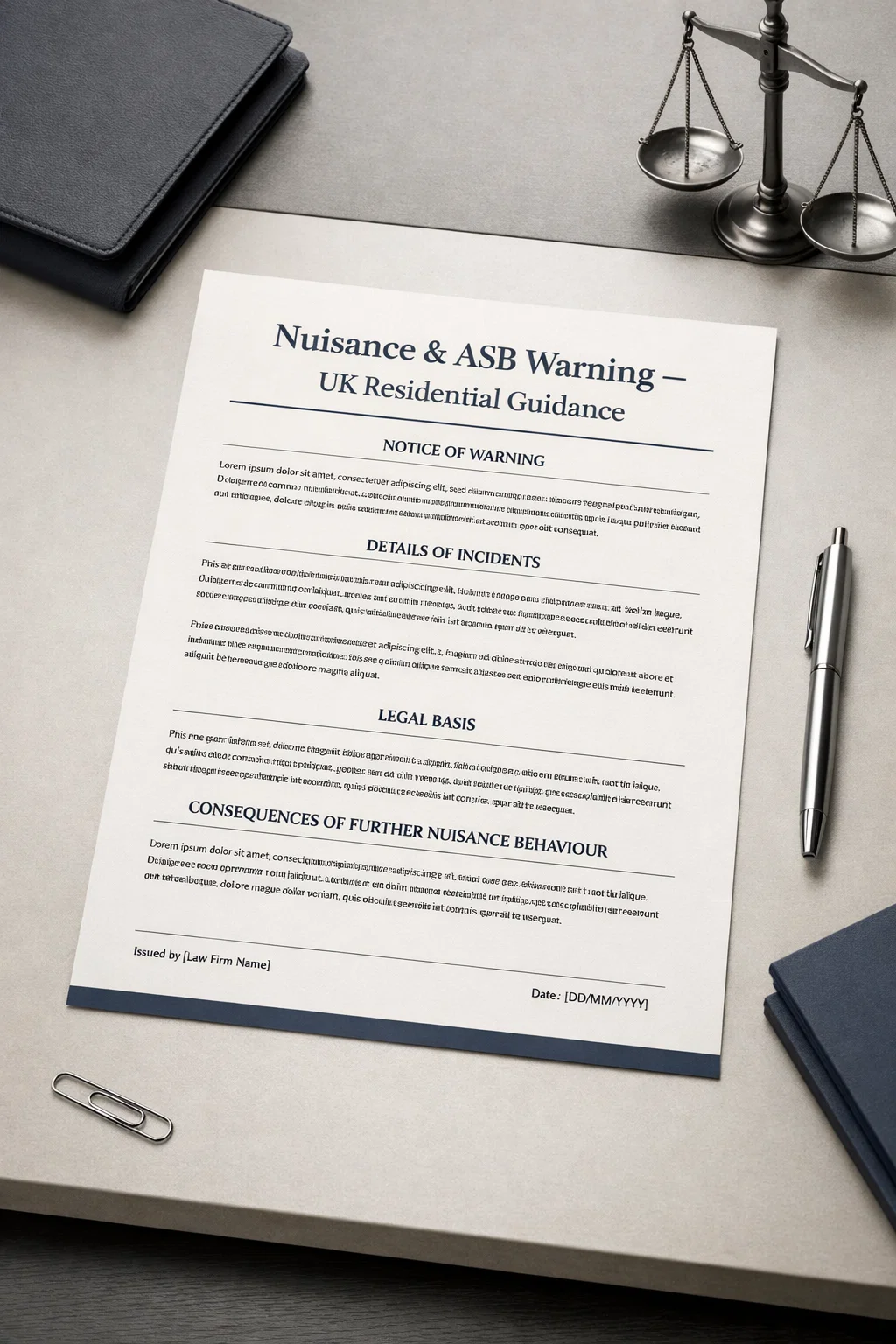
Professionally drafted nuisance and ASB warning letter for landlords — structured for Ground 14 eviction proceedings. Build your document with guided questions or classic editor — preview every clause before buying.
→ Nuisance & ASB Warning Letter Template
Prefer to do it yourself? Use our ASB checklist as a basic guide.
A landlord receives the same noise complaint from three separate neighbours — different flats, same property. No written warnings have been issued. Eight months later they’re in court seeking possession under Ground 14. The judge notes there’s no documented evidence the tenant was ever formally warned. Case dismissed.
Anti-social behaviour and nuisance complaints account for 28% of landlord-tenant disputes. The most common reason Ground 14 evictions fail is not lack of behaviour — it’s lack of documentation.
Since 1 May 2026, the Renters’ Rights Act 2025 has changed how Ground 14 works — landlords can apply to court immediately after serving notice, and judges must now consider whether the tenant cooperated with the landlord’s attempts to resolve the behaviour. Warning letters have never been more important.
This guide covers every stage of the warning process: what ASB and nuisance mean legally, how many warnings are required, what evidence courts need, when landlords face liability, and how Ground 14 eviction works.
What Are Three Examples of Anti-Social Behaviour?
Anti-social behaviour (ASB) is conduct causing or likely to cause harassment, alarm, or distress to others under the Anti-social Behaviour, Crime and Policing Act 2014.
Common examples:
- Noise nuisance: excessive loud music, shouting, banging, parties at unsociable hours causing sleep disturbance
- Harassment and intimidation: threatening behaviour, verbal abuse, aggressive confrontations with neighbours, hate-related incidents
- Criminal activity: drug dealing from property, violence, theft, criminal damage
ASB also includes property damage, vandalism, graffiti, fly-tipping, pet-related nuisance (dangerous dogs, excessive barking), and vehicle nuisance (abandoned cars, racing).
Nuisance vs Anti-Social Behaviour: What Is the Difference?
Nuisance is a civil wrong (tort) interfering with another’s use and enjoyment of property — proven by unreasonable interference causing harm.
ASB is a statutory concept under the Anti-social Behaviour Act 2003 and subsequent legislation — conduct causing harassment, alarm, or distress.
Key differences:
- Nuisance requires harm/interference (neighbour actually disturbed); ASB requires conduct likely to cause distress (actual distress not required)
- Nuisance remedies: civil claim for damages, injunction
- ASB remedies: criminal behaviour orders, community protection notices, closure orders, possession proceedings
- Both can trigger Ground 14 eviction (nuisance OR ASB)
Examples of Nuisance and ASB by Category
| Category | Examples | Legal Basis |
|---|---|---|
| Noise nuisance | Loud music after 11pm, shouting/arguments, banging/stomping, power tools late evening, parties | Nuisance + Environmental Protection Act 1990 |
| Harassment | Threats, verbal abuse, intimidation, following neighbours, aggressive behaviour, hate incidents | ASB + Protection from Harassment Act 1997 |
| Criminal activity | Drug dealing, violence, theft, burglary, criminal damage, weapons offences | ASB + criminal law |
| Property damage | Vandalism, graffiti, breaking communal areas, damage to neighbour property | ASB + nuisance + criminal damage |
| Pet nuisance | Dangerous dogs, excessive barking, fouling communal areas, aggressive animals | ASB + Dangerous Dogs Act 1991 |
| Waste/dumping | Fly-tipping, rubbish accumulation, dumping in communal areas, pest attraction | ASB + Environmental Protection Act |
| Vehicle nuisance | Abandoned vehicles, car repairs in residential areas, racing, blocking access | ASB + nuisance |
| Overcrowding/subletting | Illegal subletting, excessive occupiers, running business from residential property | Tenancy breach + nuisance |
Noise Nuisance Statutory Definition UK
Noise nuisance is defined under Environmental Protection Act 1990 Section 79 as noise emitted from premises that is prejudicial to health or a nuisance.
Local authorities (Environmental Health) assess whether noise is unreasonable considering: frequency, duration, time of day, volume, nature of noise, and sensitivity of area.
Statutory nuisance requires noise to be objectively unreasonable — not just annoying to one complainant.
Examples meeting the threshold: loud music after 11pm regularly, persistent shouting/screaming, machinery/power tools late evening, commercial noise in a residential area. The council can serve an abatement notice requiring cessation.
How Many Warnings Before Eviction in the UK?
No statutory minimum warnings are required before eviction for nuisance/ASB.
A landlord can serve a Section 8 Ground 14 notice immediately if serious ASB occurs — violence, criminal activity, or serious harassment.
However, best practice is to issue 1–3 written warnings before eviction proceedings. Courts consider proportionality — whether the landlord gave a reasonable opportunity to remedy the behaviour before seeking possession. Multiple warnings strengthen the discretionary Ground 14 case significantly.
How Many Warnings Do You Get for Anti-Social Behaviour?
This depends on severity and the landlord’s policy:
- Serious one-off incidents (violence, criminal conviction, serious harassment): zero warnings required — immediate Ground 14 notice is justified
- Moderate ongoing ASB (noise nuisance, harassment, property damage): typically 2–3 written warnings over a period demonstrating pattern and landlord attempts to resolve
- Minor/first-time issues: often 1–2 warnings with opportunity to remedy
Social housing ASB policies often specify a 3-strike approach: verbal warning, first written warning, final written warning, then eviction proceedings. Private landlords have discretion but warnings strengthen the court case.
How Much Warning Does a Landlord Need to Give?
For warning letters (pre-eviction): No statutory notice period — landlord can issue a warning any time breach occurs.
For Section 8 Ground 14 notice (eviction): Under the Renters’ Rights Act 2025, landlords can apply to court immediately after serving Ground 14 notice — no waiting period required. The court cannot make a possession order for 14 days from the date notice was given, but proceedings can be filed on the same day notice is served.
Warning letter timeline best practice: Issue first warning immediately after verified complaint → allow 14–28 days for improvement → issue second warning if behaviour continues → allow further 14 days → issue final warning → if no improvement, serve Ground 14 notice.
Total warning period is typically 4–8 weeks before eviction proceedings commence.
Warning Escalation Framework
| Stage | Action | When to Use |
|---|---|---|
| Verbal/informal warning | Phone call or informal letter noting concern | First minor incident, isolated complaint |
| First written warning | Formal letter citing specific breach, requesting cessation | Second incident or moderate severity issue |
| Second written warning | Formal letter citing pattern, warning of eviction risk | Behaviour continues despite first warning |
| Final written warning | Last opportunity letter, explicit eviction threat if continues | Pattern established, previous warnings ignored |
| Section 8 Ground 14 notice | Eviction notice (2 weeks minimum notice) | Warnings failed, behaviour continuing or serious incident |
| IMMEDIATE Ground 14 (skip warnings) | Eviction notice served immediately | Violence, serious criminal activity, extreme harassment |
What Evidence Do You Need for Anti-Social Behaviour?
Evidence required for ASB/nuisance warnings and Ground 14 eviction:
- Incident logs: detailed records with dates, times, witnesses, and description of behaviour
- Witness statements: signed written accounts from neighbours/complainants
- Police reports: crime reference numbers, police incident logs, arrests/charges
- Council complaints: Environmental Health noise logs, ASB case officer reports, abatement notices
- Physical evidence: photos of damage, video/audio recordings of noise/behaviour
- Correspondence: emails/letters to tenant about the issues
- Tenancy agreement: the clauses prohibiting nuisance/ASB
The court requires credible, corroborated evidence proving the behaviour occurred and caused distress.
This evidence is now even more critical. Under the Renters’ Rights Act 2025, judges must specifically consider whether the tenant cooperated with the landlord’s attempts to stop the behaviour — making your warning letters and the tenant’s response (or lack of response) a key factor in the court’s decision.
How to Write a Warning Notice to a Tenant
A warning letter must include:
- Date and landlord details
- Tenant name and property address
- Subject line: “Formal Warning — Nuisance/Anti-Social Behaviour”
- Specific incidents with dates, times, and witnesses
- Tenancy clause breached (quoted exactly)
- Required action (cease behaviour immediately)
- Warning of consequences (further warnings, eviction proceedings)
- Opportunity to respond (invite explanation within 7 days)
- Contact details and signature
Send via email plus recorded delivery for proof of receipt. The letter must be factual, non-accusatory, specific rather than vague, and cite evidence not hearsay.
Sample Nuisance Warning Letter Structure
[Landlord Name]
[Address]
[Email/Phone]
[Date]
[Tenant Name]
[Property Address]
SENT VIA EMAIL & RECORDED DELIVERY
Dear [Tenant],
RE: FORMAL WARNING — NOISE NUISANCE AND BREACH OF TENANCY
PROPERTY: [Address]
I am writing to formally warn you about ongoing noise nuisance from your property which breaches your tenancy obligations.
SPECIFIC INCIDENTS:
I have received multiple complaints from neighbours regarding excessive noise from your property:
- [Date], [Time]: Loud music reported by [Neighbour — Flat X] continuing until 2:00am causing sleep disturbance
- [Date], [Time]: Shouting and banging noises reported by [Neighbour — Flat Y] at 11:30pm
- [Date], [Time]: Party with loud music reported by multiple neighbours, police attended (Crime Ref: [Number])
TENANCY BREACH:
Your tenancy agreement dated [Date] Clause [X] states:
“The tenant must not cause nuisance or annoyance to neighbours or use the property for illegal or immoral purposes. The tenant must not play loud music or make excessive noise likely to disturb neighbours, particularly between 11pm and 7am.”
Your behaviour breaches this clause and constitutes nuisance under common law.
REQUIRED ACTION:
You must immediately:
- Stop playing loud music after 11:00pm
- Keep noise to reasonable levels at all times
- Ensure visitors respect neighbours’ quiet enjoyment
- Comply with all tenancy obligations regarding noise and nuisance
CONSEQUENCES OF CONTINUED BREACH:
This is a formal warning. If the noise nuisance continues, I will:
- Issue further warnings escalating towards eviction proceedings
- Serve Section 8 notice seeking possession under Ground 14 (nuisance/anti-social behaviour)
- Apply to court for possession order and your eviction from the property
YOUR RIGHT TO RESPOND:
If you wish to discuss this matter or provide explanation, please contact me within 7 days.
Yours sincerely,
[Signature]
[Landlord Name]
Evidence Requirements for Ground 14 Eviction
| Evidence Type | What to Collect | Why Important |
|---|---|---|
| Incident logs | Date, time, witness, detailed description of each incident | Establishes pattern of behaviour over time |
| Witness statements | Signed written accounts from neighbours describing impact | Corroborates landlord claims, shows distress caused |
| Police reports | Crime reference numbers, incident logs, arrests, charges | Third-party verification, proves seriousness |
| Council ASB reports | Environmental Health noise logs, ASB team case notes | Professional assessment, statutory nuisance finding |
| Audio/video recordings | Noise recordings (timestamped), CCTV footage of incidents | Direct evidence of behaviour and severity |
| Photos | Property damage, rubbish accumulation, graffiti | Visual proof of physical nuisance |
| Warning letters | Copies of all warnings sent to tenant (proof of delivery) | Shows landlord attempted to resolve before eviction |
| Medical evidence | GP letters confirming stress, anxiety, sleep disturbance | Proves health impact on complainants (strengthens case) |
Can a Landlord Be Held Liable for Nuisance Tenants in the UK?
Yes, landlords can be held liable for tenant nuisance in certain circumstances:
- Authorised/encouraged nuisance: landlord permits or facilitates the tenant’s nuisance (liable)
- Aware and failed to act: landlord knows about ongoing nuisance affecting neighbours but takes no action — may be liable under Hussain v Lancaster City Council principles
- Continuing nuisance from property state: landlord responsible for property condition causing nuisance (disrepair, structural issues)
- Covenant to control: tenancy contains landlord obligation to control tenant behaviour (common in social housing ASB duties)
Liability depends on landlord knowledge, control, and failure to take reasonable steps.
Landlord Duty to Control Tenant Nuisance UK
Private landlords: No automatic statutory duty to control tenant nuisance. Common law liability arises if the landlord is aware of serious nuisance and fails to take reasonable action — issuing warnings, pursuing eviction proceedings under Ground 14. Under the Renters’ Rights Act 2025, the importance of documented action is strengthened — landlords who can show a clear warning trail are in a significantly stronger position both for eviction and for defending liability claims.
Social housing landlords: Statutory duty under Housing Act 1996 Section 153A to have ASB policies and take reasonable steps to address tenant ASB.
Reasonable steps include: investigating complaints promptly, warning the tenant in writing, offering mediation, pursuing possession proceedings if warnings fail, and cooperating with police/council ASB teams.
What Constitutes a Breach of Quiet Enjoyment in the UK?
Quiet enjoyment is an implied covenant in every tenancy allowing a tenant to occupy property without interference from the landlord.
Breaches by landlord include unannounced entries, harassment, threatening eviction without grounds, cutting off utilities, changing locks, or removing tenant belongings.
Breaches affecting neighbouring tenants include: excessive noise preventing sleep or peaceful enjoyment, harassment creating a hostile environment, or criminal activity making the property unsafe.
A tenant can claim damages for quiet enjoyment breach. Landlord liability arises if aware of tenant-on-tenant nuisance and fails to act under Southwark LBC v Mills principles.
Can You Sue for Noise Disturbance in the UK?
Yes, affected parties can sue for noise nuisance via:
- Private nuisance claim against the perpetrator — sue for damages and injunction requiring cessation
- Statutory nuisance claim via council — Environmental Health investigates and serves abatement notice if statutory threshold is met
- Claim against landlord — if landlord is aware of tenant noise nuisance and failed to take action (Hussain duty)
- Quiet enjoyment breach — tenant affected by landlord’s failure to control another tenant’s noise
Threshold: noise must be unreasonable in frequency, duration, and severity affecting an ordinary person. Remedies include damages for distress/loss of amenity, injunction prohibiting noise, and costs.
Can You Sue a Landlord for Emotional Distress in the UK?
Yes, you can sue a landlord for emotional distress damages in nuisance/ASB cases where:
- The landlord was aware of serious tenant ASB affecting the complainant
- The landlord failed to take reasonable action (warnings, eviction proceedings)
- The complainant suffered recognisable psychiatric harm or serious distress beyond ordinary discomfort
Damages have been awarded for anxiety, stress, sleep deprivation, fear, and loss of amenity. In Mowan v Wandsworth LBC, £35,000 in damages was awarded for a landlord’s failure to address neighbour ASB causing severe distress over years.
For comprehensive guidance on eviction procedures when warnings fail, see our Section 8 Notice Guide (Ground 14 requirements).
Renters’ Rights Act 2025: What Changed for ASB and Nuisance from May 2026?
The Renters’ Rights Act 2025 took effect on 1 May 2026 and changed how landlords deal with anti-social behaviour evictions. Section 21 “no-fault” evictions have been abolished — meaning Ground 14 is now the primary route for removing nuisance tenants.
Here’s what changes and what stays the same.
Ground 14: Immediate Court Application
Until 30 April 2026, landlords had to give 2 weeks’ notice before applying to court under Ground 14.
Since 1 May 2026, that has changed. Landlords serving Ground 14 notice for ASB can apply to court immediately — no waiting period. However, the court cannot make a possession order until at least 14 days after notice was given, giving tenants time to respond.
This speeds up the process for serious cases while still protecting tenant rights.
Warning Letters Now Carry Judicial Weight
This is the biggest practical change for landlords dealing with nuisance tenants.
Since May 2026, when deciding whether to grant possession under Ground 14, the court must consider whether the tenant cooperated with the landlord’s attempts to encourage the behaviour to stop. If you sent three warning letters and the tenant ignored every one — that’s now a specific factor the judge weighs in your favour.
Conversely, if you went straight to eviction without any documented warnings, the court can hold that against you. Warning letters are no longer just best practice — they’re part of the judicial test.
Ground 7A: Serious ASB — Immediate Proceedings
For the most serious cases — criminal convictions, breach of anti-social behaviour orders, or closure orders — Ground 7A allows landlords to begin court proceedings immediately with no notice period at all. This is a mandatory ground, meaning the court must grant possession if the criteria are proven.
Ground 7A covers: conviction for a serious offence, breach of a criminal behaviour order, community protection notice, or injunction under the Anti-social Behaviour, Crime and Policing Act 2014, and closure orders exceeding 48 hours.
Section 21 No Longer Available
Before May 2026, many landlords used Section 21 “no-fault” notices to remove nuisance tenants — avoiding the need to prove ASB grounds in court. That route disappeared entirely on 1 May 2026.
Since that date, if you want a nuisance tenant out, you must use Section 8 grounds and prove the behaviour in court. This makes your evidence trail — incident logs, witness statements, police reports, and warning letters — essential.
For the full breakdown of every change affecting landlords, see our complete guide: Renters’ Rights Act 2025 — New Rules for Landlords & Tenants from 2026.
ASB Evictions Exempt from Database Requirement
The Renters’ Rights Act 2025 introduces a new private rented sector database. Landlords who fail to register cannot get a possession order — with two exceptions: Ground 7A and Ground 14 (anti-social behaviour).
This means even if a landlord hasn’t registered on the database, they can still evict for ASB. The government specifically exempted these grounds so that nuisance behaviour doesn’t go unaddressed because of a landlord’s administrative failure.
What This Means for Your Warning Letters
The Renters’ Rights Act 2025 makes warning letters more important than they’ve ever been:
- Judges must consider tenant cooperation — your warnings (and the tenant’s response) are now part of the judicial test for reasonableness
- Section 21 gone — you can no longer sidestep the evidence requirement with a no-fault notice
- Faster court access — immediate application after serving Ground 14 notice means your evidence needs to be ready from day one
- Documentation is everything — without a clear warning trail, the court can refuse possession even if the behaviour is proven
Our Section 8 Particulars Statement builds the separate sheet that attaches to your official GOV.UK Form 3. Form 3 itself is the government’s free form — Section 4 asks you to “give a full explanation of why each ground is being relied on”, which most landlords answer with one or two vague sentences that courts often reject. Our product builds that explanation properly — a chronological, evidence-referenced particulars statement covering each ground you’re relying on. The product has been updated for the May 2026 changes, including the new Ground 14 immediate court application rules. Existing customers can download the current version free from their My Templates dashboard.
Ground 14 Notice Requirements UK
Ground 14 (Housing Act 1988 Schedule 2) allows a landlord to seek possession if the tenant is guilty of conduct causing or likely to cause nuisance or annoyance to neighbours, visitors, or persons in the locality — or has been convicted of using the property for immoral/illegal purposes, or arrested for an indictable offence in the locality.
It is a discretionary ground — the court decides whether it is reasonable to grant possession, considering severity, impact, and the landlord’s efforts to resolve the situation.
Notice requirements (historical — until 30 April 2026): Section 8 notice on Form 3 citing Ground 14, minimum 2 weeks’ notice, specifying the behaviour constituting nuisance/ASB.
Notice requirements (current — from 1 May 2026): Section 8 notice citing Ground 14 with immediate court application — no waiting period. The court cannot make a possession order for 14 days from the date notice was given. The landlord must prove grounds at the hearing with evidence.
ASB Case Closure Criteria UK
ASB cases are typically closed when:
- Behaviour ceased: no incidents reported for 3–6 months after warnings
- Tenant vacated: problem resolved through eviction or voluntary departure
- Complainant withdraws: affected party no longer pursuing complaint (case may still proceed if multiple complainants or serious)
- Insufficient evidence: unable to prove ASB despite investigation
- Alternative resolution: mediation successful, acceptable behaviour contract signed and complied with
Social landlords must document closure decisions and inform all parties. Reopening is allowed if behaviour recurs within 12 months, with a shorter warning period.
Ground 14 Eviction Process Timeline
| Stage | Timing | Action |
|---|---|---|
| Warnings issued | Weeks 1–8 | 1–3 written warnings documenting nuisance/ASB (not mandatory but strengthens case) |
| Section 8 Ground 14 served | Week 9 | Eviction notice (Form 3) with 2 weeks minimum notice |
| Notice period | Weeks 9–11 | 2 weeks notice runs to earliest court application date |
| Court claim filed | Week 12 | Landlord files possession claim (Form N5) with evidence bundle |
| Court serves papers | Week 13 | Tenant receives court claim and has 14 days to file defence |
| Hearing scheduled | Weeks 20–28 | Court hearing (4–8 months typical due to backlog) |
| Possession order decision | Weeks 20–28 | Judge decides if nuisance proven and eviction reasonable (discretionary) |
| Eviction date | Weeks 22–32 | 14–42 days after order for tenant to vacate (court discretion) |
| Bailiff eviction | Weeks 24–36 | If tenant doesn’t vacate, bailiff enforces (2–4 weeks warrant wait) |
Total timeline: 6–9 months from first warning to actual eviction for Ground 14 discretionary cases. Faster with serious ASB and strong evidence; slower if the tenant defends.
For the complete Ground 14 eviction process including required evidence and court procedures, see our Section 8 Notice Guide UK.
Eviction & Legal Notices Pack
Essential Bundle • 6 Templates + Editor & Interview Versions • Save 50% vs Buying Individually
Lifetime Access • Free Updates • 30-Day Money-Back Guarantee*
Frequently Asked Questions: Nuisance & ASB Warning UK
How many warnings before eviction in the UK?
No statutory minimum warnings are required. Serious ASB (violence, criminal activity) can justify immediate Ground 14 eviction notice. Moderate ongoing issues typically warrant 2–3 written warnings over 4–8 weeks. Multiple warnings strengthen the discretionary Ground 14 court case by showing the landlord gave opportunity to remedy.
How to write a warning notice to a tenant?
Must include: specific incidents (dates/times/witnesses), tenancy clause breached (quoted), required action (cease behaviour), warning of consequences (eviction risk), and opportunity to respond (7 days). Send via email plus recorded delivery. Must be factual, specific, and cite evidence not hearsay.
What are three examples of anti-social behaviour?
(1) Noise nuisance — loud music/shouting after 11pm causing sleep disturbance. (2) Harassment — threats, verbal abuse, intimidation of neighbours. (3) Criminal activity — drug dealing, violence, theft from property. Also includes property damage, pet nuisance, waste dumping, and vehicle nuisance.
What evidence do you need for anti-social behaviour?
Incident logs (dates/times/witnesses), witness statements from neighbours, police reports (crime references), council ASB/noise reports (Environmental Health logs), recordings/photos of behaviour, and warning letters sent to the tenant. The court requires credible, corroborated evidence proving behaviour occurred and caused distress.
Can a landlord be held liable for nuisance tenants in the UK?
Yes, if the landlord is aware of serious tenant nuisance affecting neighbours and fails to take reasonable action (warnings, Ground 14 eviction proceedings). Private landlords have common law liability when aware. Social landlords have statutory ASB duties. Affected parties can sue for emotional distress damages.
What constitutes a breach of quiet enjoyment in the UK?
Quiet enjoyment allows a tenant to occupy without interference. Landlord breaches include unannounced entries, harassment, and threatening eviction without grounds. Tenant-on-tenant breaches include excessive noise preventing sleep, harassment, and criminal activity making the property unsafe. Landlord is liable if aware and fails to act.
Can you sue for noise disturbance in the UK?
Yes, via: (1) private nuisance claim against the perpetrator for damages/injunction, (2) statutory nuisance via council (Environmental Health abatement notice), (3) claim against landlord if aware and failed to act. Threshold: noise must be unreasonable in frequency, duration, and severity.
Nuisance vs anti-social behaviour: what is the difference?
Nuisance is a civil wrong interfering with property enjoyment. ASB is statutory conduct causing harassment, alarm, or distress under the Anti-social Behaviour Act 2003. Nuisance requires harm to have occurred. ASB requires conduct likely to cause distress — actual distress is not required. Both trigger Ground 14 eviction.
Ground 14 notice requirements UK?
Section 8 notice on Form 3 citing Ground 14 (nuisance/ASB/criminal conviction). Minimum 2 weeks notice (immediate if extremely serious). Discretionary ground — court decides if eviction is reasonable. The landlord must prove grounds at the hearing with evidence: incident logs, witness statements, police reports, and warnings sent.
Can you sue a landlord for emotional distress in the UK?
Yes, if the landlord was aware of serious tenant ASB affecting the complainant and failed to take reasonable action. Requires evidence of knowledge, failure to act, and significant harm beyond minor inconvenience. Damages awarded for anxiety, stress, sleep deprivation, and fear (notable case: Mowan v Wandsworth — £35,000 damages).
How does the Renters’ Rights Act 2025 affect ASB evictions?
Since 1 May 2026, landlords can apply to court immediately after serving Ground 14 notice (no 2-week wait). Judges must consider whether the tenant cooperated with the landlord’s attempts to stop the behaviour — making warning letters a key factor in the court’s decision. Section 21 has been abolished, so Ground 14 is now the primary route for removing nuisance tenants. See our full guide: Renters’ Rights Act 2025 — What Landlords Need to Know.
The Truth About “Free” Legal Template Sites (What You’re Really Signing Up For)
Most websites offering a “free legal template” follow the same pattern:
- You click because it’s advertised as free
- You spend 10–15 minutes answering questions
- At the very end, you must create an account or start a “free trial”
- Your card is required upfront
- The subscription auto-renews at £29–£39 per month
This isn’t a free template — it’s a subscription service. Many people only realise after being charged £300–£400 over the year.
Why These “Free” Templates Are a Legal Risk
- Outdated wording: not aligned with current UK law
- Missing mandatory clauses: required for legal validity
- No compliance guidance: leaving users without legal context
- No structured checklist: no way to verify the document works
- Not kept updated: often unchanged when legislation changes
One incorrect clause can weaken or invalidate the entire document.
Hidden Problem: Many “Free Template” Sites Aren’t Even UK-Based
Another major issue is that many free or auto-subscription template sites operate outside the UK and use documents originally drafted for the US legal system. These are then loosely adapted for “international use,” which creates serious problems:
- Incorrect terminology: taken from US contract law
- Missing UK statutory references: essential legal requirements omitted
- Non-applicable clauses: terms that don’t apply under UK legislation
- Legal conflicts: risks breaching UK consumer, employment, or GDPR rules
Why Templates UK Does the Opposite
- Drafted by UK professionals: written by experienced business & legal experts
- UK-law only: no US crossover or generic “international” templates
- One-time price from £10: no subscriptions, no renewals
- Full preview: see the exact document before buying
- Lifetime access: free lifetime updates included
My Templates Dashboard
All purchased templates are stored in your personal My Templates page, organised by category.
When we update a template for UK law changes, the new version appears automatically in your dashboard — free, forever.
Build a growing library of UK legal documents across every area of your business and personal life.
Transparent Pricing
From £10 per template — with free lifetime usage and free lifetime updates. No subscriptions. No renewals. No auto-billing.
Not ready to buy? Use our free interactive checklists to guide your own document — no payment required.
No tricks. No trials. No hidden fees. Just the exact UK-specific legal document you came for — at the price we told you upfront.
Build your own bespoke document with our Nuisance & ASB Warning Letter Template. Preview the full document before buying — only pay when you’re happy with it.
Save with Residential Landlord Bundle Packs
Get multiple residential property templates at discounted rates:
- Ultimate Bundle — All 28 templates for £99 (smaller packs available)
- Essentials Pack — 8 core templates for £40 (smaller packs available)
- Correspondence Pack — 7 letter templates for £35 (smaller packs available)
- Eviction Pack — 6 eviction documents for £30 (smaller packs available)
- Management Pack — 7 management documents for £35 (smaller packs available)
View all landlord bundle options →
Explore the Master Business Legal Templates Pillar Guide
The complete overview of 37 essential UK business templates.
UK Business Legal Templates — Complete Master Guide
Explore All Templates UK Pillar Guides
- Family Law Documents Guide UK
- Wills & Estate Planning Guide UK
- Residential Landlord Documents Guide UK
- Employment Documents Guide UK
- How to Set Up a Business in the UK — Legal Guide
- Website Legal Documents UK — Compliance Guide
- Financial & Commercial Contracts UK — Protection Guide
- Commercial Office Lease Guide UK
- Digital & IP Agreements Guide UK
Related Guides
- Section 8 Notice Guide UK (Ground 14 Eviction Process)
- Breach of Tenancy Letter Guide UK
- Property Inspection Notice Guide UK (Evidence Gathering)
- Assured Shorthold Tenancy Guide UK
- Renters’ Rights Act 2025 — New Rules for Landlords & Tenants
Free Legal Templates & Interactive Checklists
Access all our free UK legal templates, checklists and downloadable PDFs.
Last updated: May 2026
Disclaimer: This guide provides general UK legal information, not legal advice. Laws are current as of February 2026.