Updated: June 2026 • Based on UK Law
Quick Navigation:
What Is a Property Inspection Notice?
A property inspection notice is formal written request from landlord to tenant requesting access to property for routine inspection at specified date and time. Landlords must give minimum 24 hours written notice and obtain tenant consent for non-emergency access under Quiet Enjoyment rights. Unannounced inspections without permission constitute trespass and harassment under Protection from Eviction Act 1977.
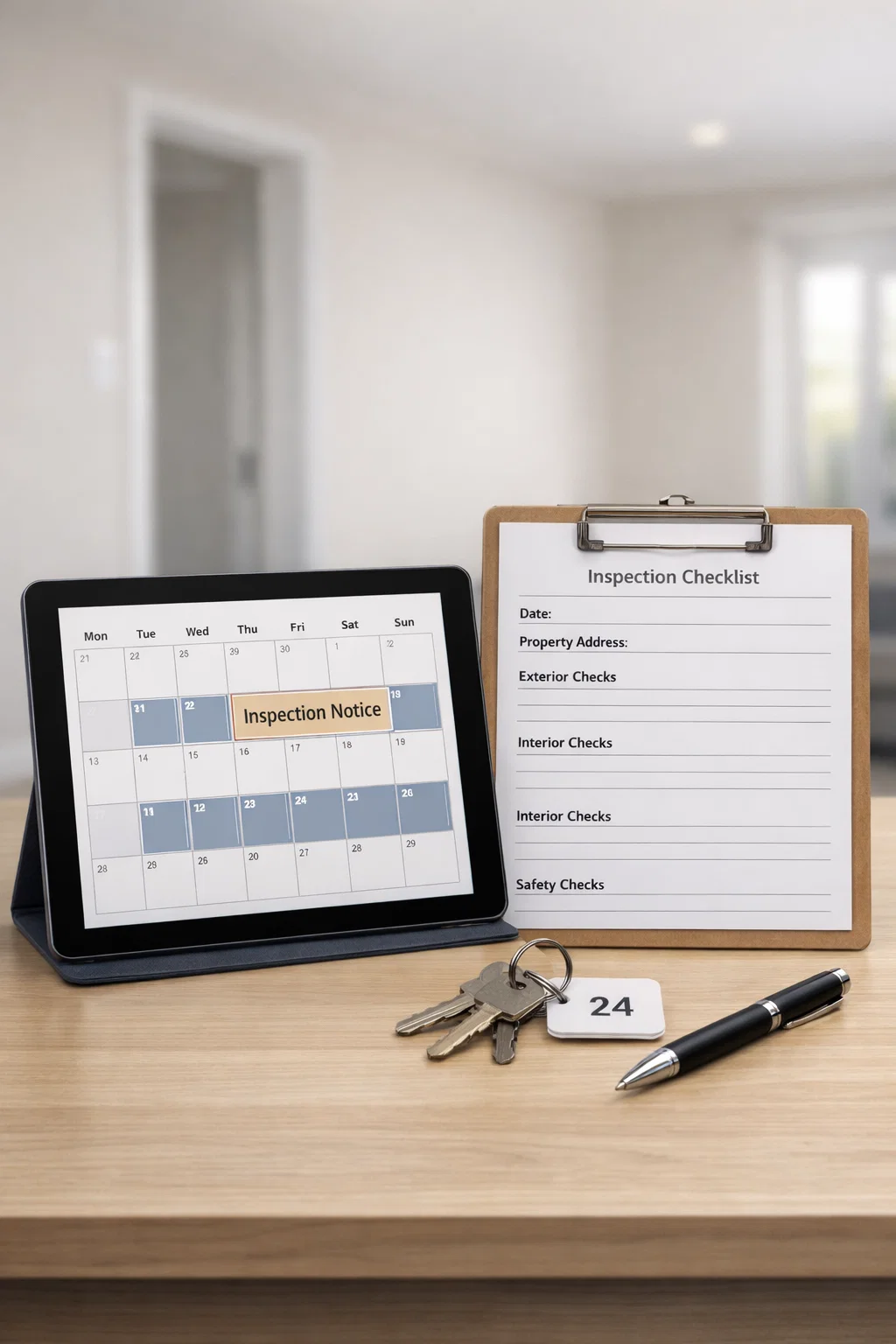
This guide covers notice requirements, tenant refusal rights, inspection frequency, and emergency access, with a free interactive property inspection checklist.
Inspection access is one of the most common sources of friction between landlords and tenants — and most disputes come down to a handful of avoidable mistakes.
The most common errors are: failing to give 24 hours written notice, arriving unannounced expecting entry, conducting excessive inspections (more than quarterly), inspecting at unreasonable times (early morning, late evening), and misunderstanding emergency access rights versus routine inspection rights.
These breaches violate tenant’s Quiet Enjoyment and can constitute harassment.
The legal framework balances landlord’s legitimate interest in property condition against tenant’s right to Quiet Enjoyment of their home.
For viewing the property’s condition and state of repair, Section 11(6) of the Landlord and Tenant Act 1985 implies a right of entry on 24 hours’ written notice at reasonable times of day.
Beyond repair-related access, routine inspections rest on the tenancy agreement terms and the common law covenant of Quiet Enjoyment, with the Protection from Eviction Act 1977 prohibiting harassment.
Landlord has no automatic right of entry for routine inspections and must obtain tenant permission via reasonable notice.
FREE Property Inspection Notice Checklist
Legal Notice Periods and Access Rights Every Landlord Must Follow
How Much Notice Does a Landlord Have to Give for an Inspection in the UK?
Landlords must give minimum 24 hours written notice for routine property inspections, though 48 hours or 1 week preferred for tenant convenience.
Notice should specify: exact date, time window (not single time), purpose of visit, and request tenant consent.
Tenant can refuse if notice insufficient or timing inconvenient.
The 24-hour written-notice standard reflects Section 11(6) of the Landlord and Tenant Act 1985 (entry to view the condition and state of repair) and ARLA/NRLA best practice.
What Is a Property Inspection Notice?
A property inspection notice is written communication from landlord to tenant requesting permission to access property for routine inspection purposes.
Must include: proposed inspection date, time window (e.g. 10am-12pm), purpose (routine inspection, safety checks, maintenance), and tenant’s right to refuse or request alternative time.
Notice demonstrates respect for Quiet Enjoyment and creates documentary evidence of proper procedure if disputes arise.
Notice Period Standards:
| Notice Period | Status | Best For |
|---|---|---|
| 24 hours | Minimum acceptable | Urgent non-emergency matters |
| 48 hours | Good practice | Routine inspections |
| 1 week | Best practice | Scheduled quarterly inspections |
| 2+ weeks | Excellent practice | Annual inspections, viewings for sale |
What Time of Day Can Landlord Inspect Property UK?
Inspections should occur during reasonable hours: typically 9am-6pm Monday-Friday or 10am-4pm Saturday.
Avoid: early mornings (before 8am), late evenings (after 7pm), Sundays, bank holidays, or times tenant specifically requests to avoid.
Reasonable hours respect tenant’s work schedule, privacy, and family life. Inspections at unreasonable times (e.g., 7am Saturday) may constitute harassment even if 24 hours notice given.
Invalid Inspection Notice UK?
Inspection notice invalid if: less than 24 hours notice given, notice not in writing (verbal request insufficient), no specific date/time provided, unreasonable time proposed (very early/late), excessive frequency (more than quarterly without cause), or purpose not stated.
Invalid notice gives tenant right to refuse entry. Landlord forcing entry with invalid notice constitutes trespass and potential criminal harassment.
Can a Tenant Refuse an Inspection in the UK?
Yes, tenants can refuse landlord inspection requests for any reason including: insufficient notice (less than 24 hours), inconvenient timing, excessive frequency, no justifiable purpose, or simply exercising Quiet Enjoyment rights.
Landlord has no automatic right of entry for routine inspections and must obtain tenant consent.
Reasonable refusals cannot trigger eviction or rent increase. Persistent unreasonable refusals blocking legitimate inspections may breach tenancy obligations.
Can I Refuse a Landlord Inspection in the UK?
You can refuse inspection when: notice insufficient (under 24 hours), time inconvenient (conflicts with work/commitments), frequency excessive (weekly/monthly without cause), purpose unclear or unjustified, landlord attempting unannounced entry, or inspection during unsociable hours.
Reasonable refusal: “I cannot accommodate inspection on [date] but am available [alternative date].”
Unreasonable refusal: blocking all inspection requests for months without justification.
Reasonable vs Unreasonable Refusal:
| Scenario | Reasonable to Refuse? | Why |
|---|---|---|
| 12 hours notice given | ✓ Yes | Insufficient notice (minimum 24 hours required) |
| Inspection at 7am Saturday | ✓ Yes | Unreasonable time (before 9am on weekend) |
| Weekly inspections requested | ✓ Yes | Excessive frequency (harassment) |
| Conflicts with work schedule | ✓ Yes (with alternative) | Legitimate conflict – offer alternative time |
| Quarterly inspection, 1 week notice | ✗ No (unreasonable) | Proper notice, reasonable frequency and purpose |
| Gas safety check (legal requirement) | ✗ No (unreasonable) | Landlord legal obligation – must cooperate |
| Refusing all inspections for 12 months | ✗ No (unreasonable) | Blocking legitimate landlord interest |
Can I Refuse Viewings as a Tenant in the UK?
Yes, tenants can refuse viewings during tenancy (landlord selling property or re-letting).
However, tenancy agreements often include viewing clauses requiring tenant cooperation during notice period.
If clause exists and tenant given proper notice (24 hours minimum, ideally 1 week), unreasonable refusal may breach tenancy.
Best approach: negotiate convenient viewing times and frequency limits (e.g., maximum 2 viewings per week). Tenant cannot be forced to deep-clean or stage property.
Property Inspection Rights During Notice Period UK?
During notice period (tenant or landlord served notice to end tenancy), landlord has stronger case for inspection/viewing access but still requires reasonable notice and consent.
Tenancy agreements commonly state “tenant shall permit viewings during final 2 months” or similar.
Tenant should accommodate reasonable requests (1-2 viewings per week, reasonable times) but can still refuse excessive demands (daily viewings, very short notice).
Balance: landlord’s legitimate re-letting interest vs tenant’s Quiet Enjoyment until tenancy actually ends.
Use our professionally drafted Property Inspection Notice Pack with compliant inspection request templates (includes free checklist).
How Often Do Landlords Inspect Property in the UK?
Standard inspection frequency: quarterly (every 3 months) typical for professional landlords, semi-annually (every 6 months) common for private landlords, annually minimum best practice.
More frequent inspections (monthly/weekly) constitute harassment unless justified by specific concerns (ongoing repairs, suspected damage).
Less frequent (over 12 months) risks missing property issues landlord responsible for.
Industry standard: 3-6 month intervals for routine condition checks.
How Often Can a Landlord Inspect a Property in the UK?
No legal limit on inspection frequency but must be reasonable.
Quarterly (every 3 months) widely accepted as reasonable maximum.
More frequent requires justification: ongoing repair works being monitored, suspected tenant breach requiring verification, property condition concerns based on evidence.
Weekly or monthly inspections without cause constitute harassment under Protection from Eviction Act 1977 and breach Quiet Enjoyment covenant.
Inspection Frequency Guidelines:
| Frequency | Assessment | When Appropriate |
|---|---|---|
| Weekly/Fortnightly | Harassment (illegal) | Never justified for routine inspections |
| Monthly | Excessive (likely harassment) | Only if specific documented concerns (ongoing repairs) |
| Quarterly (every 3 months) | Reasonable maximum | Professional landlord standard, well-managed properties |
| Semi-annual (every 6 months) | Good practice | Private landlord typical, established tenancies |
| Annual (every 12 months) | Minimum acceptable | Long-term tenants, good relationship, no concerns |
| Over 12 months | Inadequate (landlord risk) | Risks missing property issues landlord responsible for |
Mandatory vs Routine Inspections:
Mandatory inspections (legal requirements):
- Gas Safety Certificate: Annual inspection by Gas Safe engineer (landlord legal duty)
- Electrical Installation Condition Report: Every 5 years (England — new tenancies from 1 July 2020, existing tenancies from 1 April 2021)
- Energy Performance Certificate: Valid 10 years (must have at tenancy start)
- Smoke/CO alarms: Check at tenancy start, then tenant responsible (landlord should verify periodically)
These mandatory checks do NOT constitute “routine inspections” and tenant cannot reasonably refuse after proper notice.
Routine inspections (landlord interest, not legal requirement):
- General property condition check
- Furniture/appliance condition (if furnished)
- Decoration state (painting, carpets)
- Garden maintenance verification
- Inventory compliance check
These require tenant consent and reasonable notice. Tenant has greater right to refuse.
Can Landlords Show Up Unannounced in the UK?
No, landlords cannot show up unannounced for routine inspections and demand entry.
Unannounced visits without prior consent constitute trespass and potential criminal harassment under Protection from Eviction Act 1977 section 1(3).
Landlord has no automatic right of entry to let property.
Exceptions: genuine emergency (fire, flood, gas leak) where immediate entry necessary to prevent serious damage or danger. Non-emergency unannounced entry violates Quiet Enjoyment covenant.
Landlord Entry Without Permission UK?
Landlord entering property without permission commits: (1) trespass (civil wrong – tenant can sue for damages), (2) harassment (criminal offense under Protection from Eviction Act 1977 – up to 2 years prison), (3) breach of tenancy covenant (Quiet Enjoyment – tenant can claim damages/rent reduction).
Only lawful entry without permission: genuine emergency threatening property or safety, court order authorizing entry, or abandonment where reasonable belief tenant vacated permanently.
Emergency Access vs Routine Inspection UK?
Emergency access (immediate entry without prior notice) justified ONLY when: imminent danger to property (major leak, fire, gas leak), imminent danger to persons (structural collapse risk, carbon monoxide alarm), preventing serious damage (burst pipe flooding neighboring properties).
Routine inspection never constitutes emergency.
Examples NOT emergencies: general property condition check, verifying garden maintenance, checking decoration, viewing for re-letting, annual safety checks (these require notice).
Emergency vs Non-Emergency Comparison:
| Situation | Emergency Access? | Notice Required? |
|---|---|---|
| Burst pipe flooding property | ✓ Yes (genuine emergency) | No – immediate entry justified |
| Gas leak smell reported | ✓ Yes (safety hazard) | No – call Gas Emergency (0800 111 999) + enter if necessary |
| Fire/smoke visible | ✓ Yes (immediate danger) | No – call 999, enter if safe to evacuate/assist |
| Slow dripping tap | ✗ No | Yes – 24 hours minimum (non-emergency repair) |
| Routine property inspection | ✗ No | Yes – 24 hours minimum (preferably 1 week) |
| Annual gas safety check | ✗ No | Yes – 24 hours minimum (mandatory but not emergency) |
| Viewings for re-letting | ✗ No | Yes – 24 hours minimum (ideally 1 week) |
| Suspected tenant breach | ✗ No | Yes – 24 hours minimum (suspicion not emergency) |
Consequences of Unlawful Entry:
If landlord enters without permission (non-emergency):
Tenant remedies:
- Change locks immediately (landlord cannot object if caused by their breach)
- Report to police (harassment under Protection from Eviction Act 1977)
- Sue for damages (trespass + breach of Quiet Enjoyment)
- Claim rent reduction for period of harassment
- Report to local authority (licensing breach if HMO/selective licensing)
- Terminate tenancy and claim damages (if breach fundamental)
Landlord consequences:
- Criminal prosecution (up to 2 years prison, Protection from Eviction Act)
- Civil damages award to tenant
- Rent Repayment Order risk (tenants can apply for repayment of past rent where harassment or illegal eviction is established)
- Licensing breach (if applicable – penalty up to £30,000)
- Reputational damage affecting future lettings
Tenancy Correspondence Pack
Lifetime Access • Free Updates • 30-Day Money-Back Guarantee*
Property Inspection Notice Template UK?
Effective inspection notice must include: landlord/agent name and contact details, tenant name(s), property address, proposed inspection date, time window (e.g., 10am-12pm not exact time), purpose of inspection (routine condition check, gas safety, repairs), request for tenant consent, offer to discuss alternative arrangements, and contact method for response.
Send via email plus text/recorded delivery for proof. Allow tenant reasonable time to respond.
Sample Property Inspection Notice:
[Landlord/Agent Name]
[Address]
[Email/Phone]
[Date]
[Tenant Name]
[Property Address]
Dear [Tenant],
RE: PROPERTY INSPECTION REQUEST – [PROPERTY ADDRESS]
I am writing to request permission to conduct a routine property inspection at the above address.
PROPOSED INSPECTION DETAILS:
- Date: [Date] (1 week from this notice)
- Time: Between 10:00am – 12:00pm (approximately 30 minutes)
- Purpose: Routine condition inspection (general property condition, appliances, fixtures)
- Attendees: [Landlord Name / Agent Name]
WHAT THIS INVOLVES:
The inspection will involve a brief walk-through of the property to check:
- General condition of walls, floors, ceilings
- Condition of fixtures and fittings
- Appliance functionality (if furnished)
- Any maintenance issues requiring attention
This is a routine inspection to ensure the property is being maintained and to identify any repairs needed.
YOUR RIGHTS:
You are not required to be present during the inspection, though you are welcome to attend if you wish.
If the proposed date/time is inconvenient, please contact me to arrange an alternative time that suits your schedule. I am happy to accommodate your availability.
PLEASE CONFIRM:
Please confirm by [Date] whether the proposed inspection time is convenient. You can contact me:
- Email: [Email]
- Phone: [Phone]
- Text: [Mobile]
If I do not hear from you, I will assume the proposed time is acceptable and will attend as scheduled.
Thank you for your cooperation. If you have any concerns about the property you would like me to address during the inspection, please let me know.
Yours sincerely,
[Signature]
[Landlord/Agent Name]
Sample Emergency Access Notice:
[Landlord Name]
[Phone]
[Date/Time]
[Tenant Name]
[Property Address]
SENT VIA TEXT & EMAIL
Dear [Tenant],
EMERGENCY ACCESS NOTICE – IMMEDIATE ACTION REQUIRED
I have been informed of a [water leak / gas leak / other emergency] at the property that requires immediate attention to prevent serious damage.
EMERGENCY DETAILS:
- Issue: [Description of emergency – e.g., “Major water leak reported by downstairs neighbor”]
- Risk: [Potential damage/danger – e.g., “Flooding affecting neighboring properties”]
- Action needed: [What will be done – e.g., “Emergency plumber accessing property to isolate water supply”]
ACCESS REQUIRED:
Due to the emergency nature of this issue, I need to access the property immediately with [emergency contractor name].
I have attempted to contact you by phone and text. If you are available, please call me immediately on [Phone].
If I cannot reach you within the next [30 minutes / 1 hour], I will need to access the property using [my keys / locksmith] to address this emergency and prevent further damage.
I will document the emergency, the access, and any work carried out. Full details will be provided to you after the emergency is resolved.
Please contact me urgently.
[Signature]
[Landlord Name]
[Phone] [Time sent]
The Truth About “Free” Legal Template Sites (What You’re Really Signing Up For)
Most websites offering a “free legal template” follow the same pattern:
- You click because it’s advertised as free
- You spend 10–15 minutes answering questions
- At the very end, you must create an account or start a “free trial”
- Your card is required upfront
- The subscription auto-renews at £29–£39 per month
This isn’t a free template — it’s a subscription funnel. Many people only realise after being charged £300–£400 over the year.
Why These “Free” Templates Are a Legal Risk
- Outdated wording: not aligned with current UK law
- Missing mandatory clauses: required for legal validity
- No compliance guidance: leaving users without legal context
- No structured checklist: no way to verify the document works
- Not kept updated: often unchanged when legislation changes
One incorrect clause can weaken or invalidate the entire document.
Hidden Problem: Many “Free Template” Sites Aren’t Even UK-Based
Another major issue is that many free or auto-subscription template sites operate outside the UK and use documents originally drafted for the US legal system. These are then loosely adapted for “international use,” which creates serious problems:
- Incorrect terminology: taken from US contract law
- Missing UK statutory references: essential legal requirements omitted
- Non-applicable clauses: terms that don’t apply under UK legislation
- Legal conflicts: risks breaching UK consumer, employment, or GDPR rules
Why Templates UK Does the Opposite
- Drafted by UK professionals: written by experienced business and legal experts
- UK-law only: no US crossover or generic “international” templates
- £10 one-time price: no subscriptions, no renewals
- Full preview: see the exact document before buying
- Two versions included: Editor + Interview formats
- Lifetime access: free lifetime updates included
- Free compliance checklist: included with every document
No tricks. No trials. No hidden fees. Just the exact UK-specific legal document you came for — at the price we told you upfront.
Get the professionally drafted Property Inspection Notice Pack — preview every template before buying.
Explore the Master Legal Templates Pillar Guide
The complete overview of 37 essential UK business templates and all legal categories:
UK Business Legal Templates – Complete 2025 Master Guide
Explore All Templates UK Pillar Guides
- Residential Property & Landlord Legal Guide UK
- Employment Documents Guide UK
- How to Set Up a Business in the UK – Legal Guide
- Website Legal Documents UK – Compliance Guide
- Financial & Commercial Contracts UK – Protection Guide
- Commercial Office Lease Guide UK
- Digital & IP Agreements Guide UK
- Wills & Estate Planning Guide UK
Related Guides
- Assured Shorthold Tenancy Guide UK
- End of Tenancy Confirmation Guide UK
- Residential Break Clause Notice Guide UK
- Rent Increase Notice Guide UK
Save with Residential Landlord Bundle Packs
Get multiple residential property templates at discounted rates:
- Ultimate Bundle — All 28 templates for £99 (save £181)
- Essentials Pack — 8 core templates for £40 (save £40)
- Correspondence Pack — 7 letter templates for £35 (save £35)
- Eviction Pack — 6 eviction documents for £30 (save £30)
- Management Pack — 7 management documents for £35 (save £35)
View all landlord bundle options →
Free Legal Templates & Interactive Checklists
Access all our free UK legal templates, checklists and downloadable PDFs.
Last updated: June 2026
Disclaimer: This guide provides general UK legal information, not legal advice. Laws are current as of June 2026.
Frequently Asked Questions: Property Inspection Notice UK
How much notice does a landlord have to give for an inspection in the UK?
Minimum 24 hours written notice required, though 48 hours-1 week preferred. Notice must specify date, time window, purpose, and respect tenant’s Quiet Enjoyment. Inspections should occur during reasonable hours (9am-6pm weekdays). Insufficient notice gives tenant right to refuse entry.
Can a tenant refuse an inspection in the UK?
Yes, for reasonable cause: insufficient notice (under 24 hours), inconvenient timing, excessive frequency, unreasonable hours. Landlord has no automatic entry right for routine inspections. Reasonable refusals cannot trigger eviction. Persistent blocking of legitimate requests may breach tenancy.
How often can a landlord inspect a property in the UK?
Quarterly (every 3 months) reasonable maximum, semi-annually (every 6 months) typical, annually minimum. More frequent inspections constitute harassment unless justified by documented concerns. Mandatory safety inspections (gas annual, electrical 5-yearly) separate from routine inspections.
Can landlords show up unannounced in the UK?
No. Unannounced entry without permission constitutes trespass and criminal harassment (up to 2 years prison under Protection from Eviction Act 1977). Only genuine emergencies (fire, flood, gas leak) justify immediate entry without prior notice and consent.
Can I refuse viewings as a tenant in the UK?
Yes, though tenancy agreements often require cooperation during notice period. If viewing clause exists and proper notice given (24 hours minimum, ideally 1 week), unreasonable refusal may breach tenancy. Best approach: negotiate convenient times and frequency limits (maximum 2 per week).
What time of day can landlord inspect property UK?
Reasonable hours: 9am-6pm Monday-Friday or 10am-4pm Saturday. Avoid early mornings (before 8am), late evenings (after 7pm), Sundays, bank holidays. Inspections at unreasonable times may constitute harassment even if 24 hours notice given.
Emergency access vs routine inspection UK?
Emergency access (immediate entry without notice) justified ONLY for imminent danger: major leak, fire, gas leak, structural collapse risk. Routine inspections, repairs, mandatory safety checks all require minimum 24 hours written notice and tenant consent.
Landlord entry without permission UK?
Entering without permission commits: trespass (civil damages), harassment (criminal offense – up to 2 years prison), breach of Quiet Enjoyment (rent reduction/damages). Only lawful without permission: genuine emergency, court order, or reasonable belief of abandonment.
Property inspection rights during notice period UK?
Landlord has stronger case for inspection/viewing access during notice period but still requires reasonable notice and consent. Tenant should accommodate reasonable requests (1-2 viewings per week, reasonable times) but can refuse excessive demands (daily viewings, very short notice).
Invalid inspection notice UK?
Notice invalid if: less than 24 hours given, not in writing, no specific date/time, unreasonable time proposed, excessive frequency, or purpose not stated. Invalid notice gives tenant right to refuse entry. Forcing entry with invalid notice constitutes trespass and harassment.