Updated: May 2026 • Based on UK Law • England & Wales
What Is Hybrid Working?
Hybrid working is when employees split working time between the workplace and another location — usually home — under a structured employer policy.
Governed by UK flexible working law and the Employment Rights Act 2025, with strengthened day-one rights from April 2026.
This guide covers hybrid working policies, ERA 2025 flexible working rules, employer obligations, request procedures, and home working risk assessments.
A tech company lets staff “work from wherever” with no written policy. For six months, it works.
Then a manager tells one team they need to be in the office three days a week. Another team stays fully remote.
A grievance is raised. The employee argues the decision is inconsistent and discriminatory — she has childcare responsibilities and the policy was never applied equally.
The employer has no written criteria for who works where. No documented business rationale. No evidence of a fair process.
The grievance escalates. Legal costs follow.
A written hybrid working policy would have set clear, consistent rules from day one — and prevented the grievance entirely.
From 6 April 2024, every UK worker has had a day-one right to request flexible working — and from April 2026, employers must consult before refusing.
Get the policy wrong and you face indirect discrimination claims, constructive dismissal risks, and (from 2027) a “reasonableness” test on every refusal.
✓ Build a UK-compliant hybrid working policy
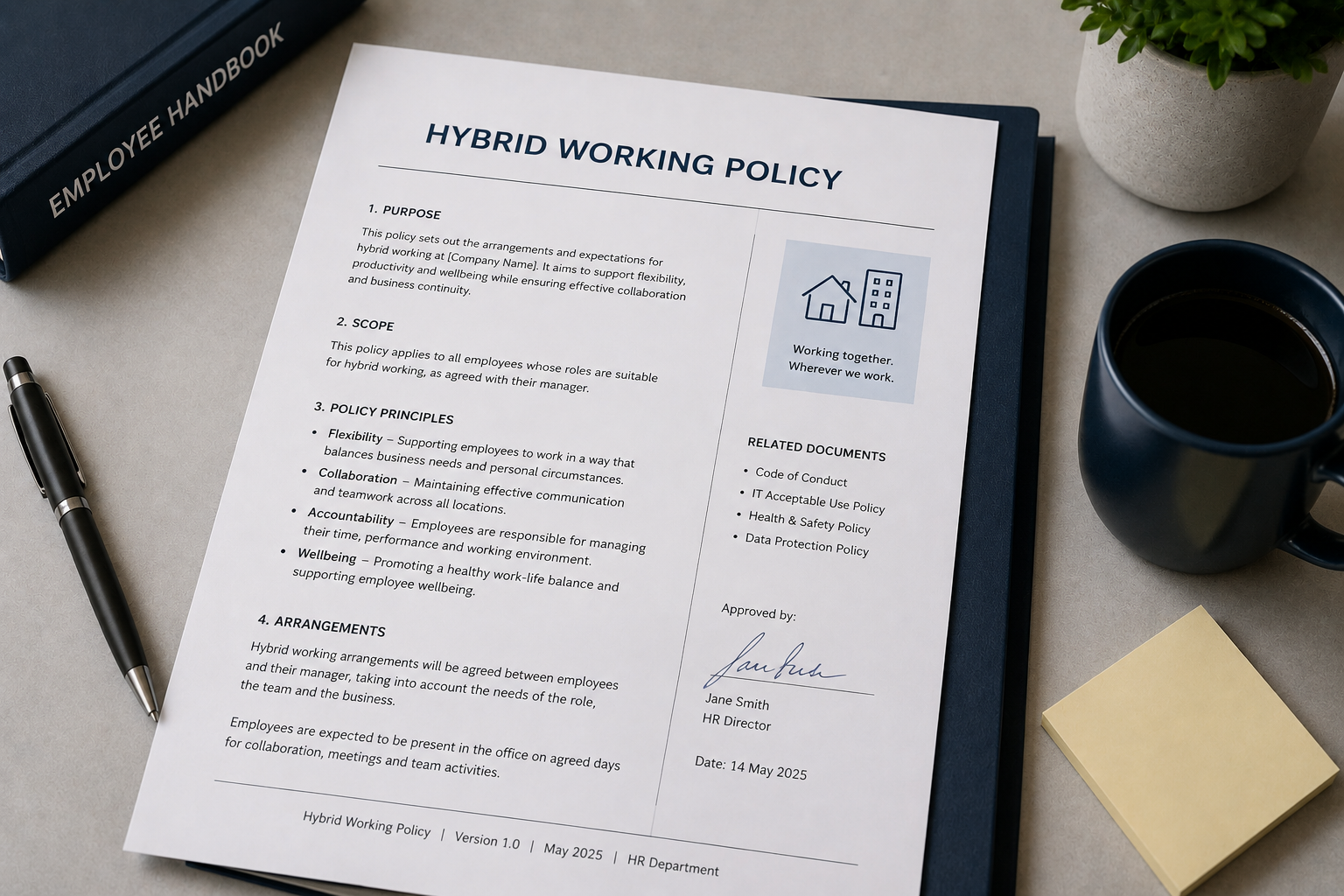
Our Hybrid Working Policy Template covers eligibility criteria, working hours, equipment, expenses, performance expectations, and the April 2026 ERA process.
Preview every clause before buying — only pay when you’re happy with it.
Need the H&S side covered too? Hybrid workers still need a Working from Home Risk Assessment for their home days (HSE requirement). Or get all 5 health & safety essentials with the Workplace Essentials Pack — £29.
What Is Hybrid Working in the UK?
Hybrid working means an employee splits their working week between two locations — typically the employer’s workplace and the employee’s home.
There is no single “hybrid” definition in UK statute.
It sits within the wider flexible working framework under the Employment Rights Act 1996 (as amended by the Employment Relations (Flexible Working) Act 2023 and the Employment Rights Act 2025).
The Three Common Hybrid Patterns
- Fixed-day hybrid: Employees work specific days in the office (e.g. Tues/Wed/Thurs) and the remainder at home.
- Minimum-days hybrid: Employees must attend the office a minimum number of days per week or month — they choose which days.
- Flexible hybrid: Employees decide their split based on workload, with no fixed office days.
The pattern matters because it affects pay, expenses, health and safety duties, and tax — all of which a written hybrid working policy should address.
Is Hybrid Working Coming to an End in the UK?
No — hybrid working is not coming to an end. The legal direction is the opposite.
High-profile return-to-office mandates (Amazon, JP Morgan, BT) created the perception that hybrid was being rolled back. The legal reality in the UK is different.
What the Law Is Actually Doing
- Day-one right to request flexible working (since 6 April 2024)
- Two flexible working requests per 12 months (up from one)
- Mandatory consultation before any refusal (Employment Rights Act 2025)
- “Reasonableness” test on refusals coming into force in 2027
- Shorter response deadline — 2 months instead of 3
Employers can still require office attendance — but the bar for refusing flexible working requests is rising, not falling.
Most UK employers have moved to a hybrid model rather than full return-to-office. The Office for National Statistics reports around 28% of UK workers were hybrid as of 2025, with the figure stable.
What Is the New Law for Working From Home in the UK?
There is no single “working from home” statute in the UK. WFH and hybrid arrangements are governed by a stack of existing employment, flexible working, and health and safety laws.
The most important changes for 2026 come from the Employment Rights Act 2025, which received Royal Assent on 18 December 2025.
April 2026 ERA Changes Affecting Hybrid & Remote Work
- Flexible working refusal consultation: Employers must consult with the employee before refusing a flexible working request. A “light touch” process — Government consultation closed 30 April 2026.
- Reasons for refusal explained: The refusal must specify which of the 8 statutory grounds applies, and (from 2027) the employer must show it was reasonable to rely on that ground.
- Day-one statutory rights expanded: Paternity leave and unpaid parental leave become day-one rights from April 2026.
- Statutory sick pay from day one: No more 3-day waiting period.
- Fair Work Agency launches: New single enforcement body consolidating NMW, holiday pay, and exploitation enforcement.
None of these changes force employers to allow hybrid working. They make refusing it harder, and the procedural risks of getting it wrong significantly higher.
Existing Laws That Apply to Hybrid Workers
- Employment Rights Act 1996 — written statement of terms must reflect work location
- Working Time Regulations 1998 — 48-hour week, daily rest, breaks apply equally at home
- Health and Safety at Work Act 1974 — duty of care extends to the home workspace
- DSE Regulations 1992 — display screen equipment risk assessment for home workers
- Equality Act 2010 — hybrid working may be a reasonable adjustment for disabled workers
- UK GDPR / Data Protection Act 2018 — data security obligations apply to home setups
Are You Allowed to Work Remotely in the UK?
There is no automatic right to work remotely in the UK.
What exists is the day-one right to request flexible working — which can include remote or hybrid working as a request.
The employer is not required to agree. They are required to consider the request reasonably, consult the employee, and respond within 2 months.
How a Flexible Working Request Works
- Submit in writing — clear request setting out what is wanted
- Employer must consult with the employee before refusing (ERA 2025)
- Decision within 2 months (was 3 months — shortened by the 2023 Act)
- Up to two requests in 12 months (was one)
- Refusal must rely on one of 8 statutory grounds (see below)
Employees no longer have to explain how their flexible working request will affect the business. That burden shifted to the employer in 2024.
What Reasons Can Flexible Work Be Denied?
An employer can only refuse a flexible working request by relying on at least one of 8 statutory grounds.
- Burden of additional costs — the change would cost the business too much
- Detrimental effect on ability to meet customer demand
- Inability to reorganise work among existing staff
- Inability to recruit additional staff
- Detrimental impact on quality
- Detrimental impact on performance
- Insufficiency of work during the periods the employee proposes to work
- Planned structural changes to the business
From 2027, the ERA 2025 adds a reasonableness requirement. The employer must not only cite one of the 8 grounds — they must show it was reasonable to rely on that ground in the circumstances.
Generic refusals (“affects team collaboration”) without evidence will not survive the new test.
Discrimination Risk on Refusal
A flexible working refusal can become indirect discrimination if it disproportionately disadvantages a protected group — typically women with caring responsibilities or disabled workers.
Tribunals have repeatedly held employers liable where blanket “no hybrid” policies couldn’t be justified by a legitimate aim and proportionate means.
Can You Legally Work Two Jobs in the UK?
Yes — there is no UK law preventing an employee from holding more than one job.
But three constraints apply, and they catch employers and employees out regularly.
1. The 48-Hour Working Week Applies Across All Jobs
Under the Working Time Regulations 1998, a worker must not work more than 48 hours a week on average (over a 17-week reference period) — combining hours across all jobs.
Both employers are responsible for ensuring the limit isn’t breached. Workers can sign a written opt-out, but cannot be forced to.
2. Employment Contract Restrictions
Many contracts contain “exclusivity” or “no other work” clauses. These are enforceable unless they are unreasonable in scope.
Exclusivity clauses in zero-hours contracts are unenforceable under the Exclusivity Terms in Zero Hours Contracts Regulations 2015.
3. Tax Implications
The first employment uses the standard tax code (1257L for most). The second job is taxed at the basic rate (BR code) on every pound from the first £1.
This often results in initial overpayment or underpayment — HMRC reconciles via PAYE adjustment or year-end tax return.
Is It Legal to Work 60 Hours a Week in the UK?
Yes — but only if the worker has signed a written opt-out from the 48-hour weekly limit.
The Working Time Regulations 1998 cap average weekly working time at 48 hours, calculated over a 17-week reference period.
The UK is the only EU/EEA member state that allowed an individual opt-out — a position the UK has retained post-Brexit.
Rules Around the 48-Hour Opt-Out
- Must be voluntary — workers cannot be forced or penalised for refusing
- In writing — verbal agreement is not enough
- Worker can cancel — typically with 7 days’ notice (up to 3 months if specified in writing)
- Cannot be detrimented — no penalty for refusing or revoking the opt-out
- Daily and weekly rest still apply — opt-out only relaxes the weekly cap, not rest periods
A worker who has not opted out cannot lawfully work 60-hour weeks averaged over 17 weeks.
Certain workers cannot opt out at all — including airline staff, road transport workers, sea workers, and security guards.
Does 9 to 5 Include Lunch in the UK?
It depends on the employment contract — there is no statutory rule that 9 to 5 means 8 paid hours.
What the law does say: if a worker works more than 6 hours in a day, they are entitled to an uninterrupted rest break of at least 20 minutes (Working Time Regulations 1998, Regulation 12).
That break is unpaid by default, unless the employment contract says otherwise.
How It Usually Works in Practice
- Salaried roles — most contracts treat the lunch break as unpaid, so 9 to 5 = 7.5 paid hours (30-minute unpaid lunch) or 7 paid hours (1-hour unpaid lunch)
- Hourly workers — lunch breaks are almost always unpaid time
- Some employers — pay full 8 hours for 9 to 5 with paid lunch, as a benefit
- “On call” lunches don’t count as a statutory break — workers must be free to leave their workstation
The statutory minimum is 20 minutes for any shift over 6 hours. Many employers offer more (30-60 minutes) as standard practice.
Workers under 18 have stronger rights — 30 minutes after 4.5 hours worked.
What Are Legally Required HR Policies in the UK?
Only three HR policies are legally required for most UK employers. Many more are strongly recommended.
The 3 Legally Required Policies
- Written Health & Safety Policy — required for any employer with 5 or more employees (Health and Safety at Work Act 1974)
- Disciplinary Procedure — must comply with the Acas Code of Practice on Disciplinary and Grievance Procedures
- Grievance Procedure — must also follow the Acas Code
Failure to follow the Acas Code can result in tribunal compensation being increased by up to 25%.
Effectively Required (Even If Not Statutory)
- Data Protection / Privacy Policy — required under UK GDPR and the Data Protection Act 2018
- Equal Opportunities Policy — strong tribunal defence against discrimination claims (Equality Act 2010)
Strongly Recommended for Hybrid Employers
- Hybrid Working / Flexible Working Policy — sets out eligibility, working hours, equipment, expenses, performance expectations
- Whistleblowing Policy — essential for the failure-to-prevent-fraud defence
- Anti-Harassment Policy — required in practice from October 2024 (employer duty to prevent sexual harassment)
- Sickness Absence Policy — particularly important with SSP day-one rights from April 2026
A written hybrid working policy is the single best way to manage the procedural and discrimination risks the April 2026 ERA changes introduce.
What Should a UK Hybrid Working Policy Include?
A policy that meets ERA 2025 expectations and supports tribunal defence should cover the following sections.
- Eligibility: Which roles, length-of-service requirements (now day-one), probation rules
- Working pattern: Office days, home days, core hours, flexibility
- Request & consultation process: The light-touch consultation steps before any refusal (ERA 2025)
- Equipment & expenses: What the employer provides, what the employee provides, tax position
- Working hours & rest breaks: 48-hour week, daily rest, lunch break — applies equally at home
- Performance expectations: Productivity standards, meeting attendance, response times
- Data security & confidentiality: UK GDPR obligations for home workstations
- Health & safety: Reference to the home working risk assessment (HSE requirement)
- Right to disconnect: Setting clear out-of-hours boundaries
- Review & trial periods: When and how the arrangement gets reviewed
Our Hybrid Working Policy Template covers all of these sections, structured following the ERA 2025 and the latest Acas guidance.
For the health & safety side, hybrid workers also need a Working from Home Risk Assessment (HSE requirement under MHSWR 1999 and DSE Regs 1992).
Or get all 5 H&S essentials with the Workplace Essentials Pack at £29 — saving 42%.
Frequently Asked Questions
Is hybrid working coming to an end in the UK?
No. The legal direction is the opposite — the Employment Rights Act 2025 makes refusing flexible working harder, not easier.
High-profile return-to-office mandates have not been matched by changes in UK law. Around 28% of UK workers were hybrid in 2025, and the figure remains stable.
Can you legally work two jobs in the UK?
Yes. There is no UK law preventing multiple employments. The 48-hour weekly working time limit applies across all jobs combined (unless the worker has signed an opt-out).
Employers should check existing contracts for exclusivity clauses. Exclusivity clauses in zero-hours contracts are unenforceable.
Is it legal to work 60 hours a week in the UK?
Yes, but only if the worker has signed a written opt-out from the 48-hour weekly limit under the Working Time Regulations 1998.
The opt-out must be voluntary. Daily and weekly rest rules still apply regardless.
Does 9 to 5 include lunch in the UK?
It depends on the employment contract. There is no statutory rule.
Workers working more than 6 hours are entitled to an uninterrupted 20-minute rest break, which is unpaid by default unless the contract says otherwise.
Are you allowed to work remotely in the UK?
There is no automatic right to work remotely. There is a day-one right to request flexible working — which includes remote and hybrid arrangements.
The employer can refuse on 8 statutory grounds, but must consult before refusing and (from 2027) demonstrate the refusal was reasonable.
What are legally required HR policies in the UK?
Only three: a written Health & Safety policy (5+ employees), a Disciplinary procedure, and a Grievance procedure (both following the Acas Code).
Data Protection and Equal Opportunities are effectively required under UK GDPR and the Equality Act 2010. Hybrid Working, Whistleblowing, and Anti-Harassment policies are strongly recommended.
Is remote work going away in 2026?
No. The Employment Rights Act 2025 strengthens flexible working protections from April 2026, with mandatory consultation before refusal and a reasonableness test from 2027.
The trend in legislation is towards more remote/hybrid access, not less.
What reasons can flexible work be denied?
Eight statutory grounds apply: burden of additional costs, detrimental effect on customer demand, inability to reorganise work, inability to recruit, detrimental impact on quality or performance.
Also: insufficient work in the proposed period, or planned structural changes. From 2027, the employer must also show it was reasonable to rely on the chosen ground.
What is hybrid working in the UK?
Hybrid working is an arrangement where employees split their working time between the workplace and another location, usually home, under a structured policy.
Common patterns include fixed days (e.g. Tues/Wed/Thurs office), minimum-days requirements, or flexible scheduling. All sit under the UK flexible working legal framework.
What is the new law for working from home in the UK?
There is no single “working from home” statute. The Employment Rights Act 2025 strengthens the existing flexible working framework from April 2026.
Key changes include mandatory consultation before refusal, day-one statutory sick pay, day-one paternity and unpaid parental leave, and (from 2027) a reasonableness test on refusals.
Is our hybrid working policy template legally binding?
Yes. When adopted by the employer and issued to workers, our Hybrid Working Policy creates a clear written framework that sits alongside the contract of employment. The policy is non-contractual by default, which means it can be amended, suspended or withdrawn following appropriate consultation.
It is structured following the Employment Rights Act 1996 (as amended by the Employment Relations (Flexible Working) Act 2023 and the Employment Rights Act 2025) and the Acas Code of Practice on requests for flexible working.
Do I need a solicitor for a hybrid working policy?
Most UK employers complete a hybrid working policy without one. Our template walks through every section with plain-English guidance.
Consider solicitor review if you have complex sector-specific obligations (financial services, healthcare) or unionised workplace agreements.
The Truth About “Free” Legal Template Sites (What You’re Really Signing Up For)
Most websites offering a “free legal template” follow the same pattern:
- You click because it’s advertised as free
- You spend 10–15 minutes answering questions
- At the very end, you must create an account or start a “free trial”
- Your card is required upfront
- The subscription auto-renews at £29–£39 per month
This isn’t a free template – it’s a subscription service. Many people only realise after being charged £300–£400 over the year.
Why These “Free” Templates Are a Legal Risk
- Outdated wording: not aligned with current UK law
- Missing mandatory clauses: required for legal validity
- No compliance guidance: leaving users without legal context
- No structured checklist: no way to verify the document works
- Not kept updated: often unchanged when legislation changes
One incorrect clause can weaken or invalidate the entire document.
Hidden Problem: Many “Free Template” Sites Aren’t Even UK-Based
Another major issue is that many free or auto-subscription template sites operate outside the UK and use documents originally drafted for the US legal system. These are then loosely adapted for “international use,” which creates serious problems:
- Incorrect terminology: taken from US contract law
- Missing UK statutory references: essential legal requirements omitted
- Non-applicable clauses: terms that don’t apply under UK legislation
- Legal conflicts: risks breaching UK consumer, employment, or GDPR rules
Why Templates UK Does the Opposite
- Drafted by UK professionals: written by experienced business & legal experts
- UK-law only: no US crossover or generic “international” templates
- One-time price from £10: no subscriptions, no renewals
- Full preview: see the exact document before buying
- Lifetime access: free lifetime updates included
My Templates Dashboard
All purchased templates are stored in your personal My Templates page, organised by category.
When we update a template for UK law changes, the new version appears automatically in your dashboard — free, forever.
Build a growing library of UK legal documents across every area of your business and personal life.
Transparent Pricing
From £10 per template — with free lifetime usage and free lifetime updates. No subscriptions. No renewals. No auto-billing.
Not ready to buy? Use our free interactive checklists to guide your own document — no payment required.
No tricks. No trials. No hidden fees. Just the exact UK-specific legal document you came for — at the price we told you upfront.
Build your own bespoke document with our Hybrid Working Policy Template. Preview the full document before buying — only pay when you’re happy with it.
Explore the Master Business Legal Templates Pillar Guide
The complete overview of 37 essential UK business templates.
UK Business Legal Templates — Complete Master Guide
Explore All Templates UK Pillar Guides
- Family Law Documents Guide UK
- Wills & Estate Planning Guide UK
- Residential Landlord Documents Guide UK
- Employment Documents Guide UK
- How to Set Up a Business in the UK — Legal Guide
- Website Legal Documents UK — Compliance Guide
- Financial & Commercial Contracts UK — Protection Guide
- Commercial Office Lease Guide UK
- Digital & IP Agreements Guide UK
Related Guides
- Working from Home Risk Assessment — UK Employer Guide
- Is a Whistleblowing Policy Mandatory? UK Employer Guide
- Employment Documents Guide UK — Complete Set
- Workplace Essentials Pack — 5 H&S Documents for £29
Free Legal Templates & Interactive Checklists
Access all our free UK legal templates, checklists and downloadable PDFs.
Last updated: May 2026
Disclaimer: This guide provides general UK legal information, not legal advice.
Laws current as of May 2026 — Employment Rights Act 2025 flexible working consultation requirements take effect April 2026, with the reasonableness test from 2027.
This guide applies to England and Wales. Scottish employment law is broadly aligned but contracts and policies for Scotland-based employers should select Scotland as the governing-law jurisdiction. Northern Ireland operates under separate devolved employment law and is not covered here.
Always verify current requirements with official sources. Existing customers receive the updated template free in their My Templates page.
![Director Service Agreement UK 2025: Statutory Duties, Tax Implications & Legal Requirements [Complete Guide] - Templates UK](https://templatesuk.com/wp-content/uploads/2025/10/director-200x300.webp)
![Cookie Policy UK Guide 2025: GDPR Compliance, DUA Act & Legal Requirements [Complete Guide] - Templates UK](https://templatesuk.com/wp-content/uploads/2025/11/cookie-policy-pic-200x300.webp)