What Are the Warning Signs of a Free Template Scam?
Key warning signs include: requiring credit card details for “free” downloads, 7-day trial language, US legal terminology in UK templates, auto-renewal buried in terms, no template preview before signup, and prices only revealed after completing lengthy forms.
UK businesses lose hundreds of pounds annually to subscription traps disguised as free legal templates. The Consumer Rights Act 2015 and Consumer Contracts Regulations 2013 require clear pricing disclosure, yet many template sites exploit loopholes by technically displaying terms — just in places users rarely check. This guide identifies seven specific red flags so you can spot problematic sites before handing over your payment details.
Free UK Legal Checklists – No Tricks
No credit card. No subscriptions. No "free trial" that charges you later.
Red Flag 1: Credit Card Required for a “Free” Download
The most obvious warning sign: if something is genuinely free, why do they need your payment details?
What Legitimate Free Looks Like
- Download button leads directly to the document
- Email signup at most (to deliver the file)
- No payment page whatsoever
What a Subscription Trap Looks Like
- “Free” prominently advertised
- 15-20 minutes completing forms and questionnaires
- Credit card form appears at the final step
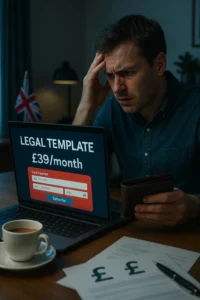
- Small print mentions “7-day trial” then £29-£35/month
If they ask for your card, it is not free. The “free trial” model relies on users forgetting to cancel within 7 days, at which point monthly charges begin automatically.
Red Flag 2: “Free Trial” Language Anywhere on the Site
The phrase “free trial” is legally distinct from “free.” A free trial is a limited period before paid subscription begins — and in the legal template industry, this typically means:
- Trial period: 7 days
- Monthly charge after trial: £29-£35
- Annual cost if unnoticed: £348-£420
Sites using “free trial” language are not offering free templates. They are offering a brief window to cancel before charges begin. The business model depends on a percentage of users missing that window.
Red Flag 3: US Legal Terminology in UK Templates
Many “free” template sites operate from the United States and simply relabel US documents for international markets. Warning signs include:
Terminology Red Flags
- “At-will employment” — This US concept does not exist in UK law. UK employees have statutory protections from day one (and enhanced rights after qualifying periods).
- “LLC” or “Corporation” — UK equivalents are Ltd (Limited Company) or LLP (Limited Liability Partnership).
- “State of [X]” — UK documents should reference England and Wales, Scotland, or Northern Ireland.
- “Attorney” — UK term is solicitor or barrister.
- “CCPA” or “California” — UK data protection is governed by UK GDPR and the Data Protection Act 2018, not US state laws.
Why This Matters
A contract using US terminology may be:
- Unenforceable in UK courts
- Missing mandatory UK statutory clauses
- Non-compliant with UK GDPR (fines up to £17.5m)
- Invalid for UK employment tribunal purposes
Red Flag 4: No Clear Contact Information or UK Presence
Check the footer and contact page. Legitimate UK legal document providers typically display:
- Clear contact email or support channel
- UK-focused content and pricing in GBP
- Responsive customer support
- Company registration details (if a limited company)
Warning Signs
- No way to contact them at all
- US-only contact details with no UK support
- Generic contact form with no response
- No indication of who operates the site
If there’s no clear way to reach the provider or get support, pursuing refunds or resolving issues becomes significantly harder.
Save More With Template Bundles
HR, Digital & IP, Commercial, Life & Estate – choose the pack that fits your business.
Lifetime Access • Free Updates • 30-Day Money-Back Guarantee*
Red Flag 5: Auto-Renewal Buried in Terms and Conditions
Consumer Contracts Regulations 2013 require businesses to make renewal terms clear. However, many template sites technically comply by placing auto-renewal information in lengthy terms — while ensuring the signup flow never highlights it.
What to Look For
- Search the terms page for “auto” or “renew” or “recurring”
- Check whether the signup page mentions subscription billing
- Look for the cancellation policy before entering payment details
Common Patterns
- Terms state subscription renews automatically unless cancelled
- Cancellation requires logging into an account (which you may not realise you created)
- Cancellation must occur before the trial ends — not on the last day, but before
- Refunds explicitly excluded once billing begins
Trustpilot reviews for major template sites consistently report users being charged despite believing they cancelled, or struggling to find the cancellation option within their account.
Red Flag 6: No Template Preview Before Signup
Legitimate template providers let you see what you are buying before you pay. Warning signs:
- Must complete full questionnaire before seeing the template
- Must create account before viewing any content
- Sample documents watermarked beyond readability
- No indication of document length, structure, or clauses included
Why This Matters
If you cannot preview the template, you cannot verify:
- Whether it uses UK law and terminology
- Whether it includes the clauses you need
- Whether it has been updated for current legislation
- Whether the quality justifies any cost
The “complete questionnaire first” approach is designed to create sunk cost — after investing 15-20 minutes, you are more likely to proceed with payment rather than abandon your work.
Red Flag 7: Price Only Revealed After Lengthy Form Completion
This is the signature tactic of subscription template sites:
- Advertise “Free [Document Type]”
- User clicks through, begins completing forms
- 10-15 screens of questions (name, address, specific clauses, preferences)
- At the final screen: “Create your account to download”
- Account creation requires payment details
- Small print reveals £29-£35/month subscription
By this point, users have invested significant time. The psychological pressure to complete the process — rather than start again elsewhere — is deliberate.
What Transparent Pricing Looks Like
- Price visible on the product page before starting
- No account required to see costs
- One-time purchase option clearly available
- Total cost stated (not “from £X” or “starting at”)
Quick Checklist: Before You Download Any “Free” Template
Run through these seven questions:
- Do they ask for credit card details? (If yes — not free)
- Do they mention “free trial”? (If yes — subscription trap)
- Does the template use UK legal terminology? (If US terms — wrong jurisdiction)
- Can you contact them easily? (If no — limited recourse)
- Can you find auto-renewal terms easily? (If buried — intentionally hidden)
- Can you preview the document before signup? (If no — red flag)
- Is the price visible before completing forms? (If no — dark pattern)
If a site fails more than one of these checks, look elsewhere.
Looking for genuinely free resources? Browse our 37 Free UK Legal Compliance Checklists – no subscription, no credit card, no catch.
The Templates UK Approach
For comparison, here is how a transparent UK template provider operates:
- Price visible upfront: £10 one-time payment (introductory price), shown before any forms
- Full preview available: See the complete template structure before purchasing
- No subscription: One payment, lifetime access, free updates
- UK law only: Every template drafted specifically for England and Wales
- No credit card tricks: Pay once, download immediately, nothing recurring
Browse All UK Legal Templates →
Free Legal Templates UK: The Hidden Subscription Trap Nobody Talks About
More in This Series
- Why Free Templates Ask for Your Credit Card
- Free vs Paid Legal Templates: The Real Difference
- The Real Cost of “Free” Legal Documents UK
- You are here: Free Legal Template Red Flags: 7 Warning Signs
- What Makes a Contract Template Legally Valid in the UK?
- Legal Template Subscription Costs UK: The 5-Year Comparison
Explore the Master Legal Templates Pillar Guide
The complete overview of 37 essential UK business templates and all legal categories:
UK Business Legal Templates – Complete 2025 Master Guide
Explore All Templates UK Pillar Guides
- Employment Documents Guide UK
- How to Set Up a Business in the UK – Legal Guide
- Website Legal Documents UK – Compliance Guide
- Financial & Commercial Contracts UK – Protection Guide
- Commercial Office Lease Guide UK
- Digital & IP Agreements Guide UK
Free Legal Templates & Interactive Checklists
Access all our free UK legal templates, checklists and downloadable PDFs.
Frequently Asked Questions
Why do free template sites ask for credit card details?
Sites asking for card details operate subscription models, not genuine free downloads. The “free trial” allows 7 days of access before monthly billing (typically £29-£35) begins automatically. The business model relies on users forgetting to cancel.
How can I tell if a template uses UK or US law?
Look for terminology: “at-will employment,” “LLC,” “State of California,” or “attorney” indicate US origin. UK documents should reference England and Wales (or Scotland/Northern Ireland), use “Ltd” or “LLP,” mention “solicitor,” and cite UK GDPR rather than CCPA.
What should I do if I have already been charged?
Contact the company immediately requesting cancellation and refund. If unsuccessful, contact your bank to dispute the charge. Document everything — screenshot your cancellation confirmation and any terms that were not clearly displayed during signup.
Are subscription template sites breaking the law?
Most technically comply with Consumer Contracts Regulations by displaying terms somewhere on the site. However, the practice of burying auto-renewal terms and revealing prices only after significant time investment is considered a “dark pattern” — legal but ethically questionable design intended to manipulate user behaviour.
Last updated: December 2025
Disclaimer: This guide provides general UK legal information, not legal advice. Laws are current as of December 2025. If you have been charged by a subscription service, consider seeking advice from Citizens Advice or your bank.